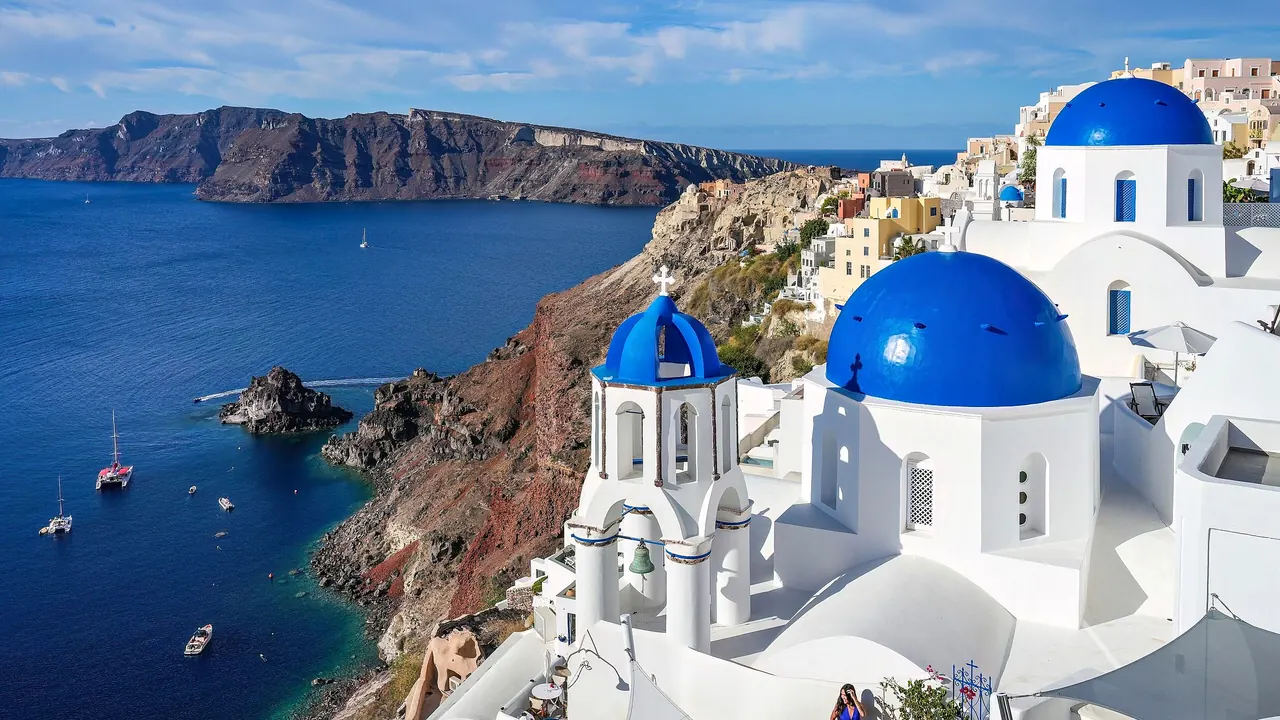
Photos: Santorini by Giles Laurent, CC BY-SA 4.0, cropped.
Ios or Santorini?
Our verdict in twelve categories, each scored against the same fixed benchmark cities, and the climate month by month, so you can choose for your trip.
Choose Ios for
- nightlife
- prices
- beaches
Ios is the pick for a young, sociable trip built around sand and late nights. Its beaches are golden and soft, from the busy bay at Mylopotas to the sheltered coves of Manganari. After dark the lanes of Chora fill with bars until dawn, and it all costs noticeably less than its famous neighbour. What you give up is depth: the food is mostly simple, and the sights fill an afternoon.
Choose Santorini for
- culture and sights
- nature and the outdoors
- food and drink
Santorini rewards travellers who come for the place itself rather than the beach. The caldera cliffs, the cliff-top villages, the excavated Bronze Age town at Akrotiri and the island's wines make it the better choice for couples, for sightseers and for anyone who wants a slow, good-looking stay. You pay heavily for a room on the rim, the beaches are dark volcanic sand, and the nights are quieter.
Scoreboard
Twelve categories on one fixed scale from 0 to 100. The shaded stretch is the gap between the two.
Your match
Pick a travel style or drag the sliders, and both match scores follow your weighting.
Too close to call, 2 points apart
Wins on nightlife and prices with your weighting.
Wins on culture and sights and nature and the outdoors with your weighting.
What matters to you?
Category by category
What the scores mean for a trip.
Beaches & swimming
This is Ios's strongest suit. Its beaches are golden sand: Mylopotas is long and sociable, with water sports and sunbeds below Chora, Manganari's coves in the south are sheltered and very shallow, and the bays on the east and north coasts are wilder and emptier for anyone with a scooter.
Santorini's swimming is volcanic and different in kind. Kamari and the long strip from Perissa to Perivolos have black sand and fine pebble that gets very hot underfoot, set against dramatic coloured cliffs. They are good to look at but less comfortable to lie on, and the caldera villages where most people stay have no beach at all. The water is equally warm on both islands, and the meltemi roughs up the exposed coasts of each.
Food & drink
Santorini eats far better, and much of the difference grows out of its volcanic soil. It has yellow-pea fava, cherry-tomato fritters, white aubergines and capers, and above all wine: basket-trained Assyrtiko vines and sweet Vinsanto, tasted at wineries around Pyrgos and Megalochori. The best meals are in the inland villages and at the fish tavernas of Ammoudi Bay rather than on the sunset rim.
Ios has honest harbour tavernas in Yialos and its own tangy skotyri cheese. In high summer, though, many of its kitchens feed the bar crowd with gyros and pizza, and a good dinner takes some looking for.
Culture & sights
Santorini is well ahead. Akrotiri, a Bronze Age town preserved under volcanic ash with multi-storey houses and fine wall paintings, is one of the great sites of the Aegean. Ancient Thera, the Museum of Prehistoric Thera in Fira, the cliff-hung villages of Oia and Imerovigli and the medieval kastelli of Pyrgos and Emporio add enough for several days.
On Ios the sightseeing is modest. There are Chora's windmills and white chapels, the Early Cycladic walls at Skarkos, the spot at Plakotos that tradition calls Homer's tomb and the ruined castle of Paleokastro. It makes a pleasant few hours between beach days.
Nightlife
Ios is the party island of the pair. In summer, Chora's old lanes and main square pack dozens of small bars and a few clubs together, and the crowd drifts from one doorway to the next until dawn. Mylopotas adds afternoon beach parties that run into the evening. It is young, loud and cheap rather than polished.
Santorini's evenings are built around the sunset, a long dinner and a drink with a caldera view, which suits couples more than night owls. Fira has a few lanes of cocktail bars and clubs that run late in high summer, and Oia goes quiet after dinner.
Nature & outdoors
Ios is good walking country but has nothing to match its neighbour. Its bare, terraced hills climb to Profitis Ilias, a modest summit rather than a real mountain. Old mule tracks lead to the windmills, remote chapels and northern bays, and boat trips reach sea caves and coves that no road gets to. When the summer wind blows, windsurfers head for the open bay at Mylopotas.
Santorini's landscape is far more dramatic. The island is the rim of a drowned volcano, with cliffs of layered ash and lava dropping more than 300m into the caldera. The cliff-top path from Fira through Imerovigli to Oia runs for about 10km with the caldera beside you the whole way, and boats cross to climb the black lava cone of Nea Kameni. Sailing around the caldera and diving along its underwater walls add to it.
Day trips
Both islands depend entirely on ferries, which run well in summer and thin out sharply in spring and autumn, so the options are broadly similar. The difference is where the boats lead. From Ios, the best day out is Santorini itself, with Naxos's Venetian old town a little further and the quiet cliff villages of Sikinos and Folegandros as gentler outings.
Santorini has a day trip inside its own caldera: small boats cross to Thirasia, a fragment of the old rim with almost no visitors. It also has the high-speed crossing to Heraklion, which puts Knossos on Crete within a long day. All of this runs through the single port at Athinios, down a switchback road below the cliffs.
Good for families
Neither island is built for children, and they are about equal here. Both work as a beach base as long as you avoid the clifftop or party areas. On Ios, that means the shallow sandy coves of Manganari, but in July and August the island belongs to a young party crowd whose noise carries late, so June or September is wiser.
Santorini has no comparable party crowd, but its caldera villages are all steps and unfenced terraces, and many cliff hotels don't take young children. Kamari and Perissa are the answer, with flat promenades, gently shelving water and a small water park. The boat to the volcano and a visit to Akrotiri also give older children more to see than anything on Ios.
Getting around
Ios is the easier island to move around. Its main triangle of the port at Yialos, Chora and Mylopotas is compact, linked by a frequent summer bus and an old stepped path you can walk. Only the far eastern and northern bays need a hired scooter or car. The catch is arrival: with no airport, everyone comes by ferry.
Santorini has an airport, but once on the island it takes patience. Every bus goes through Fira, so crossing the island usually means changing there on a crowded bus, and narrow roads, tour coaches and scarce parking in Oia slow down anyone driving. Fira is the most practical base without a car.
Shopping & style
Neither island is a shopping destination, but Santorini has more worth buying. The lanes of Oia and Fira have jewellers, galleries of island painters and photographers, linen and ceramics. The best things to take home are edible: Assyrtiko, Vinsanto, capers and fava from the island itself.
Shopping on Ios runs to beachwear, sandals, jewellery and souvenirs in Chora's evening lanes, plus a few boutiques of Greek-made clothes. It covers a forgotten sundress and not much more.
Affordability
Ios is much the cheaper island. Its backpacker past still shows in the hostels, campsites and simple rooms around Mylopotas and Chora, the grill food and the bars' drinks offers. Only comfortable rooms in July and August, and the ferry fares, push the cost up.
On Santorini the price is driven by the view. Cave suites with plunge pools on the rim at Oia, Imerovigli and Fira are among the most expensive rooms in Greece, and sunset dinners and boat trips cost accordingly. Staying in Kamari or Perissa and taking the bus up for the sunset brings the cost down, though not to Ios levels.
Live music & performing arts
Ios has very little to go and see. The open-air Odysseas Elytis theatre by the windmills in Chora puts on the odd summer concert, and saints' day festivals bring traditional music and dancing to the villages. Beyond that, the island's music is whatever the bars are playing.
Santorini offers slightly more. Its main event is a long-running international classical music festival in Fira at the end of summer, and there are occasional concerts in restored mansions and old wineries. That is still not a reason to choose it, because neither island has a regular season of plays or concerts to plan a trip around.
Wellness & relaxation
Santorini is the better place to unwind, mainly because of its cave hotels. Whitewashed suites at Imerovigli and Oia come with heated plunge pools, spa treatments and long, quiet days facing the caldera, and boats stop off Palea Kameni for a swim in warm, rust-coloured spring water. Imerovigli and the wine villages of Pyrgos and Megalochori stay peaceful even when Oia is crowded.
Ios runs on late nights in high summer. A calm stay there means June or September, a hotel near Manganari or a quiet bay, and the massages and yoga a few boutique places offer.
When should you go?
Pick your month. The climate figures are measured averages, not a forecast.
Ios in July
Santorini in July
Daytime high, °C
Rainfall in the month, mm
Where the figures come from
Ios's temperatures are measured 41 km from the centre, at Santorini Island / Monólithos.
Ios has no rain gauge within 25 km of the centre, so its rainfall comes from a gridded climate dataset read at the destination rather than from a gauge further away.
Santorini's station stands 182 m below the place it is measured for, so that place is likely a little cooler than the figures say.
Santorini has no rain gauge within 25 km of the centre, so its rainfall comes from a gridded climate dataset read at the destination rather than from a gauge further away.
Temperature and rainfall are climate normals, averaged over the years shown. Ios: 2000-2025, 12 years observed (rainfall 1991-2020) normals, Santorini Island / Monólithos (40.9 km from centre). Santorini: 2000-2025, 12 years observed (rainfall 1991-2020) normals, Santorini Island / Monólithos (5 km from centre).
The two islands lie less than an hour apart by fast ferry and share almost exactly the same weather, so the choice of month is the same for both. June to September is dry, hot and reliably sunny for the beach. Daytime highs reach about 30°C in July and August, and the sea warms to around 24°C by late summer. It stays swimmable into early October on both. In those peak weeks the midday heat makes walking hard, which matters more on Santorini, where the cliff path and the ruins are much of the point.
For walking the streets and paths, May and October are the sweet spot, with highs around 23°C and the sea still pleasant late in the season. The rain comes back from late October, and from November to February both islands are cool, wet and largely closed. Santorini is a little wetter in winter, with nearly 100mm in January, but neither island is a winter destination.
Which traveller are you?
On a beach and sun trip, Ios is the stronger island. Its beaches are soft golden sand, with a lively main bay at Mylopotas and clear, shallow coves at Manganari. Santorini's black sand gets scorching by midday, and its beaches are a side attraction rather than the reason to go.
For a culture and arts trip, choose Santorini. Akrotiri's buried Bronze Age streets and wall paintings, Ancient Thera on its ridge, and the fortified villages of Pyrgos and Emporio easily fill two or three days. On Ios, Chora and the Skarkos ruins fill an afternoon.
On a trip on a tight budget, Ios goes much further. Hostels, campsites and simple rooms near Mylopotas, plus gyros and drinks offers, keep costs low. On Santorini, saving money means staying on the east coast and only visiting the caldera views you came for.
Before you go
| Measure | Ios | Santorini |
|---|---|---|
| Official language | Greek | Greek |
| Currency | Euro (EUR) | Euro (EUR) |
| Sockets | CF230 V, 50 Hz | CF230 V, 50 Hz |
| Driving side | Right | Right |
| Time zone | UTC+2, UTC+3 in summer | UTC+2, UTC+3 in summer |
| Emergency number | 112 | 112 |
| Main airport | Santorini International Airport (JTR)60 non-stop destinations | Santorini International Airport (JTR)60 non-stop destinations |
| Public holidays this year | 15 days | 15 days |
By the numbers
| Measure | Ios | Santorini |
|---|---|---|
| Population | - | 17,430 |
| People per km² | - | 220 |
| Swim season, months above 21 °C | 5 months | 5 months |
Where else could you go?
Every comparison below shares a destination with this one, so you can follow Ios or Santorini somewhere new.