Greece
Santorini
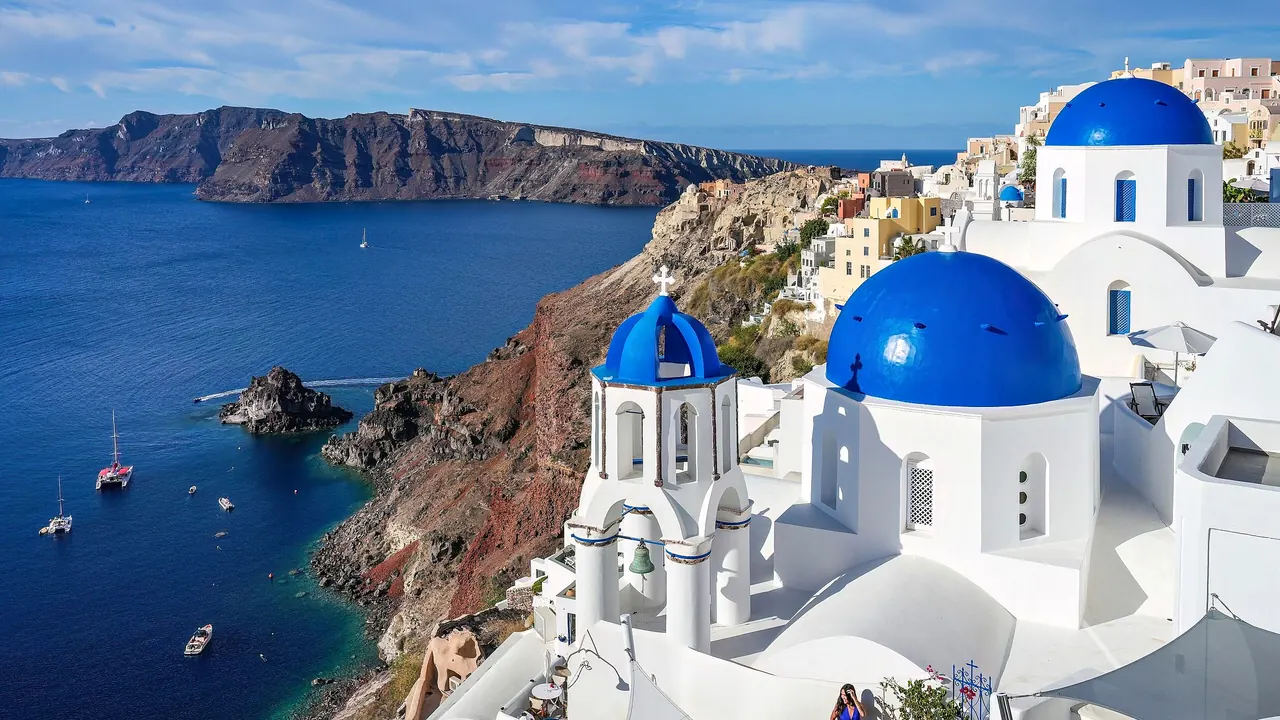
The three blue domes of Oia above the caldera
- Nature & outdoors70
- Food & drink64
- Culture & sights64
Photo: Giles Laurent, CC BY-SA 4.0, cropped
Match
45
Every category weighted equally
- Beach & sun48
- Culture & arts44
- Food & nightlife44
- Family trip46
- Outdoors50
- Relax & unwind48
- Shopping & style44
- On a budget43
Santorini in twelve categories
Our verdict on each, scored 0 to 100 against the same fixed benchmark cities, so a score means the same thing on every page.
Beaches & swimming. Scores 60 out of 100.
Food & drink. Scores 64 out of 100.
Culture & sights. Scores 64 out of 100.
Nightlife. Scores 42 out of 100.
Nature & outdoors. Scores 70 out of 100.
Day trips. Scores 50 out of 100.
Good for families. Scores 34 out of 100.
Getting around. Scores 42 out of 100.
Shopping & style. Scores 36 out of 100.
Affordability. Scores 22 out of 100.
Live music & performing arts. Scores 14 out of 100.
Wellness & relaxation. Scores 44 out of 100.
Santorini category by category
Beaches & swimming
60The beaches are volcanic, which gives them a character of their own: black sand and fine pebble that gets very hot underfoot by midday, set against cliffs of red, grey and ochre rock. The best place to stay for beach life is the east and south coast, where Kamari and the long strip of Perissa and Perivolos have sunbeds, tavernas and clear water that shelves gently. On the south coast, Vlychada sits under pale, wind-carved cliffs, and Red Beach near Akrotiri is striking but small, with crumbling cliffs above it.
The sea is warm enough to swim from June to October and reaches about 24°C in August. The summer meltemi wind can make the open coast choppy. The caldera villages have no beaches at all, so a visitor staying in Oia or Fira goes down to the coast by bus or car. The beaches are pleasant rather than exceptional, and most people treat them as part of the stay rather than the reason for it.
Food & drink
64Food on the island grows out of dry volcanic soil. Local dishes are built on small, intense ingredients: Santorini fava made from yellow split peas, tomato fritters from the sweet local cherry tomatoes, white aubergines, capers and caper leaves, and the soft cheese called chloro. Wine is the real distinction. Assyrtiko vines are trained low into basket shapes against the wind, and the sweet, sun-dried Vinsanto has been made here for centuries. Wineries spread across the interior around Pyrgos, Megalochori and Exo Gonia welcome visitors for tastings.
The best cooking is usually found away from the caldera rim, in village tavernas inland and in the fish tavernas at Ammoudi Bay below Oia. On the cliff edge in Fira, Imerovigli and Oia, there are some serious kitchens, but plenty of places charge mainly for the sunset. Street food stays simple, mostly gyros and bakery pies, and the scene closes down with the season.
Culture & sights
64The great sight is Akrotiri, a Bronze Age town buried by the eruption around 1600 BC. Its streets, multi-storey houses and stairways survive under a protective roof, and the wall paintings found there are among the finest of the Aegean. Some are shown at the Museum of Prehistoric Thera in Fira. High on a ridge between Kamari and Perissa, Ancient Thera has Hellenistic and Roman ruins with wide views over the sea.
The built landscape is the other draw. The whitewashed caldera villages of Fira, Imerovigli and Oia cling to the cliff, with cave houses, blue-domed churches and sea captains' mansions. Inland, Pyrgos and Emporio keep medieval kastelli, fortified cores of tight lanes. Megalochori has old wineries and quiet squares. The whole heritage can be seen in two or three days, and the most photographed corners of Oia are very crowded at sunset.
Nightlife
42Most evenings revolve around sunset, dinner and a drink with a caldera view, and the island suits couples more than serious night owls. The one real going-out area is a few lanes in Fira, where cocktail bars and a handful of clubs stay busy past midnight and well into the early hours in July and August. Kamari and Perissa add relaxed beach bars with music on summer nights. Oia and the inland villages are quiet after dinner. The scene runs from late spring to early autumn and almost disappears in winter.
Nature & outdoors
70The island is the rim of a drowned volcano. Cliffs of layered ash and lava drop more than 300m into a flooded caldera, and the volcanic islets of Nea Kameni and Palea Kameni sit in the middle. The classic outing is the cliff-top path from Fira through Imerovigli to Oia, about 10km of views along the rim. The other is a boat across the caldera to walk up the black lava cone of Nea Kameni. Sailing trips around the caldera are the island's signature water activity, and there is diving along the submerged walls.
Away from the cliffs the land is low, dry and treeless, with vineyards, a climb up Profitis Ilias, the island's highest point, and the walk over Mesa Vouno. Spring and autumn are best for walking, because summer is hot and shadeless. A day or two covers the main routes.
Day trips
50Every day out from Santorini goes by sea. Small boats cross the caldera to Thirasia, the quiet inhabited fragment of the old rim, with a cliff-top village and almost no visitors. In summer, fast ferries reach Ios in under an hour and Anafi or Folegandros in a little longer. Naxos and Paros are within about two hours, and the high-speed crossing to Heraklion on Crete puts Knossos within reach of a long day.
The catch is logistics. Most departures leave from the single port at Athinios, below the cliffs, and services thin out sharply outside the summer months. The meltemi can cancel crossings on windy days. With careful planning there is a real choice of islands, but nothing as easy as hopping on a train.
Good for families
34The island's image comes from honeymoons and cliff-edge suites, and the caldera villages are hard work with children. Fira, Imerovigli and Oia are networks of steep steps, narrow lanes and unfenced terraces, hot and crowded in summer, and impossible with a pushchair. Many of the smaller cliff hotels do not take young children at all.
Families do better on the east and south coast. In Kamari and Perissa, flat promenades, beachfront tavernas and gently shelving water make long days easy, and Perissa has a small water park. The boat to the volcano and a visit to Akrotiri work for older children. Beyond that there is little made for children, and the high-summer heat on dark sand needs managing.
Getting around
42Distances are short, and Oia to Perissa is under an hour by road, but moving around in summer takes patience. Public buses run out from Fira to Oia, Kamari, Perissa, Akrotiri and the port. Because they all go through Fira, cross-island trips usually mean a change there, and the buses are packed in high season. Many visitors hire a car, quad or scooter. Narrow roads, tour coaches and very scarce parking in Oia and Fira slow everything down.
Inside the caldera villages everything is on foot, up and down steps. Arriving by sea means a switchback road up from the port at Athinios. Cruise passengers land at the old port below Fira and climb by cable car, on foot or by donkey. Fira itself is the most practical base for getting around without a car.
Shopping & style
36Shopping is concentrated in the cliff-top lanes of Oia and Fira, and it is geared to people on a romantic, well-funded trip. There are jewellery shops, art galleries showing island painters and photographers, linen and resort-wear boutiques, and ceramics. Between them come a great many souvenir shops. Fira also has a street of jewellers near the cathedral. The most rewarding things to take home are edible: bottles of Assyrtiko and Vinsanto from the wineries, capers, fava and sun-dried tomatoes. There is no market life, high street or department store to speak of, and most shops close for the winter.
Affordability
22Santorini is an expensive island in season, and the main driver is the view. Rooms on the caldera rim in Oia, Imerovigli and Fira, especially cave suites with private plunge pools, cost far more than almost anywhere else in Greece. Meals with a sunset view are priced accordingly, and boat trips and wine tastings add up. A visitor watching the budget stays on the east coast in Kamari or Perissa, where studios and family-run guesthouses cost much less. That visitor eats at village tavernas and gyros counters, rides the public bus, and walks up to the rim for the sunset rather than sleeping on it. Spring and late autumn are noticeably cheaper than July and August.
Live music & performing arts
14Performing arts play little part in a stay. The main event is a long-running international classical music festival held in Fira at the end of summer. Occasional concerts and cultural evenings take place in summer in restored mansions and old wineries. Otherwise live music means a singer or guitarist in a taverna or bar. There is no theatre, opera or regular concert season, and in winter there is essentially nothing.
Wellness & relaxation
44The island has no bathing tradition of its own. Its wellness offer is the luxury cave hotel: whitewashed suites carved into the cliff at Imerovigli and Oia, with heated plunge pools, spa treatments and long, unhurried days facing the caldera. The one natural bathing spot is off Palea Kameni, where boats stop so passengers can swim into a cove of rust-coloured, slightly warm volcanic spring water.
The calm depends on where you stay. Imerovigli and the inland wine villages of Pyrgos and Megalochori are quiet and restful. The rim at Oia and Fira fills with day crowds and cruise passengers at peak hours in summer. For a slow, restorative stay, spring and autumn suit best.
Where to stay in Santorini
The first choice is between the caldera rim and the coast. Fira is the practical base. Every bus route starts there, the island's only late-night lanes are there, and it suits a first visit without a car. Imerovigli, a short walk north along the cliff path, has the same view with far more quiet, which makes it the pick for couples and a restful stay. Oia, at the northern tip, is the postcard village, best early in the morning and late in the evening, because day crowds fill it around sunset. All three are steps and narrow lanes with no beach below, and they are hard going with small children.
Families and beach lovers do better in Kamari or Perissa, where rooms sit along flat seafronts beside the black-sand beaches, cost much less, and come with easy evenings at beach bars. The trade-off is a bus ride or a drive up to the rim for the views. For food, wine and a slow pace, Pyrgos or Megalochori in the interior put a visitor among village tavernas and wineries, and a hire car makes them easy to stay in.
The island is small, so one base covers a week without moving. Some visitors split the stay, spending a few nights on the rim for the views and the rest on the coast for swimming.
When should you go?
Pick a month to see what it is like. The climate figures are measured averages, not a forecast.
Santorini in July
Daytime high, °C
Rainfall in the month, mm
The whole year
Shaded against this city’s own year: the deepest cell is its best month for that figure and the palest its weakest.
Where the figures come from
Santorini's station stands 182 m below the place it is measured for, so that place is likely a little cooler than the figures say.
Santorini has no rain gauge within 25 km of the centre, so its rainfall comes from a gridded climate dataset read at the destination rather than from a gauge further away.
Temperature and rainfall are climate normals, averaged over the years shown. Santorini: 2000-2025, 12 years observed (rainfall 1991-2020) normals, Santorini Island / Monólithos (5 km from centre).
Before you go
| Measure | Santorini |
|---|---|
| Official language | Greek |
| Currency | Euro (EUR) |
| Sockets | CF230 V, 50 Hz |
| Driving side | Right |
| Time zone | UTC+2, UTC+3 in summer |
| Emergency number | 112 |
| Main airport | Santorini International Airport (JTR)60 non-stop destinations |
| Public holidays this year | 15 days |
By the numbers
| Measure | Santorini |
|---|---|
| Population | 17,430 |
| People per km² | 220 |
| Swim season, months above 21 °C | 5 months |
Compare Santorini with
Every comparison with a written verdict behind it.