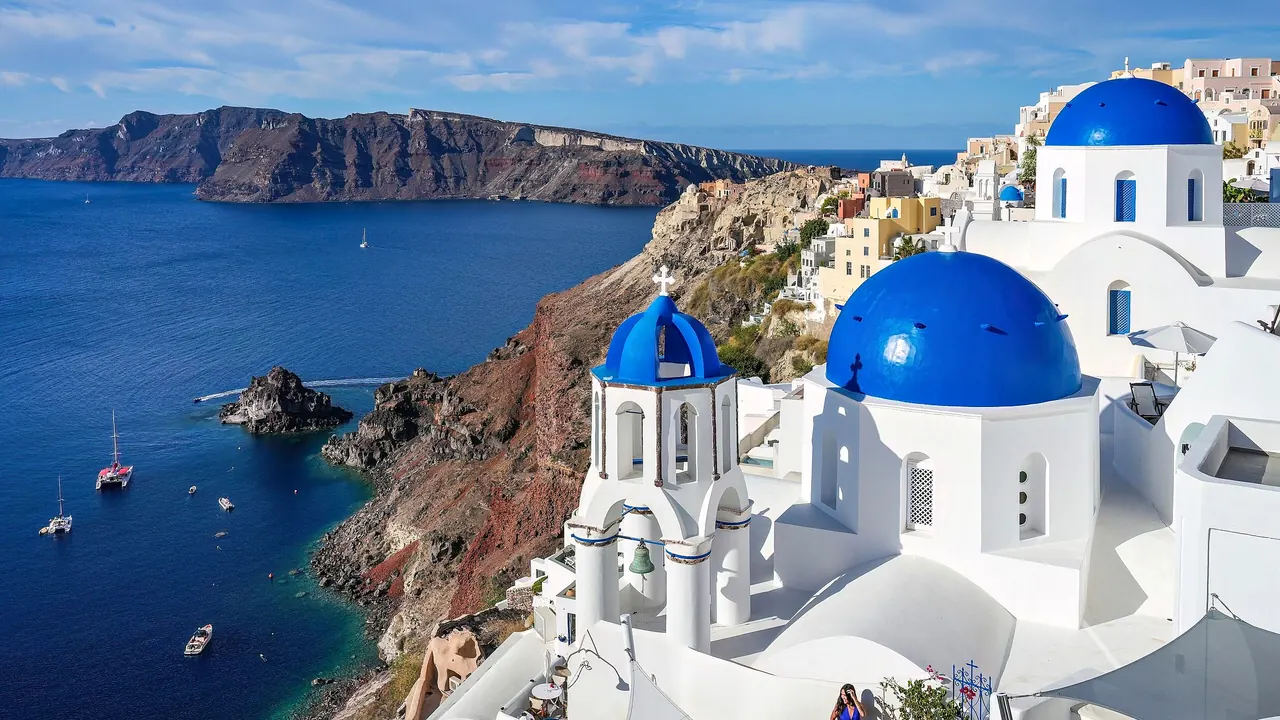
Photos: Santorini by Giles Laurent, CC BY-SA 4.0, cropped.
Peloponnese or Santorini?
Our verdict in twelve categories, each scored against the same fixed benchmark cities, and the climate month by month, so you can choose for your trip.
Choose Peloponnese for
- prices
- day trips
- families
The Peloponnese suits travellers who want room to roam and plenty to see: Olympia, Mycenae, Epidaurus and Mystras, mountain gorges in Arcadia, and long sandy beaches in Messinia and on Elafonisos. It costs far less than the famous islands, works better for families, and rewards a longer trip with a hire car and two or three bases.
Choose Santorini for
- shopping
- nightlife
Santorini is the choice for a short, concentrated stay built around one extraordinary landscape. The caldera cliffs, the whitewashed villages along the rim, Akrotiri and the island's volcanic wines fill a few days well, and the island suits couples. Expect to pay a lot for the view, and don't come for the beaches or a broad sweep of history.
Scoreboard
Twelve categories on one fixed scale from 0 to 100. The shaded stretch is the gap between the two.
Your match
Pick a travel style or drag the sliders, and both match scores follow your weighting.
Wins on prices and day trips with your weighting.
Wins on shopping and nightlife with your weighting.
What matters to you?
Category by category
What the scores mean for a trip.
Beaches & swimming
The Peloponnese is the better destination for beaches, and it has far more of them. Voidokilia's horseshoe and the sweep of Navarino Bay on the Messinian coast, the pale sand of Elafonisos and the rocky coves below Kardamyli give you real choice, and the water is slightly warmer.
Santorini's beaches are dark volcanic sand and fine pebble at Kamari and Perissa, dramatic under coloured cliffs but scorching at midday. The meltemi wind can make the sea choppy. The caldera villages have no beach at all, so swimming means a trip down to the coast.
Food & drink
The two eat about equally well, but in different styles. The Peloponnese offers generous country cooking: Kalamata olives and oil, slow-cooked goat, Mani cured pork and harbour fish, with Nemea reds and Moschofilero whites from Arcadia's highland plateau to go with them.
Santorini's cooking is smaller and more intense, built on fava, cherry-tomato fritters, capers and white aubergines from volcanic soil. Its Assyrtiko and Vinsanto make winery visits a highlight of the stay. On the caldera rim, though, you often pay for the sunset rather than the food.
Culture & sights
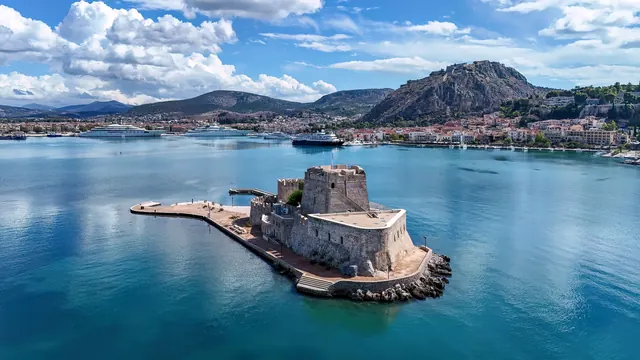
Both have a great Bronze Age site, Mycenae in the Peloponnese and Akrotiri on Santorini. Beyond those, the Peloponnese goes much further, with Olympia, the theatre at Epidaurus, Messene, Bassae and Ancient Corinth, then the medieval layer of Mystras, Monemvasia and the Venetian castles at Methoni and Koroni. Nafplio makes an elegant base for the Argolid sites.
Santorini's heritage is Akrotiri and its frescoes, the ruins of Ancient Thera, and the cliff-hung villages of Oia and Fira with fortified Pyrgos inland. It is memorable but compact, and two or three days see it.
Nightlife
Neither is a place for serious night owls, and evenings on both mostly mean a long dinner and a drink by the water. On Santorini the going-out area is in one place: a few lanes in Fira where cocktail bars and clubs run late in July and August, plus beach bars at Kamari and Perissa.
The Peloponnese spreads its evenings out. Nafplio's waterfront bars and the seafront in Kalamata draw a local crowd, and the region's only real club scene is in Patras, a long way from most visitors' bases.
Nature & outdoors
The Peloponnese has more to offer outdoors and much more variety. You can hike Taygetos at about 2,400m, follow the Lousios gorge between cliff monasteries, walk the long Menalon Trail or cross the stark Mani to Cape Tainaron. The Gialova lagoon adds birdwatching, and Chelmos has winter skiing.
Santorini has one landscape, but it is unforgettable: the 10km cliff-top walk from Fira to Oia, a hike up the lava cone of Nea Kameni, and sailing or diving inside the caldera. A day or two covers it.
Day trips
The Peloponnese gives you more and easier outings, as long as you have a car. From Nafplio you can reach the Nemea wineries, ferries to car-free Hydra and Spetses, and even Athens. Further south, Monemvasia, the Mani villages and Elafonisos each fill a good day.
Every trip from Santorini goes by boat from Athinios: Thirasia, Ios, Folegandros, Naxos, or a long day to Knossos on Crete. The choice is attractive in summer, but services thin out after the season and the meltemi can cancel crossings.
Good for families
The Peloponnese is far easier with children. Shallow, sandy bays at Tolo, in Messinia and on Elafonisos, resort hotels with kids' clubs and relaxed tavernas make for good beach days, though the distances mean a lot of driving.
On Santorini, the steep steps and unfenced terraces of the caldera villages rule out pushchairs, and many cliff hotels do not take young children. Kamari and Perissa, with flat promenades and a small water park, are where families can manage.
Getting around
Neither is easy without your own wheels, but for opposite reasons. The Peloponnese is a large region where you need a car. Motorways make the main towns quick to reach, but mountain and Mani roads turn short distances into long drives.
Santorini is small, under an hour from end to end, yet it is congested in summer. Every bus route runs through Fira, the buses are crowded, and parking in Oia is scarce. Fira is the one base that works without a car.
Shopping & style
Santorini has the edge for browsing, though neither is a shopping destination. Oia and Fira have jewellers, galleries of island painting and photography, linen and resort-wear boutiques, all aimed at well-funded visitors and mostly closed in winter.
The Peloponnese's best shopping is more modest: Nafplio's lanes for ceramics and worry beads, weekly markets in Kalamata and Tripoli, and olive oil, honey and Nemea wine bought at the source.
Affordability
The gap in cost is large. In the Peloponnese, village rooms, taverna meals and local wine are good value. The main costs are a hire car, fuel and entry to the big ancient sites.
Santorini charges heavily for its caldera views, from cave suites at Oia and Imerovigli to sunset dinners, boat trips and tastings. Staying in Kamari or Perissa and taking the bus helps, but it still costs more than the mainland.
Live music & performing arts
The Peloponnese has one of the great live experiences in Greece: ancient drama on summer weekend nights in the theatre at Epidaurus, with summer concerts at its Little Theatre and Kalamata's dance festival in July.
Santorini offers much less: a long-running classical music festival in Fira at the end of summer, occasional concerts in old wineries and mansions, and otherwise a guitarist in a taverna.
Wellness & relaxation
The Peloponnese has a slight edge, mostly because of its natural water and slow pace. There are old thermal spa towns at Loutraki and Methana, warm sulphur springs at Kaiafas, and quiet stone villages for doing very little.
Santorini's version of rest is the luxury cave hotel, a heated plunge pool facing the caldera, plus a swim in the warm, rust-coloured springs off Palea Kameni. For quiet, stay in Imerovigli or the wine villages rather than Oia.
When should you go?
Pick your month. The climate figures are measured averages, not a forecast.
Peloponnese in July
Santorini in July
Daytime high, °C
Rainfall in the month, mm
Where the figures come from
Peloponnese's temperatures are measured 89 km from the centre, at Kalamata Airport.
Peloponnese has no rain gauge within 25 km of the centre, so its rainfall comes from a gridded climate dataset read at the destination rather than from a gauge further away.
Santorini's station stands 182 m below the place it is measured for, so that place is likely a little cooler than the figures say.
Santorini has no rain gauge within 25 km of the centre, so its rainfall comes from a gridded climate dataset read at the destination rather than from a gauge further away.
Temperature and rainfall are climate normals, averaged over the years shown. Peloponnese: 1991-2020 normals, Kalamata Airport (89 km from centre). Santorini: 2000-2025, 12 years observed (rainfall 1991-2020) normals, Santorini Island / Monólithos (5 km from centre).
Both are classic Aegean summer destinations, warm enough for swimming from June to October, but the Peloponnese runs hotter. Where most visitors stay, its days reach 32°C in July and August, and the sea warms to about 26°C, a couple of degrees above Santorini's. That heat makes midsummer hard going at inland sites such as Mycenae or Olympia. The Peloponnese also has a lot of sun, peaking at over 350 hours in July.
Santorini is almost completely dry from June to September, with milder highs of around 30°C, though the cliff paths offer no shade. On both, May, late September and October are the best months for walking and sightseeing in comfortable warmth. Rain sets in from November, and Santorini's wettest month is January, with about 98mm.
Which traveller are you?
On a culture and arts trip, choose the Peloponnese. Olympia, Mycenae, Epidaurus, Mystras and Monemvasia are enough for a week or more, and drama at Epidaurus on summer nights adds a live stage. Santorini's history, Akrotiri above all, takes two or three days.
On a tight budget, the Peloponnese goes much further. You'll find family-run rooms in Mani and Arcadian villages, cheap taverna meals and local wine. Santorini is one of Greece's most expensive islands, and even its cheaper east coast cannot match those prices.
For a honeymoon or romantic getaway, Santorini has something the Peloponnese cannot offer: cave suites with plunge pools on the caldera rim at Imerovigli and Oia, sunset dinners facing the drowned volcano, and wine tastings among basket-trained vines.
Before you go
| Measure | Peloponnese | Santorini |
|---|---|---|
| Official language | Greek | Greek |
| Currency | Euro (EUR) | Euro (EUR) |
| Sockets | CF230 V, 50 Hz | CF230 V, 50 Hz |
| Driving side | Right | Right |
| Time zone | UTC+2, UTC+3 in summer | UTC+2, UTC+3 in summer |
| Emergency number | 112 | 112 |
| Main airport | Athens Eleftherios Venizelos International Airport (ATH)176 non-stop destinations | Santorini International Airport (JTR)60 non-stop destinations |
| Public holidays this year | 15 days | 15 days |
By the numbers
| Measure | Peloponnese | Santorini |
|---|---|---|
| Population | - | 17,430 |
| People per km² | - | 220 |
| Swim season, months above 21 °C | 5 months | 5 months |
Where else could you go?
Every comparison below shares a destination with this one, so you can follow Peloponnese or Santorini somewhere new.
- Iosvs Santorini
- Naxosvs Santorini
- Parosvs Santorini
- Milosvs Santorini
- Mykonosvs Santorini
- Cretevs Santorini