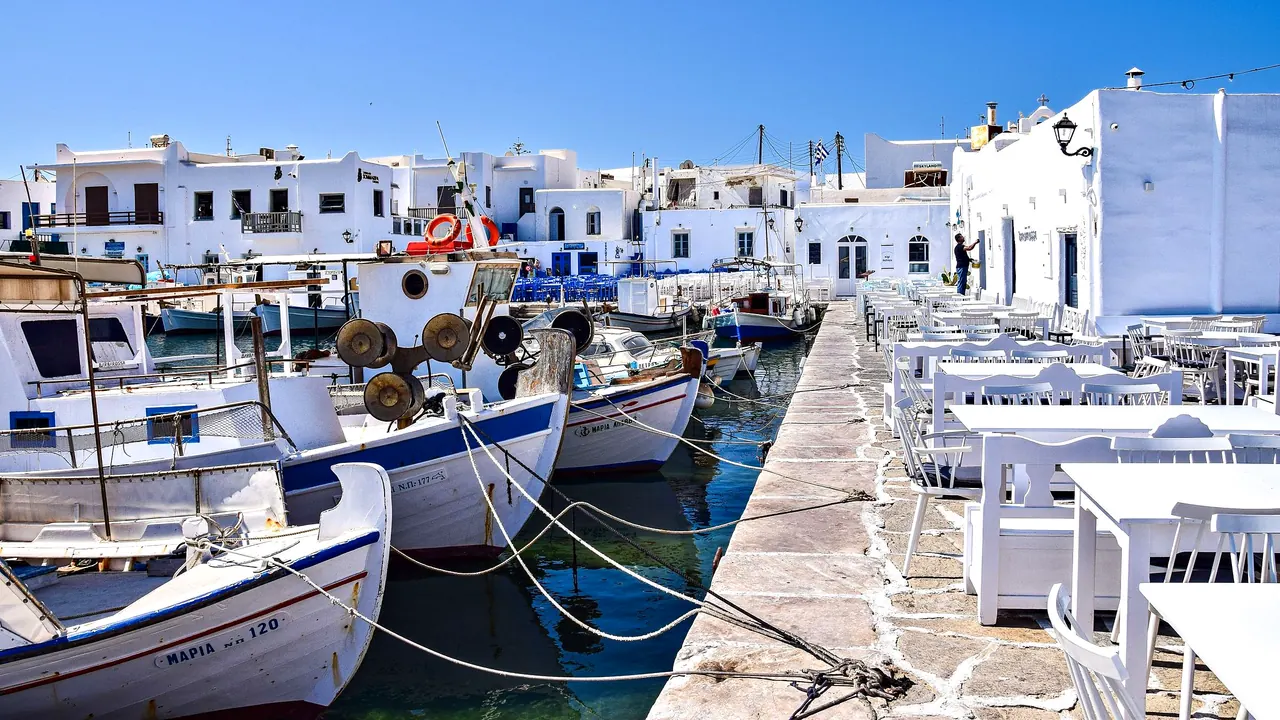
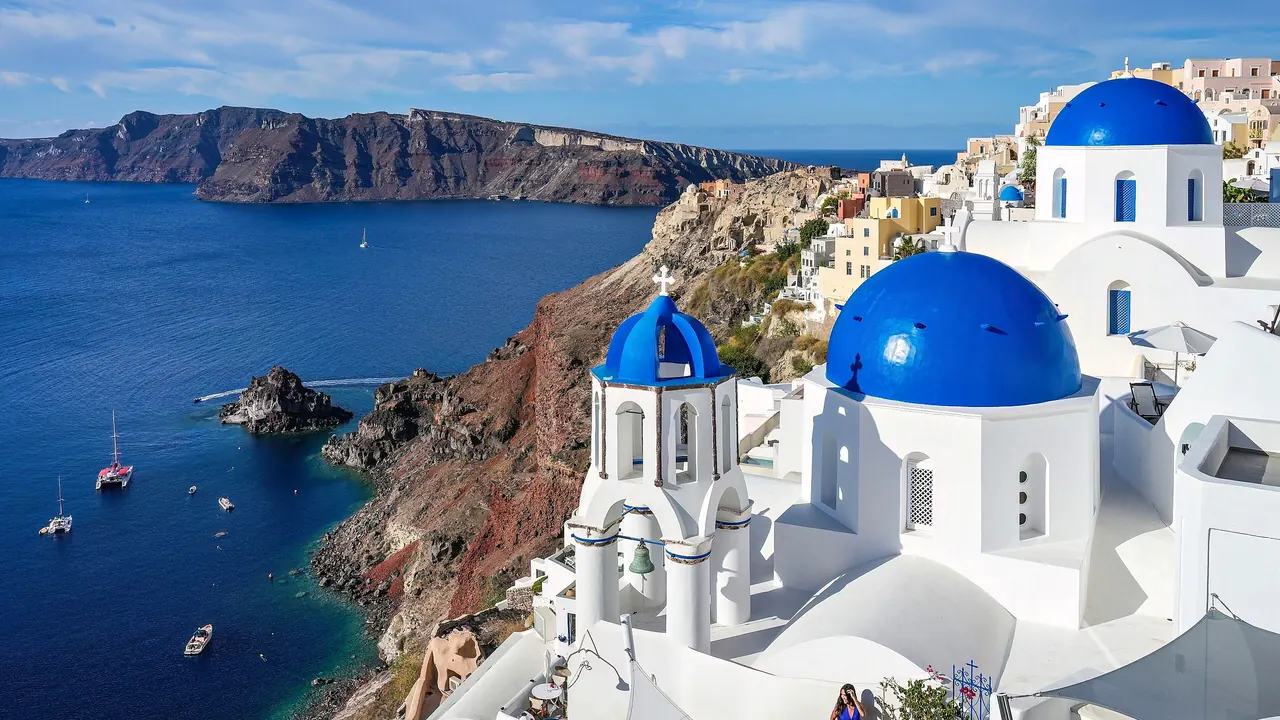
Photos: Paros by AXP Photography, Pexels License; Santorini by Giles Laurent, CC BY-SA 4.0, cropped.
Paros or Santorini?
Our verdict in twelve categories, each scored against the same fixed benchmark cities, and the climate month by month, so you can choose for your trip.
Choose Paros for
- families
- beaches
- nightlife
Paros is the island for a beach vacation with a social side. Sandy bays ring the coast, so there is always a sheltered one when the meltemi blows, and Naoussa's harbour gives you a lively evening without turning the island into a party scene. Families and island-hoppers have an easier time here too. The bus network out of Parikia is simple, the ferries to Antiparos and Naxos are short, and the room bills, though not small, stay well below Santorini's.
Choose Santorini for
- nature and the outdoors
- culture and sights
- food and drink
Choose Santorini when the landscape and the history are the point of the trip. The drowned volcano, the walk along the caldera rim, the buried Bronze Age town at Akrotiri and the Assyrtiko vineyards add up to something no other Cycladic island has. It suits couples and sightseers who don't mind paying a lot, climbing steps and sharing the sunset with a crowd, and who treat the dark-sand beaches as a bonus rather than the reason to come.
Scoreboard
Twelve categories on one fixed scale from 0 to 100. The shaded stretch is the gap between the two.
Your match
Pick a travel style or drag the sliders, and both match scores follow your weighting.
Wins on families and beaches with your weighting.
Wins on nature and the outdoors and culture and sights with your weighting.
What matters to you?
Category by category
What the scores mean for a trip.
Beaches & swimming
Paros is the stronger beach island by a distance. Its coast is ringed with sandy bays on clear water: the granite-framed coves of Kolymbithres, the longer sands at Santa Maria and Lageri, and wide, gently shelving Golden Beach and Drios in the south-east. When the meltemi blows from the north, the bays near Pounta and Farangas stay calm, and Antiparos adds quieter coves.
Santorini's beaches are volcanic: black sand and fine pebble that burns underfoot by midday, under cliffs of red and grey rock. Perissa, Perivolos and Kamari on the east and south coast have the sunbeds and gentle water, and Red Beach is more a sight than a place to spend the day. If you stay in a caldera village, every swim means a trip down to the coast.
Food & drink
The food on the two islands is equally good but different in kind. Paros eats around the sea, with grilled octopus and fish at the harbour tables of Naoussa, chickpeas baked slowly in clay pots and a glass of souma. Its simpler, home-style cooking is found in Lefkes and Marpissa.
On Santorini the volcanic soil sets the menu: fava, tomato fritters, white aubergines and chloro cheese. Its wine is the real draw. You can taste Assyrtiko and sweet Vinsanto at the wineries around Pyrgos and Megalochori, which is a better outing than anything Paros's own wines offer. On both islands the best value is away from the famous views, and many kitchens close out of season.
Culture & sights
Santorini has much more to see. Akrotiri, the Bronze Age town buried by the eruption, is one of the great sites of the Aegean. The Museum of Prehistoric Thera in Fira and the ridge-top ruins of Ancient Thera add to it, and the cliff villages and the fortified kastelli of Pyrgos and Emporio are worth exploring in their own right.
Paros has one major monument, the very old Ekatontapiliani church in Parikia. Beyond it come a small museum, the Frankish castle, Naoussa's Venetian fort and the ancient marble quarries at Marathi. These fill pleasant half-days rather than a sightseeing programme.
Nightlife
Paros has the better nights out. In summer, Naoussa's harbour and the lanes behind it fill with cocktail bars and a well-dressed crowd that stays out past midnight. Parikia's seafront is looser and younger, with a few late clubs, and there are beach-bar parties on the coast.
On Santorini the evening usually means a sunset, a long dinner and a drink with a caldera view, which suits couples well. Only a few lanes in Fira keep going into the early hours, and Oia goes quiet after dinner.
Nature & outdoors
Santorini's scenery is in another league. Cliffs of ash and lava more than 300m high drop into a flooded caldera. You can walk the rim from Fira to Oia, take a boat to climb the black cone of Nea Kameni, or sail and dive along the submerged walls.
Paros has the low, dry, terraced hills typical of the Cyclades. Its best walks are the marble-paved Byzantine path from Lefkes to Prodromos and the trails on the headland at Agios Ioannis Detis. Its real outdoor strength is the wind: Golden Beach, New Golden Beach and Pounta are among the best windsurfing and kitesurfing spots in the Aegean.
Day trips
Paros sits better for island-hopping. Antiparos, with its cave, is a short crossing from Pounta, and Naxos's Chora and Portara gateway are under an hour away by fast boat. Mykonos, Ios and Sifnos are easy reaches in summer.
Santorini's options are real but take more planning. Small boats go to quiet Thirasia, and Ios is close. Naxos and Paros are about two hours away, and Knossos on Crete is a long day. Most departures funnel through the single cliff-foot port at Athinios, and on both islands the meltemi can cancel smaller boats.
Good for families
Paros is much the kinder island for children. The shallow sandy bays at Livadia, Golden Beach, Logaras and Piso Livadi suit small swimmers, the villages feel safe, and nobody minds children at the taverna table late in the evening. Parikia and the east-coast villages make calm, compact bases.
Santorini works for families only on its east and south coast. There, Kamari and Perissa have flat promenades and a small water park, and the volcano boat and Akrotiri interest older children. The caldera villages are a maze of steep steps and unfenced drops that no pushchair can manage, and many cliff hotels don't take young children at all.
Getting around
Paros is the simpler island to move around. You can cross it by car in under half an hour, and in summer buses from Parikia's port reach Naoussa, Lefkes and the main beaches. Small boats cross the bay from Naoussa to Kolymbithres.
Santorini's distances are also short, but summer travel is slow. Every bus route runs through Fira, so cross-island trips mean changing there on crowded buses, and narrow roads, tour coaches and scarce parking in Oia hold up drivers. Inside the caldera villages everything is on foot, up and down steps.
Shopping & style
Neither island is a shopping destination, and both shut most of their shops for the winter. Paros's appeal is an evening browse through the lanes of Naoussa and Parikia's old market street, looking at linen, Greek jewellery and sandals, with a few craft workshops in Lefkes.
Santorini's shops in Oia and Fira lean towards jewellers and galleries of island art, with plenty of souvenir shops in between. The best things to bring home are bottles of Assyrtiko and Vinsanto from the wineries.
Affordability
Neither island is cheap in high summer, but Paros is easier on the budget. Naoussa and the famous beaches charge resort prices. Parikia and the east-coast and inland villages, however, have simple rooms and fairly priced tavernas, and the buses cost little.
On Santorini the view sets the price. Cave suites on the caldera rim cost far more than almost anywhere else in Greece, and so do sunset dinners. Staying in Kamari or Perissa and walking up to the rim for the evening brings costs down. On both islands, the months either side of July and August are noticeably cheaper.
Live music & performing arts
Live music on Paros is folk and festive, while Santorini leans towards the classical, and on both islands it belongs to the summer and stops in winter. On Paros the music comes from the village feast days, where island violin and lute play while people eat and dance. The biggest are the mid-August feast of the Virgin at the Ekatontapiliani in Parikia and Naoussa's re-enactment of a pirate raid, which ends with fireworks.
Santorini's high point is a long-running international classical music festival held in Fira at the end of summer, with occasional concerts in restored mansions and old wineries. Outside the festival, summer music means a singer or guitarist in a taverna or bar. Santorini has no theatre or opera, and neither island has a regular concert season.
Wellness & relaxation
The two islands are about level here, and neither has a bathing tradition. They differ in how you rest. On Paros, rest comes from the slow pace, with long lunches, siestas and quiet evenings in Lefkes, Marpissa or across the water on Antiparos, plus a few yoga and retreat centres.
On Santorini, wellness means the luxury cave hotel, with a heated plunge pool facing the caldera. The island also has a swim into the warm, rust-coloured spring water off Palea Kameni. If you want quiet, stay in Imerovigli or the wine villages rather than on the crowded rim at Oia and Fira.
When should you go?
Pick your month. The climate figures are measured averages, not a forecast.
Paros in July
Santorini in July
Daytime high, °C
Rainfall in the month, mm
Where the figures come from
Paros's temperatures are measured 82 km from the centre, at Santorini Island / Monólithos.
Paros has no rain gauge within 25 km of the centre, so its rainfall comes from a gridded climate dataset read at the destination rather than from a gauge further away.
Santorini's station stands 182 m below the place it is measured for, so that place is likely a little cooler than the figures say.
Santorini has no rain gauge within 25 km of the centre, so its rainfall comes from a gridded climate dataset read at the destination rather than from a gauge further away.
Temperature and rainfall are climate normals, averaged over the years shown. Paros: 2000-2025, 12 years observed (rainfall 1991-2020) normals, Santorini Island / Monólithos (81.8 km from centre). Santorini: 2000-2025, 12 years observed (rainfall 1991-2020) normals, Santorini Island / Monólithos (5 km from centre).
The two islands share almost the same weather pattern. Days reach 30°C in July and August, and from June to September there is barely any rain. The sea on both is warm enough for swimming from June into early October and peaks at about 24°C in August. Santorini holds that warmth a little longer into September. High summer is uncomfortable for walking, especially on Santorini's shadeless caldera path, so April, May and October are better for exploring on foot.
The rain returns in October and builds through the winter, and Santorini is the wetter of the two, with about 98mm in January against 78mm on Paros. Winter days on both are mild but grey, with a sea too cool for most swimmers. For a beach stay on either island, June and September give the warm water without the hottest days.
Which traveller are you?
For a beach and sun trip, Paros is the clear pick. Its sandy bays are the main reason people go there. On Santorini the volcanic beaches are a pleasant extra to the views rather than the point of the trip.
On a family trip with young children, Paros keeps the days simpler, with gentle sandy water and calm, compact bases. Santorini works only from its flat east coast, because the famous cliff villages are hard going with small children.
For an outdoors trip, Santorini comes out ahead. Its drowned volcano gives walking, sailing and diving a sense of drama that Paros's low, terraced hills cannot match. Wind sports are the exception, and for those Paros is the stronger choice.
Before you go
| Measure | Paros | Santorini |
|---|---|---|
| Official language | Greek | Greek |
| Currency | Euro (EUR) | Euro (EUR) |
| Sockets | CF230 V, 50 Hz | CF230 V, 50 Hz |
| Driving side | Right | Right |
| Time zone | UTC+2, UTC+3 in summer | UTC+2, UTC+3 in summer |
| Emergency number | 112 | 112 |
| Main airport | Paros National Airport (PAS)5 non-stop destinations | Santorini International Airport (JTR)60 non-stop destinations |
| Public holidays this year | 15 days | 15 days |
By the numbers
| Measure | Paros | Santorini |
|---|---|---|
| Population | 13,715 | 17,430 |
| People per km² | 71 | 220 |
| Swim season, months above 21 °C | 5 months | 5 months |
Where else could you go?
Every comparison below shares a destination with this one, so you can follow Paros or Santorini somewhere new.