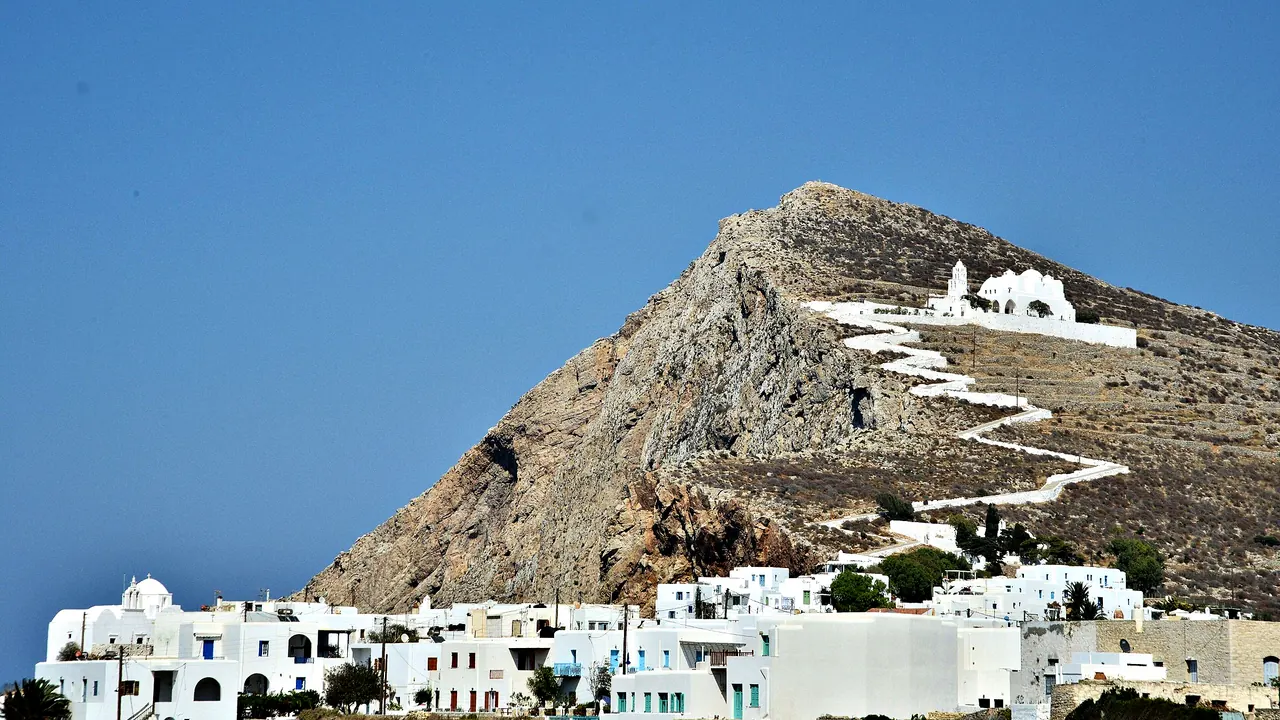
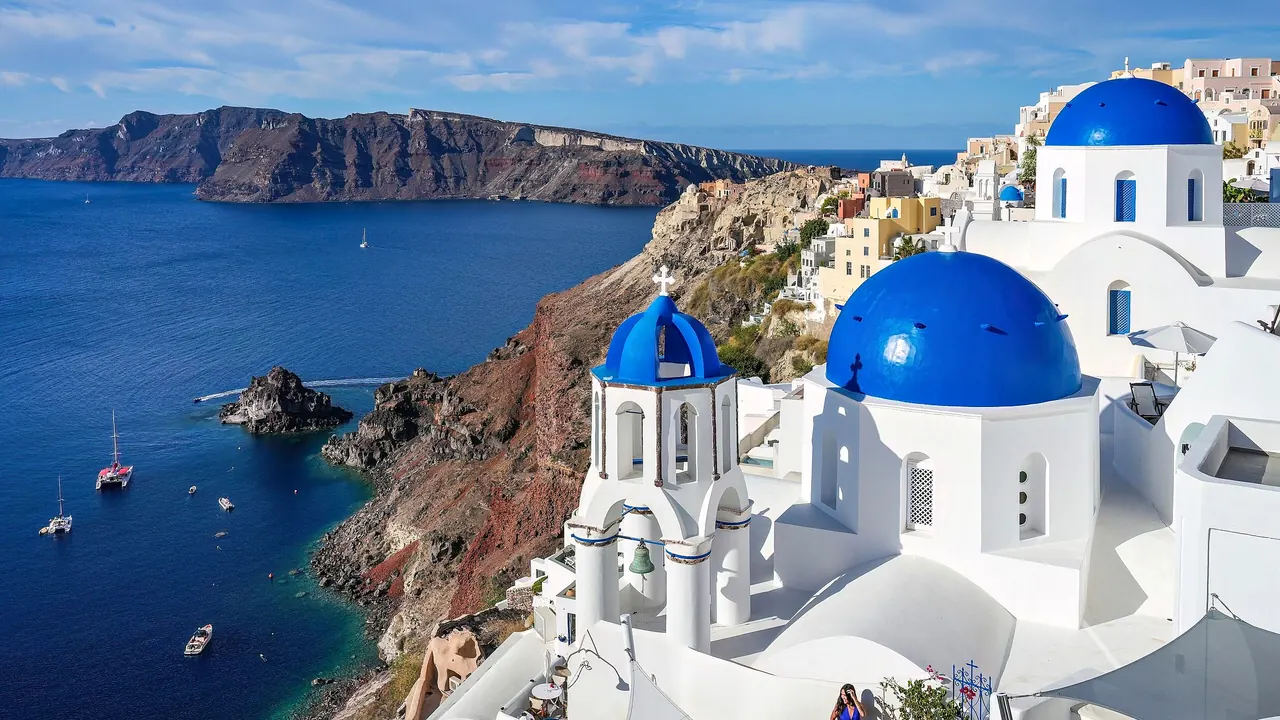
Photos: Folegandros by Chris Kar, CC BY-SA 4.0, cropped; Santorini by Giles Laurent, CC BY-SA 4.0, cropped.
Folegandros or Santorini?
Our verdict in twelve categories, each scored against the same fixed benchmark cities, and the climate month by month, so you can choose for your trip.
Choose Folegandros for
- prices
- beaches
- getting around
Folegandros suits travellers who want the Cyclades at a slower pace. You get one cliff-top village, footpaths down to clear shingle coves and long evenings at tables in Chora's squares, with no clubs and no day crowds. The swimming is better and rooms cost less. In return there is little to see beyond Chora and its Kastro, and only a short list of places to eat.
Choose Santorini for
- culture and sights
- food and drink
- nightlife
Santorini is the choice for a fuller trip with more to do each day. Akrotiri and the caldera villages give it real sights, the volcano and the rim walk to Oia make its landscape unforgettable, and the wineries and inland tavernas put its food and wine well ahead. Expect higher costs, packed lanes at sunset and black-sand beaches that are pleasant rather than the point of coming.
Scoreboard
Twelve categories on one fixed scale from 0 to 100. The shaded stretch is the gap between the two.
Your match
Pick a travel style or drag the sliders, and both match scores follow your weighting.
Wins on prices and beaches with your weighting.
Wins on culture and sights and food and drink with your weighting.
What matters to you?
Category by category
What the scores mean for a trip.
Beaches & swimming
Folegandros has the better swimming. Its small coves of shingle and sand sit under bare cliffs and have exceptionally clear water. Livadi, Vardia and Agali are easy to reach, but you need a boat or a rough walk for Katergo and Livadaki, and few coves have shade or sunbeds.
Santorini's beaches are volcanic: black sand and fine pebble that burns underfoot by midday. Kamari and Perissa have organised rows of sunbeds and tavernas, and the water shelves gently, so a beach day there takes less effort. They are a pleasant part of a stay rather than its purpose, and anyone sleeping in Oia or Fira has to travel down to them.
Food & drink
Santorini eats and drinks far better. Its volcanic soil gives fava, tomato fritters, white aubergines and the soft chloro cheese, but wine is the real reason to sit down: Assyrtiko from vines trained into low baskets, and sweet Vinsanto, tasted at the wineries around Pyrgos and Megalochori. The cliff-edge tables often charge for the sunset, so the better meals are found inland or at Ammoudi Bay.
Folegandros has a few dishes of its own, such as matsata pasta with rooster and karpouzopita, a watermelon pie, and dinner in Chora's shaded squares is a real pleasure. The choice is small, though, and most kitchens close once summer ends.
Culture & sights
Santorini has the sights. Akrotiri, a Bronze Age town preserved under volcanic ash, is one of the great archaeological sites of the Aegean. Add the Museum of Prehistoric Thera, Ancient Thera on its ridge and the fortified villages of Pyrgos and Emporio, and you have two or three full days.
On Folegandros the village itself is the sight. There is Chora's Kastro, where the houses form a wall along the cliff edge, the zigzag climb to the Panagia and the folklore museum at Ano Meria. That takes an afternoon, but it comes without Oia's sunset crowds.
Nightlife
Neither is a party island, but Santorini does offer a night out if you want one. A few lanes in Fira have cocktail bars and clubs open into the early hours in high summer, and Kamari and Perissa add beach bars. Folegandros has no clubs at all. After dinner the evening moves from Chora's squares to a handful of small bars on the lanes and the cliff edge, which is exactly what many of its visitors come for.
Nature & outdoors
Santorini's landscape is the more dramatic. It is a flooded volcano with cliffs over 300m high, a rim path from Fira to Oia and a boat out to climb the lava cone of Nea Kameni. Sailing across the caldera and diving along its submerged walls add a sea side to the outdoors.
Folegandros is quieter and more about walking. It is a bare, terraced ridge with tall sea cliffs below Chora, and its waymarked paths lead to the western coves and along the ridge at Ano Meria. Boat trips run past sea caves such as Chrysospilia.
Day trips
Santorini is the better base for days out by sea. Thirasia is a short boat ride across the caldera and Ios is under an hour by fast ferry. Naxos, Paros and even Knossos on Crete are possible in a long day, though almost everything leaves from Athinios and services thin out after summer.
Folegandros is an island for staying put. Sikinos is close and Santorini can be reached on a faster boat, but routes do not run every day and the north wind can cancel crossings. Most people who want a second island move on rather than come back the same day.
Good for families
Neither island is built for children, and the real difference is the kind of beach day. Santorini's east coast at Kamari and Perissa has flat promenades, gently shelving water and a small water park. The caldera villages, though, are mazes of steps that you cannot manage with a pushchair, and the dark sand gets very hot.
Folegandros offers quiet, safety and Chora's car-free lanes, and Livadi and Agali are the easiest beaches. Many other coves mean a steep walk or a boat, and the cliffs call for care, so it suits older children who swim and walk well.
Getting around
On both islands getting around takes some effort, in different ways. Folegandros is small enough for one bus line linking the port, Chora, Ano Meria and the road to Agali. Many beaches lie beyond the road end, on rough paths or by caique, and with no airport every arrival is by ferry.
Santorini has an airport and a wider bus network, but every route runs through Fira and the buses are packed in high season. A hired car means narrow roads, tour coaches and almost no parking in Oia.
Shopping & style
Santorini has more to browse. The lanes of Oia and Fira have jewellers near the cathedral, galleries showing island painters and resort-wear boutiques, with plenty of souvenir shops in between, and the best things to take home are bottles of Assyrtiko and Vinsanto. Folegandros has a few shops in Chora's lanes selling jewellery, ceramics, linen, honey and capers, enough for a stroll after dinner and no more.
Affordability
Folegandros is easier on the wallet, though neither island is cheap in summer. Chora's boutique hotels with cliff views are pricey, but simpler rooms near Karavostasis or in Ano Meria, fair taverna meals and cheap buses keep a stay manageable.
On Santorini the caldera view sets the price. Cave suites in Oia and Imerovigli and sunset dinners cost far more than elsewhere in Greece, and boat trips and wine tastings add up. To keep costs down, stay in Kamari or Perissa and walk up to the rim for the sunset. Both islands are noticeably cheaper outside July and August.
Live music & performing arts
Neither island has a theatre or a concert season, and their live music is of different kinds. Santorini has a long-running international classical music festival in Fira at the end of summer, plus occasional concerts in restored mansions and old wineries. On Folegandros the music comes from the panigyria, saints' day festivals where violin and lute play late into the night, and from the Easter procession of the Panagia icon, which feels closer to village life than to a stage.
Wellness & relaxation
Both are restful islands with no bathing tradition, but the rest takes different forms. Santorini has the luxury cave hotel, with heated plunge pools and spa treatments facing the caldera at Imerovigli and Oia, and a swim in the warm volcanic spring water off Palea Kameni. The rim at Oia and Fira does fill with day crowds.
Folegandros has few spas and relies on its pace: no big resorts, a car-free village and days split between a cove and a nap. It is at its calmest in June and September.
When should you go?
Pick your month. The climate figures are measured averages, not a forecast.
Folegandros in July
Santorini in July
Daytime high, °C
Rainfall in the month, mm
Where the figures come from
Folegandros has no weather station within reach, so its figures come from a gridded climate model rather than a measured record, and read a broad area rather than one spot.
Santorini's station stands 182 m below the place it is measured for, so that place is likely a little cooler than the figures say.
Santorini has no rain gauge within 25 km of the centre, so its rainfall comes from a gridded climate dataset read at the destination rather than from a gauge further away.
Temperature and rainfall are climate normals, averaged over the years shown. Folegandros: 2001-2020 normals, NASA POWER reanalysis grid, no weather station within 90 km. Santorini: 2000-2025, 12 years observed (rainfall 1991-2020) normals, Santorini Island / Monólithos (5 km from centre).
The two islands share the same Cycladic year. The sea is warm enough to swim from June to October and holds at about 24°C from July to September. Summer is almost completely dry. The rain returns in October and keeps falling through the winter until March, with the heaviest falls in December and January.
The real difference is how hot the summer gets. Folegandros peaks at around 27°C in August, so its paths are best walked early in the morning or in the evening, but the heat stays manageable. Santorini reaches about 30°C in July and August, which makes the shadeless rim path and the steps of Oia hard going at midday. On both islands May is the gentle month for walking, warm and dry, though the sea is still cool. September is the better compromise, with a warm sea and easier heat. October is still pleasant for swimming, but it is the month the autumn rain comes back, so expect some wet days.
Which traveller are you?
On a beach and sun trip, Folegandros is the better pick. Its shingle and sand coves, from Agali round to Katergo, have clearer water and more character than Santorini's hot black sand, as long as you accept steep paths, boats and little shade.
For a culture and arts trip, Santorini wins easily. Folegandros has Chora's Kastro and a small folklore museum, enough for an afternoon. Santorini has the Bronze Age streets of Akrotiri, the frescoes in Fira's museum, Ancient Thera and the kastelli of Pyrgos, enough for several days.
On a trip on a tight budget, Folegandros goes further because its best days cost almost nothing: a footpath to a cove, a swim and a long evening in Chora's squares. On Santorini most of the signature experiences come with a bill, so a budget there means choosing which to skip.
Before you go
| Measure | Folegandros | Santorini |
|---|---|---|
| Official language | Greek | Greek |
| Currency | Euro (EUR) | Euro (EUR) |
| Sockets | CF230 V, 50 Hz | CF230 V, 50 Hz |
| Driving side | Right | Right |
| Time zone | UTC+2, UTC+3 in summer | UTC+2, UTC+3 in summer |
| Emergency number | 112 | 112 |
| Main airport | Santorini International Airport (JTR)60 non-stop destinations | Santorini International Airport (JTR)60 non-stop destinations |
| Public holidays this year | 15 days | 15 days |
By the numbers
| Measure | Folegandros | Santorini |
|---|---|---|
| Population | - | 17,430 |
| People per km² | - | 220 |
| Swim season, months above 21 °C | 5 months | 5 months |
Where else could you go?
Every comparison below shares a destination with this one, so you can follow Folegandros or Santorini somewhere new.
- Iosvs Folegandros
- Iosvs Santorini
- Milosvs Folegandros
- Sifnosvs Folegandros
- Parosvs Folegandros
- Naxosvs Folegandros