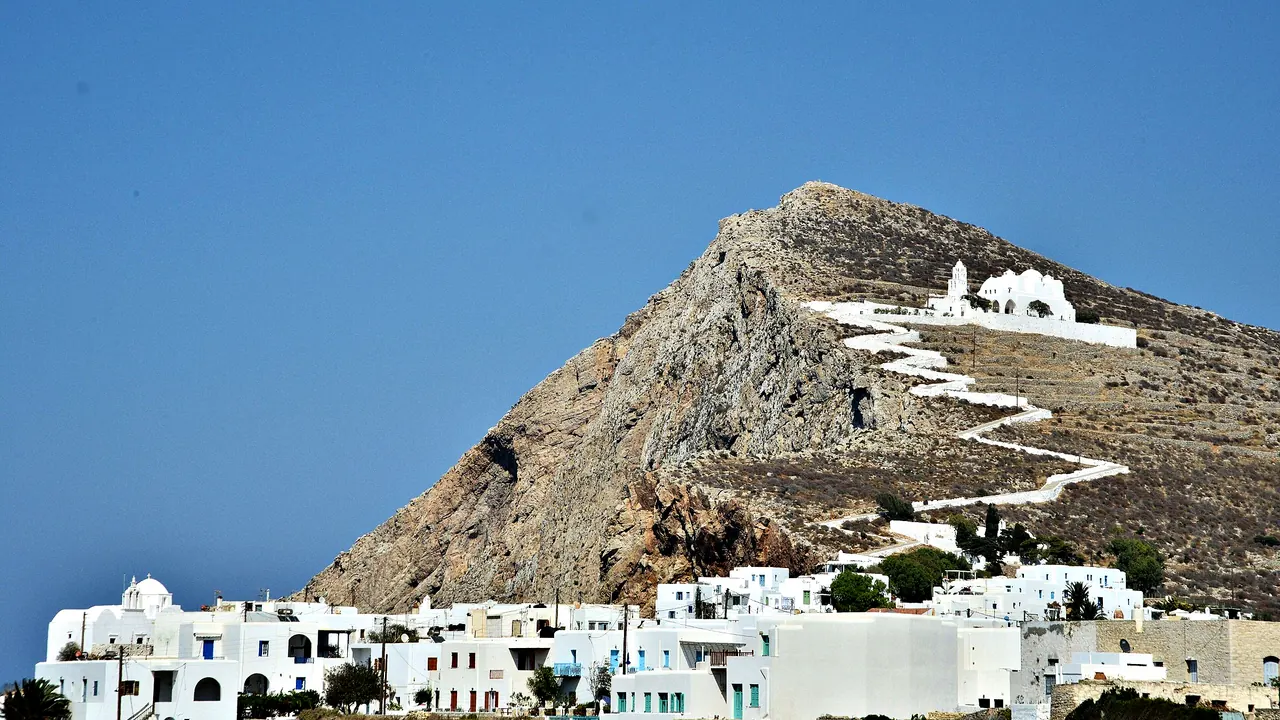
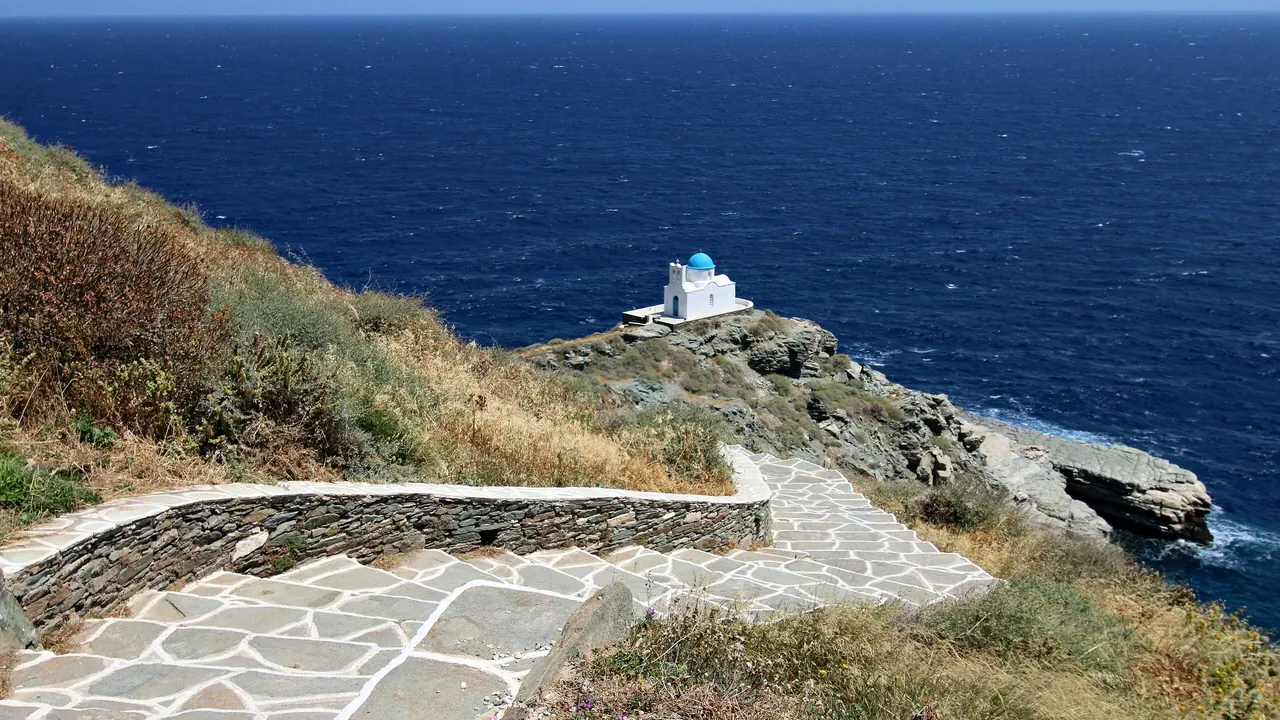
Photos: Folegandros by Chris Kar, CC BY-SA 4.0, cropped; Sifnos by Zde, CC BY-SA 4.0, cropped.
Folegandros or Sifnos?
Our verdict in twelve categories, each scored against the same fixed benchmark cities, and the climate month by month, so you can choose for your trip.
Choose Folegandros for
- prices
Folegandros is for the traveller who wants an island pared back to cliffs, coves and one remarkable village. Chora sits on its cliff edge with the walled Kastro at its heart, and most evenings end in its squares. Days go on walking down to shingle bays such as Agali or taking a boat to Katergo. Reaching the water takes more effort, and there is less to eat and do, but that sparseness is what draws people. Rooms away from Chora can also be a little easier on the budget.
Choose Sifnos for
- food and drink
- shopping
- families
Sifnos gives more on almost every front at the same unhurried pace. Beach days are simple, even with small children, thanks to the sandy, shallow bays at Platis Gialos, Vathi and Kamares. Its slow-cooked dishes, from Sunday revithia to mastelo, make eating a reason in itself to come. Add a wider spread of villages, chapels and ruins, working pottery studios and a fast boat to Milos, and it suits a longer stay or anyone who wants a bit more from each day.
Scoreboard
Twelve categories on one fixed scale from 0 to 100. The shaded stretch is the gap between the two.
Your match
Pick a travel style or drag the sliders, and both match scores follow your weighting.
Wins on prices with your weighting.
Wins on food and drink and shopping with your weighting.
What matters to you?
Category by category
What the scores mean for a trip.
Beaches & swimming
Sifnos is the better swimming island, mainly because of its sand. Platis Gialos is a long curve of fine sand on shallow water, and Kamares is an easy beach right at the port. Vathi's enclosed bay stays calm when the meltemi blows elsewhere, so there is always a sheltered option within reach.
Folegandros has clear water just as warm, but in smaller coves of shingle and sand under bare cliffs. Livadi, Vardia and Agali are straightforward, yet the most memorable, Katergo, takes a boat or a rough walk, and shade is scarce. It rewards swimmers who enjoy the effort of getting there.
Food & drink
Food is where Sifnos pulls furthest ahead. Its tradition of slow cooking in clay pots, from Sunday revithia baked in the wood oven to mastelo with red wine and dill, is known across Greece. The tavernas spread from Apollonia and Artemonas to the waterside tables at Cheronissos.
Folegandros eats well for its size, with matsata pasta, soft souroto cheese and karpouzopita, and dinner in Chora's shaded squares is a highlight. The choice is narrow, though, centred on one village, and most kitchens close outside summer.
Culture & sights
Each island has a medieval Kastro whose outer houses form the defensive wall, but Sifnos has more beyond it. Its Kastro adds a small archaeological museum. The island also reaches further back in time, to the Mycenaean acropolis of Agios Andreas and Hellenistic watchtowers from its mining past. With Chrysopigi and the villages of Apollonia and Artemonas, that fills several unhurried days.
On Folegandros the sight is Chora itself on its cliff rim, along with the zigzag climb to the Panagia church and the folklore museum at Ano Meria. It is striking, but an afternoon covers it.
Nightlife
Neither is a party island, and neither has clubs. Sifnos has a little more going on: in high summer the narrow lane through Apollonia fills with cocktail and music bars until the early hours, and Kamares has a few bars for sunset. Folegandros keeps its evenings to Chora's squares and a few small bars on the lanes and cliff edge, which is exactly what many of its visitors come for.
Nature & outdoors
The two are evenly matched outdoors, but the landscapes differ. Folegandros is a narrow, almost treeless ridge with some of the highest sea cliffs in the Cyclades, and boat trips along them reach sea caves such as Chrysospilia.
Sifnos is gentler and greener, terraced with olive groves and thyme. Its old stone-paved mule tracks link villages, monasteries and bays, up to the monastery on Profitis Ilias at about 680m. On both, spring is the time for walking, and summer hikes are kept to early and late in the day.
Day trips
Sifnos has the better ferry outings. Milos is about an hour away by fast boat, Serifos and its hilltop chora are very close, and quiet Kimolos can be reached from Milos.
From Folegandros, peaceful Sikinos is near, and faster boats reach Milos and Santorini. Routes do not run every day, though, so most visitors move on rather than come back the same evening. On both islands the north wind can upset plans.
Good for families
Sifnos is the easier choice for families. Its sandy, shallow beaches at Platis Gialos, Kamares and Vathi suit small children, and distances are short, though the stepped villages are hard going with a pushchair.
Folegandros is just as calm and safe but has fewer easy beaches, mainly Livadi, those near Karavostasis, and Agali. Elsewhere, steep paths, scarce shade and cliffs in strong wind make it better for older children who like walking and swimming.
Getting around
The only way to reach either island is by ferry from Piraeus or a neighbouring island, and summer wind delays sailings to both, so the difference once you are there is small. Sifnos has a wider summer bus network covering Kamares, Apollonia, Kastro, Faros and the main beaches, and a hired car makes the remoter coves and monasteries easy.
On Folegandros a local bus runs from Karavostasis to Chora, Ano Meria and the road to Agali, and car-free Chora is walked in minutes. Many coves lie beyond the road end, though, and need a hike or a seasonal caique.
Shopping & style
Sifnos gives you a real reason to browse: its potters' workshops around Kamares, Vathi and Platis Gialos, which have been throwing clay casseroles and jugs for local kitchens for centuries. Apollonia adds a few boutiques and shops with capers, cheese and almond sweets. Folegandros has a few small shops in Chora's lanes selling jewellery, ceramics and linen, pleasant after dinner but no more.
Affordability
Costs on the two islands run close, with Folegandros a shade gentler from day to day. Its taverna meals are fair by Greek standards, the bus linking Karavostasis, Chora and Ano Meria costs little, and a day spent walking out to the western coves costs nothing at all.
On Sifnos dinner costs more than it would on the mainland, though the cooking earns much of that, and on an island where eating well is half the point, it is money most visitors are glad to spend. The summer buses and the old mule tracks keep the rest of the day cheap. On both islands, rooms for July and August are booked out early, so leaving it late narrows the choice whichever you pick.
Live music & performing arts
Neither island has a theatre, so live music on both means the summer panigyria, saints' day feasts with violin and lute late into the night. Sifnos offers more of it, with feasts at its many chapels and monasteries, circle dancing open to visitors and the occasional village concert. Folegandros adds the Easter procession of the Panagia icon through its settlements, and beyond that a guitar in a Chora bar is about all there is.
Wellness & relaxation
For rest, the two are much alike: no thermal springs, spa treatments only at a few hotels, and a pace set by car-free lanes and days without a plan. The difference lies in the texture of a day.
Folegandros is sparer, with life centred on one cliff-top village and its squares. Sifnos offers long lunches and evening walks between Apollonia and Artemonas, though its villages and main beaches fill up in August. June and September are the calmest months on both.
When should you go?
Pick your month. The climate figures are measured averages, not a forecast.
Folegandros in July
Sifnos in July
Daytime high, °C
Rainfall in the month, mm
Where the figures come from
Folegandros has no weather station within reach, so its figures come from a gridded climate model rather than a measured record, and read a broad area rather than one spot.
Sifnos has no weather station within reach, so its figures come from a gridded climate model rather than a measured record, and read a broad area rather than one spot.
Temperature and rainfall are climate normals, averaged over the years shown. Folegandros: 2001-2020 normals, NASA POWER reanalysis grid, no weather station within 90 km. Sifnos: 2001-2020 normals, NASA POWER reanalysis grid, no weather station within 90 km.
The two islands are close neighbours in the western Cyclades, and their weather runs almost in step. On both, the swimming season lasts from June to October, when the sea holds at 22°C to 24°C, and the summer is nearly rainless. July and August bring highs around 27°C and the strong north wind. Walking is best kept to early morning and evening then, and exposed beaches can turn choppy. Late May, June and September are the most comfortable months for combining a swim with longer walks.
Rain returns in October, and winter is wet, with about 100mm a month in December and January. Sifnos is slightly wetter than Folegandros, and highs on both drop to the mid-teens. April and May are mild and mostly dry, the time for hiking and spring flowers on either island, though the sea is still cool for most swimmers.
Which traveller are you?
For a food and nightlife trip, Sifnos is the clear pick. Its clay-pot cooking, manoura cheese and seafood at Cheronissos give dinners real depth, and the bar lane through Apollonia stays lively later than the handful of small bars around Chora's squares.
On a family trip with young children, Sifnos is easier. Platis Gialos, Kamares and Vathi have sand and shallow water within easy reach. Many Folegandros coves mean a steep path or a boat and little shade, which suits older children better.
On a trip on a tight budget, Folegandros edges ahead, though neither island is cheap in summer. Simpler rooms near Karavostasis or in Ano Meria undercut Chora's boutique hotels, while Sifnos leans more towards stylish houses. June or September helps on both.
Before you go
| Measure | Folegandros | Sifnos |
|---|---|---|
| Official language | Greek | Greek |
| Currency | Euro (EUR) | Euro (EUR) |
| Sockets | CF230 V, 50 Hz | CF230 V, 50 Hz |
| Driving side | Right | Right |
| Time zone | UTC+2, UTC+3 in summer | UTC+2, UTC+3 in summer |
| Emergency number | 112 | 112 |
| Main airport | Santorini International Airport (JTR)60 non-stop destinations | Milos Airport (MLO)2 non-stop destinations |
| Public holidays this year | 15 days | 15 days |
By the numbers
| Measure | Folegandros | Sifnos |
|---|---|---|
| Swim season, months above 21 °C | 5 months | 5 months |
Where else could you go?
Every comparison below shares a destination with this one, so you can follow Folegandros or Sifnos somewhere new.
- Iosvs Folegandros
- Milosvs Sifnos
- Parosvs Sifnos
- Milosvs Folegandros
- Santorinivs Folegandros
- Parosvs Folegandros