Greece
Folegandros
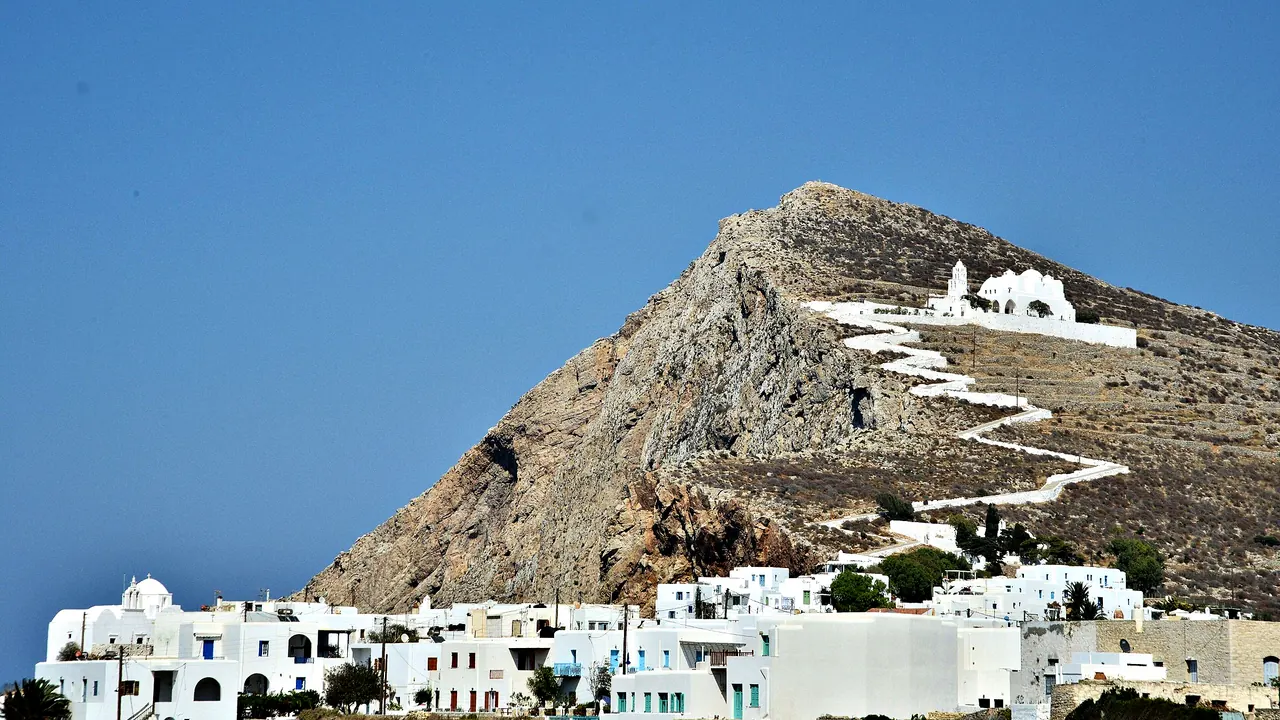
The winding path to the Panagia church above Chora
- Beaches68
- Nature & outdoors55
- Getting around45
Photo: Chris Kar, CC BY-SA 4.0, cropped
Match
35
Every category weighted equally
- Beach & sun41
- Culture & arts31
- Food & nightlife31
- Family trip40
- Outdoors40
- Relax & unwind40
- Shopping & style31
- On a budget36
Folegandros in twelve categories
Our verdict on each, scored 0 to 100 against the same fixed benchmark cities, so a score means the same thing on every page.
Beaches & swimming. Scores 68 out of 100.
Food & drink. Scores 38 out of 100.
Culture & sights. Scores 30 out of 100.
Nightlife. Scores 20 out of 100.
Nature & outdoors. Scores 55 out of 100.
Day trips. Scores 30 out of 100.
Good for families. Scores 32 out of 100.
Getting around. Scores 45 out of 100.
Shopping & style. Scores 14 out of 100.
Affordability. Scores 40 out of 100.
Live music & performing arts. Scores 8 out of 100.
Wellness & relaxation. Scores 40 out of 100.
Folegandros category by category
Beaches & swimming
68Swimming on Folegandros means small coves of shingle and sand under bare cliffs, with water of great clarity that reaches about 24°C by August. The easy beaches are near the port at Karavostasis, Livadi and Vardia, and at Agali on the west coast, where a few tavernas sit on the sand. From Agali footpaths and summer boats continue to Agios Nikolaos, Livadaki and Galifos. Katergo, on the southeast tip, is the one people remember: a pale shingle bay facing a rock islet, reached by boat or a rough walk.
Many coves have no shade or facilities, and getting down to them is part of the outing. The north wind blows hard in July and August, so the sheltered side changes from day to day. The sea is warm enough to swim from June to October.
Food & drink
38Eating out happens mostly in Chora, where tables fill the tree-shaded squares on summer evenings, with a few tavernas at Agali, Karavostasis and Ano Meria. The island has dishes of its own: matsata, hand-rolled pasta served with rooster or rabbit, souroto, a soft local cheese, and karpouzopita, a watermelon pie baked from summer fruit. Cooking is simple and island-based, with goat, fish when the boats bring it in, capers and thyme honey.
For a place this small the standard is good, and an evening meal in the squares is one of the pleasures of a stay. Range is limited, though, and outside the summer months most kitchens close.
Culture & sights
30The sight is Chora itself, a whitewashed village set on the rim of a cliff about 200m above the sea. Its core is the Kastro, a medieval quarter whose outer houses form a continuous defensive wall, with narrow lanes and wooden balconies inside. A zigzag path climbs from the village to the church of the Panagia, which looks over the cliffs and the open sea.
Ano Meria, strung out along the ridge to the north, keeps a small folklore museum in an old farmhouse, with threshing floors and terraced fields around it. Beyond that there is little to visit, and an afternoon covers it.
Nightlife
20Evenings are long but low-key. After dinner people stay in Chora's squares, or move to a few small bars on the lanes and the cliff edge, some playing music until late in July and August. There are no clubs, and the island's appeal for many visitors is that it is not a party island. Outside the summer peak most places close early or not at all.
Nature & outdoors
55Folegandros is a long, narrow ridge of bare rock with some of the highest sea cliffs in the Cyclades along its northeast side under Chora. The landscape is dry and stony, with stone-walled terraces, chapels and juniper on the slopes, and almost no trees. Waymarked footpaths cross the island, from Chora to the western coves and along the ridge at Ano Meria, and walking them is the main outdoor activity.
Boat trips around the coast pass sea caves, including the Chrysospilia cave in the north cliffs. Spring brings wild flowers and the best walking weather. In midsummer heat and wind make hiking a matter for early morning and evening.
Day trips
30This is an island where you stay put. In summer, ferries make day trips possible to neighbouring islands: quiet Sikinos is close, and Milos and Santorini are around an hour or two away on faster boats. Not every route runs every day, though, and the north wind can disrupt crossings, so most visitors who want more than one island move on, not come back the same day.
Good for families
32Families come for quiet and safety, but the island offers little made for children. Livadi and the beaches near Karavostasis, and Agali with its tavernas, are the easiest with young children. Many of the other coves need a steep walk down or a boat, and few have shade. Chora's car-free lanes are pleasant for evening walks, but the cliffs and strong summer winds call for care. It suits older children who like swimming and walking more than toddlers.
Getting around
45Folegandros is small, and a local bus links the port of Karavostasis with Chora, Ano Meria and the road down to Agali. Chora itself is car-free and walked in minutes. Many beaches beyond the road end need a hike on rough paths or a seasonal caique, and some visitors hire a scooter or quad for the island's few roads. There is no airport, so arriving means a ferry from Piraeus or a neighbouring island, and in the north wind crossings can be slow or cancelled.
Shopping & style
14Shopping is confined to a few small shops in the lanes of Chora selling jewellery, ceramics, linen and summer clothes, along with local honey, capers and herbs. It makes for a pleasant browse after dinner, but there is no reason to come here to shop.
Affordability
40In summer the island is not cheap. Chora is full of small boutique hotels with cliff views priced for a discerning crowd, and in July and August rooms get booked out early. Taverna meals are fair for Greece, buses are inexpensive and walking is free. Simpler rooms near Karavostasis or in Ano Meria bring the cost down, and June and September are noticeably easier on the budget than the peak.
Live music & performing arts
8There is no theatre or concert venue. Live music means village festivals, the panigyria held on saints' days in summer, where island violin and lute music plays late into the night, and the Easter procession of the Panagia icon through the island's settlements. Otherwise, a guitar in a Chora bar is about as formal as it gets.
Wellness & relaxation
40Folegandros has no thermal springs or bathing tradition, and spa treatments are limited to a handful of hotels. What it offers is the pace: no big resorts, a car-free village, long evenings in the squares and days divided between a cove and a nap. Rest is the main reason many visitors come, especially in June and September when the island is at its calmest.
Where to stay in Folegandros
Most visitors stay in Chora, and it is the natural base for a first visit. The village sits on the cliff rim about 200m above the sea. It is car-free and you can walk across it in minutes, with dinner in the shaded squares and the few late bars on your doorstep. It suits couples, walkers and anyone who wants long evenings without needing transport. The beaches are a bus ride or a hike away, though, and rooms with cliff views are the most expensive on the island.
Karavostasis, the port, is the practical choice for beach days and for families with young children. Livadi and Vardia are close by, and the bus runs up to Chora for the evenings. Rooms here tend to be simpler and cheaper. Agali, on the west coast, puts you on the sand with tavernas beside it, and footpaths and summer boats lead on to the further coves. It suits a stay built around swimming.
Ano Meria stretches along the ridge to the north and is the quietest option, with terraced fields, ridge walks and a few tavernas. It suits a slow, restful stay, ideally with a scooter. The island is small enough that one base covers all of it, so there is no need to move around.
When should you go?
Pick a month to see what it is like. The climate figures are measured averages, not a forecast.
Folegandros in July
Daytime high, °C
Rainfall in the month, mm
The whole year
Shaded against this destination’s own year: the deepest cell is its best month for that figure and the palest its weakest.
Where the figures come from
Folegandros has no weather station within reach, so its figures come from a gridded climate model rather than a measured record, and read a broad area rather than one spot.
Temperature and rainfall are climate normals, averaged over the years shown. Folegandros: 2001-2020 normals, NASA POWER reanalysis grid, no weather station within 90 km.
Before you go
| Measure | Folegandros |
|---|---|
| Official language | Greek |
| Currency | Euro (EUR) |
| Sockets | CF230 V, 50 Hz |
| Driving side | Right |
| Time zone | UTC+2, UTC+3 in summer |
| Emergency number | 112 |
| Main airport | Santorini International Airport (JTR)60 non-stop destinations |
| Public holidays this year | 15 days |
By the numbers
| Measure | Folegandros |
|---|---|
| Swim season, months above 21 °C | 5 months |
Compare Folegandros with
Every comparison with a written verdict behind it.
- Aegina
- Corfu
- Crete
- Halkidiki
- Hydra
- Ios
- Kefalonia
- Kos
- Lefkada
- Milos
- Mykonos
- Naxos
- Paros
- Paxos
- Peloponnese
- Rhodes
- Samos
- Santorini
- Sifnos
- Skiathos
- Skopelos
- Thassos
- Zakynthos