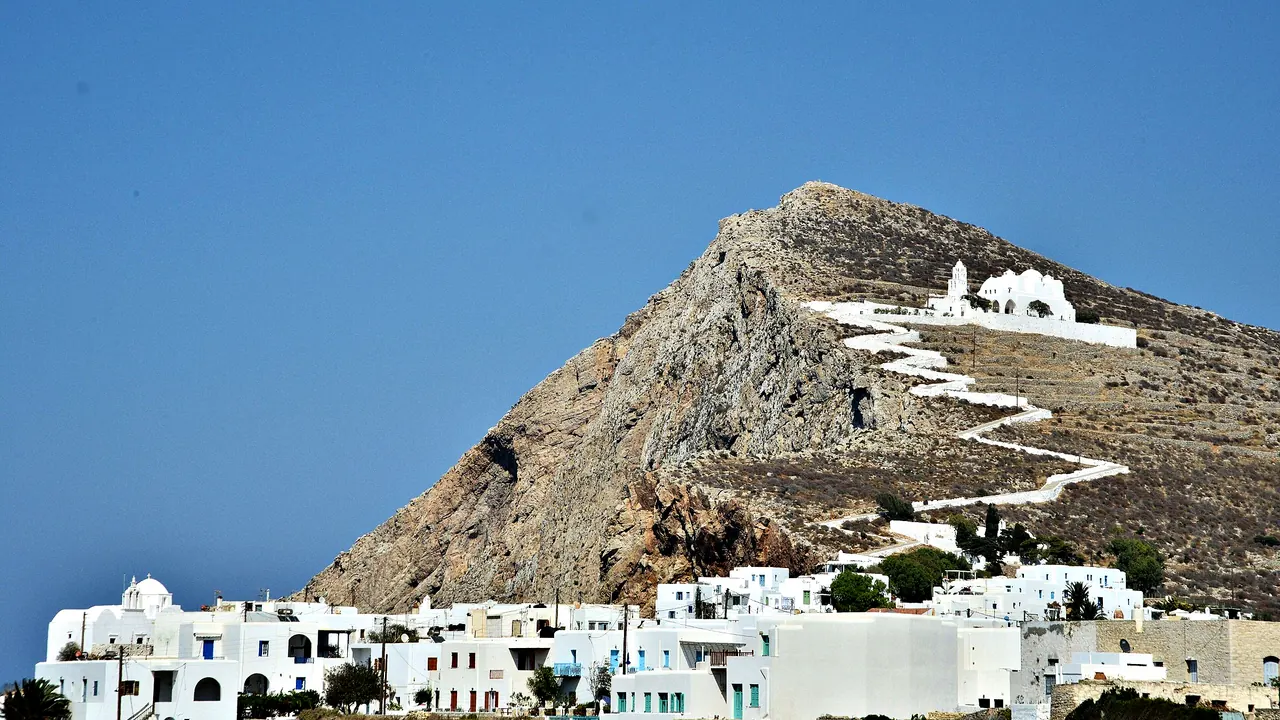
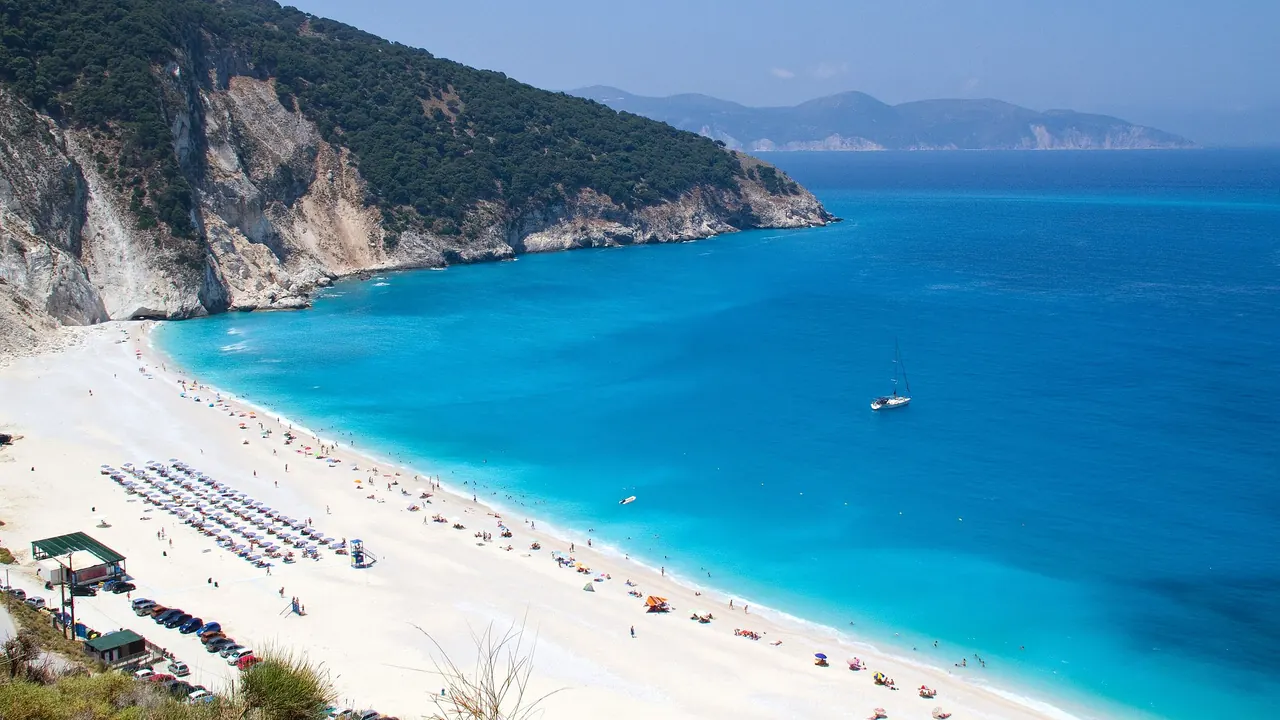
Photos: Folegandros by Chris Kar, CC BY-SA 4.0, cropped; Kefalonia by Tony Hisgett from Birmingham, UK, CC BY 2.0, cropped.
Folegandros or Kefalonia?
Our verdict in twelve categories, each scored against the same fixed benchmark cities, and the climate month by month, so you can choose for your trip.
Choose Folegandros for
- getting around
Folegandros suits travellers who want to stay in one place and barely move. You base yourself in Chora, a car-free cliff-top village, and spend the days walking footpaths down to shingle coves, with the evenings at tables in its squares. It is small, the local bus and your feet cover most of it, and it never pretends to be a party island. The cost is variety: fewer beaches, a narrower choice of food and very little to do beyond swimming, walking and eating.
Choose Kefalonia for
- families
- beaches
- food and drink
Kefalonia is the better pick for a fuller island vacation with a hire car. It has more beaches, and better ones, spread over several coasts, from Myrtos and Petani to the sandy south at Skala. Add a forested mountain national park, cave lakes, Robola wineries and an easy ferry to Ithaca, and there is far more to fill a week or two, particularly for families. In return you spend time on winding roads, and the island feels less of a single, close-knit place.
Scoreboard
Twelve categories on one fixed scale from 0 to 100. The shaded stretch is the gap between the two.
Your match
Pick a travel style or drag the sliders, and both match scores follow your weighting.
Wins on getting around with your weighting.
Wins on families and beaches with your weighting.
What matters to you?
Category by category
What the scores mean for a trip.
Beaches & swimming
Kefalonia is clearly the stronger beach island. Myrtos is the famous view, a white pebble crescent beneath cliffs, and Petani on Paliki is a quieter twin. Xi has reddish sand and Skala and Lourdas have long sandy stretches, so there is a beach for each kind of day, as long as you are prepared to drive between coasts.
Folegandros swaps that range for intimacy. Its coves are small, mostly shingle, under bare cliffs and often without shade, and you reach many of them by footpath or summer boat from Agali. Katergo is the standout. Expect to work a little for each swim, and to choose your side of the island by the strength of the north wind.
Food & drink
Kefalonia gives you more to eat and drink. There are the meat pie and aliada with salt cod, the red mandoles almonds and Robola tastings in the Omala valley, and Argostoli adds a fish market and the widest choice of tables. Menus do repeat once you leave the resorts.
Folegandros cooks well within a much smaller range: matsata pasta with rooster or rabbit, soft souroto cheese and watermelon pie, eaten mostly in Chora's shaded squares. Dinner there is a highlight, but over a long stay the options run thin.
Culture & sights
Neither island is a reason to travel for sightseeing, but what each offers is different. On Folegandros the sight is the village itself: the walled Kastro quarter of Chora on its cliff edge and the path up to the Panagia, with a small folklore museum at Ano Meria.
Kefalonia's heritage is more scattered and was badly damaged by the 1953 earthquake. It survives in pastel Fiskardo, the Venetian forts at Assos and Agios Georgios, a Mycenaean tomb, the Argostoli museum and the ruins of Old Vlachata, which means a series of separate drives rather than one stroll.
Nightlife
Both are islands for a late dinner and a drink, not for clubbing. On Folegandros the evening stays in Chora, in the squares and a few small bars on the cliff edge. Kefalonia spreads its evenings out more, with the Lithostroto in Argostoli, the strip of beach and cocktail bars at Lassi, and harbour bars at Skala and Fiskardo.
Nature & outdoors
Here you are choosing between a bare ridge and a forested mountain. Folegandros is dry stone, with terraces, chapels and juniper and hardly a tree, and some of the highest cliffs in the Cyclades drop to the sea below Chora. Outdoors, that means walking the waymarked paths and taking a boat round the coast to the Chrysospilia sea cave. Spring, when the wild flowers are out, is the time to come for it.
Kefalonia's landscape is higher, greener and much more varied. Mount Ainos rises to about 1,628m as a national park of dark Greek fir with semi-wild horses, and underground there are the sunlit lake of Melissani and the stalactites of Drogarati. Add the white cliffs above Myrtos and Assos, loggerhead turtles in Argostoli harbour, and sea kayaking along the north-east coast, and the outdoor days are far more varied.
Day trips
Kefalonia has the better day out close at hand: a short ferry from Sami to Ithaca, for Vathy, Kioni and the sites linked to Odysseus. In summer boats also reach Zakynthos and Lefkada, and the island is big enough that Fiskardo or Paliki count as outings in their own right.
On Folegandros the ferries tend to carry people onward rather than back the same day. Sikinos is close, and Milos or Santorini can be reached on faster boats, but timetables and the north wind make island-hopping a better plan than day trips.
Good for families
Kefalonia does a better job with children if you base yourselves in the south or on Paliki, where sandy, shallow beaches replace the steep pebble drop-offs of the north-west. Melissani and turtle-spotting give you a couple of reliable outings, although the drives are long and hot.
Folegandros feels safe and quiet, and Chora's car-free lanes make evening walks easy. Beyond Livadi, Agali and the coves near the port, though, beaches mean steep paths or boats with little shade, so it works for older children who like walking far better than for toddlers.
Getting around
Folegandros is the easier island to get around once you are there. A local bus links the port, Chora, Ano Meria and the Agali road, the village is walked in minutes, and a scooter covers the rest. The catch is arriving: there is no airport, only ferries that the wind can delay.
On Kefalonia you will want a car. Beaches, caves and villages sit on different coasts, linked by winding mountain roads; Argostoli to Fiskardo is about an hour and a half, the buses are sparse, and parking at Myrtos, Assos and Fiskardo is tight in summer.
Shopping & style
Neither island is worth visiting for the shops, though Kefalonia offers slightly more. Argostoli's Lithostroto and the boutiques around Fiskardo give you a real street to browse, and Robola, olive oil and mandoles make good things to take home. Folegandros has a handful of jewellery, ceramics and linen shops in Chora's lanes, plus honey and capers.
Affordability
Kefalonia is easier on the budget, with fair-priced apartments around Skala, Lourdas, Lassi and the southern villages. Car hire is the cost almost everyone adds, and Fiskardo and Assos are noticeably dearer.
Folegandros leans more expensive in summer, because Chora is full of boutique hotels with cliff views and rooms book out early. You save on transport, since buses are cheap and walking is free. Simpler rooms near Karavostasis or in Ano Meria, and travelling in June or September, help on both islands.
Live music & performing arts
Kefalonia gives you the better chance of hearing live music, because it has a little more of it. Argostoli's philharmonic band is an old institution, and on summer evenings concerts are held outdoors in the town's squares. Neither island has a theatre or an opera season, so that is as formal as it gets.
On Folegandros, music has no fixed home and follows the church calendar. If your stay falls on a summer panigyri, you can join a village dancing to violin and lute until the small hours. If it does not, a guitar in a Chora bar may be all you hear. Kefalonia's own kantades, sung by small groups to guitar and mandolin, also turn up at its village festivals, so on either island it is worth asking which saint's day is coming up.
Wellness & relaxation
Neither island has springs or a bathing tradition, and on both, rest comes from the pace more than from treatments. Folegandros is the more complete escape, with no big resorts, a car-free village and the day shared between a cove and a nap. Kefalonia has proper spas at the larger hotels around Lassi, Skala and Fiskardo, and you can slow down on the quieter Paliki peninsula and the north-east coast.
When should you go?
Pick your month. The climate figures are measured averages, not a forecast.
Folegandros in July
Kefalonia in July
Daytime high, °C
Rainfall in the month, mm
Where the figures come from
Folegandros has no weather station within reach, so its figures come from a gridded climate model rather than a measured record, and read a broad area rather than one spot.
Kefalonia's temperatures are measured 59 km from the centre, at Zakinthos / Agrilia.
Kefalonia has no rain gauge within 25 km of the centre, so its rainfall comes from a gridded climate dataset read at the destination rather than from a gauge further away.
Temperature and rainfall are climate normals, averaged over the years shown. Folegandros: 2001-2020 normals, NASA POWER reanalysis grid, no weather station within 90 km. Kefalonia: 1991-2020 normals, Zakinthos / Agrilia (58.6 km from centre).
Both islands have swimmable sea from June to October, and both are dry through high summer. Their summers feel quite different, though. Folegandros stays moderate, with August highs around 27°C and the north wind keeping things fresh, so midday walks in the lanes are still manageable. Kefalonia gets much hotter, reaching about 33°C in August, and it has the long sunny days and slightly warmer sea of the Ionian. Its high summer is better spent in the water than on trails or long drives.
The seasons also close differently. Kefalonia's rains come back sharply from September and turn heavy by November, at around 159mm, which makes late spring and early autumn its sweet spot for walking and sightseeing. Folegandros stays dry a little longer into autumn and gets wet more gradually. Spring on either island brings mild days that suit hiking, but the sea is still cool for swimming until June.
Which traveller are you?
On a family trip with children, Kefalonia is the safer choice. The gently shelving sand at Skala, Lourdas and Xi suits small swimmers, and the boat through Melissani and the turtles in Argostoli harbour make easy outings. Folegandros has few easy beaches, and its cliffs need watching.
For an outdoors trip, Kefalonia offers more range. You can walk through the fir forest of Mount Ainos, paddle a sea kayak along the north-east coast, sail towards Ithaca and go down into karst caves. Folegandros has fine cliff-path walking, but on a bare, much smaller ridge.
On a relaxing and wellness trip, both islands are slow and neither has a spa culture to speak of. Folegandros has the edge for anyone who wants to leave the car behind entirely, with a car-free village, a bus and a cove a short walk away.
Before you go
| Measure | Folegandros | Kefalonia |
|---|---|---|
| Official language | Greek | Greek |
| Currency | Euro (EUR) | Euro (EUR) |
| Sockets | CF230 V, 50 Hz | CF230 V, 50 Hz |
| Driving side | Right | Right |
| Time zone | UTC+2, UTC+3 in summer | UTC+2, UTC+3 in summer |
| Emergency number | 112 | 112 |
| Main airport | Santorini International Airport (JTR)60 non-stop destinations | Kefalonia International Airport "Anna Pollatou" (EFL)41 non-stop destinations |
| Public holidays this year | 15 days | 15 days |
By the numbers
| Measure | Folegandros | Kefalonia |
|---|---|---|
| Population | - | 36,064 |
| People per km² | - | 49 |
| Swim season, months above 21 °C | 5 months | 5 months |
Where else could you go?
Every comparison below shares a destination with this one, so you can follow Folegandros or Kefalonia somewhere new.
- Iosvs Folegandros
- Milosvs Folegandros
- Sifnosvs Folegandros
- Santorinivs Folegandros
- Parosvs Folegandros
- Zakynthosvs Kefalonia