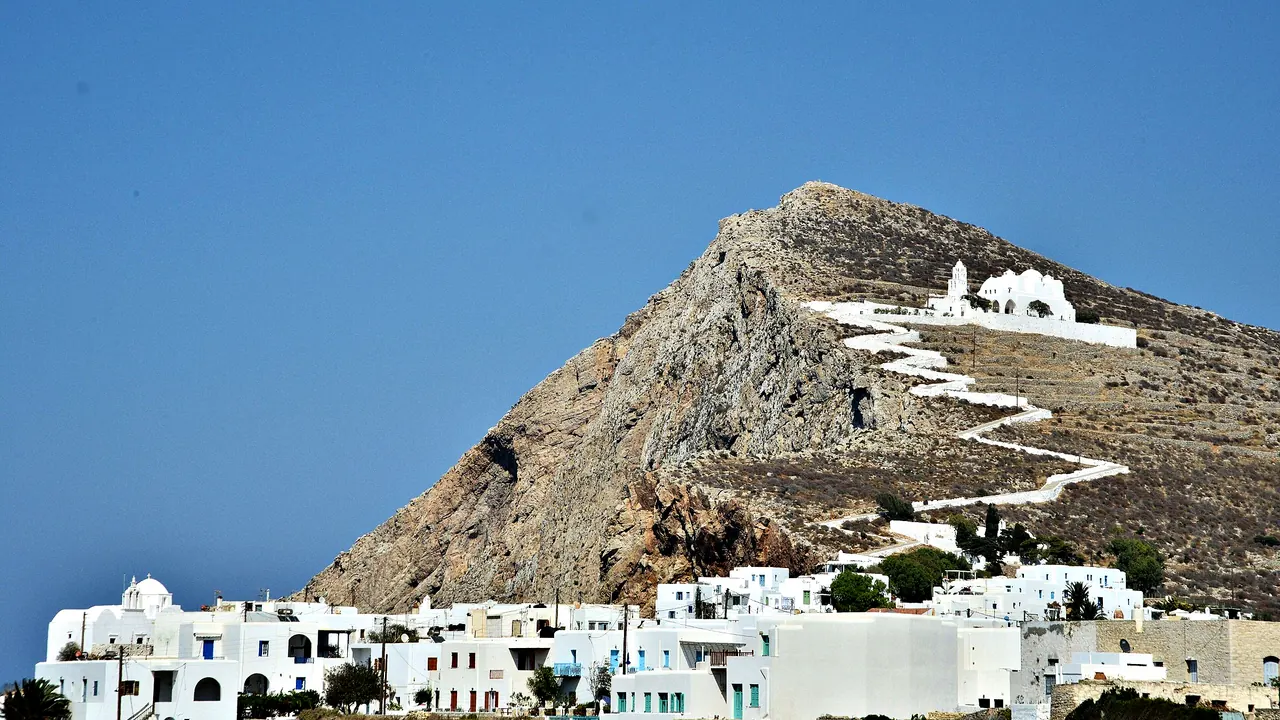
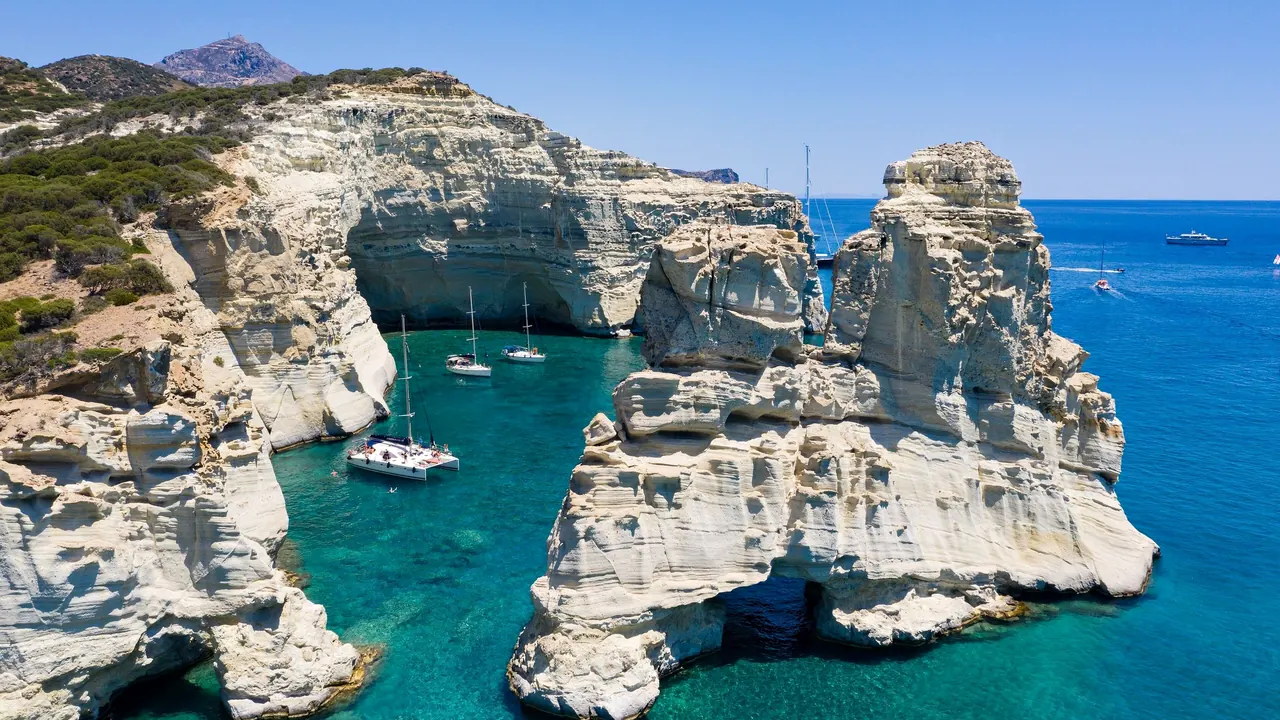
Photos: Folegandros by Chris Kar, CC BY-SA 4.0, cropped; Milos by dronepicr, CC BY 2.0, cropped.
Folegandros or Milos?
Our verdict in twelve categories, each scored against the same fixed benchmark cities, and the climate month by month, so you can choose for your trip.
Choose Folegandros for
- prices
- getting around
Folegandros is the better choice for travellers who want one quiet base and little else to plan. Life centres on Chora, a car-free village on a clifftop, with evenings in its squares, waymarked paths out to the coves and a local bus that covers what the walking does not. The beaches are fewer and harder to reach, and there is less to see, but it costs a little less than Milos and asks almost nothing of you.
Choose Milos for
- beaches
- families
- food and drink
Milos suits people who come above all to swim. Its volcanic coast has far more beaches, sandy ones on the south coast and white pumice at Sarakiniko, and the north wind leaves somewhere calm on most days. It also has more to see, from the catacombs to Phylakopi, a gentler time for families and a small airport. The cost is a hire car, busier beaches in August and a bigger bill.
Scoreboard
Twelve categories on one fixed scale from 0 to 100. The shaded stretch is the gap between the two.
Your match
Pick a travel style or drag the sliders, and both match scores follow your weighting.
Wins on prices and getting around with your weighting.
Wins on beaches and families with your weighting.
What matters to you?
Category by category
What the scores mean for a trip.
Beaches & swimming
Both islands have very clear water that warms to the same summer temperatures, but Milos has much more coastline worth swimming from. Its volcanic shore gives white pumice inlets at Sarakiniko, coloured cliffs, and a run of long sandy beaches on the south coast from Firiplaka to Agia Kyriaki. Because the island has two sides, the north-shore coves around Pollonia and the south-coast sands, one or the other is usually calm whatever the wind does.
Folegandros has a shorter list of small shingle-and-sand coves under bare cliffs. Livadi, Vardia and Agali are the easy ones, and Katergo is the standout, reached by boat or a rough path. It is a beautiful place to swim, but with fewer beaches and harder access you will spend more of your day getting down to the water.
Food & drink
Milos gives you more choice at the table. Fish tavernas line the waterfronts of Pollonia and Adamas, Klima serves octopus and the morning catch, and Plaka and Tripiti have a few more ambitious kitchens with sunset terraces, alongside island dishes such as pitarakia and ladenia.
Folegandros eats well for its size but in fewer places, almost all of them in Chora's shaded squares. Its own dishes are worth looking for, especially matsata pasta with rooster or rabbit and souroto cheese. Expect a pleasant evening routine rather than variety.
Culture & sights
Milos has more to visit, enough for two days: the early Christian catacombs below Plaka, the field where the Venus de Milo was found, a Roman theatre, the Bronze Age site at Phylakopi, and the painted syrmata boathouses at Klima.
On Folegandros the main sight is Chora itself, with the Kastro quarter, where the outer houses form a defensive wall, and the walk up to the Panagia church on the cliff. Add the folklore museum at Ano Meria and you have seen the island's heritage in an afternoon.
Nightlife
Neither island is for partying, and both are quiet by design. On Folegandros the night stays in one place, in Chora's squares and a few small bars along the lanes and the cliff edge. Milos spreads it out more, with sunset drinks in Plaka or Tripiti, then the harbour at Adamas, where a few bars stay open late in high summer.
Nature & outdoors
The landscapes are about equally rewarding but best seen in different ways. Folegandros is a narrow ridge of bare rock, with some of the highest sea cliffs in the Cyclades, and it is best on foot, along waymarked paths from Chora to the western coves and along the terraced ridge at Ano Meria.
Milos is best seen from the water. Sailing or kayak trips take in the rock towers and caves of Kleftiko, the coloured cliffs at Firopotamos and Papafragas, and the pumice of Sarakiniko, and there is some snorkelling. Its inland trails, to the old sulphur mines at Paliorema, are milder than the Folegandros paths.
Day trips
Milos has the easier day out: Kimolos is a short crossing from Pollonia, and in summer the fast boats put Sifnos and its pottery villages within an hour. From Folegandros, the realistic hop is to quiet Sikinos, and Milos or Santorini only work on the faster boats. On both islands the wind and the timetable decide, so many visitors simply move on to the next island.
Good for families
Milos works better with children. Several south-coast beaches shelve gently into calm water, and Pollonia has a sheltered beach in the village itself, although a car is needed for most outings and shade is scarce.
Folegandros has fewer easy options, mainly Livadi, the beaches near Karavostasis and Agali, and the cliffs and strong winds call for watchfulness. It suits older children who enjoy walking and swimming more than families with toddlers.
Getting around
The two are about equally manageable but in different ways. On Folegandros you can do without a car: Chora is car-free, and a bus runs from the port to Chora, Ano Meria and the road down to Agali, with paths and caiques for the rest. The catch is arrival, which is ferry only and depends on the wind.
Milos really needs a hired car or quad, since buses miss most of the coast and the west is reached on dirt roads. In return, it is easier to reach, with a short flight from Athens to its small airport as well as the ferries.
Shopping & style
Neither island is worth visiting for the shops. Milos has a little more, with linen, jewellery and ceramics boutiques in Plaka and practical stores and beachwear in Adamas. Folegandros has a handful of small shops in Chora's lanes. On both, local capers, honey and herbs are the best things to bring home.
Affordability
Folegandros is the slightly gentler island on the wallet, though neither is cheap in July and August. Its boutique hotels in Chora charge for the cliff views, but the bus and walking mean you can manage without a car.
On Milos, rooms in Pollonia, Plaka and Adamas cost more, and car hire and boat trips to Kleftiko add to the bill. On both islands, June, September and simpler rooms away from the main villages bring the cost down.
Live music & performing arts
Live music on both islands means the summer panigyria, saints'-day feasts in the villages and chapels where violin and lute play late into the night. Folegandros adds the Easter procession of the Panagia icon through its settlements, and beyond that a guitar in a Chora bar is as formal as it gets. Milos now and then hosts a summer concert at its ancient theatre or in Adamas, but neither island has a theatre or concert hall to plan a trip around.
Wellness & relaxation
Both islands restore people through their slow pace rather than through spas, but Milos has warm water from its volcano. There are rustic soaks at the old baths at Lakkos and near Provatas, and warm sand at Paliochori. Folegandros has no springs, but its car-free village and lack of big resorts make it the stiller of the two, especially when August brings traffic to the main beaches on Milos.
When should you go?
Pick your month. The climate figures are measured averages, not a forecast.
Folegandros in July
Milos in July
Daytime high, °C
Rainfall in the month, mm
Where the figures come from
Folegandros has no weather station within reach, so its figures come from a gridded climate model rather than a measured record, and read a broad area rather than one spot.
Milos has no weather station within reach, so its figures come from a gridded climate model rather than a measured record, and read a broad area rather than one spot.
Temperature and rainfall are climate normals, averaged over the years shown. Folegandros: 2001-2020 normals, NASA POWER reanalysis grid, no weather station within 90 km. Milos: 2001-2020 normals, NASA POWER reanalysis grid, no weather station within 90 km.
The two islands sit close together and share almost the same weather, so the choice of month matters more than the choice of island. The sea is warm enough to swim from June, when it reaches about 22°C, and stays around 24°C from July to September. Days peak near 27°C in August, and with the north wind blowing hard and no shade on the hills, walking is best kept to early morning and evening. That hits Folegandros, where walking is the main activity, a little harder than Milos, where boats and beaches matter more.
For walking, April and May are milder and nearly dry, though the sea is still cool. Rain comes back in October and builds through the winter to about 100mm a month in December and January, a little wetter on Milos than on Folegandros. Since most kitchens and boats on both islands close outside the warm months, June to September is the real season, with June and September the calmer ends.
Which traveller are you?
On a beach and sun trip, Milos is the clear pick. Its volcanic coast has many more beaches, from Sarakiniko's white pumice to the long sandy south-coast bays, so you can follow the wind to calm water almost every day.
On a family trip with children, Milos is easier. Beaches such as Provatas and Paliochori shelve gently into calm water and Pollonia has sand right in the village. On Folegandros, most coves need a steep walk or a boat.
For a trip on a tight budget, Folegandros goes a little further. Simpler rooms near Karavostasis or in Ano Meria, a cheap bus and a car-free main village mean no hire car, while Milos almost requires one on top of its higher room prices.
Before you go
| Measure | Folegandros | Milos |
|---|---|---|
| Official language | Greek | Greek |
| Currency | Euro (EUR) | Euro (EUR) |
| Sockets | CF230 V, 50 Hz | CF230 V, 50 Hz |
| Driving side | Right | Right |
| Time zone | UTC+2, UTC+3 in summer | UTC+2, UTC+3 in summer |
| Emergency number | 112 | 112 |
| Main airport | Santorini International Airport (JTR)60 non-stop destinations | Milos Airport (MLO)2 non-stop destinations |
| Public holidays this year | 15 days | 15 days |
By the numbers
| Measure | Folegandros | Milos |
|---|---|---|
| Swim season, months above 21 °C | 5 months | 5 months |
Where else could you go?
Every comparison below shares a destination with this one, so you can follow Folegandros or Milos somewhere new.
- Iosvs Folegandros
- Sifnosvs Milos
- Sifnosvs Folegandros
- Santorinivs Folegandros
- Parosvs Folegandros
- Naxosvs Folegandros