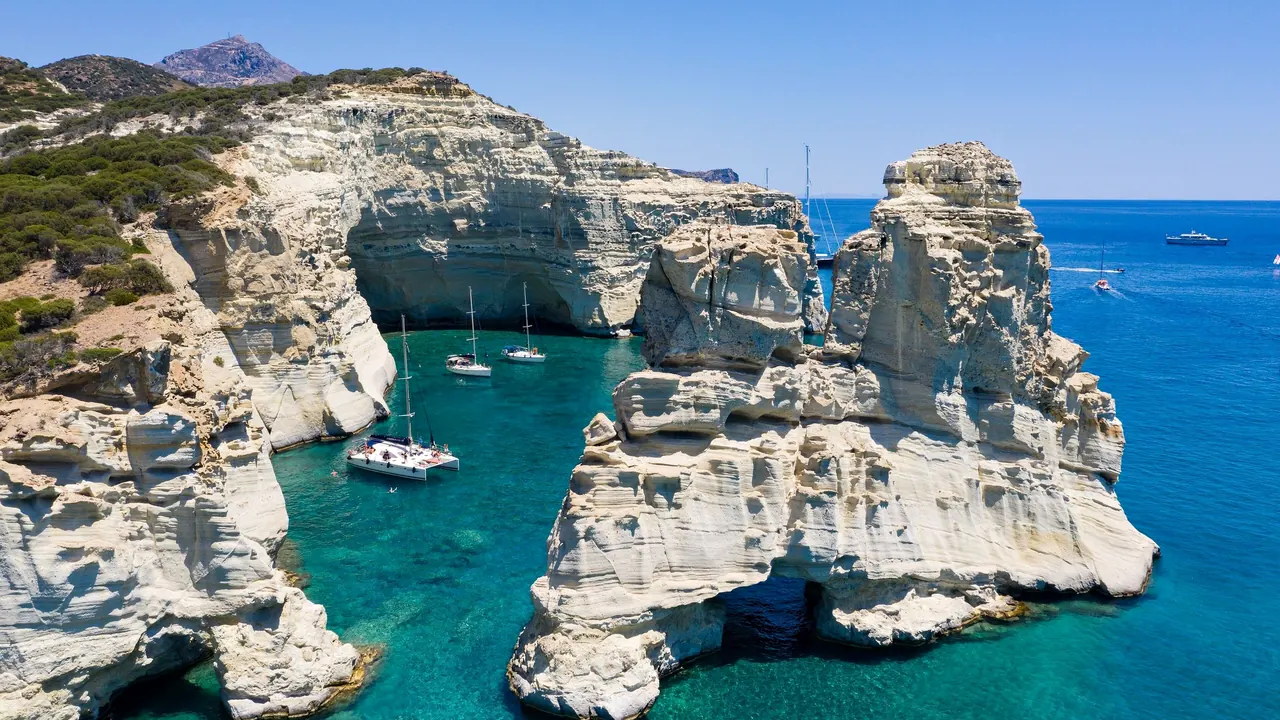
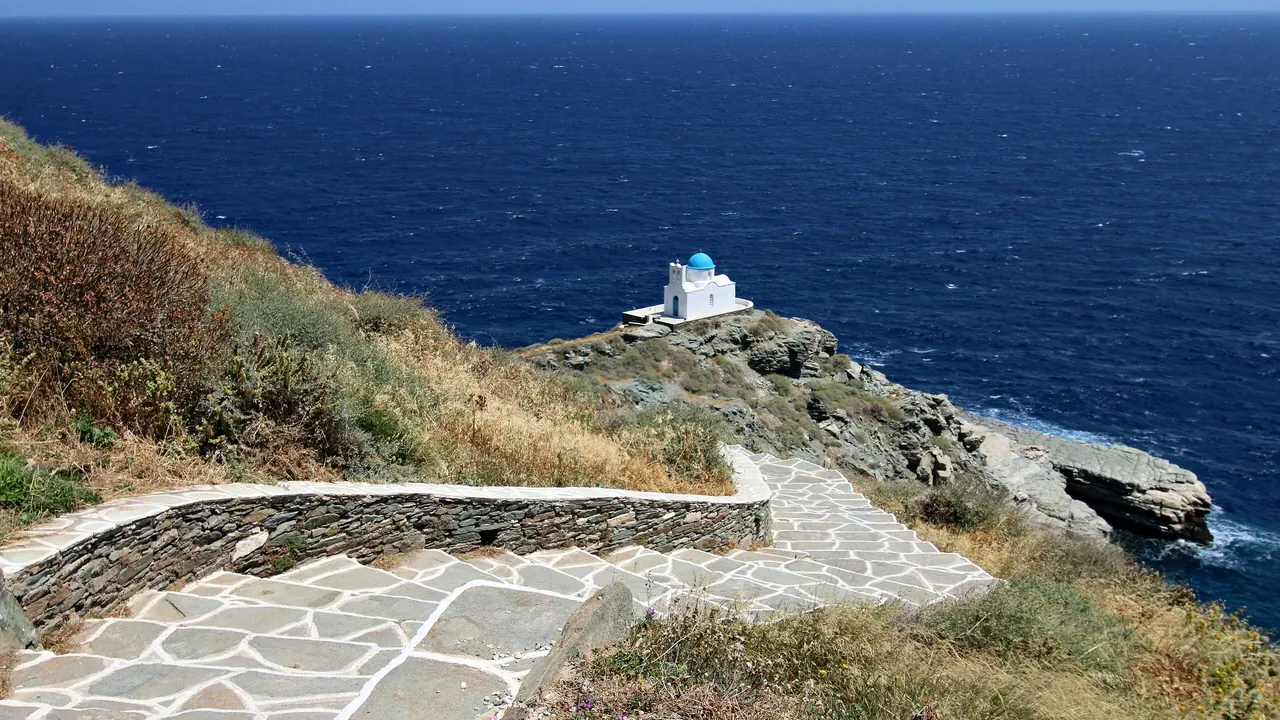
Photos: Milos by dronepicr, CC BY 2.0, cropped; Sifnos by Zde, CC BY-SA 4.0, cropped.
Milos or Sifnos?
Our verdict in twelve categories, each scored against the same fixed benchmark cities, and the climate month by month, so you can choose for your trip.
Choose Milos for
- beaches
- nature and the outdoors
- wellness
Milos is the island for people whose days revolve around the sea. Its volcanic coast gives you white pumice at Sarakiniko, coloured cliffs, boat-only sandy bays on the south coast and the sea caves of Kleftiko, and there are hot springs to soak in at the end of the day. You will want a car or quad and a taste for unequipped beaches, because the best of the island lies at the end of dirt tracks or a boat ride.
Choose Sifnos for
- food and drink
- shopping
- getting around
Sifnos suits travellers who care as much about the table and the walk as about the swim. Its clay-pot cooking is the best reason to eat your way round any Cycladic island, its stone mule paths link villages, monasteries and bays, and the pottery workshops give a stay a thread of craft. The beaches are gentler and easier rather than spectacular, and Apollonia's lanes give the evenings a little more life.
Scoreboard
Twelve categories on one fixed scale from 0 to 100. The shaded stretch is the gap between the two.
Your match
Pick a travel style or drag the sliders, and both match scores follow your weighting.
Wins on beaches and nature and the outdoors with your weighting.
Wins on food and drink and shopping with your weighting.
What matters to you?
Category by category
What the scores mean for a trip.
Beaches & swimming
Milos is the stronger beach island, and clearly so. The volcano has given it sand and rock in white, ochre, red and grey, from the swimming inlets of Sarakiniko to long south-coast sands such as Firiplaka, Tsigrado and Paliochori, some reachable only by boat. Many have no sunbeds or shade, so they feel wild.
Sifnos has fewer and softer beaches: the broad, shallow curve of Platis Gialos, sheltered Vathi, the easy port beach at Kamares and the coves near Faros. They have more facilities and less drama. On both islands the meltemi decides where you swim.
Food & drink
On Milos, food is a pleasant part of the day rather than a reason to come: waterfront fish tavernas in Pollonia and Adamas, grilled octopus in Klima, and local pitarakia cheese pies and ladenia flatbread.
Sifnos is the island to pick if you travel to eat. Its clay-pot tradition gives you revithia baked overnight and mastelo with red wine and dill. You can eat fish in Cheronissos as the boats come in, and Artemonas has long-standing bakeries and sweet shops. Neither island offers much beyond Greek cooking.
Culture & sights
The two are about level, but their heritage takes different forms. Milos has named sites with a story: the early Christian catacombs, the field where the Venus de Milo was found, a marble Roman theatre, Bronze Age Phylakopi and a mining museum tracing obsidian and sulphur.
Sifnos is more about atmosphere, and its villages are the sights. Kastro's houses form its defensive wall, Apollonia and Artemonas have dovecotes and windmills, and Chrysopigi sits on its rock. Hellenistic watchtowers dot the hills. You can see Milos in two days, while Sifnos rewards a slower pace.
Nightlife
Both islands are quiet after dark, with no clubs on either. The difference is where you end up. On Milos the evening is a sunset from Plaka's castle hill, then a drink on the harbour at Adamas, where a few bars stay open late in high summer. On Sifnos, the small cocktail and music bars along Apollonia's pedestrian lane fill up in July and August and stay busy into the early hours.
Nature & outdoors
These are close in quality but suit different ways of getting out. On Milos the drama is on the coast: Kleftiko's rock towers, the coloured cliffs of Papafragas and sea arches, best seen from a sailing boat or kayak. Inland it is dry and scarred by quarries.
On Sifnos the best of it is on foot. Old stone mule tracks run between terraced hillsides, monasteries and bays, and the island can be crossed on foot, with Profitis Ilias giving views across the western Cyclades. Walkers lean to Sifnos, and people who want to explore by boat lean to Milos.
Day trips
Kimolos is the best outing from Milos, a short ferry hop from Pollonia to a fortified village, a few tavernas and very few visitors. In summer the fast boats also put Sifnos about an hour away, while Serifos and Folegandros are better saved for island-hopping.
Sifnos has a little more within reach, and its best day out is Milos itself, an hour away by fast boat for Plaka, the painted boathouses and the catacombs. Serifos and its hilltop chora lie close to the north, and Kimolos can be reached on a boat excursion. On both islands the wind and the ferry timetable have the final say.
Good for families
Both suit simple beach vacations with children, with welcoming tavernas, safe villages and nothing built for kids. On Milos, Pollonia has a sheltered beach in the village and the south-coast sands shelve gently, but many good beaches mean dirt tracks or steep paths, and a car is close to essential. Sifnos keeps distances shorter and has shallow water at Platis Gialos and Kamares, though its stepped village lanes are hard work with a pushchair.
Getting around
Sifnos is the easier island to get around. Summer buses link the port, the main villages and the beaches at Platis Gialos, Faros and Vathi. Footpaths join the villages, and Apollonia is a central base with everything a short drive away.
Milos is larger and less connected. Buses miss most of the coast, the western half is on rough dirt roads some rental agreements exclude, and Kleftiko is a boat trip. Milos is easier to reach, though: it has a small airport with flights from Athens, while Sifnos can only be reached by ferry, which strong winds can disrupt.
Shopping & style
Neither is a shopping destination, but Sifnos gives you more reason to browse. Its potters have worked for centuries, and the workshops around Kamares, Vathi and Platis Gialos sell the clay cooking pots the island's food depends on. Milos has a few linen and jewellery boutiques in Plaka's lanes and souvenir shops in Adamas, so capers, honey and sweets are the most local things to bring home.
Affordability
Summer rooms are the big cost on either island. The real difference is where you can save: on Milos it is the room, on Sifnos the days. Milos has simple rooms in the inland villages and away from the waterfront, and an ordinary taverna meal is fairly priced, but you need a car and the Kleftiko boat trip, and those add up.
On Sifnos the rooms are mostly boutique hotels and stylish rented houses, so cheap lodgings are hard to find. Once you have a bed, though, the buses and the footpaths cost little or nothing, and a day of walking between villages and bays barely touches the budget. June and September bring room prices down on both.
Live music & performing arts
The stage barely exists on either island, and the real music is at the summer panigyria, where village saints'-day feasts end in violin, lute and dancing late into the night. Sifnos makes a little more of it, with feasts held at its many chapels and monasteries and occasional concerts in the villages. On Milos you may catch the odd summer concert at the ancient theatre or in Adamas.
Wellness & relaxation
Both are restful rather than spa islands, but Milos has what Sifnos lacks: volcanic warmth. You can soak in the rustic old baths at Lakkos in Adamas or the springs near Provatas, and feel warm sand at Paliochori. Sifnos has no thermal springs, so its calm comes from car-free village lanes, long lunches and evening walks between Apollonia and Artemonas.
When should you go?
Pick your month. The climate figures are measured averages, not a forecast.
Milos in July
Sifnos in July
Daytime high, °C
Rainfall in the month, mm
Where the figures come from
Milos has no weather station within reach, so its figures come from a gridded climate model rather than a measured record, and read a broad area rather than one spot.
Sifnos has no weather station within reach, so its figures come from a gridded climate model rather than a measured record, and read a broad area rather than one spot.
Temperature and rainfall are climate normals, averaged over the years shown. Milos: 2001-2020 normals, NASA POWER reanalysis grid, no weather station within 90 km. Sifnos: 2001-2020 normals, NASA POWER reanalysis grid, no weather station within 90 km.
The two islands are neighbours and share almost the same weather, so you are choosing between islands, not seasons. On both, swimming runs from June to October, with the sea warming to about 24°C in high summer and staying that warm into September. July and August bring afternoon highs around 27°C and almost no rain, which is fine on the beach but tiring for midday walking, especially on Sifnos's paths and Milos's treeless interior.
April, May and October are the months for walking, with highs around 20°C and the hillsides greener in spring. The rains arrive in late autumn and peak in winter at over 100mm a month on both, when the islands are cool, wet and largely shut down. June and September are the sweet spot on either: warm sea, dry days and fewer people.
Which traveller are you?
On a beach and sun trip, choose Milos. Its volcanic shore gives far more variety, from Sarakiniko's pumice inlets to the long south-coast sands, and the north wind just sends you to the other side of the island rather than ruining the day.
For a food and nightlife trip, Sifnos is the better bet. Its slow-baked revithia, mastelo and manoura cheese make every meal worth looking forward to, and the bar-lined pedestrian lane in Apollonia keeps going later than the quiet harbour in Adamas.
On a shopping trip, Sifnos has the edge thanks to its pottery. Workshops around Kamares and Vathi still make the clay casseroles used in local kitchens, which make far better things to bring home than the few boutiques and souvenir shops on Milos.
Before you go
| Measure | Milos | Sifnos |
|---|---|---|
| Official language | Greek | Greek |
| Currency | Euro (EUR) | Euro (EUR) |
| Sockets | CF230 V, 50 Hz | CF230 V, 50 Hz |
| Driving side | Right | Right |
| Time zone | UTC+2, UTC+3 in summer | UTC+2, UTC+3 in summer |
| Emergency number | 112 | 112 |
| Main airport | Milos Airport (MLO)2 non-stop destinations | Milos Airport (MLO)2 non-stop destinations |
| Public holidays this year | 15 days | 15 days |
By the numbers
| Measure | Milos | Sifnos |
|---|---|---|
| Swim season, months above 21 °C | 5 months | 5 months |
Where else could you go?
Every comparison below shares a destination with this one, so you can follow Milos or Sifnos somewhere new.