Greece
Sifnos
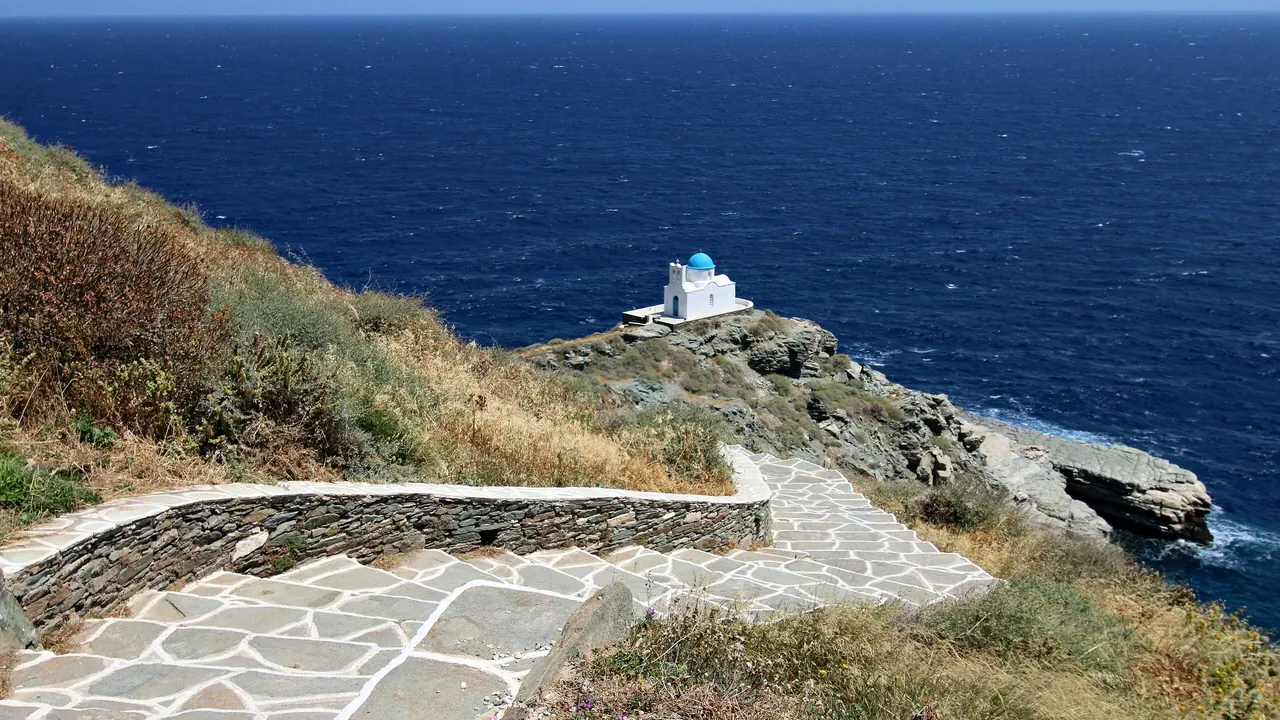
The church of the Seven Martyrs below Kastro
- Beaches77
- Food & drink60
- Nature & outdoors55
Photo: Zde, CC BY-SA 4.0, cropped
Match
44
Every category weighted equally
- Beach & sun49
- Culture & arts40
- Food & nightlife42
- Family trip48
- Outdoors48
- Relax & unwind48
- Shopping & style42
- On a budget43
Sifnos in twelve categories
Our verdict on each, scored 0 to 100 against the same fixed benchmark cities, so a score means the same thing on every page.
Beaches & swimming. Scores 77 out of 100.
Food & drink. Scores 60 out of 100.
Culture & sights. Scores 38 out of 100.
Nightlife. Scores 28 out of 100.
Nature & outdoors. Scores 55 out of 100.
Day trips. Scores 44 out of 100.
Good for families. Scores 48 out of 100.
Getting around. Scores 50 out of 100.
Shopping & style. Scores 32 out of 100.
Affordability. Scores 35 out of 100.
Live music & performing arts. Scores 18 out of 100.
Wellness & relaxation. Scores 42 out of 100.
Sifnos category by category
Beaches & swimming
77Sifnos is a summer swimming island, and most stays are built around a beach. The longest is Platis Gialos on the south coast, a broad curve of fine sand on shallow, clear water. Vathi on the west is a deep, almost enclosed bay where the sea stays calm when the wind blows elsewhere, and Kamares, the port beach, is sandy and easy. Smaller coves cluster around Faros and Glyfo, and the chapel of Chrysopigi sits on a rock between two swimming spots.
The water is clear and warm enough to swim from June to October, reaching about 24°C in August. In July and August the north wind, the meltemi, can make exposed beaches choppy, so a visitor picks a sheltered bay for the day. Beaches are organised in parts but stay low-key, without large resort strips.
Food & drink
60Sifnos has the strongest food reputation in the Cyclades, and eating is a real reason to come. The island gave Greece its most famous cookbook writer and keeps a tradition of slow cooking in local clay pots: revithia, chickpeas baked overnight in a wood oven and eaten on Sunday, and mastelo, lamb or goat cooked with red wine and dill. Manoura, a sheep's cheese aged in wine lees, capers, honey and almond sweets fill out the table.
The tavernas are spread between Apollonia, Artemonas, Kamares, Vathi and the fishing hamlet of Cheronissos, where the catch comes in next to the tables. Artemonas has long-standing bakeries and sweet shops. The range is the island's own cooking and Greek seafood, done well, with a few more ambitious modern kitchens but no wider international scene.
Culture & sights
38The sights are the island's villages and chapels rather than museums. Kastro, on a cliff above the east coast, is a medieval fortified village whose outer houses form the defensive wall, with a small archaeological museum and Venetian-era doorways. Apollonia and Artemonas are classic white Cycladic villages with dovecotes, mansions and windmills, and the monastery of Chrysopigi on its rocky islet is the island's emblem.
Older layers show in the Mycenaean acropolis of Agios Andreas and the ruined Hellenistic watchtowers scattered over the hills, a reminder of the gold and silver mines that once made Sifnos rich. A folk museum in Apollonia and hundreds of chapels complete a modest but rewarding set, best taken slowly over several days.
Nightlife
28Evenings here are about long dinners, then a drink. The main going-out area is the narrow pedestrian lane through Apollonia, where small cocktail and music bars fill up in July and August and stay busy until the early hours. Kamares has a few seafront bars for sunset. There are no real clubs, and outside the peak summer weeks the island is quiet soon after dinner. Visitors after dancing until dawn should look elsewhere in the Cyclades.
Nature & outdoors
55Sifnos is one of the better Cycladic islands for walking. A network of waymarked paths, many of them old stone-paved mule tracks, links the villages, monasteries, watchtowers and bays, and much of the island can be crossed on foot. The highest point, Profitis Ilias, rises to about 680m with a monastery on top and views across the western Cyclades.
The landscape is terraced, dry hillside of thyme, stone walls and olive groves, green in spring and burnt gold by August. Spring and autumn suit hiking best, since summer heat and wind make midday walking hard. On the water there is snorkelling around the rocky coves and boat trips to bays without road access, but the outdoor offer is pleasant rather than spectacular.
Day trips
44Day trips from Sifnos mean other islands, and they depend on the summer ferries. Milos, about an hour away by fast boat, is the best outing, with its hilltop Plaka, fishing villages with painted boathouses and catacombs. Serifos, very close to the north, has one of the most striking hilltop choras in the Cyclades, and little Kimolos is a quiet village island reached from Milos or by boat excursion.
Folegandros is possible on some routes but makes a long day. The list ends there, and in strong wind or outside the main season the connections thin, so most visitors treat a stay on Sifnos as a stay on Sifnos.
Good for families
48Sifnos works for a simple, beach-based family vacation. Platis Gialos, Kamares and Vathi have sand and shallow water that suits small children, the villages are safe and relaxed, and Greek tavernas welcome children late into the evening. Distances are short, so no day involves long drives.
There is nothing built for children, though: no water parks, aquariums or attractions, and the villages are steep, stepped and hard with a pushchair. Summer heat and the ferry crossing from the mainland, which can be rough in the wind, are worth planning around. Families who want entertainment will find it thin; those who want quiet beaches will be content.
Getting around
50Sifnos is small, and once there nothing is far: the main beaches are a short drive from Apollonia, the central village that makes the most practical base. In summer local buses link Kamares, Apollonia, Artemonas, Kastro, Platis Gialos, Faros and Vathi, and the footpaths connect the villages for those who walk. A hired car or scooter makes the remoter coves and monasteries easy, though roads are narrow and parking in villages is tight.
The effort is in arriving. There is no airport, so visitors come by ferry from Piraeus, a journey of a few hours, and strong summer winds sometimes delay or cancel sailings. Inside the villages, lanes are stepped and car-free.
Shopping & style
32The shopping worth knowing about is pottery. Sifnos has been a potters' island for centuries, and workshops around Kamares, Vathi and Platis Gialos still throw the clay casseroles and jugs used in the local kitchen, alongside decorative pieces. Beyond that, the lanes of Apollonia hold a handful of clothing and jewellery boutiques and shops selling capers, honey, cheese and almond sweets to take home. It is a short, pleasant browse rather than a shopping destination.
Affordability
35Sifnos is an upmarket island in summer. Rooms in July and August are expensive and book out early, with much of the accommodation in small boutique hotels and stylish rented houses rather than budget lodgings. Taverna meals cost more than on the mainland, though they remain reasonable for the quality, and buses and hiking are cheap ways to fill a day. June and September bring lower room prices and the same sea.
Live music & performing arts
18There is no formal stage life on Sifnos. What the island does have is the panigyri, the feast held at a chapel or monastery on its saint's day, where a shared meal is followed by traditional violin and lute music and circle dancing that can last all night. These run mostly through the summer, and visitors are welcome to join. Occasional summer concerts in the villages add a little, but anyone wanting theatre or classical music will find almost nothing.
Wellness & relaxation
42Sifnos has no thermal springs or bathing tradition, and spa treatments are limited to a few boutique hotels. Its restorative quality lies in the pace: car-free village lanes, long lunches, early evening walks between Apollonia and Artemonas, and quiet bays where the day has no fixed plan. June and September are the calmest months, when the island is at its most peaceful; in August the villages and main beaches get busy.
Where to stay in Sifnos
Apollonia, the central village, is the most practical base on Sifnos. Buses leave from here for the main beaches and villages, footpaths start at the edge of the village, and its pedestrian lane holds the island's evening bars. That makes it a good choice for a first visit, for walkers without a car and for anyone who wants a drink after dinner. Artemonas, a short walk north, is the calmer option, with old mansions, windmills and long-standing bakeries. It suits couples and food lovers who like to stroll to dinner.
If the trip is mostly about the sea, stay on the coast. Platis Gialos has the longest sandy beach and shallow water, so it is the easiest base for families with small children. Kamares, the port, has a sandy beach, pottery workshops and a few seafront bars for sunset, and it is handy for ferry days. Vathi, on the west coast, is the quiet choice. Its enclosed bay stays calm when the meltemi blows, there are a few tavernas and not much else, and it works best with a car or scooter.
Sifnos is small, so one base covers the whole stay and you never need to move. In July and August, choose your base early, because rooms book out well ahead.
When should you go?
Pick a month to see what it is like. The climate figures are measured averages, not a forecast.
Sifnos in July
Daytime high, °C
Rainfall in the month, mm
The whole year
Shaded against this destination’s own year: the deepest cell is its best month for that figure and the palest its weakest.
Where the figures come from
Sifnos has no weather station within reach, so its figures come from a gridded climate model rather than a measured record, and read a broad area rather than one spot.
Temperature and rainfall are climate normals, averaged over the years shown. Sifnos: 2001-2020 normals, NASA POWER reanalysis grid, no weather station within 90 km.
Before you go
| Measure | Sifnos |
|---|---|
| Official language | Greek |
| Currency | Euro (EUR) |
| Sockets | CF230 V, 50 Hz |
| Driving side | Right |
| Time zone | UTC+2, UTC+3 in summer |
| Emergency number | 112 |
| Main airport | Milos Airport (MLO)2 non-stop destinations |
| Public holidays this year | 15 days |
By the numbers
| Measure | Sifnos |
|---|---|
| Swim season, months above 21 °C | 5 months |
Compare Sifnos with
Every comparison with a written verdict behind it.
- Aegina
- Corfu
- Crete
- Folegandros
- Halkidiki
- Hydra
- Ios
- Kefalonia
- Kos
- Lefkada
- Milos
- Mykonos
- Naxos
- Paros
- Paxos
- Peloponnese
- Rhodes
- Samos
- Santorini
- Skiathos
- Skopelos
- Thassos
- Zakynthos