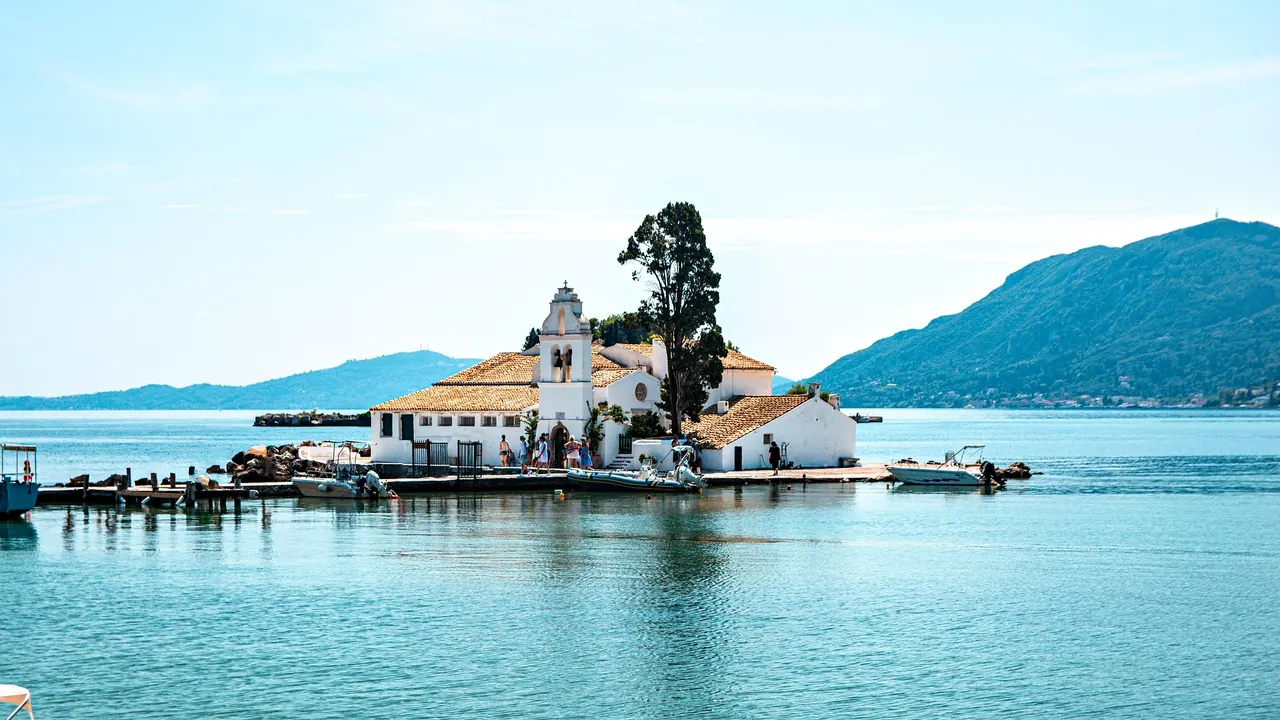
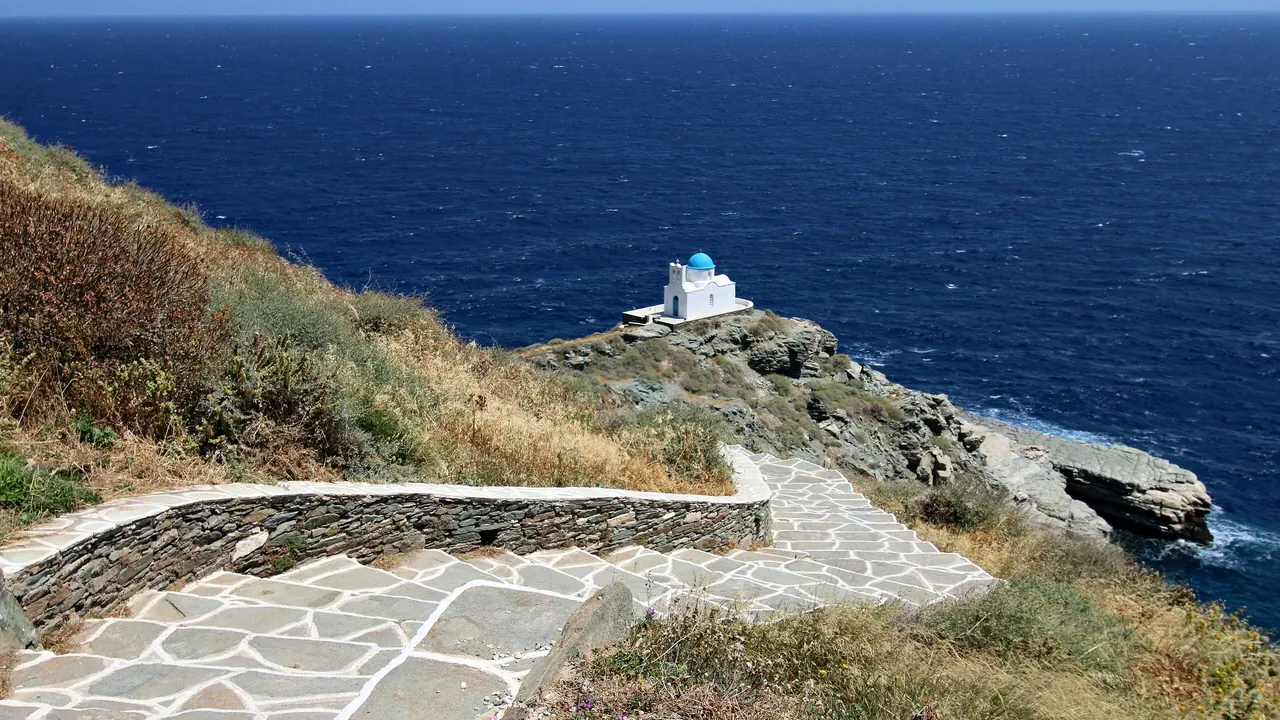
Photos: Corfu by Nico Hartnauer, Pexels License; Sifnos by Zde, CC BY-SA 4.0, cropped.
Corfu or Sifnos?
Our verdict in twelve categories, each scored against the same fixed benchmark cities, and the climate month by month, so you can choose for your trip.
Choose Corfu for
- nightlife
- culture and sights
- families
Corfu suits travellers who want an island with more than one side to it. You get a Venetian old town with fortresses and museums, long west-coast sands and quiet pebble bays, gently shelving beaches for small children, and boat trips to Paxos or across to Albania. It also costs less in most places, and its evenings range from cocktails under the Liston to all-night Kavos. You give up some peace and will probably need a car.
Choose Sifnos for
- getting around
- food and drink
Sifnos is the better pick for a slow, small-scale Cycladic stay built around food, walking and a handful of good beaches. The island is compact, car-free in its village lanes and free of resort strips, and its clay-pot cooking draws visitors in its own right. There is little to see and less to do after dinner, though, and it is dearer in summer and only reached by ferry. It rewards people who want very little to happen.
Scoreboard
Twelve categories on one fixed scale from 0 to 100. The shaded stretch is the gap between the two.
Your match
Pick a travel style or drag the sliders, and both match scores follow your weighting.
Wins on nightlife and culture and sights with your weighting.
Wins on getting around and food and drink with your weighting.
What matters to you?
Category by category
What the scores mean for a trip.
Beaches & swimming
Both islands are built for swimming, and the difference is mostly in scale and style. Corfu has more range: the long sandy beaches of the west coast at Glyfada and Agios Gordios, the dune-backed sands of Issos, clear coves under the cliffs at Paleokastritsa and calm pebble bays in the northeast, plus boat trips to the turquoise water of Antipaxos. The price is crowding near the busiest resorts in high summer.
Sifnos has fewer beaches, but they are low-key, with no resort strips. Platis Gialos is a broad curve of fine sand and Vathi an almost enclosed bay, and the chapel of Chrysopigi stands between two swimming spots. In July and August the meltemi roughs up exposed shores, so you choose your bay by the wind.
Food & drink
The two islands eat about equally well, but in very different ways. Corfu's cooking carries its Venetian past, with pastitsada, sofrito and a fiery bourdeto, plus kumquat liqueur and the ginger beer left by British rule. The good meals are in Corfu Town's back lanes and inland villages, because the resorts lean towards package menus.
Sifnos treats food as a reason to come. Its tradition is slow cooking in clay pots: revithia baked overnight for Sunday, mastelo with wine and dill, and manoura cheese aged in wine lees. You will find it in tavernas from Apollonia to the harbour at Cheronissos, and the standard is more even across the island.
Culture & sights
This is one of the widest gaps between them. Corfu Town is a UNESCO-listed Venetian old town of tall houses and kantounia lanes, framed by the Old and New Fortresses. It has the Liston and Spianada, Agios Spyridon, a museum of Asian art and the Gorgon pediment in the Archaeological Museum. Beyond town you can visit the Achilleion and the cliff-top ruins of Angelokastro.
Sifnos offers a quieter set: the fortified cliff village of Kastro, the white villages of Apollonia and Artemonas, the monastery of Chrysopigi and scattered Hellenistic watchtowers from its mining past. It is pleasant to explore over a few slow days, but not a sightseeing destination like Corfu.
Nightlife
Corfu has far more after dark, and it is sorted by place. Kavos at the southern tip is a full party resort that goes on until dawn, Ipsos and Dassia have a mixed run of beach bars, and Corfu Town offers cocktails under the Liston arcades and bars in its old lanes.
On Sifnos the evening is a long dinner followed by a drink in the small bars along Apollonia's pedestrian lane, which only get lively in July and August. There are no clubs, and for most of the season the island goes quiet soon after eating.
Nature & outdoors
Both are good islands for walking, but the landscapes could hardly look more different. Corfu is green with olive groves and cypresses, rises to Mount Pantokrator and its abandoned stone villages, and has the Corfu Trail running its whole length. It also adds sea caves for diving off Paleokastritsa and birdwatching at the Korission lagoon.
Sifnos is dry, terraced hillside of thyme and stone walls, burnt gold by August. Its waymarked network of old mule tracks links villages, monasteries and bays so closely that you can cross much of the island on foot. On both, midsummer heat pushes serious walking into spring and autumn.
Day trips
Corfu gives you the wider choice of days out, and some of them leave Greece altogether. Paxos and the bays of Antipaxos make an easy island day, a short crossing to Saranda opens up the ruins of Butrint in Albania, and excursions run to Parga and Sivota on the Greek mainland.
From Sifnos, the outings are other Cycladic islands: Milos with its Plaka and painted boathouses, nearby Serifos and its hilltop chora, and little Kimolos. All of them depend on summer ferries and calm seas, so many visitors simply stay put.
Good for families
Corfu is the easier family choice. Roda, Acharavi, Sidari and the sands of Issos shelve gently into calm water, many resorts are built around pools and kids' clubs, and there is a water park, pirate-style boat trips and fortresses for older children. Just keep clear of Kavos and Ipsos.
Sifnos suits a simple beach stay at Platis Gialos, Kamares or Vathi, where short distances mean no long drives. But it has nothing made for children, the stepped villages are hard going with a pushchair, and the ferry from the mainland can be rough.
Getting around
Once you have arrived, Sifnos is the easier island to get around. It is small, Apollonia is a central base within a short drive of the main beaches, summer buses link the villages and bays, and footpaths connect the villages for those who walk. The catch is getting there: there is no airport, and the ferry from Piraeus takes a few hours and can be held up by wind.
Corfu has its own airport, but the island is about 60km long and its green buses run too rarely to rely on. Most visitors hire a car for the narrow, twisting roads of the north and west, and summer traffic around town is heavy.
Shopping & style
Neither island is a shopping destination, and what you bring home differs. In Corfu Town's old lanes and around Nikiforou Theotoki you will find olive-wood bowls, kumquat liqueur, olive oil and local soaps, with ordinary Greek chains in the newer streets. Sifnos is about pottery: workshops around Kamares and Vathi still throw the clay casseroles used in its kitchens, and Apollonia has a few boutiques and stalls of capers and honey.
Affordability
Corfu is noticeably kinder to the wallet. Its package resorts on the north and east coasts offer reasonable rooms and tavernas, and only the villa coast around Kassiopi and Corfu Town in midsummer are markedly dearer. Car hire is the main extra.
Sifnos is upmarket in summer, with boutique hotels and stylish houses that fill early and few budget beds. Buses and hiking cost little, and June or September bring lower room prices with the same sea.
Live music & performing arts
Corfu has the richer musical life, thanks to Venice. Historic philharmonic bands play in the Spianada and village squares, accompany the Easter processions, and kantades serenades survive in tavernas, with some classical evenings in the Old Fortress.
Sifnos has no formal stage at all. Its music is the panigyri, a saint's-day feast at a chapel with violin, lute and circle dancing late into the night, which is memorable if you catch one.
Wellness & relaxation
Neither has a bathing tradition, so on both islands relaxation comes from the pace rather than from spas. On Corfu that means picking a hill village or the quiet northeast coast over the busy resort strips. On Sifnos the whole island is small-scale, with car-free lanes, evening walks between Apollonia and Artemonas, and the calmest weeks in June and September.
When should you go?
Pick your month. The climate figures are measured averages, not a forecast.
Corfu in July
Sifnos in July
Daytime high, °C
Rainfall in the month, mm
Where the figures come from
Sifnos has no weather station within reach, so its figures come from a gridded climate model rather than a measured record, and read a broad area rather than one spot.
Temperature and rainfall are climate normals, averaged over the years shown. Corfu: 1991-2020 normals, Kerkyra Airport (0.9 km from centre). Sifnos: 2001-2020 normals, NASA POWER reanalysis grid, no weather station within 90 km.
Corfu runs the hotter of the two in high summer. Its highs reach about 32°C in July and August, which makes midday walking in the old town or the hills tiring, and the sea warms to about 26°C. Summers there are long and very sunny, but the rain returns in September, is heavy by October and peaks at about 188mm in November. Late May, June and September are the most comfortable months for mixing the beach with sightseeing.
Sifnos stays milder, topping out around 27°C, and from June to August it barely rains at all. The sea is a little cooler, about 24°C in August, but holds that warmth into September and stays swimmable into October. Spring and autumn are drier there than on green, wetter Corfu, so April, May and October suit walking on Sifnos well. Winter is cool and damp on both.
Which traveller are you?
On a culture and arts trip, Corfu is the clear choice. Its UNESCO-listed old town, two fortresses, the Asian art and archaeological museums, the Achilleion and its philharmonic bands give you far more than the villages, chapels and small museums of Sifnos.
On a family trip with children, Corfu works better. Its north coast and southern sands shelve gently, many resorts have pools and kids' clubs, and there is a water park and boat trips. Sifnos has calm beaches but nothing built for children, and steep stepped villages.
On a trip on a tight budget, Corfu goes further. The big package resorts on the north and east coasts have fairly priced rooms and tavernas. Summer on Sifnos means boutique hotels and stylish houses that book out early, with few budget beds.
Before you go
| Measure | Corfu | Sifnos |
|---|---|---|
| Official language | Greek | Greek |
| Currency | Euro (EUR) | Euro (EUR) |
| Sockets | CF230 V, 50 Hz | CF230 V, 50 Hz |
| Driving side | Right | Right |
| Time zone | UTC+2, UTC+3 in summer | UTC+2, UTC+3 in summer |
| Emergency number | 112 | 112 |
| Main airport | Corfu Ioannis Kapodistrias International Airport (CFU)88 non-stop destinations | Milos Airport (MLO)2 non-stop destinations |
| Public holidays this year | 15 days | 15 days |
By the numbers
| Measure | Corfu | Sifnos |
|---|---|---|
| Population | 100,854 | - |
| People per km² | 161 | - |
| Swim season, months above 21 °C | 5 months | 5 months |
Where else could you go?
Every comparison below shares a destination with this one, so you can follow Corfu or Sifnos somewhere new.