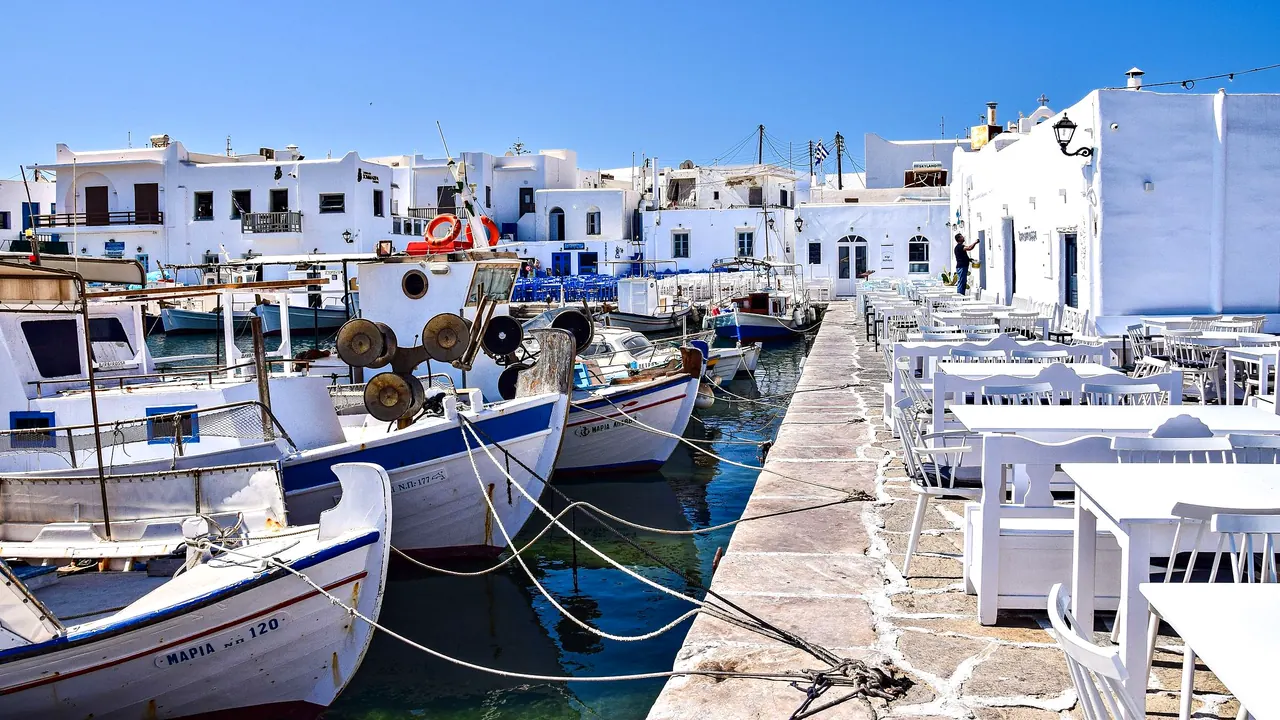
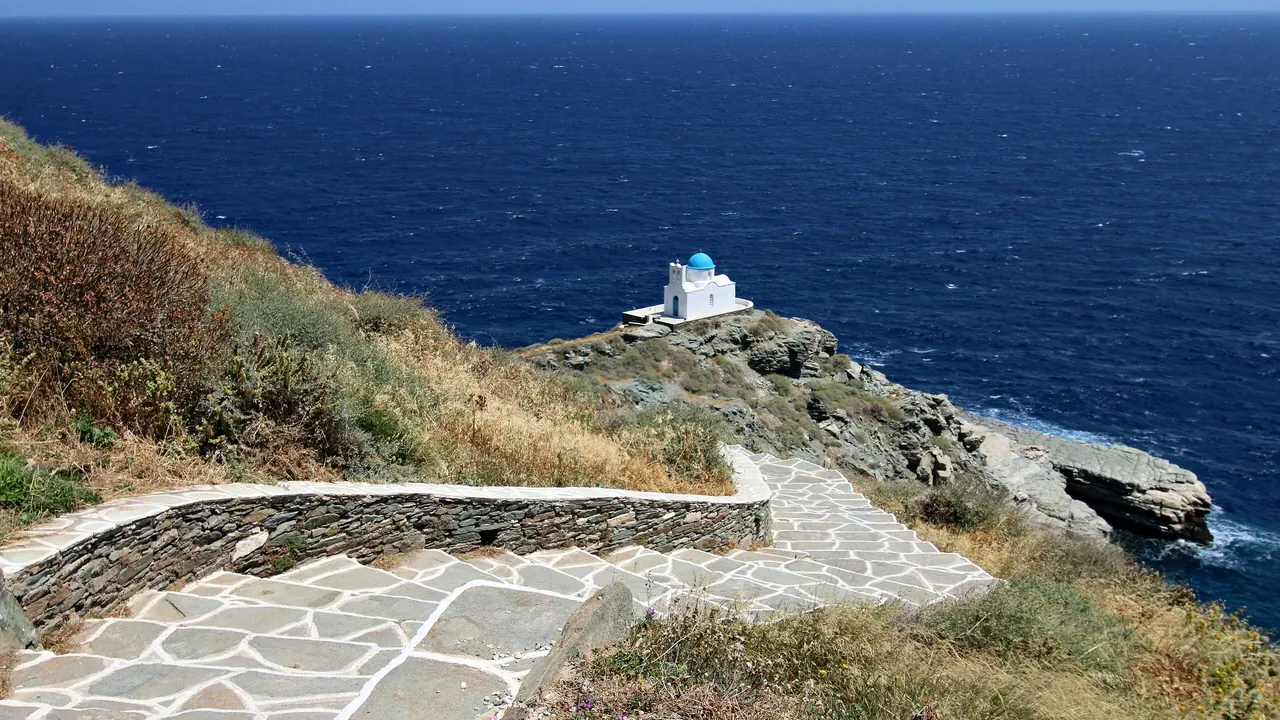
Photos: Paros by AXP Photography, Pexels License; Sifnos by Zde, CC BY-SA 4.0, cropped.
Paros or Sifnos?
Our verdict in twelve categories, each scored against the same fixed benchmark cities, and the climate month by month, so you can choose for your trip.
Choose Paros for
- nightlife
- day trips
- culture and sights
Paros is the better pick for a summer that mixes beaches with a bit of everything else. It has more sandy bays, and the meltemi coasts give you good windsurfing. Naoussa's harbour bars keep going past midnight, and the ferry links to Naxos, Antiparos and beyond are better. Choose it if you want lively evenings, a choice of outings and enough to keep children or restless companions busy for a week or more.
Choose Sifnos for
- nature and the outdoors
- live music and the arts
- wellness
Sifnos is for travellers who want the island itself rather than a base for seeing others. Its old stone paths link villages, monasteries and bays, so walking is the main activity outside the beach. Evenings are long dinners in Apollonia, and the nights are quiet. It suits couples and walkers who are happy to stay put, and those who would rather have a slower pace than a busy programme.
Scoreboard
Twelve categories on one fixed scale from 0 to 100. The shaded stretch is the gap between the two.
Your match
Pick a travel style or drag the sliders, and both match scores follow your weighting.
Wins on nightlife and day trips with your weighting.
Wins on nature and the outdoors and live music and the arts with your weighting.
What matters to you?
Category by category
What the scores mean for a trip.
Beaches & swimming
Paros has the slightly stronger beach offer, mainly because it has more of them. Kolymbithres has its granite boulders, there are longer stretches of sand at Santa Maria and Lageri, and the wide, gently shelving bays around Golden Beach and Drios add more. When the meltemi blows, there is usually a sheltered coast to retreat to, and Antiparos is just across the water if you want quieter coves.
Sifnos has fewer beaches, but they are good ones. Platis Gialos is a long curve of fine sand, and Vathi is an almost enclosed bay that stays calm in a north wind. Both islands' beaches are sandy and have the same warm sea. On Sifnos they stay low-key, with nothing like the busier stretches of Paros.
Food & drink
The two islands eat equally well, but in different ways. Sifnos has the reputation: it is the home of the clay-pot cooking that runs through Cycladic kitchens, with revithia baked overnight for Sunday, lamb mastelo with wine and dill, and manoura cheese aged in wine lees. Many people make eating there the purpose of the trip, from the bakeries of Artemonas to fish at Cheronissos.
Paros offers more settings and more wine. You can eat octopus at the harbour in Naoussa or home cooking in Lefkes and Marpissa, and drink local Monemvasia and Mandilaria at the wineries. Naoussa also has more polished modern Greek kitchens if you want a change from the taverna.
Culture & sights
Paros has the one major monument of the two, the Ekatontapiliani in Parikia, an early Christian church with its baptistery still in place. Around it are the old town's castle, built from reused marble, and the ancient quarries at Marathi that supplied sculptors in the classical age.
Sifnos has no comparable single sight. Its heritage is spread across the landscape: the cliff-top fortified village of Kastro, the Mycenaean acropolis at Agios Andreas, watchtowers left from its mining past, and the chapel of Chrysopigi on its rock. It rewards slow exploring rather than a sightseeing day.
Nightlife
On Paros, you can go out properly in summer. Naoussa's harbour and lanes fill with cocktail bars until well after midnight, Parikia's seafront has late clubs for a younger crowd, and some beach bars hold parties. It is still not a party island, but there is a choice of where to go.
Sifnos has one lane of bars through Apollonia, busy in July and August, and a few sunset spots in Kamares. There are no clubs, and after the peak weeks evenings end soon after dinner.
Nature & outdoors
Sifnos is the better island for walking. Its network of waymarked, stone-paved mule tracks lets you cross much of it on foot, and Profitis Ilias rises to about 680m, with a monastery on top and views over the western Cyclades.
Paros has fewer walks: the Byzantine path from Lefkes to Prodromos and the trails at Agios Ioannis Detis. Its strength outdoors is the wind, which makes Golden Beach, New Golden Beach and Pounta serious windsurfing and kitesurfing spots, with boat trips around Antiparos as well.
Day trips
Paros sits at the centre of the Cyclades ferry routes, and that shows in its outings. Antiparos and its cave are a short crossing away, and Naxos with its Portara is under an hour by fast boat. Mykonos, Ios, Delos and Santorini are all possible in summer, even if the last two make long days.
From Sifnos the main outings are Milos and Serifos, both good, with Kimolos as a quieter extra. Beyond those the list ends quickly, so you are more likely to stay on the island.
Good for families
Paros gives families more choice of shallow, sandy water. Children can paddle at Livadia near Parikia and at Golden Beach, and the bays around Logaras and Piso Livadi on the east coast are just as easy. Parikia or those east-coast villages make a calmer base than the crowded lanes of Naoussa in August.
Sifnos has fewer such beaches, though Platis Gialos, Kamares and Vathi all suit small children, and no day involves a long drive. Its villages are steep and stepped, which is hard going with a pushchair, and the ferry from Piraeus can be rough in the wind. Neither island has anything built for children beyond the sea, so on both the vacation rests on the beach.
Getting around
Once you have arrived, the two are much alike: small islands with summer buses to the main villages and beaches, and a hired car or scooter for the remoter coves. Paros has the wider bus network out of Parikia and better roads, plus small boats across the bay from Naoussa.
The bigger difference is in getting there. Paros has a small domestic airport and is a main ferry hub. Sifnos has no airport and is reached by a ferry of a few hours from Piraeus, which a strong meltemi can delay. On the island, Sifnos makes up for some of this with footpaths between villages that are genuinely practical for getting about.
Shopping & style
Shopping is modest on both islands, but they sell different things. Paros has more boutiques, with linen, resort wear, sandals and Greek designer jewellery along Naoussa's lanes and Parikia's market street, though prices in Naoussa run high.
Sifnos has its potters. Workshops near Kamares, Vathi and Platis Gialos still make the clay casseroles used in local kitchens, which are the best thing to take home, along with capers, cheese and almond sweets from Apollonia.
Affordability
Both islands are expensive in July and August, and in both cases June and September bring prices down while the sea stays warm. The difference is in what you can find to save money. Paros has simpler rooms in Parikia, the east-coast villages and inland, so a careful budget can work.
Sifnos is upmarket in a different way. Much of its accommodation is in boutique hotels and rented houses, and rooms sell out early. Its tavernas give good value for the quality, though, and walking costs nothing.
Live music & performing arts
Neither island has much formal performance. What both offer is the village feast day, with island violin and lute music and dancing. On Sifnos the panigyri at a chapel or monastery can last all night, and visitors are welcome to join in.
Paros has two larger events: the mid-August feast of the Virgin at the Ekatontapiliani and Naoussa's pirate-raid re-enactment with fireworks. There are also a few bars with live sets.
Wellness & relaxation
The two islands are about equally restful, and neither has a bathing tradition, so the difference is in how you find the calm. On Paros you choose it by picking your base. Stay away from Naoussa in August and in the inland villages of Lefkes and Marpissa or on the south-east coast instead. If you want something more structured, there are hotel spas and a few yoga and retreat centres, and Antiparos across the strait makes a gentler evening out.
On Sifnos the calm belongs to the island as a whole rather than to certain corners of it. Apollonia and the main beaches fill up in August, but there is no resort town to steer around. Treatments are harder to find than on Paros, so resting here is less about the spa and more about strolling between the villages at dusk and spending unplanned days in a sheltered bay. On both islands, June and September are calmer than high summer.
When should you go?
Pick your month. The climate figures are measured averages, not a forecast.
Paros in July
Sifnos in July
Daytime high, °C
Rainfall in the month, mm
Where the figures come from
Paros's temperatures are measured 82 km from the centre, at Santorini Island / Monólithos.
Paros has no rain gauge within 25 km of the centre, so its rainfall comes from a gridded climate dataset read at the destination rather than from a gauge further away.
Sifnos has no weather station within reach, so its figures come from a gridded climate model rather than a measured record, and read a broad area rather than one spot.
Temperature and rainfall are climate normals, averaged over the years shown. Paros: 2000-2025, 12 years observed (rainfall 1991-2020) normals, Santorini Island / Monólithos (81.8 km from centre). Sifnos: 2001-2020 normals, NASA POWER reanalysis grid, no weather station within 90 km.
Both islands are summer swimming places, with the sea warm enough from June to October and reaching 24°C in August. Sifnos keeps that warmth through September. From June to August almost no rain falls on either. Paros gets hotter, with afternoons around 30°C in July and August, while Sifnos stays nearer 27°C. On Paros that heat makes the middle of the day a time for the beach or a siesta rather than the lanes of Parikia.
The difference shows most outside summer. Sifnos is noticeably wetter from October to March, with up to 107mm in December, against a drier Paros. For walking on Sifnos, April, May and the start of autumn are best, with mild afternoons around 20°C and the hills still green in spring. September suits both islands well: the sea is still warm and the heat has eased.
Which traveller are you?
For a food and nightlife trip, Paros is the clear choice. Both islands eat equally well, but only Paros has a real night out. Naoussa's harbour cocktail bars and the later clubs on Parikia's seafront keep going well past the hour when Sifnos has gone to bed.
On an outdoors trip, Sifnos is the better island for walkers. Waymarked mule tracks cross it from village to monastery to bay, and you can climb Profitis Ilias. Paros has fewer good walks, though anyone who comes to windsurf or kitesurf should choose Paros instead.
On a family trip with young children, Paros has the edge. It has more shallow sandy bays, flatter villages that are easier with a pushchair, and day boats to Antiparos and its cave. The steep, stepped lanes of Sifnos and its thinner choice of outings make a long stay harder with small children.
Before you go
| Measure | Paros | Sifnos |
|---|---|---|
| Official language | Greek | Greek |
| Currency | Euro (EUR) | Euro (EUR) |
| Sockets | CF230 V, 50 Hz | CF230 V, 50 Hz |
| Driving side | Right | Right |
| Time zone | UTC+2, UTC+3 in summer | UTC+2, UTC+3 in summer |
| Emergency number | 112 | 112 |
| Main airport | Paros National Airport (PAS)5 non-stop destinations | Milos Airport (MLO)2 non-stop destinations |
| Public holidays this year | 15 days | 15 days |
By the numbers
| Measure | Paros | Sifnos |
|---|---|---|
| Population | 13,715 | - |
| People per km² | 71 | - |
| Swim season, months above 21 °C | 5 months | 5 months |
Where else could you go?
Every comparison below shares a destination with this one, so you can follow Paros or Sifnos somewhere new.