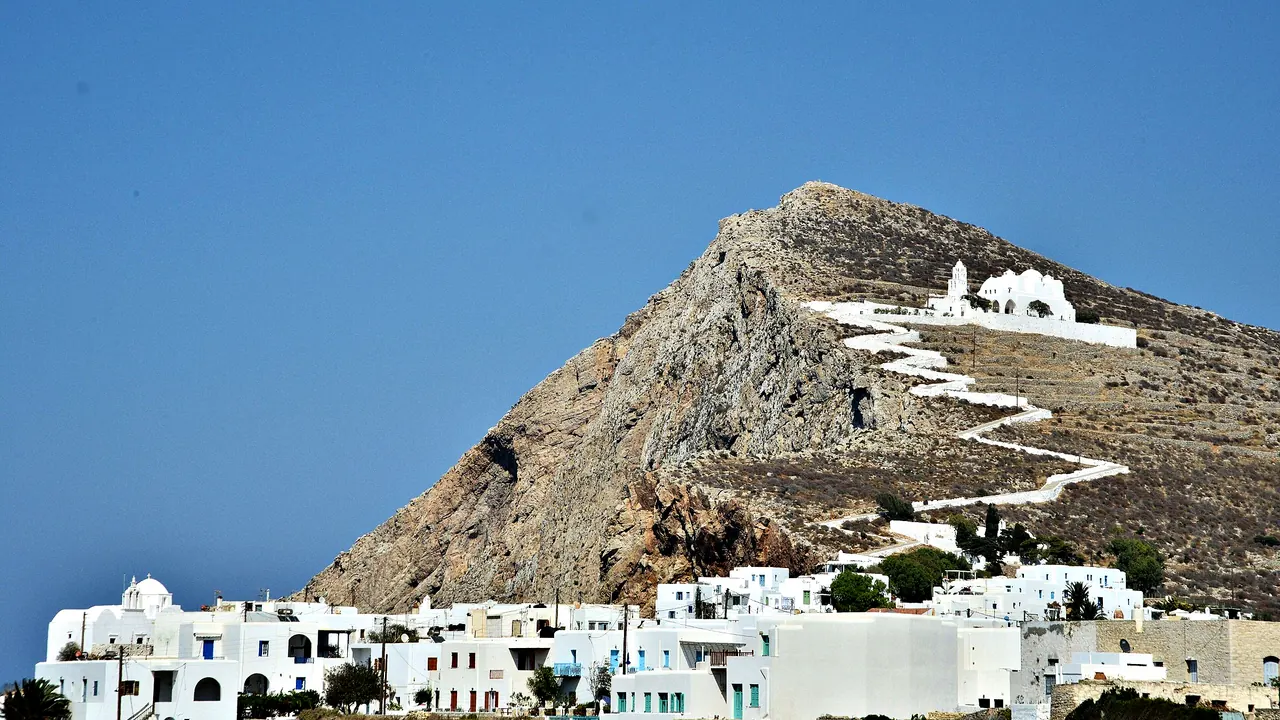
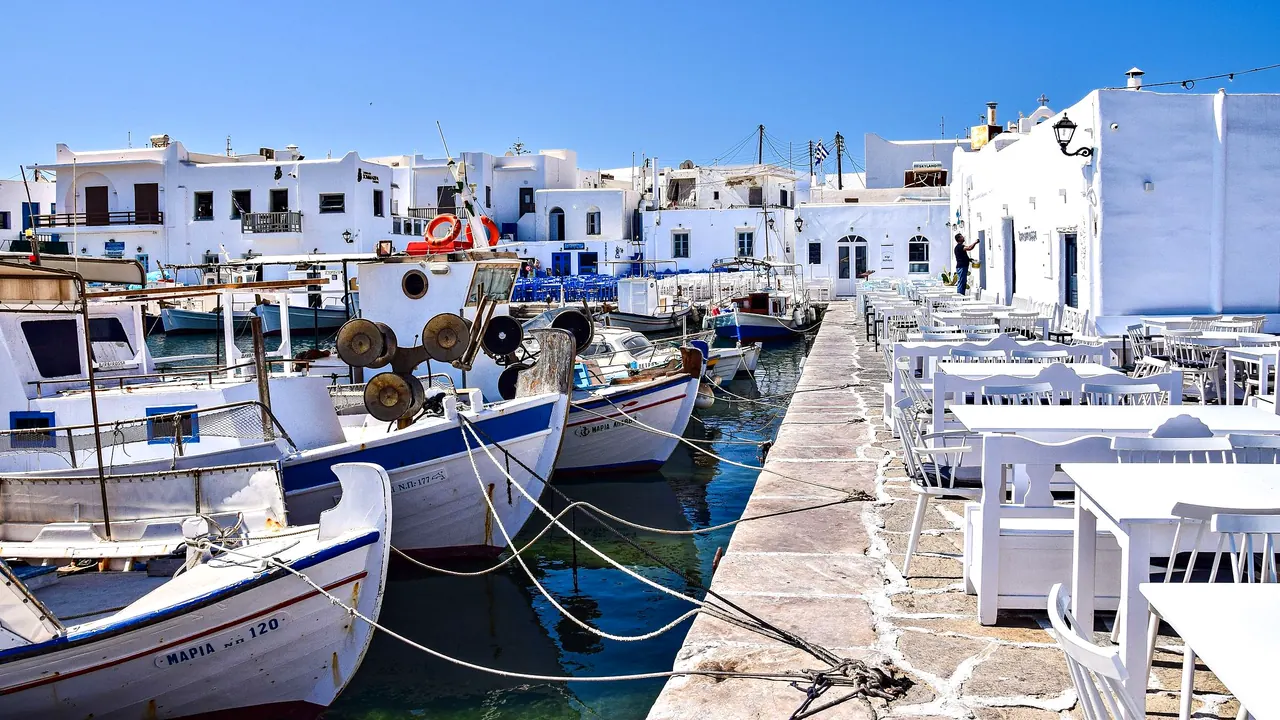
Photos: Folegandros by Chris Kar, CC BY-SA 4.0, cropped; Paros by AXP Photography, Pexels License.
Folegandros or Paros?
Our verdict in twelve categories, each scored against the same fixed benchmark cities, and the climate month by month, so you can choose for your trip.
Choose Folegandros for
- nature and the outdoors
- prices
Folegandros is for travellers who want very little to happen. It is one cliff-top village, a ridge of footpaths and a set of shingle coves you often have to walk or sail to. There are no clubs, few shops and not many outings, and that is exactly why people come. It suits couples and walkers who are happy to stay on one island, eat in the same squares each night and spend the days between a cove and a long rest.
Choose Paros for
- nightlife
- day trips
- families
Paros gives you more of everything, and it is the easier island for most trips. Its sandy bays are easier to reach and gentler for children. Its tavernas and wineries offer more choice, Naoussa's harbour stays busy after midnight, and ferries reach Antiparos and Naxos in time to be back for dinner. Pick it for a first trip to the Cyclades, a family beach stay, or a week that mixes swimming with evenings out and other islands.
Scoreboard
Twelve categories on one fixed scale from 0 to 100. The shaded stretch is the gap between the two.
Your match
Pick a travel style or drag the sliders, and both match scores follow your weighting.
Wins on nature and the outdoors and prices with your weighting.
Wins on nightlife and day trips with your weighting.
What matters to you?
Category by category
What the scores mean for a trip.
Beaches & swimming
Paros has the stronger beaches and the easier ones. Sandy bays ring the island, from the granite coves of Kolymbithres to the long sands of Santa Maria and the wide, gently shelving Golden Beach, and buses or a short drive reach most of them. When the meltemi blows, you can simply cross to the calmer south or west coast, or take the boat to Antiparos.
Folegandros gives you less sand and more effort. Its coves are mostly shingle under bare cliffs, with very clear water. Beyond Agali, Livadi and the bays near the port, getting down is part of the outing, and the best of them, Katergo, means a boat or a rough walk with no shade at the end.
Food & drink
Paros has more range: octopus drying along Naoussa's harbour, chickpeas baked in clay, its own wines from Monemvasia and Mandilaria grapes, and a few polished modern restaurants alongside cheaper home cooking in Lefkes and Marpissa.
Folegandros is smaller but has dishes of its own worth seeking out, such as matsata pasta with rooster or rabbit, soft souroto cheese and watermelon pie. You will mostly eat them in Chora's shaded squares, where you dine most nights because there are few other places to go. On both islands, choice drops sharply once summer ends.
Culture & sights
Neither island makes a sightseeing trip, but Paros has more to see. The Ekatontapiliani in Parikia, one of the oldest surviving churches in Greece, is a real landmark, and around it sit an archaeological museum, a Frankish castle built from ancient marble, Naoussa's Venetian fort and the quarries at Marathi that supplied Parian marble for classical sculpture.
On Folegandros the village itself is the sight. The Kastro quarter in Chora, whose outer houses form the defensive wall, and the zigzag climb to the Panagia church are memorable, and the folklore museum at Ano Meria adds an hour. Most visitors cover the lot in an afternoon.
Nightlife
Paros is where you go out. In high summer Naoussa's harbour and lanes fill with well-dressed people at cocktail bars until late. Parikia's seafront is looser and younger, with a few clubs, and beach bars on the coast hold parties, yet the island never turns into a party island.
Folegandros keeps its evenings low-key on purpose. There are no clubs, just Chora's squares after dinner and a handful of small bars on the cliff edge, a few playing music late in July and August.
Nature & outdoors
Folegandros has the more striking landscape: a narrow ridge of bare rock with sheer cliffs above the sea, terraces and juniper, and almost no trees. Its waymarked footpaths make walking the main thing to do, and boats run to sea caves such as Chrysospilia.
Paros is gentler, with low hills sloping to an indented coast. Its walking comes down to the Byzantine path from Lefkes to Prodromos and the headland at Agios Ioannis Detis. Its strength is the wind, which makes Golden Beach and Pounta first-rate for windsurfing and kitesurfing.
Day trips
Paros sits at the centre of the ferry network. Antiparos and its cave are a short hop, Naxos's Chora and Portara gateway make an easy day, and in summer boats reach Mykonos, Ios, Sifnos, Delos and Santorini.
From Folegandros, a day trip is the exception. Sikinos is close, and Milos or Santorini can be done on fast summer boats, but timetables are thin and the north wind cancels crossings. Most people who want a second island move on to it.
Good for families
Folegandros suits older children who like swimming and walking more than toddlers. Families come for the quiet and for Chora's car-free lanes, which make an easy evening stroll. Beyond Livadi, the bays near Karavostasis and Agali with its tavernas, though, a beach day takes planning, and the summer wind calls for care along the cliff edge.
Paros is the better island for a family, mainly because of the water. Much of its coast shelves gently into sand, so small children can paddle safely at places such as Piso Livadi, and buses or a short drive reach these bays without a hike. A base in Parikia or the east-coast villages keeps the days simple, and children are welcome at taverna tables late into the evening. It has no zoo or theme park, but with beaches this easy, few families miss one.
Getting around
Paros is easier to get around. Its summer bus network fans out from Parikia to Naoussa, Lefkes and the main beaches, small boats cross the bay to Kolymbithres, and good roads make a hired car worth having, since crossing the island takes under half an hour.
Folegandros has a single bus line linking the port, Chora, Ano Meria and the road to Agali. Many coves past the road's end need a hike or a caique. Getting there is harder too: there is no airport, so you arrive by ferry, and the wind can slow or cancel crossings.
Shopping & style
Shopping is a sideline on both islands, but Paros has more of it. Naoussa's lanes and Parikia's old market street have boutiques selling linen, resort wear, Greek designer jewellery and sandals, and Lefkes has craft workshops. On Folegandros, a few shops in Chora's lanes selling jewellery, ceramics, honey and capers make a short browse after dinner.
Affordability
Costs are broadly similar, and neither island is cheap in July and August. What you pay for differs. On Folegandros the expense is the boutique cliff-view rooms in Chora, which book out early, while everyday costs stay low because the bus is cheap and you walk most places. On Paros the costs pile up over a week: Naoussa's rooms and harbour prices, sunbeds, car hire and ferry hops.
The way to save is much the same on both. Stay near Karavostasis or in Ano Meria on Folegandros, or in Parikia and the inland villages on Paros, and come in June or September.
Live music & performing arts
Neither island has a theatre or concert hall, and on both the music worth hearing is island violin and lute at the summer saints' day festivals. Paros adds a little more: the great mid-August feast at the Ekatontapiliani, Naoussa's pirate-raid festival with fireworks, and the odd open-air concert. Folegandros has its Easter procession of the Panagia icon and a guitar in a Chora bar.
Wellness & relaxation
The two are level here. Neither has a bathing tradition, and spa treatments mostly mean hotel spas, though Paros also has a few yoga and retreat centres. What differs is how you find the quiet. On Folegandros the whole island is calm, with its car-free village and no big resorts. On Paros you have to choose it, by staying in Lefkes, Prodromos or on the south-east coast rather than Naoussa. Both are calmest in June and September.
When should you go?
Pick your month. The climate figures are measured averages, not a forecast.
Folegandros in July
Paros in July
Daytime high, °C
Rainfall in the month, mm
Where the figures come from
Folegandros has no weather station within reach, so its figures come from a gridded climate model rather than a measured record, and read a broad area rather than one spot.
Paros's temperatures are measured 82 km from the centre, at Santorini Island / Monólithos.
Paros has no rain gauge within 25 km of the centre, so its rainfall comes from a gridded climate dataset read at the destination rather than from a gauge further away.
Temperature and rainfall are climate normals, averaged over the years shown. Folegandros: 2001-2020 normals, NASA POWER reanalysis grid, no weather station within 90 km. Paros: 2000-2025, 12 years observed (rainfall 1991-2020) normals, Santorini Island / Monólithos (81.8 km from centre).
Both islands are made for summer, and the sea runs on almost the same calendar: warm enough to swim from June into October, at about 24°C by August. The difference is on land. Paros gets hotter, with afternoons around 30°C in July and August, so walking through Parikia or out to Lefkes is best done early or late. Folegandros stays a few degrees cooler, peaking near 27°C, though its strong north wind and the bare, shadeless ridge still push walks to the morning and evening.
The good walking months are late spring and early autumn. May and September are dry and pleasantly warm on both islands, and Paros warms up a little earlier in spring. Winter is wetter on Folegandros, where January brings close to 97mm of rain against noticeably less on Paros. From November to March neither island is a beach destination, and that is when most kitchens close too.
Which traveller are you?
For a food and nightlife trip, Paros is the clear choice. Naoussa's harbour tavernas, the local wines and souma, and cocktail bars that stay open past midnight give you far more than Folegandros. Evenings there mean a long dinner in Chora's squares and maybe one quiet bar.
On a family trip with children, Paros works better. Shallow sandy bays such as Golden Beach, Livadia and Logaras are easy for small children. On Folegandros many coves need a steep path or a boat, have little shade, and sit near cliffs that need watching.
On an outdoors trip built around walking, Folegandros has the edge. Waymarked paths cross the whole ridge, from Chora to the western coves and along Ano Meria, below some of the tallest sea cliffs in the Cyclades. Paros has one fine Byzantine path, but its real outdoor draw is windsurfing.
Before you go
| Measure | Folegandros | Paros |
|---|---|---|
| Official language | Greek | Greek |
| Currency | Euro (EUR) | Euro (EUR) |
| Sockets | CF230 V, 50 Hz | CF230 V, 50 Hz |
| Driving side | Right | Right |
| Time zone | UTC+2, UTC+3 in summer | UTC+2, UTC+3 in summer |
| Emergency number | 112 | 112 |
| Main airport | Santorini International Airport (JTR)60 non-stop destinations | Paros National Airport (PAS)5 non-stop destinations |
| Public holidays this year | 15 days | 15 days |
By the numbers
| Measure | Folegandros | Paros |
|---|---|---|
| Population | - | 13,715 |
| People per km² | - | 71 |
| Swim season, months above 21 °C | 5 months | 5 months |
Where else could you go?
Every comparison below shares a destination with this one, so you can follow Folegandros or Paros somewhere new.