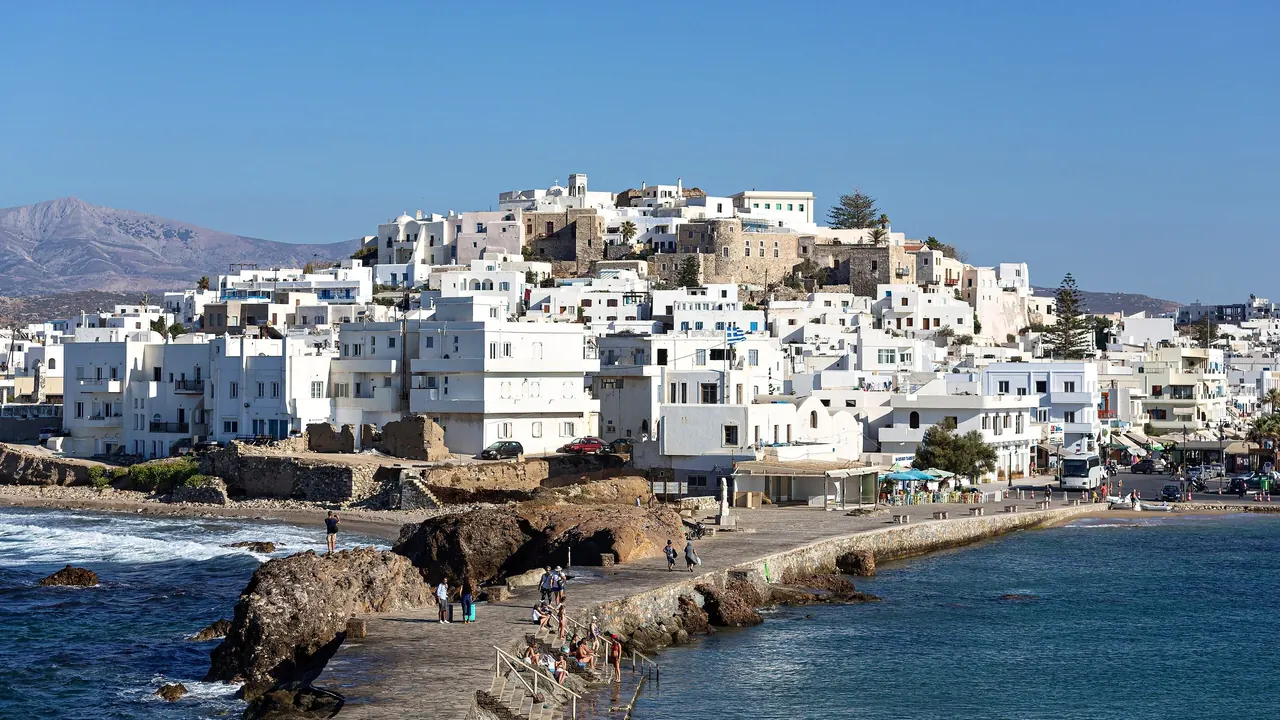
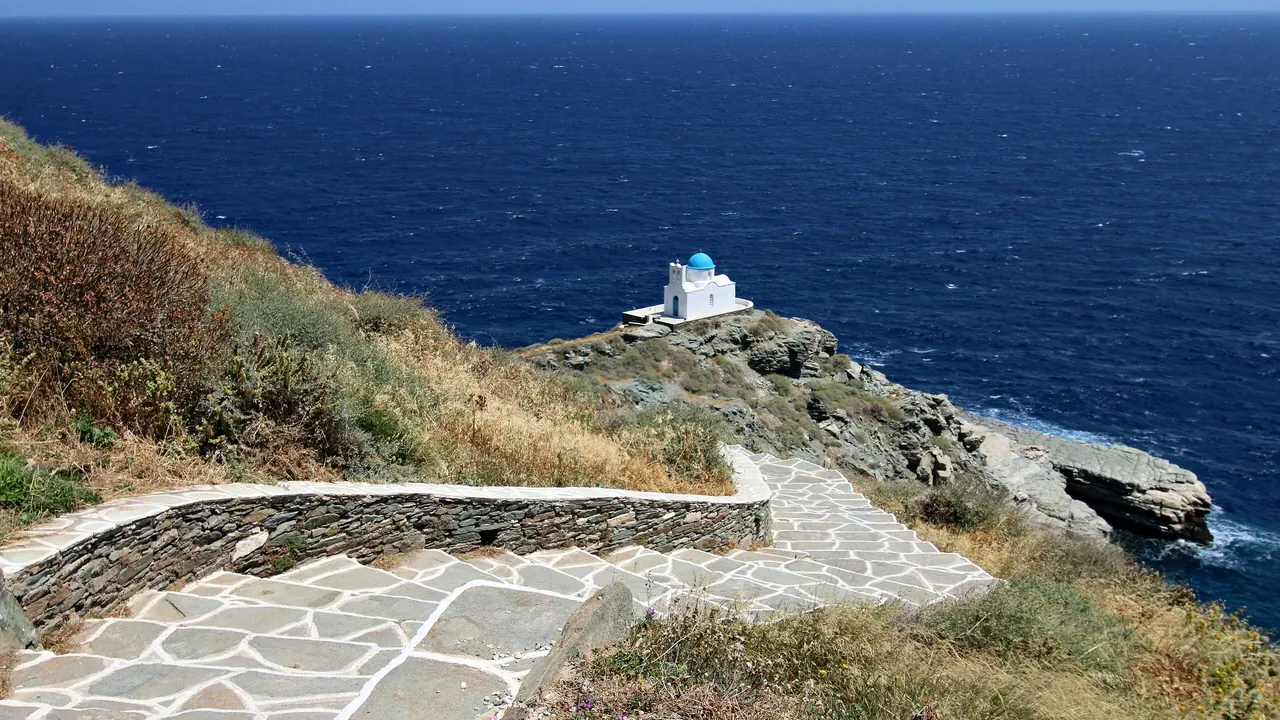
Photos: Naxos by Manfred Werner (Tsui), CC BY-SA 4.0, cropped; Sifnos by Zde, CC BY-SA 4.0, cropped.
Naxos or Sifnos?
Our verdict in twelve categories, each scored against the same fixed benchmark cities, and the climate month by month, so you can choose for your trip.
Choose Naxos for
- culture and sights
- prices
- families
Naxos is the bigger island, and it suits travellers who want more of everything: a long chain of sandy beaches down the west coast, a Venetian kastro and ancient marble above the harbour, mountain villages to drive between, and ferries to half the Cyclades. It is also the easier choice for families and for anyone watching costs, with family-run studios that keep a summer stay within reach.
Choose Sifnos for
- wellness
- shopping
- food and drink
Sifnos is for a slower, more polished stay on a smaller canvas. Its pull is the table, with clay-pot cooking that Greeks themselves travel for, along with waymarked mule paths between white villages and quiet bays where a day needs no plan. You give up range, the easy island-hopping and the lower prices, and in return you get an island that feels calm and complete once you have arrived.
Scoreboard
Twelve categories on one fixed scale from 0 to 100. The shaded stretch is the gap between the two.
Your match
Pick a travel style or drag the sliders, and both match scores follow your weighting.
Wins on culture and sights and prices with your weighting.
Wins on wellness and shopping with your weighting.
What matters to you?
Category by category
What the scores mean for a trip.
Beaches & swimming
Naxos has the stronger beaches, mainly because there are so many of them. The west coast from Agios Georgios down through Agios Prokopios, Plaka and Mikri Vigla to Alyko is almost one unbroken run of pale sand and shallow water, so finding an empty stretch is easy even in high summer.
Sifnos has fewer beaches but good ones: the broad sweep of Platis Gialos, the easy sand at Kamares and small coves around Faros and Chrysopigi. Its real asset is Vathi, a nearly enclosed bay that stays calm when the meltemi churns the open coast. Naxos relies on Agios Georgios and a few tucked-away coves for the same shelter.
Food & drink
The two eat about equally well, but they are good at different things. Naxos is a farming island, and its strength is raw produce: potatoes, graviera and arseniko cheeses, kitron liqueur from Halki, and grilled meat in mountain villages such as Apiranthos and Filoti.
Sifnos is a cooking island. Its reputation rests on dishes like revithia baked overnight in clay pots and mastelo lamb in red wine, with manoura cheese and almond sweets from the Artemonas bakeries. It also has a few more ambitious kitchens, whereas the Naxos beach strips fall back on standard menus.
Culture & sights
Naxos has much more heritage to explore. The Portara frames the harbour, the Venetian kastro above it holds churches, crested mansions and a museum of Cycladic figurines, and inland there are the Temple of Demeter, the abandoned kouroi at Flerio and Apollonas, and the Byzantine chapels of the Tragaea valley.
Sifnos offers a smaller set built around its villages. Kastro, whose outer houses form its wall, is the highlight, alongside the Mycenaean acropolis of Agios Andreas and the old watchtowers. It rewards slow wandering, but it is a few days' gentle interest rather than a programme.
Nightlife
Both islands spend their evenings over long dinners, and both go quiet outside the summer. The difference is that Chora on Naxos has a couple of clubs open into the small hours and sunset bars on the beaches at Agios Prokopios and Plaka. On Sifnos, the going-out is one narrow lane of cocktail bars in Apollonia, with no clubs at all.
Nature & outdoors
The outdoors is equally good on both, in different ways. Naxos is the mountain island: the climb up Mount Zas to about 1,000m is the classic walk, the north and east coasts are wild, and the meltemi turns Mikri Vigla into one of the Aegean's main kitesurfing and windsurfing spots.
Sifnos is lower and drier, but it is laid out for walkers, with waymarked stone mule tracks that let you cross most of the island on foot. Snorkelling in the rocky coves and boat trips to bays without roads round out an outdoor stay that is gentler than the one on Naxos.
Day trips
Naxos makes the better base for day trips. From the centre of the Cyclades, Paros is under an hour away, the Small Cyclades make easy outings, and Mykonos and Delos are within reach, on top of a full day's drive through the island's own hill villages.
From Sifnos the options are Milos with its painted boathouses, hilltop Serifos and little Kimolos, and the list ends there. Connections also thin quickly when the wind is up, so a Sifnos stay tends to stay on Sifnos.
Good for families
Naxos is the easier island with children. Its beaches give toddlers a long stretch of shallow, soft-sand paddling, there is room to spread out even in August, and Agios Georgios is a sheltered beach within walking distance of town.
Sifnos manages a simple beach vacation at Platis Gialos, Kamares and Vathi, and short distances mean no long car journeys. But its stepped villages are hard going with a pushchair, and the ferry from Piraeus can be rough. Neither island has attractions built for children.
Getting around
Getting around is much the same once you are on either island: summer buses link the main villages and beaches, and a car or scooter opens up the rest. On Naxos that means longer, winding drives, well over an hour to Apollonas. On Sifnos everything is a short hop from Apollonia, and the footpaths are a real way to travel between villages.
Arrival is where they differ. Naxos has a small airport as well as frequent ferries, while Sifnos can only be reached by a few hours on a ferry from Piraeus, and that crossing is exposed to the summer wind.
Shopping & style
Neither island is a shopping destination, but each has something worth taking home. On Sifnos it is pottery, the clay casseroles and jugs still thrown in workshops around Kamares and Vathi, with a few boutiques in Apollonia. On Naxos it is mostly food, graviera and kitron, plus jewellery and linen in the old market below the kastro and weaving from Apiranthos.
Affordability
Naxos is the clearly cheaper island. Family-run studios and village rooms keep it moderately priced even in summer, although costs rise in August and the boutique hotels near Chora and Plaka are not cheap.
Sifnos leans upmarket, with its rooms mostly in small boutique hotels and rented houses that fill early for July and August. Taverna meals are fair for their quality, and on both islands June and September bring prices down while the sea stays warm.
Live music & performing arts
Neither island has a theatre or concert season, and on both the music worth staying up for is the summer panigyri, a saint's-day feast with violin, lute and circle dancing late into the night. Naxos adds a little formal programme on top, with a summer festival in a restored Venetian tower and small recitals in the kastro. On Sifnos there are only the occasional village concerts.
Wellness & relaxation
Sifnos is the more restful of the two. Its car-free lanes, short distances and quiet bays make an unplanned day come naturally, especially in June and September.
Naxos can be just as unhurried in the hills around Halki or on the emptier southern beaches. But its busier west coast and larger summer crowds make that calm something you have to seek out. Neither has a bathing tradition, and spa treatments on both are limited to a few hotels and, on Naxos, some yoga retreats.
When should you go?
Pick your month. The climate figures are measured averages, not a forecast.
Naxos in July
Sifnos in July
Daytime high, °C
Rainfall in the month, mm
Where the figures come from
Naxos's temperatures are measured 79 km from the centre, at Santorini Island / Monólithos.
Naxos has no rain gauge within 25 km of the centre, so its rainfall comes from a gridded climate dataset read at the destination rather than from a gauge further away.
Sifnos has no weather station within reach, so its figures come from a gridded climate model rather than a measured record, and read a broad area rather than one spot.
Temperature and rainfall are climate normals, averaged over the years shown. Naxos: 2000-2025, 12 years observed (rainfall 1991-2020) normals, Santorini Island / Monólithos (78.8 km from centre). Sifnos: 2001-2020 normals, NASA POWER reanalysis grid, no weather station within 90 km.
Both islands are at their best for swimming from June to September, when the rain all but stops and the sea warms to about 24°C by August. Naxos runs hotter: its July and August afternoons reach around 30°C, warm enough that walking and sightseeing are best kept to the mornings. Sifnos stays a few degrees milder, at about 27°C, and its sea holds its August warmth through September, which makes that month especially good there.
Spring and autumn are the walking seasons on both, with May and October still mild and mostly dry. From November the rain sets in, and Sifnos gets the wetter winter, with around 107mm in December against noticeably less on Naxos. Neither is a beach destination between November and April.
Which traveller are you?
On a family trip with young children, Naxos is the easier choice. Stay in Agios Prokopios or Plaka with the sand at your door, take the summer bus along the beaches instead of hiring a car, and keep costs down in family-run studios.
For a culture and arts trip, Naxos has the deeper history. Its sites run from Archaic temples to Venetian tower houses and marble-paved villages such as Apiranthos, and Delos is within reach by boat via Mykonos. Sifnos suits slow village wandering better.
On a relaxing and wellness trip, Sifnos has the edge. Car-free village lanes, short distances, evening walks between Apollonia and Artemonas and calm bays such as Vathi make for an easy rhythm. Both islands get busy in August, so June or September is calmer.
Before you go
| Measure | Naxos | Sifnos |
|---|---|---|
| Official language | Greek | Greek |
| Currency | Euro (EUR) | Euro (EUR) |
| Sockets | CF230 V, 50 Hz | CF230 V, 50 Hz |
| Driving side | Right | Right |
| Time zone | UTC+2, UTC+3 in summer | UTC+2, UTC+3 in summer |
| Emergency number | 112 | 112 |
| Main airport | Naxos Island National Airport (JNX)3 non-stop destinations | Milos Airport (MLO)2 non-stop destinations |
| Public holidays this year | 15 days | 15 days |
By the numbers
| Measure | Naxos | Sifnos |
|---|---|---|
| Population | 17,930 | - |
| People per km² | 42 | - |
| Swim season, months above 21 °C | 5 months | 5 months |
Where else could you go?
Every comparison below shares a destination with this one, so you can follow Naxos or Sifnos somewhere new.