Greece
Naxos
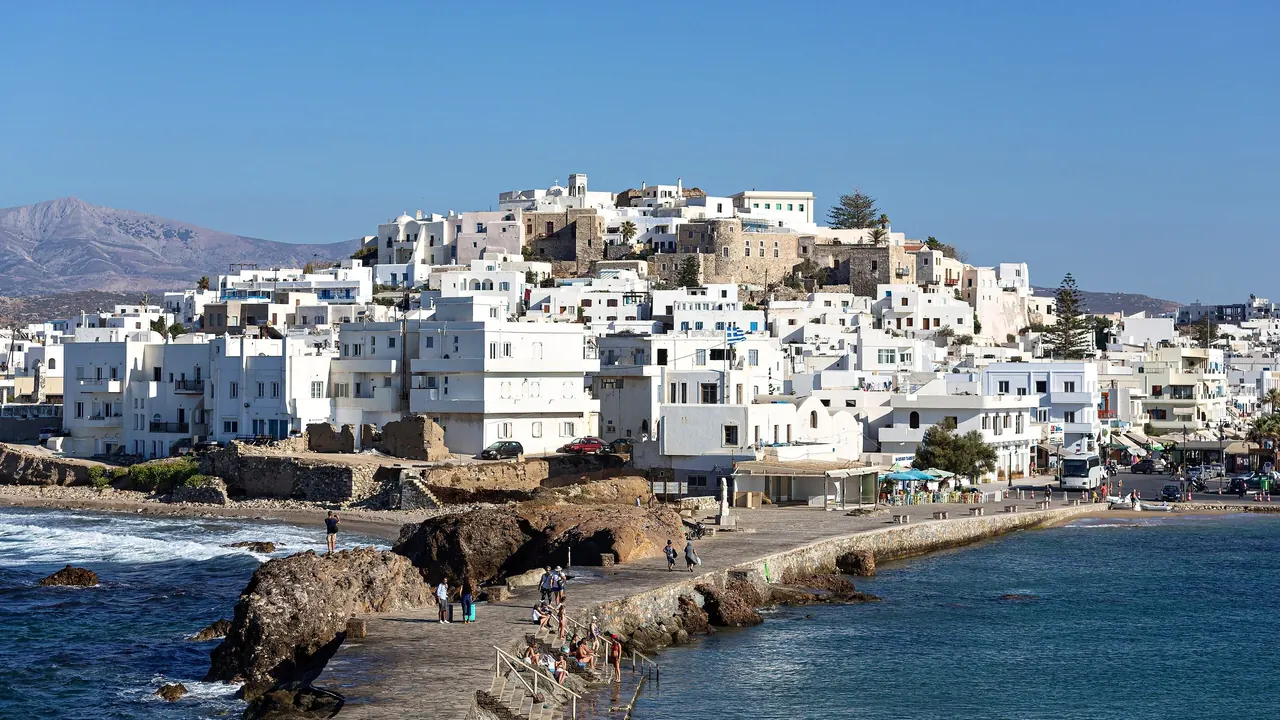
Naxos Town and its castle above Grotta beach
- Beaches84
- Families62
- Food & drink57
Photo: Manfred Werner (Tsui), CC BY-SA 4.0, cropped
Match
48
Every category weighted equally
- Beach & sun53
- Culture & arts45
- Food & nightlife44
- Family trip55
- Outdoors53
- Relax & unwind51
- Shopping & style44
- On a budget49
Naxos in twelve categories
Our verdict on each, scored 0 to 100 against the same fixed benchmark cities, so a score means the same thing on every page.
Beaches & swimming. Scores 84 out of 100.
Food & drink. Scores 57 out of 100.
Culture & sights. Scores 54 out of 100.
Nightlife. Scores 32 out of 100.
Nature & outdoors. Scores 56 out of 100.
Day trips. Scores 56 out of 100.
Good for families. Scores 62 out of 100.
Getting around. Scores 50 out of 100.
Shopping & style. Scores 28 out of 100.
Affordability. Scores 50 out of 100.
Live music & performing arts. Scores 18 out of 100.
Wellness & relaxation. Scores 33 out of 100.
Naxos category by category
Beaches & swimming
84The beaches are the main reason most people come. The west coast south of the main town is close to one continuous chain of sand: Agios Georgios at the edge of Chora, then Agios Prokopios and Agia Anna, then the long dune-backed strands of Plaka, Mikri Vigla, Kastraki and Alyko. The sand is fine and pale, the water clear and shallow for a long way out, and there are enough beaches that a quiet stretch is never far away.
The sea is warm enough to swim from June to October, reaching about 24°C in August. The summer meltemi wind blows from the north and can make the west coast choppy for days; Agios Georgios and the coves tucked behind headlands stay calmer. Stay in Agios Prokopios or Plaka to have the sand at your door.
Food & drink
57Naxos feeds itself in a way few Aegean islands do. Its fertile valleys grow the potatoes Greeks know it for, and its hills support the cattle, sheep and goats behind its graviera, arseniko and soft xinomyzithra cheeses. The kitron liqueur, made from citron leaves, is distilled in Halki. The best eating is in the mountain villages, Halki, Filoti, Apiranthos and Koronos, where tavernas grill local meat and cook slow stews, and in Chora's harbourfront fish tavernas.
What Naxos lacks is range. Outside traditional Greek cooking there is little of note, the beach strips lean on predictable menus, and serious fine dining is rare. Come for the produce and the village taverna, not for variety.
Culture & sights
54Naxos was settled and fought over for millennia, and it shows in layers. The great marble doorway of the Portara, all that stands of a sixth-century BC temple to Apollo, frames the harbour of Chora. Above it, the Venetian kastro is a maze of stone lanes, Catholic churches, mansions with coats of arms and a small archaeological museum of Cycladic figurines.
Inland, the reconstructed Temple of Demeter stands near Sangri, giant unfinished kouroi lie where they were abandoned in the quarries at Flerio and Apollonas, and the Tragaea valley hides dozens of Byzantine chapels, Panagia Drosiani among them with very early frescoes. Venetian tower houses and marble-paved villages such as Apiranthos complete a heritage worth a few days of driving, intimate rather than monumental.
Nightlife
32Evenings on Naxos are about a long dinner and a drink by the water. In summer the harbourfront of Chora and the lanes below the kastro fill with cocktail and music bars, a couple of clubs keep going into the small hours, and the beach bars at Agios Prokopios and Plaka host sunset sessions. The season runs from June to September, and outside it the island goes quiet early. Those who want to dance all night take the ferry to a neighbouring island; most visitors here are happy not to.
Nature & outdoors
56Naxos is the most mountainous and the greenest of the Cyclades. Mount Zas rises to about 1,000m above Filoti, and the climb to its summit and cave is the island's classic walk, with views over the whole archipelago. Old mule paths link the marble villages of the Tragaea valley through olive groves, and the east and north coasts are wild, rocky and empty.
The summer meltemi makes the west coast one of the best places in the Aegean for kitesurfing and windsurfing, centred on Mikri Vigla. Spring and autumn are the seasons for hiking, when the hills are green and the heat has eased; in July and August walking is a matter for early mornings.
Day trips
56As the central island of the Cyclades, Naxos is a good ferry base. Paros, with the white towns of Parikia and Naoussa, is under an hour away, and the Small Cyclades to the south, Koufonisia, Schinoussa and Iraklia, make easy days of quiet harbours and village lanes. Mykonos is about an hour by fast boat, the route to the sacred island of Delos, and Santorini is within reach for a long day.
On Naxos itself, the hill villages of Halki, Filoti, Apiranthos and Koronos and the fishing harbour of Apollonas make a varied day's drive. Outings depend on boats, which run most fully from June to September and can be cut by strong wind.
Good for families
62Naxos is one of the easier Greek islands to bring children to. The west-coast beaches shelve gently over soft sand, so toddlers can paddle a long way out, and Agios Georgios is walkable from Chora and sheltered from the wind. Family-run studios and tavernas are welcoming, the pace is unhurried, and there is plenty of space on the beaches even in August.
There is almost nothing built for children, though: no water parks, zoos or museums aimed at them. Days are beach, boat and village ice cream, and the meltemi can make the open beaches too rough for small swimmers on some days.
Getting around
50Chora is compact and best explored on foot, and in summer local buses run from its harbour along the west-coast beaches as far as Plaka and up to the main mountain villages. A visitor staying in Chora or Agios Prokopios can manage without a car. To see the interior villages, the Byzantine chapels and the empty north and east coasts, a hired car or scooter is the practical choice; the roads are sound but narrow and winding, and the mountain drive to Apollonas takes well over an hour.
Shopping & style
28Shopping is a pleasant side activity. The lanes of the old market below the kastro in Chora are lined with small jewellery, ceramic and linen shops, and the best things to take home are edible: graviera cheese, kitron liqueur, honey and thyme from delicatessens and village co-operatives. Apiranthos and Halki sell local weaving and marble work. There is no fashion or design scene to speak of.
Affordability
50Naxos is a moderately priced Greek island. Family-run studios and village rooms keep accommodation within reach even in summer, and taverna meals, local wine and the buses are reasonable. Prices climb in August, when beachfront rooms book up and car hire costs more, and the boutique hotels around Chora and Plaka are firmly mid to upper range. June and September give the best value while the sea is still warm.
Live music & performing arts
18There is little formal performance. In summer a cultural festival brings concerts and theatre to a restored Venetian tower inland, and small recitals are held in Chora's kastro. The more memorable music comes from the village panigyria, the saints' day festivals held through summer, where island violin and lute play late into the night and everyone dances. Otherwise there is no theatre or concert season to plan around.
Wellness & relaxation
33Naxos has no thermal springs, hammams or bathing tradition, and spa treatments are limited to a handful of resort hotels and small yoga retreats along the southwest coast. What it does offer is pace. Out of the August peak, the beach villages and mountain hamlets are quiet, days settle into a rhythm of swim, siesta and long dinner, and a stay in the hills around Halki or on the emptier southern beaches feels properly unhurried.
Where to stay in Naxos
Chora is the natural base for a first visit. The harbour puts every ferry and day trip on your doorstep, and the evenings are spent in the kastro lanes and the fish tavernas along the waterfront. Agios Georgios is a short walk away for sheltered, shallow swimming, so the town works well for families and for anyone without a car. In summer, buses leave from the harbour for the beaches and the mountain villages.
Agios Prokopios and Agia Anna, a few kilometres south, suit travellers who want long beach days with the sand right outside, a bus into town and sunset bars nearby. Further down the coast, Plaka has the same pale sand with more space and a quieter feel. Mikri Vigla is the place for kitesurfers and windsurfers who come for the meltemi. On windy days these open beaches can get choppy.
For walking, food and a slow pace, stay inland around Halki or Filoti. You'll be at the foot of Mount Zas, close to the village tavernas and the paths of the Tragaea valley. You'll need a car here. The island is small enough that one base covers most trips. On a return visit, splitting a week between the coast and the hills works well.
When should you go?
Pick a month to see what it is like. The climate figures are measured averages, not a forecast.
Naxos in July
Daytime high, °C
Rainfall in the month, mm
The whole year
Shaded against this city’s own year: the deepest cell is its best month for that figure and the palest its weakest.
Where the figures come from
Naxos's temperatures are measured 79 km from the centre, at Santorini Island / Monólithos.
Naxos has no rain gauge within 25 km of the centre, so its rainfall comes from a gridded climate dataset read at the destination rather than from a gauge further away.
Temperature and rainfall are climate normals, averaged over the years shown. Naxos: 2000-2025, 12 years observed (rainfall 1991-2020) normals, Santorini Island / Monólithos (78.8 km from centre).
Before you go
| Measure | Naxos |
|---|---|
| Official language | Greek |
| Currency | Euro (EUR) |
| Sockets | CF230 V, 50 Hz |
| Driving side | Right |
| Time zone | UTC+2, UTC+3 in summer |
| Emergency number | 112 |
| Main airport | Naxos Island National Airport (JNX)3 non-stop destinations |
| Public holidays this year | 15 days |
By the numbers
| Measure | Naxos |
|---|---|
| Population | 17,930 |
| People per km² | 42 |
| Swim season, months above 21 °C | 5 months |
Compare Naxos with
Every comparison with a written verdict behind it.