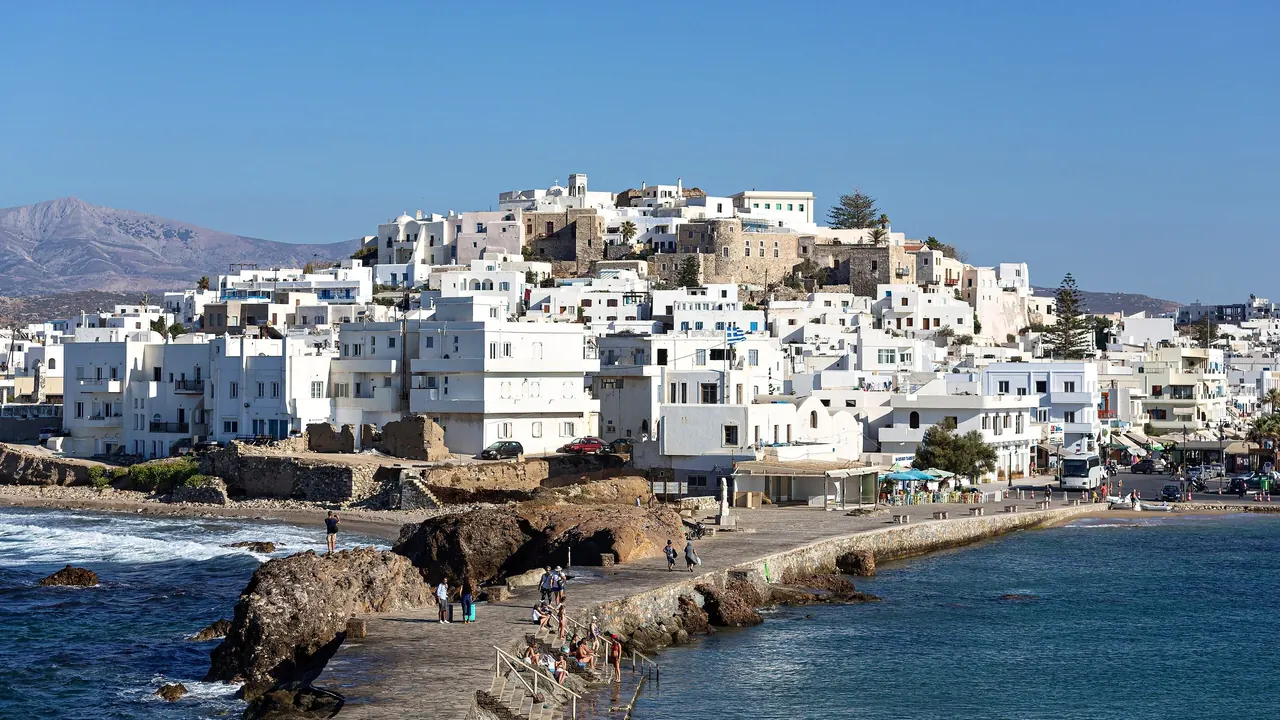
Photos: Naxos by Manfred Werner (Tsui), CC BY-SA 4.0, cropped.
Lefkada or Naxos?
Our verdict in twelve categories, each scored against the same fixed benchmark cities, and the climate month by month, so you can choose for your trip.
Choose Lefkada for
- nature and the outdoors
- day trips
- prices
Lefkada suits travellers who want drama on the water and something to do on it. The west coast's white cliffs and turquoise coves are among the most striking swims in Greece, Vasiliki is a windsurfing bay of real standing, and the channels to Meganisi and the islets make it a natural base for sailing. It also connects to the mainland by a causeway, so you can drive there without a ferry. Expect to hire a car and to spend most of your days outdoors rather than at sights.
Choose Naxos for
- culture and sights
- food and drink
- families
Naxos is the better pick for a family beach trip and for anyone who wants history alongside the sand. Its west coast is a long chain of soft, shallow beaches, its marble villages and Venetian kastro give days away from the sea some depth, and its cheeses and mountain tavernas make the eating more memorable. Ferries to Paros, Delos and the Small Cyclades add island-hopping, and you can manage without a car if you stay near Chora.
Scoreboard
Twelve categories on one fixed scale from 0 to 100. The shaded stretch is the gap between the two.
Your match
Pick a travel style or drag the sliders, and both match scores follow your weighting.
Wins on nature and the outdoors and day trips with your weighting.
Wins on culture and sights and food and drink with your weighting.
What matters to you?
Category by category
What the scores mean for a trip.
Beaches & swimming
Both islands are first and foremost beach destinations, but the beaches feel very different. Lefkada's famous ones are on the west coast, at Porto Katsiki, Egremni and Kathisma, where pale cliffs drop to intensely turquoise water. These beaches face the open Ionian, so the shore shelves steeply, waves build in the afternoon, and some coves are reached by long staircases. The calm east-coast bays around Nikiana and Nidri make up for this.
Naxos is about sand rather than scenery. From Agios Georgios through Agios Prokopios and Plaka to Alyko there is an almost unbroken run of fine, dune-backed beaches where the water stays shallow a long way out. You can stay with the beach at your door, and there is always space. The trade-off is the summer north wind, which can make the open stretches choppy for days at a time.
Food & drink
Naxos has the more distinctive table, because it grows so much of its own food. Its potatoes, graviera and arseniko cheeses and the kitron liqueur distilled in Halki come from the island itself, and a meal in Halki, Filoti or Apiranthos is a reason to drive inland.
Lefkada eats well but more simply. Expect grilled fish on the harbours of Lefkada town and Nidri, Eglouvi lentils and the local salami, and the most traditional cooking up around Karya. Neither island offers much beyond Greek food, and both have resort strips with predictable menus.
Culture & sights
Here Naxos is well ahead. The marble doorway of the Portara frames the harbour, the Venetian kastro above it is a warren of mansions and Catholic churches, and inland there are unfinished kouroi lying in the quarries at Flerio and Apollonas, the Temple of Demeter near Sangri and the early frescoes of Panagia Drosiani. Together they make several days of exploring rather than a single stop.
Lefkada's heritage is pleasant but small. The fortress of Santa Maura at the causeway, the painted church ceilings and earthquake-proof timber houses of Lefkada town, and the Faneromeni monastery fill a morning, with the Sappho legend at Cape Lefkatas as a scenic extra.
Nightlife
Neither island is a party destination, and both go quiet early outside high summer. On Lefkada the evenings are spread out: young Greek visitors fill the lanes of Lefkada town, sailing crews gather on Nidri's harbour and windsurfers meet in Vasiliki's bars.
Naxos keeps its nights mostly in Chora, along the harbourfront and below the kastro, where a couple of clubs stay open late, plus sunset sessions at the beach bars of Agios Prokopios and Plaka. Anyone wanting a real club night takes a boat to a neighbouring island.
Nature & outdoors
Lefkada has the edge outdoors, mainly at sea. The bay at Vasiliki is one of the Mediterranean's best-known windsurfing spots, the sheltered channels towards Meganisi are classic yachting waters, and the big marina makes chartering a boat easy. On land, the interior climbs above 1,100m, and the cliff road to Cape Lefkatas and the Dimosari waterfall walk are highlights.
Naxos, the greenest of the Cyclades, is better for walking than its outdoor reputation suggests. The climb up Mount Zas gives views over the whole archipelago, mule paths link the Tragaea villages, and Mikri Vigla is a serious kitesurfing beach. What it lacks is Lefkada's sailing.
Day trips
Both islands make good bases for outings, but the outings differ. From Lefkada you can mix Ionian islands with the mainland: boats to Meganisi, Kalamos and Kastos, ferries to Fiskardo on Kefalonia and to Ithaca, and drives to Roman Nikopolis, the Acheron oracle and Parga under its castle.
Naxos is all about island-hopping in the central Cyclades. Paros is under an hour away, the Small Cyclades are easy days out, Delos is reached via Mykonos, and Santorini is possible as a long day. Every one of these depends on ferries, which run fully only in summer and can be cancelled by strong wind.
Good for families
Naxos is the easier island for children. Its soft west-coast sand shelves so gently that small children can paddle well out, there is room on the beaches even in August, and sheltered Agios Georgios is within walking distance of Chora.
On Lefkada, families need to choose a base carefully. The east-coast bays at Nikiana and Ligia, and Agiofili and Vasiliki in the south, have calm paddling water, but the celebrated west coast, with its steep drop-offs, afternoon surf and cliff staircases, is better as an occasional day out. Neither island has much built for children.
Getting around
On Lefkada, plan on hiring a car or scooter from the first day. The island's buses link its towns but are no use for a day of moving between beaches. Short distances on the map also become slow drives once the road climbs or follows the cliffs, and the busiest spots jam in high summer. Only Lefkada town is easy to explore on foot.
Naxos lets you do much more without a car. In summer, buses from Chora's harbour run down the beach coast as far as Plaka and up into the mountain villages, so a stay in Chora or Agios Prokopios works on foot and by bus. A car is worth hiring for the interior chapels and the empty north and east coasts. Drives there are long too: Apollonas is well over an hour from Chora.
Shopping & style
Shopping is a minor pleasure on both islands, and the best things to take home are local products. Lefkada's is an evening stroll along the pedestrian main street of Lefkada town for olive oil, honey and lentils, with hand embroidery from Karya.
Naxos centres on the old market lanes below the kastro, with jewellery and ceramics, while graviera cheese and kitron liqueur from village co-operatives, and weaving and marble work from Apiranthos, make the more distinctive souvenirs.
Affordability
Both are mid-priced Greek islands with plenty of family-run studios, and on both June and September are noticeably cheaper than August. On Lefkada the extra costs are a hire car, which you will almost certainly need, boat excursions and rooms near the famous west-coast beaches. On Naxos the summer buses let you skip the car, though the boutique hotels around Chora and Plaka are at the upper end.
Live music & performing arts
Neither island offers a theatre or concert season, and live performance on both happens in summer. Lefkada's main event is the long-running international folklore festival in August, which brings dance groups from many countries to open-air stages in town.
On Naxos the best music is less formal: island violin and lute at the village saints' day festivals, plus concerts in a restored Venetian tower and small recitals in the kastro.
Wellness & relaxation
Both islands lack a bathing tradition, and spas on either mean a few hotels or small yoga retreats. Rest comes from the pace of island life. On Lefkada that means quiet interior villages and calm evenings in the small east-coast harbours. On Naxos it means the hills around Halki and the emptier southern beaches. On both, the slow rhythm is at its best in June or September rather than in the busy August peak.
When should you go?
Pick your month. The climate figures are measured averages, not a forecast.
Lefkada in July
Naxos in July
Daytime high, °C
Rainfall in the month, mm
Where the figures come from
Lefkada has no rain gauge within 25 km of the centre, so its rainfall comes from a gridded climate dataset read at the destination rather than from a gauge further away.
Naxos's temperatures are measured 79 km from the centre, at Santorini Island / Monólithos.
Naxos has no rain gauge within 25 km of the centre, so its rainfall comes from a gridded climate dataset read at the destination rather than from a gauge further away.
Temperature and rainfall are climate normals, averaged over the years shown. Lefkada: 1998-2020 (rainfall 1991-2020) normals, Aktion Airport (24.3 km from centre). Naxos: 2000-2025, 12 years observed (rainfall 1991-2020) normals, Santorini Island / Monólithos (78.8 km from centre).
The two islands are equally hot in summer, with daytime highs around 30°C in July and August. Both are warm enough for swimming from June into early October, and Lefkada's sea runs a degree or two warmer at its August peak. The real difference is rain. Naxos is almost completely dry from May to September, and October stays fairly settled. On Lefkada the Ionian weather returns sooner. September already brings real showers, October is properly wet, and by November the island gets about 150mm against roughly 61mm on Naxos, well over twice as much.
For walking and touring, May is comfortable on both islands, and the hottest weeks of midsummer are best kept for the beach. Autumn favours Naxos, where late September and October stay mostly dry for exploring the villages. On Lefkada, showers become more likely as autumn goes on. In winter Naxos is a little milder and noticeably drier, but neither island is a beach destination then. June is the month when both are at their best.
Which traveller are you?
On an outdoors trip, Lefkada is the stronger choice, especially if you want to be active on the water. A week there can mix windsurfing lessons, a few days on a chartered yacht and a cliff-top drive. Naxos is better for hill walking than for time at sea.
For a culture and arts trip, Naxos gives you a reason to leave the beach every other day. You can spend mornings exploring ancient and Venetian remains and afternoons swimming. On Lefkada, history is a short break from the beach rather than the theme of a trip.
On a family trip with young children, Naxos makes the days easier. You can pick one beach base, walk to the sand and let toddlers paddle without worrying about the surf. On Lefkada you would need to plan around which coast is calm, and drive more.
Before you go
| Measure | Lefkada | Naxos |
|---|---|---|
| Official language | Greek | Greek |
| Currency | Euro (EUR) | Euro (EUR) |
| Sockets | CF230 V, 50 Hz | CF230 V, 50 Hz |
| Driving side | Right | Right |
| Time zone | UTC+2, UTC+3 in summer | UTC+2, UTC+3 in summer |
| Emergency number | 112 | 112 |
| Main airport | Aktion National Airport (PVK)47 non-stop destinations | Naxos Island National Airport (JNX)3 non-stop destinations |
| Public holidays this year | 15 days | 15 days |
By the numbers
| Measure | Lefkada | Naxos |
|---|---|---|
| Population | 22,652 | 17,930 |
| People per km² | 64 | 42 |
| Swim season, months above 21 °C | 5 months | 5 months |
Where else could you go?
Every comparison below shares a destination with this one, so you can follow Lefkada or Naxos somewhere new.