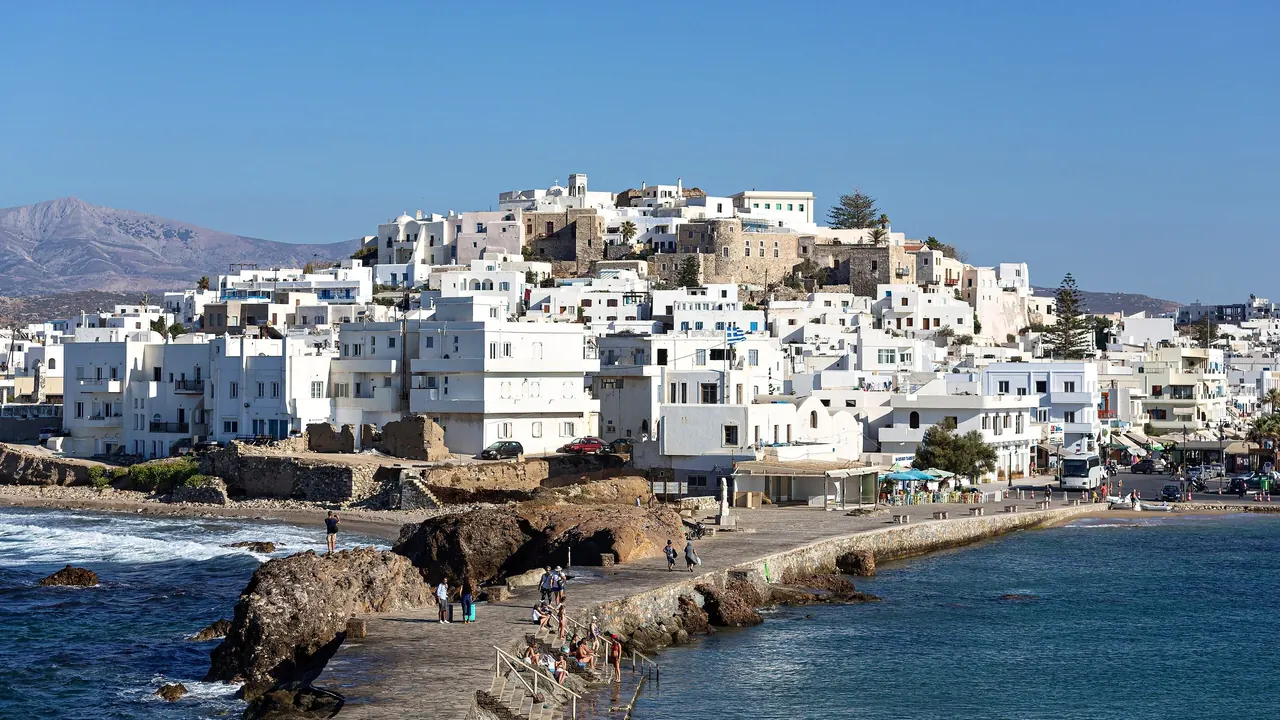
Photos: Naxos by Manfred Werner (Tsui), CC BY-SA 4.0, cropped.
Naxos or Peloponnese?
Our verdict in twelve categories, each scored against the same fixed benchmark cities, and the climate month by month, so you can choose for your trip.
Choose Naxos for
- families
- getting around
- beaches
Naxos suits travellers who want one island, one base and sand at the door. The west coast is almost a single run of fine beaches within reach of Chora, children can paddle far out in shallow water, and you can manage without a car if you stay near the town. The island villages, marble quarries and Byzantine chapels give the trip some depth, and ferries to the neighbouring Cyclades add variety. What you give up is range: the history is on a small scale, and there is little to do in the evenings or in spa-style rest.
Choose Peloponnese for
- culture and sights
- nature and the outdoors
- day trips
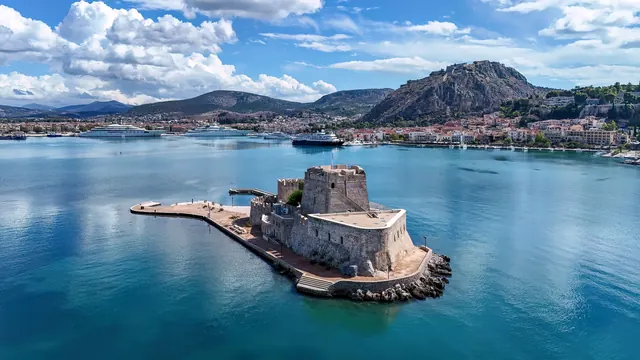
The Peloponnese is the better pick for a road trip with real substance. Mycenae, Epidaurus, Olympia, Mystras and Monemvasia make it one of the great historical journeys in Greece, and between them come high mountains, deep gorges, wine country and beaches that compare well with Naxos. It costs less than the famous islands and has thermal springs and summer drama under the stars. In return you will drive a lot, and you will probably move between two or three bases.
Scoreboard
Twelve categories on one fixed scale from 0 to 100. The shaded stretch is the gap between the two.
Your match
Pick a travel style or drag the sliders, and both match scores follow your weighting.
Wins on families and getting around with your weighting.
Wins on culture and sights and nature and the outdoors with your weighting.
What matters to you?
Category by category
What the scores mean for a trip.
Beaches & swimming
These two are close as beach destinations, but the shape of the coast is different. Naxos gives you one long chain of fine pale sand down the west coast, from Agios Georgios through Agios Prokopios and Plaka to Alyko. You can stay on it and walk to a different beach each day, though the summer meltemi can make it choppy.
The Peloponnese spreads its beaches around a much larger coastline, so the variety is wider: the horseshoe of Voidokilia and Navarino Bay in Messinia, the tropical-looking water of Elafonisos, pebble coves and rock swimming in the Mani, and easy family sand at Tolo. Getting between them means driving, and the sea is a degree or two warmer at its peak.
Food & drink
Both serve country Greek cooking built on local produce, but the Peloponnese has more of it and more places to eat it. Kalamata olives and oil, Mani cured pork and the wines of Nemea, the Tripoli plateau and Monemvasia give it real depth. Kalamata and Nafplio have the widest choice of places to eat, and the covered market in Kalamata is worth a visit.
Naxos is narrower but distinctive. Its graviera and arseniko cheeses, its potatoes and the kitron liqueur from Halki are best eaten in the mountain tavernas of Filoti, Apiranthos and Koronos. Beyond those, choice soon runs thin.
Culture & sights
The gap here is wide. The Peloponnese holds a large part of ancient and medieval Greece: the Lion Gate at Mycenae, the theatre at Epidaurus, Olympia, Messene, the lone temple at Bassae, and then Byzantine Mystras, the rock of Monemvasia and the Venetian castles at Methoni and Koroni. You could fill two weeks and still leave sites unseen.
Naxos is on a smaller, more personal scale. The Portara doorway over the harbour, the Venetian kastro of Chora, the unfinished kouroi lying in the quarries and the frescoed chapels of the Tragaea valley make a rewarding few days of driving. It does not compare with the major sites across the water.
Nightlife
On both, evenings centre on a long dinner and a drink near the water. The Peloponnese has a slight edge because of Patras, a university city with streets of bars and clubs and a famous carnival. Kalamata's seafront bars are also busier and more local than anything on Naxos.
On Naxos the harbourfront of Chora, a couple of clubs and sunset bars at Agios Prokopios and Plaka cover the summer. Outside June to September the island goes quiet early.
Nature & outdoors
Naxos is green and hilly for the Cyclades, but the Peloponnese plays in a different league. Taygetos rises to about 2,400m, more than twice the height of Mount Zas. The Lousios gorge links cliff monasteries, the Menalon Trail crosses Arcadia, the Vouraikos gorge has its rack railway, and Gialova lagoon draws migrating birds.
Naxos does have its own strengths. The climb up Zas and the old mule paths between Tragaea villages make fine spring walks. The meltemi also turns Mikri Vigla into one of the best kitesurfing and windsurfing spots in the Aegean.
Day trips
The two offer different kinds of outing. From Naxos the outings are by boat: Paros under an hour away, the quiet Small Cyclades, Delos by way of Mykonos, and Santorini as a long day out. All depend on the ferry season and the wind.
The Peloponnese offers more, and it is reached by car. From Nafplio you can visit car-free Hydra and Spetses, the Nemea wineries or even Athens. From the south you can reach Pylos, Methoni, the Mani villages, Monemvasia and Elafonisos, and Kythira is a ferry ride further.
Good for families
Naxos is the simpler place to bring small children. You can stay in Chora and walk to sheltered Agios Georgios, the west-coast sand shelves gently, and days need little planning. The catch is that windy days can make the open beaches too rough for small swimmers.
The Peloponnese works too, with shallow bays at Tolo and in Messinia and resort hotels with kids' clubs. Older children may enjoy Mycenae and Olympia. But the distances mean long hours in the car, and the sites have little shade.
Getting around
Neither is easy without wheels, but Naxos is the more forgiving. Summer buses run from Chora's harbour along the beaches to Plaka and up to the main hill villages, so a beach stay is possible without a car. You only need one for the interior and the empty north and east.
In the Peloponnese a car is close to essential. Motorways make the main towns quick to reach, but the Mani and mountain roads are slow, and buses rarely reach the sites, beaches or villages.
Shopping & style
Neither is a shopping destination, and on both the best things to bring home are edible. On Naxos that means graviera, kitron and honey from the old market lanes below the kastro, with weaving and marble work in Apiranthos and Halki.
The Peloponnese adds Kalamata olive oil, wine bought at the Nemea wineries, and weekly street markets in Kalamata and Tripoli. Nafplio's old lanes, with their worry beads and small boutiques, have the best mix of shops.
Affordability
The mainland is the cheaper of the two. Village rooms in the Mani and Arcadia, tavernas and local wine cost noticeably less than on the islands, although a hire car and site entry fees add to the bill.
Naxos is moderately priced for a Greek island, with family-run studios and reasonable buses. August pushes up beachfront rooms and car hire. On both, June and September give the best balance of price and warm sea.
Live music & performing arts
The Peloponnese has one experience worth planning a summer around: ancient drama on weekend nights at Epidaurus, in a theatre where actors need no amplification. The nearby Little Theatre hosts concerts, and Kalamata holds a dance festival in July.
Naxos has a summer festival in a restored Venetian tower and small recitals in the kastro. Its liveliest music comes from the village saints' day festivals, where violin and lute play late into the night.
Wellness & relaxation
Both are restful mainly because of their slow pace, but only the Peloponnese has a bathing tradition. The old spa towns of Loutraki and Methana, the warm sulphur lake at Kaiafas and the full resort spas in Messinia give it real options for treatments and soaking.
Naxos has no springs or hammams and only a few hotel spas and yoga retreats. Its calm comes from quiet days in the hills around Halki or on the emptier southern beaches.
When should you go?
Pick your month. The climate figures are measured averages, not a forecast.
Naxos in July
Peloponnese in July
Daytime high, °C
Rainfall in the month, mm
Where the figures come from
Naxos's temperatures are measured 79 km from the centre, at Santorini Island / Monólithos.
Naxos has no rain gauge within 25 km of the centre, so its rainfall comes from a gridded climate dataset read at the destination rather than from a gauge further away.
Peloponnese's temperatures are measured 89 km from the centre, at Kalamata Airport.
Peloponnese has no rain gauge within 25 km of the centre, so its rainfall comes from a gridded climate dataset read at the destination rather than from a gauge further away.
Temperature and rainfall are climate normals, averaged over the years shown. Naxos: 2000-2025, 12 years observed (rainfall 1991-2020) normals, Santorini Island / Monólithos (78.8 km from centre). Peloponnese: 1991-2020 normals, Kalamata Airport (89 km from centre).
Both are at their best for swimming from June to September. On Naxos the sea along the west coast warms to about 24°C by August, and the days rarely go far beyond 30°C. Around the coast where most Peloponnese visitors stay, July and August run a little hotter and the sea a little warmer, which makes the midday heat harder for exploring ruins. On both, May and October are the gentler months for walking and sightseeing, with the sea still swimmable in October.
The Peloponnese has very long, bright summer days and turns wet earlier and harder, with about 95mm of rain in November, so autumn sightseeing is best finished by October. Naxos stays almost completely dry from May to September and gets its rain from November to February. In winter both drop to the mid-teens by day, which is mild enough for sites but not for the beach.
Which traveller are you?
On a culture and arts trip, the Peloponnese wins clearly. Mycenae, Olympia, Mystras and Monemvasia lie within one region, and you can watch ancient drama at Epidaurus in summer. Naxos has the Portara and its kastro, which are charming but take only a few days.
On a family trip with young children, Naxos is the easier choice. Agios Georgios is a walk from Chora and stays sheltered from the wind, sandy shallows run along the whole west coast, and short bus rides replace the long drives the Peloponnese demands.
For an outdoors trip, the Peloponnese offers far more ground. You can walk Taygetos, the Lousios gorge and the Menalon Trail, and watch birds at Gialova. Naxos has one classic summit walk on Zas and excellent kitesurfing at Mikri Vigla, but the mountain country is smaller.
Before you go
| Measure | Naxos | Peloponnese |
|---|---|---|
| Official language | Greek | Greek |
| Currency | Euro (EUR) | Euro (EUR) |
| Sockets | CF230 V, 50 Hz | CF230 V, 50 Hz |
| Driving side | Right | Right |
| Time zone | UTC+2, UTC+3 in summer | UTC+2, UTC+3 in summer |
| Emergency number | 112 | 112 |
| Main airport | Naxos Island National Airport (JNX)3 non-stop destinations | Athens Eleftherios Venizelos International Airport (ATH)176 non-stop destinations |
| Public holidays this year | 15 days | 15 days |
By the numbers
| Measure | Naxos | Peloponnese |
|---|---|---|
| Population | 17,930 | - |
| People per km² | 42 | - |
| Swim season, months above 21 °C | 5 months | 5 months |
Where else could you go?
Every comparison below shares a destination with this one, so you can follow Naxos or Peloponnese somewhere new.