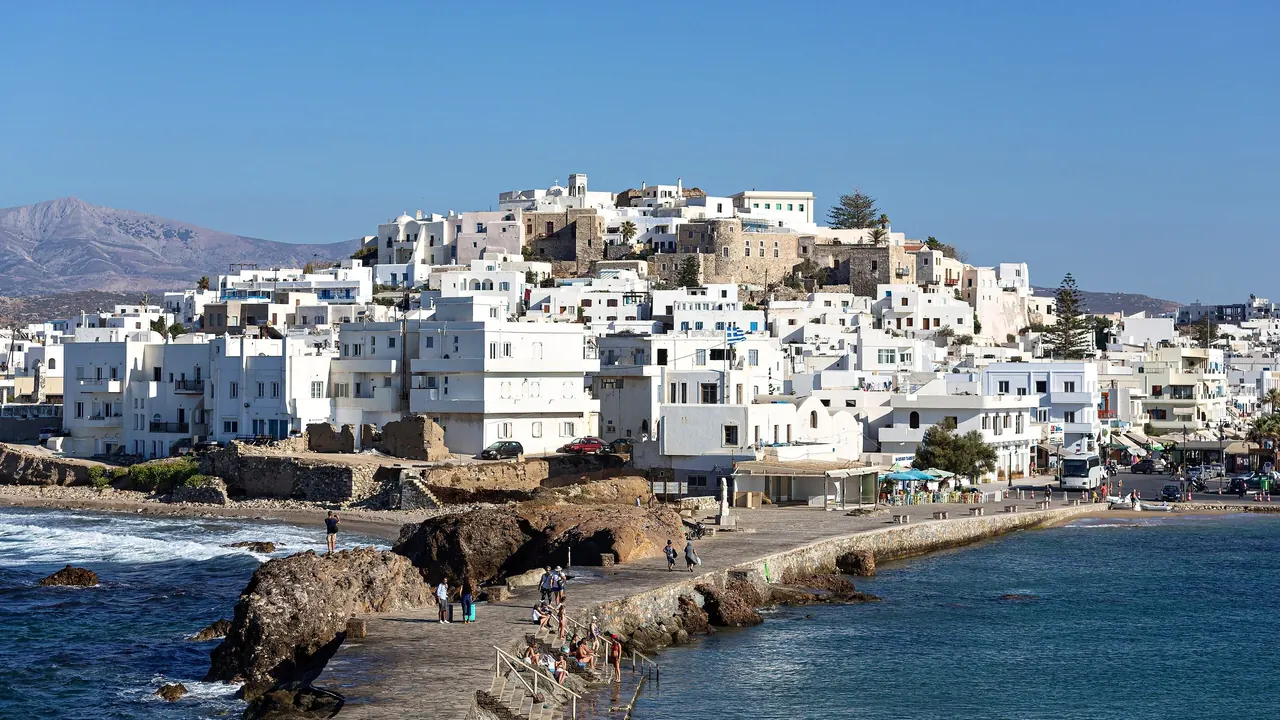
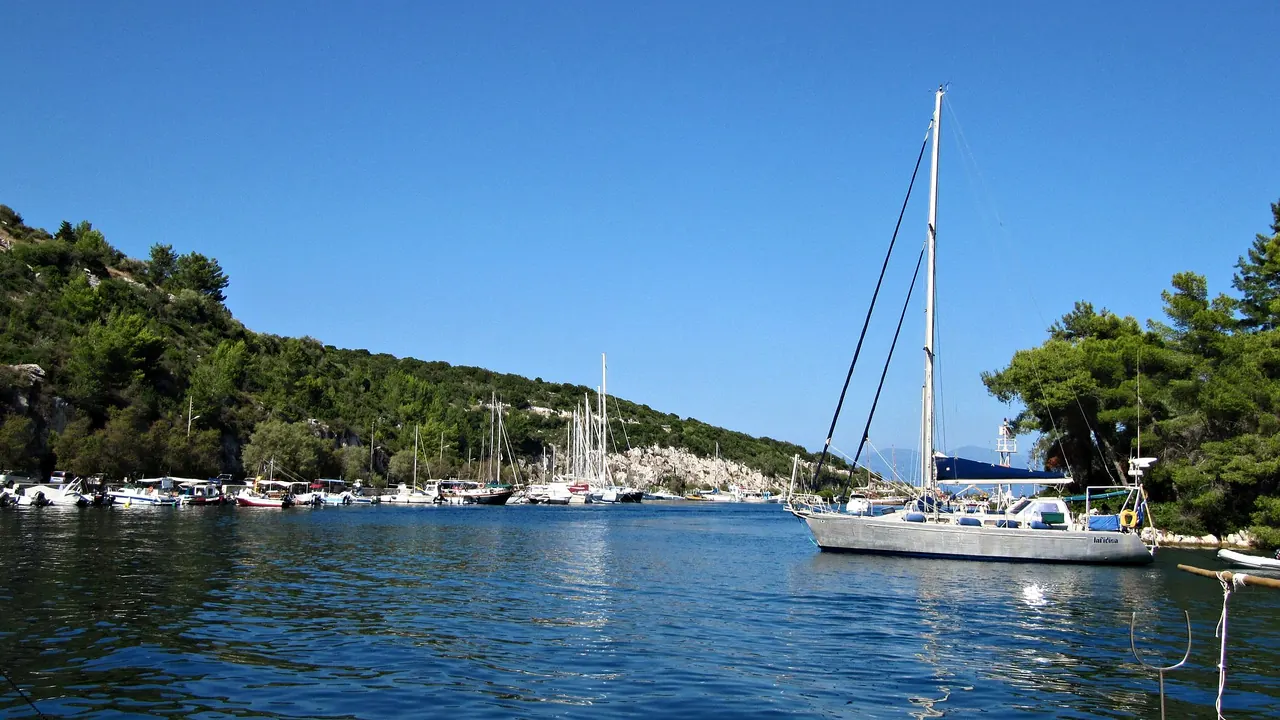
Photos: Naxos by Manfred Werner (Tsui), CC BY-SA 4.0, cropped; Paxos by Poiesia, CC BY-SA 4.0, cropped.
Naxos or Paxos?
Our verdict in twelve categories, each scored against the same fixed benchmark cities, and the climate month by month, so you can choose for your trip.
Choose Naxos for
- culture and sights
- families
- prices
Naxos suits the traveller who wants a lot from one island: a long chain of sandy beaches on the west coast, marble villages and Byzantine chapels inland, a mountain to climb and ferries to half the Cyclades. It is also the easier and cheaper island of the two. Buses run along the beach strip, the sand shelves gently for small children, and family-run studios keep a summer stay within reach.
Choose Paxos for
- wellness
Choose Paxos for a slower, more private stay. It is a small island covered in olive trees, and the days revolve around a hired boat, the pebble coves of the east coast and the turquoise sand of Antipaxos. Evenings end early on the harbour at Gaios or Lakka. It costs more and has less to see, but for a couple who want quiet, clear water and a villa among the olive groves, that narrowness is the point.
Scoreboard
Twelve categories on one fixed scale from 0 to 100. The shaded stretch is the gap between the two.
Your match
Pick a travel style or drag the sliders, and both match scores follow your weighting.
Wins on culture and sights and families with your weighting.
Wins on wellness with your weighting.
What matters to you?
Category by category
What the scores mean for a trip.
Beaches & swimming
Both islands are superb for swimming, but the beaches are very different. On Naxos the west coast south of Chora is one long run of fine pale sand, from Agios Prokopios and Agia Anna to the dunes of Plaka, Mikri Vigla and Alyko. You can walk straight onto it from your room, and a quiet stretch is never far away. The catch is the meltemi, which can churn up the open beaches for days at a time.
Paxos is mostly pebble coves along its sheltered east coast, with sandy shallows only in Lakka bay, and its west coast is all cliffs. The beaches people remember are a boat ride away on Antipaxos, where Voutoumi and Vrika have turquoise water but get crowded at midday. On Naxos you walk to the beach. On Paxos you mostly take a boat.
Food & drink
Naxos eats better because it produces so much of its own food: potatoes from the valleys, graviera and arseniko cheeses from the hill herds, and kitron liqueur distilled in Halki. The meals to look for are grilled meat and slow stews in the tavernas of Halki, Filoti, Apiranthos and Koronos, along with fish on the harbourfront in Chora.
Paxos has fewer places to eat, mostly harbourside tavernas in Gaios, Lakka and Loggos serving fish, bourdeto and sofrito with the island's olive oil. Cooking for villa guests keeps standards fairly high, but the menus are much alike and many kitchens close out of season. Neither island offers much beyond Greek cooking.
Culture & sights
The islands are far apart here. Naxos has thousands of years of history to show: the marble Portara framing Chora's harbour, the Venetian kastro with its mansions and Cycladic figurines, the Temple of Demeter near Sangri, and the unfinished kouroi still lying in the quarries at Flerio and Apollonas. Add the Byzantine chapels of the Tragaea valley and you have several days of driving between sights.
Paxos has the ruined Venetian fort and the small monastery on the islets off Gaios, a schoolhouse museum of olive farming, and old presses and stone houses you pass on a walk. Anyone who wants real history takes the boat to Corfu Town.
Nightlife
Neither island is a place for partying, but Naxos has more going on after dinner. In summer the lanes below the kastro in Chora fill with cocktail and music bars, a couple of clubs stay open into the small hours, and the beach bars at Agios Prokopios and Plaka hold sunset sessions.
On Paxos the evening is a drink on the waterfront in Gaios or Lakka with yachts moored a few metres away. Only in July and August does the harbour stay lively late, with one or two places to dance.
Nature & outdoors
Naxos offers more variety outdoors. Mount Zas rises to about 1,000m above Filoti, the mule paths of the Tragaea valley run through olive groves between marble villages, and the north and east coasts are wild and empty. The meltemi also makes Mikri Vigla one of the best kitesurfing and windsurfing spots in the Aegean.
Paxos is low and gentle, a single island of olive groves crossed by a waymarked trail from end to end. Its best scenery is on the sea. The white cliffs at Erimitis, the Tripitos arch and the sea caves are best seen from a kayak or a boat, and the snorkelling is excellent.
Day trips
Naxos sits at the centre of the Cyclades, so the ferry choice is wide. Paros is under an hour away, the quiet Small Cyclades of Koufonisia, Schinoussa and Iraklia make easy days out, Mykonos leads on to Delos, and Santorini is possible in a long day. The drive through the hill villages to Apollonas fills another day without leaving the island.
From Paxos the main outing is Corfu Town, about an hour by fast ferry, with its fortresses and UNESCO-listed old town. Excursion boats also run to Parga and the coves around Sivota, and Antipaxos is close by. Once those are done, there is little else, and rough seas can cancel any of them.
Good for families
Naxos is the better island for children. The west-coast sand is soft and shallow a long way out, Agios Georgios is sheltered and within walking distance of Chora, and even in August there is room to spread out. Neither island has attractions built for children, so days on Naxos are beach, boat and village ice cream.
Paxos suits families with older children who like swimming and snorkelling. Lakka bay is the one easy spot for toddlers, most other beaches are pebble with steep paths, and villas up in the olive groves mean driving everywhere.
Getting around
Naxos is easier to reach and to get around. It has a small airport as well as ferries, and in summer buses from Chora's harbour serve the west-coast beaches as far as Plaka and the main mountain villages, so a stay in Chora or Agios Prokopios works without a car. You will need a car for the interior and the far north, and the winding drive to Apollonas takes well over an hour.
Paxos can only be reached by ferry, and rough seas can stop the boats. The island is only about 10km long, but buses are rare, so most visitors hire a scooter or a small car, and many find a hired boat the most useful way to reach the coves.
Shopping & style
Shopping is a sideline on both islands, though Naxos has a little more to browse. The old market lanes below the kastro in Chora have jewellery, ceramics and linen, and Apiranthos and Halki sell local weaving and marble work. Paxos has a few summer boutiques behind the harbours in Gaios and Lakka, and anything practical means a trip to Corfu. On both islands the best things to take home are edible: cheese and kitron from Naxos, olive oil and honey from Paxos.
Affordability
Naxos is noticeably cheaper. Family-run studios and village rooms stay affordable even in summer, taverna meals and buses are reasonable, and only August pushes up room and car hire prices.
Paxos is one of the dearer Greek islands. Most places to stay are private villas, harbourside restaurants charge for the setting, and ferry crossings plus boat or car hire add to the bill. Self-catering helps, and on both islands the shoulder months are kinder on the budget.
Live music & performing arts
On both islands the music worth staying up for belongs to the saints' days rather than a stage. Naxos holds its village panigyria right through the summer, with island violin and lute playing late, and adds a summer festival of concerts and theatre in a restored Venetian tower inland, plus small recitals in Chora's kastro.
Paxos has fewer dates to aim for. The big night is the August feast of the Panagia in Gaios, and at the end of summer a small chamber music festival fills churches and village squares. The rest of the season, live music means the odd guitarist in a taverna.
Wellness & relaxation
Paxos is the more restful island. With few cars and no high-rise building, villas looking out to sea through the olive trees, and yoga or retreat weeks on some estates, it feels calm almost everywhere, especially once the Corfu day boats thin out.
Naxos is larger and busier in August. You find the same easy routine of swim, siesta and long dinner in the hills around Halki or on the emptier southern beaches. Neither island has a spa or bathing tradition.
When should you go?
Pick your month. The climate figures are measured averages, not a forecast.
Naxos in July
Paxos in July
Daytime high, °C
Rainfall in the month, mm
Where the figures come from
Naxos's temperatures are measured 79 km from the centre, at Santorini Island / Monólithos.
Naxos has no rain gauge within 25 km of the centre, so its rainfall comes from a gridded climate dataset read at the destination rather than from a gauge further away.
Paxos's temperatures are measured 52 km from the centre, at Kerkyra Airport.
Paxos has no rain gauge within 25 km of the centre, so its rainfall comes from a gridded climate dataset read at the destination rather than from a gauge further away.
Temperature and rainfall are climate normals, averaged over the years shown. Naxos: 2000-2025, 12 years observed (rainfall 1991-2020) normals, Santorini Island / Monólithos (78.8 km from centre). Paxos: 1991-2020 normals, Kerkyra Airport (52.1 km from centre).
Around Chora on Naxos, the weather is almost rainless from May to September, and the sea is warm enough to swim from June to October. July and August reach about 30°C. That is fine on the beach, where the meltemi takes the edge off, but too hot for walking the mountain paths after mid-morning. The wet months run from November to February, mild but often grey. April, May and October are the best months for exploring the villages on foot.
Paxos runs hotter and much wetter. July and August are its driest and sunniest months, reaching about 32°C, and the sea ends up slightly warmer, about 26°C in August. June is almost as dry and a little less hot, so it suits anyone who wants to walk the olive-grove trail as well as swim. The rain comes earlier than on Naxos: September is already showery, and by November Paxos gets 163mm, close to three times as much as Naxos. On Naxos, September is as settled as June.
Which traveller are you?
On a culture and arts trip, choose Naxos. Ancient temples, a Venetian kastro, marble quarries and frescoed Byzantine chapels are spread across the island, so you can plan several days around them with a hired car. On Paxos the history takes a morning, and anything more means a day in Corfu Town.
On a family trip with young children, Naxos makes the days simpler. Stay at Agios Prokopios or Plaka and the beach, a taverna and the bus stop are all close by, so there is no car or boat to arrange. Paxos is better kept for when the children are old enough to snorkel.
For a relaxing and wellness trip, Paxos is the better choice if rest means doing almost nothing: a terrace with a sea view, a slow boat to an empty cove, an early night. You can slow down just as much on Naxos in a mountain village, but there you have to look for the quiet.
Before you go
| Measure | Naxos | Paxos |
|---|---|---|
| Official language | Greek | Greek |
| Currency | Euro (EUR) | Euro (EUR) |
| Sockets | CF230 V, 50 Hz | CF230 V, 50 Hz |
| Driving side | Right | Right |
| Time zone | UTC+2, UTC+3 in summer | UTC+2, UTC+3 in summer |
| Emergency number | 112 | 112 |
| Main airport | Naxos Island National Airport (JNX)3 non-stop destinations | Corfu Ioannis Kapodistrias International Airport (CFU)88 non-stop destinations |
| Public holidays this year | 15 days | 15 days |
By the numbers
| Measure | Naxos | Paxos |
|---|---|---|
| Population | 17,930 | 2,300 |
| People per km² | 42 | 91 |
| Swim season, months above 21 °C | 5 months | 5 months |
Where else could you go?
Every comparison below shares a destination with this one, so you can follow Naxos or Paxos somewhere new.