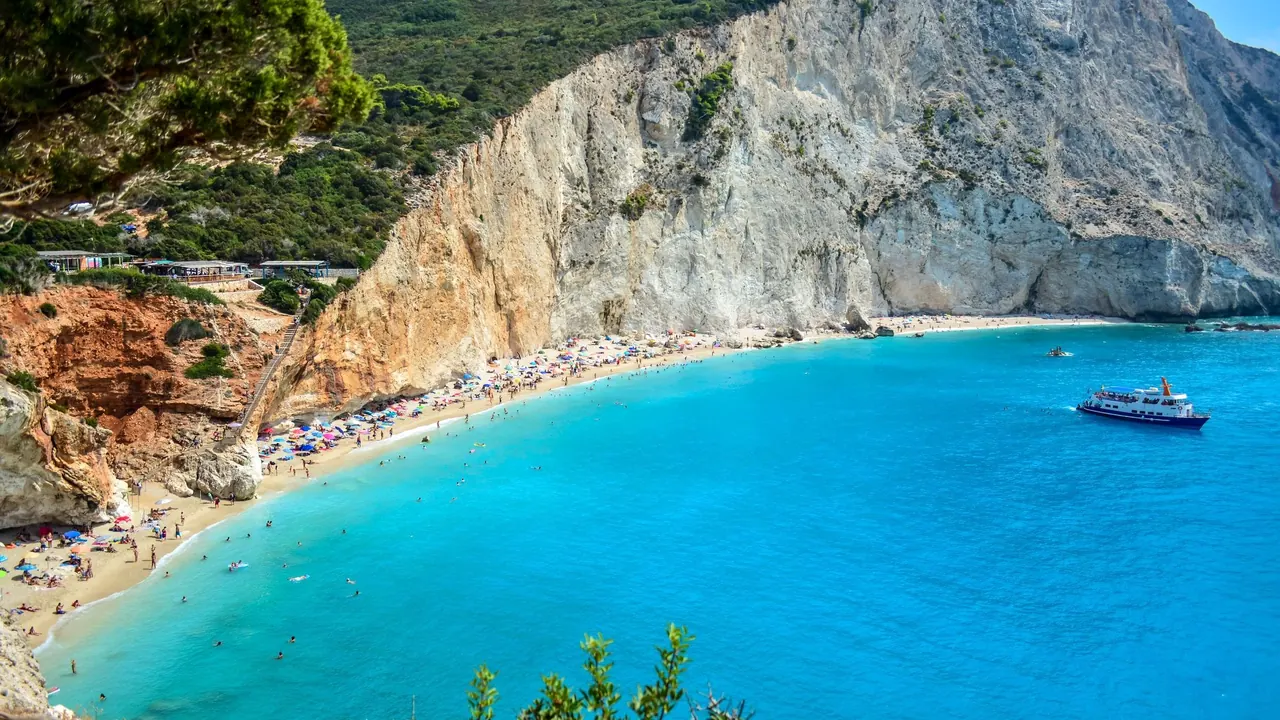
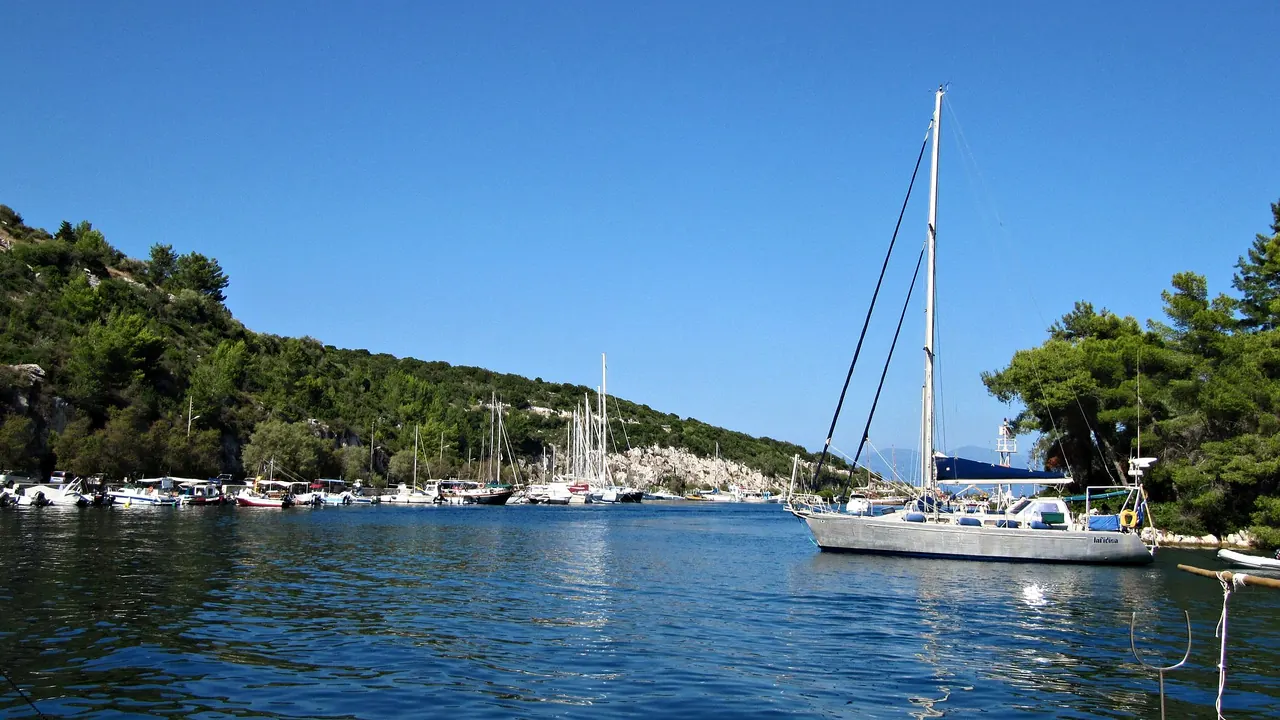
Photos: Lefkada by Antone Adi, Pexels License; Paxos by Poiesia, CC BY-SA 4.0, cropped.
Lefkada or Paxos?
Our verdict in twelve categories, each scored against the same fixed benchmark cities, and the climate month by month, so you can choose for your trip.
Choose Lefkada for
- prices
- day trips
- nightlife
Lefkada is the bigger, busier and more varied island, and it suits a trip with plenty going on. It has the dramatic west-coast strands under white cliffs, the windsurfing bay at Vasiliki, sailing waters to the east, and a mainland drive to Parga or Nikopolis. Lefkada town gives you evenings out as well. It is also the easier island on the budget, and since a causeway joins it to the mainland, you reach it by road from a nearby airport rather than by ferry.
Choose Paxos for
- wellness
- getting around
Paxos is for travellers who want to do very little, very well. It is a small, low island of olive groves, pebble coves and three harbour villages, with the sand of Antipaxos a short boat ride away. Its calm is the whole point: few cars, quiet evenings by the yachts, villas among the trees. You pay more for that, and you give up nightlife, sights and much variety beyond the boat.
Scoreboard
Twelve categories on one fixed scale from 0 to 100. The shaded stretch is the gap between the two.
Your match
Pick a travel style or drag the sliders, and both match scores follow your weighting.
Wins on prices and day trips with your weighting.
Wins on wellness and getting around with your weighting.
What matters to you?
Category by category
What the scores mean for a trip.
Beaches & swimming
Both islands are built around swimming, but the beaches differ in kind. Lefkada's west coast has long, open strands such as Kathisma, Porto Katsiki and Egremni, with turquoise water below high cliffs. Being open to the Ionian, they get afternoon waves and the shore shelves steeply. For calm water you go to the east-coast bays around Nikiana and Ligia, or south to Agiofili.
Paxos itself is mostly small pebble coves on the sheltered east side, plus sandy shallows in the bay at Lakka. Its best sand is across the water on Antipaxos, at Voutoumi and Vrika. Many visitors hire a motorboat for coves no road reaches, which makes a beach day on Paxos a boat day.
Food & drink
Lefkada has a little more range. On top of harbour fish in Lefkada town and Nidri, it has a mountain-village kitchen around Karya and Englouvi, small lentils from the Eglouvi plateau and its own cured salami. Away from the resort strips, you get a fair sense of how the island itself eats.
Paxos cooks Ionian dishes such as bourdeto and sofrito, dressed with its own olive oil. Because so many guests stay in villas, the cooking can be more careful than at a typical resort. Still, the menus in Gaios, Lakka and Loggos are much alike, and many kitchens close after summer.
Culture & sights
Neither island is a culture trip. Lefkada at least gives you a few good afternoons: the fortress of Santa Maura at the causeway, the painted Ionian churches and earthquake-proof timber houses of Lefkada town, the Faneromeni monastery and the embroidery tradition of Karya.
On Paxos, the sights are mostly seen from the harbour at Gaios: a ruined Venetian fort and a small monastery on two islets, plus a modest museum of island life. Anyone wanting real history takes the ferry to Corfu Town.
Nightlife
Lefkada has a proper summer night out. Lefkada town's lanes and waterfront fill with cocktail bars and young Greek visitors, Nidri's harbour draws resort guests and sailing crews, and Vasiliki has the windsurfers' bars. It is still a scene for drinks and strolling rather than clubs.
On Paxos, a night out usually means a long harbour dinner and a drink beside the moored yachts in Gaios or Lakka. Only a couple of places have dancing, and even that is only in high summer.
Nature & outdoors
Lefkada is the more dramatic island, and the more active one. It rises above 1,100m into a green mountain interior, has a cliff road to Cape Lefkatas and a waterfall walk above Nidri. On the water, Vasiliki is one of the Mediterranean's known windsurfing bays, and the channels to the east are classic sailing waters for a week on a yacht.
Paxos is low and gentle, all ancient olive groves and walled mule tracks with a waymarked trail from end to end. Its best scenery is the west-coast cliffs, the Tripitos arch and the sea caves, best seen by kayak or boat, and it has good snorkelling. There is no high ground or wild country.
Day trips
From Lefkada you can head in more directions. Boats from Nidri visit Meganisi, Kalamos and Kastos, and ferries from Vasiliki reach Fiskardo on Kefalonia and Ithaca. By car you can cross to Preveza and Roman Nikopolis, or drive north to Parga past the oracle site on the Acheron.
Paxos depends on boats. Its one strong outing is Corfu Town's UNESCO-listed old town, about an hour away by fast ferry. Beyond that there are Parga, the Sivota coves and the beaches of Antipaxos, and rough seas can cancel any of them.
Good for families
Lefkada is the easier island with children, as long as you stay on the east side. The bays around Nikiana and Ligia, and the shore at Agiofili and Vasiliki, are calm enough for toddlers to paddle in. The west-coast beaches, with their surf and cliff staircases, are best kept for the odd day out.
Paxos has one ideal spot for little ones, the shallow bay at Lakka. Elsewhere, its beaches are mostly pebble at the bottom of steep paths, and villas up in the groves usually mean a car. It suits families with older children who like snorkelling better.
Getting around
Both islands need a hired car or scooter, but for different reasons. Lefkada is easy to reach, by a causeway and about half an hour from Aktion airport. Once there, though, its winding mountain and west-coast roads are slow, and Nidri and Porto Katsiki get jammed in midsummer.
Paxos is harder to reach, with no airport and ferries that bad weather can cancel. Once you arrive, its 10km length means nothing is far. A small hired boat is often the most useful vehicle of all.
Shopping & style
Shopping is a minor pleasure on both islands. Lefkada offers a bit more: a pedestrian main street in Lefkada town for an evening stroll, and hand embroidery in Karya. On Paxos it comes down to a few summer boutiques in Gaios and Lakka and a bottle of the island's olive oil to take home.
Affordability
Lefkada costs noticeably less. You can choose between studios and family apartments, taverna meals are reasonable and there are few entry fees. What adds up is August accommodation near the west coast, car hire and boat trips.
Paxos is one of the pricier Greek islands. Its villas fill early, its harbour restaurants charge for the setting, and ferries, cars and boats all add to the bill. On both islands, self-catering and the shoulder months bring the cost down.
Live music & performing arts
Live performance is thin on both islands and happens almost only in summer. Lefkada has the long-running international folklore festival every August, with dance groups on open-air stages. Paxos has a small chamber music festival at the end of summer and the August feast of the Panagia in Gaios, when traditional music goes on late.
Wellness & relaxation
On Lefkada you have to go looking for calm. You find it in the hill villages of the interior, in the small east-coast harbours at dusk, and across the whole island in June and September. In August, though, Nidri and the famous west-coast coves are crowded and noisy. Treatments mostly mean the spa at one of the better hotels or a yoga stay up in the hills.
On Paxos quiet is the normal state of the whole island, not something tucked away in a few corners. Even in high summer it is mostly the day boats from Corfu and late evenings in Gaios that disturb it. There are only a few retreats, but they match that pace: yoga weeks on private estates and massage rooms in the larger villas and hotels. May, June and September are the stillest months.
When should you go?
Pick your month. The climate figures are measured averages, not a forecast.
Lefkada in July
Paxos in July
Daytime high, °C
Rainfall in the month, mm
Where the figures come from
Lefkada has no rain gauge within 25 km of the centre, so its rainfall comes from a gridded climate dataset read at the destination rather than from a gauge further away.
Paxos's temperatures are measured 52 km from the centre, at Kerkyra Airport.
Paxos has no rain gauge within 25 km of the centre, so its rainfall comes from a gridded climate dataset read at the destination rather than from a gauge further away.
Temperature and rainfall are climate normals, averaged over the years shown. Lefkada: 1998-2020 (rainfall 1991-2020) normals, Aktion Airport (24.3 km from centre). Paxos: 1991-2020 normals, Kerkyra Airport (52.1 km from centre).
The two islands sit close together in the Ionian and share nearly the same year. The sea is warm enough for swimming from June to early October and peaks at about 26°C in August. July and August are the driest months on both and also the hottest, with afternoons around 31°C on Lefkada and 32°C on Paxos. That is fine on a beach but tiring for walking the trails or the hill villages. Paxos gets almost unbroken sun in high summer, close to 349 hours in July.
For walking, May and late September to October are the better months, warm without the summer heat. Rain returns in September and October, a little heavier on Paxos. From November to February both islands are wet and cool, with Paxos reaching about 163mm in November, so neither is a winter beach destination.
Which traveller are you?
On a trip on a tight budget, Lefkada is the better choice. It sits mid-range for a Greek island, with plenty of studios and family-run apartments. Paxos is mostly villas and harbourside restaurants, and ferry crossings, a hired car and a boat all add to the cost.
For a relaxing and wellness trip, Paxos wins. It has few cars, no high-rise building, harbours that wake slowly and villas in the olive groves. Lefkada's quiet villages and east-coast harbours are restful too, but its busiest resorts lose that calm in August.
For an outdoors trip, choose Lefkada. Vasiliki's steady afternoon winds draw windsurfers from across the Mediterranean, and there is kitesurfing at Agios Ioannis, sailing in sheltered channels, and walks up to the Dimosari waterfall and through a mountainous interior. Paxos offers a pleasant end-to-end trail and sea caves, but little more.
Before you go
| Measure | Lefkada | Paxos |
|---|---|---|
| Official language | Greek | Greek |
| Currency | Euro (EUR) | Euro (EUR) |
| Sockets | CF230 V, 50 Hz | CF230 V, 50 Hz |
| Driving side | Right | Right |
| Time zone | UTC+2, UTC+3 in summer | UTC+2, UTC+3 in summer |
| Emergency number | 112 | 112 |
| Main airport | Aktion National Airport (PVK)47 non-stop destinations | Corfu Ioannis Kapodistrias International Airport (CFU)88 non-stop destinations |
| Public holidays this year | 15 days | 15 days |
By the numbers
| Measure | Lefkada | Paxos |
|---|---|---|
| Population | 22,652 | 2,300 |
| People per km² | 64 | 91 |
| Swim season, months above 21 °C | 5 months | 5 months |
Where else could you go?
Every comparison below shares a destination with this one, so you can follow Lefkada or Paxos somewhere new.
- Corfuvs Paxos
- Kefaloniavs Lefkada
- Corfuvs Lefkada
- Kefaloniavs Paxos
- Zakynthosvs Lefkada
- Zakynthosvs Paxos