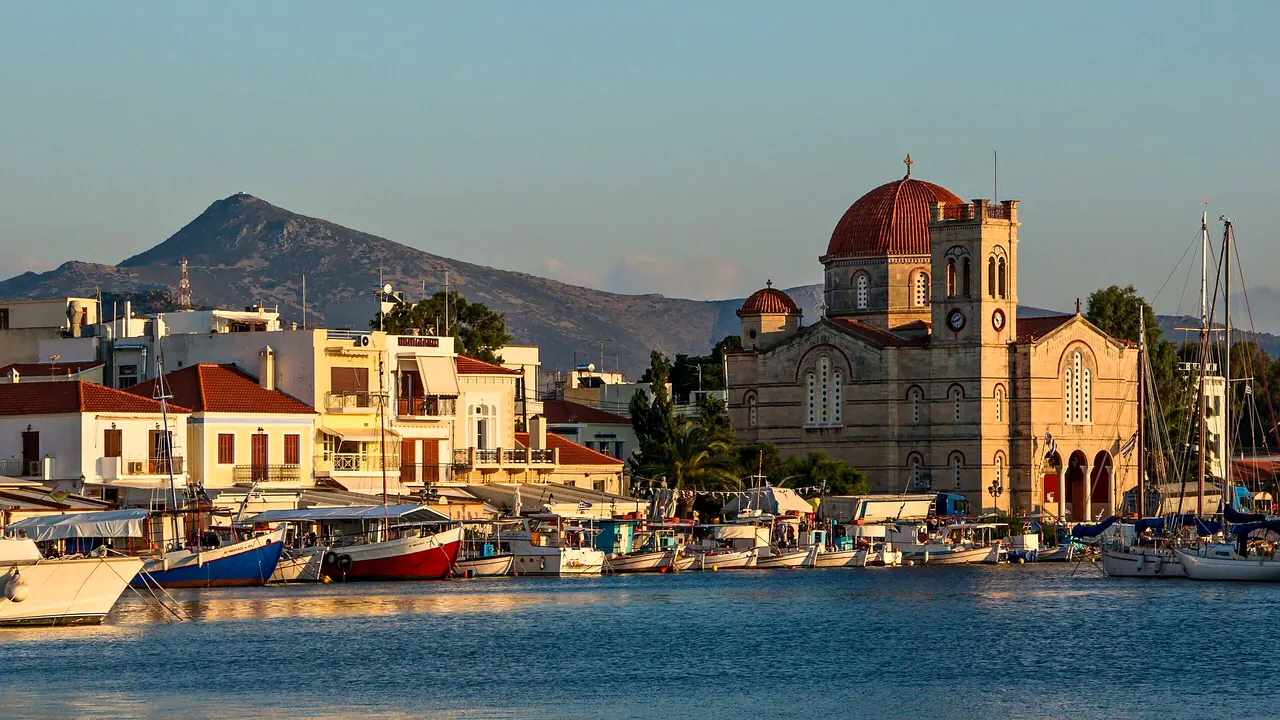
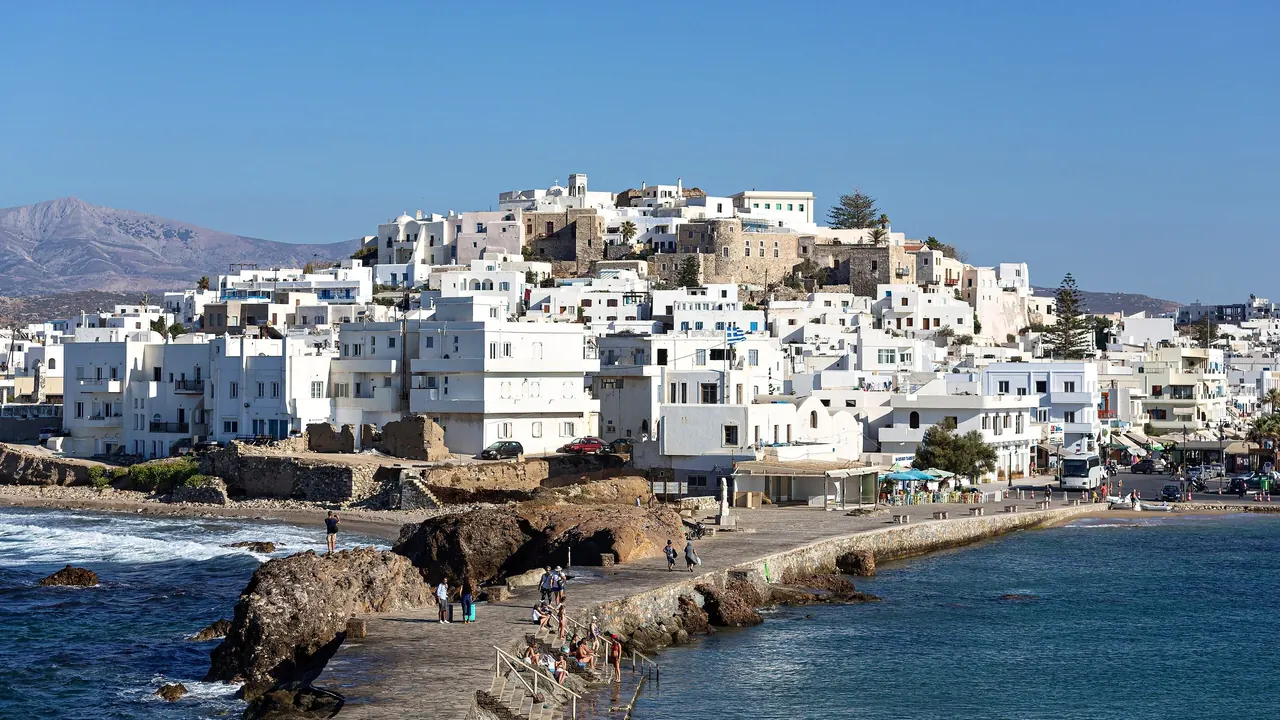
Photos: Aegina by Jebulon, CC0; Naxos by Manfred Werner (Tsui), CC BY-SA 4.0, cropped.
Aegina or Naxos?
Our verdict in twelve categories, each scored against the same fixed benchmark cities, and the climate month by month, so you can choose for your trip.
Choose Aegina for
- day trips
- getting around
- prices
Aegina suits a traveller who wants Greek island life without giving a day to getting there. The fast boat from Piraeus takes well under an hour, so the island pairs naturally with Athens: a few days of the Acropolis and the city museums, then quiet coves at Marathonas, the Temple of Aphaia on its pine hill and fish dinners on the quay at Perdika. It is a small, easy place for a short, unhurried stay, and its tavernas cook for Athenians rather than for tour groups.
Choose Naxos for
- beaches
- families
- food and drink
Naxos is the better choice for a longer beach vacation and for anyone who wants an island with room to explore. The west coast is an almost unbroken run of pale sand from Agios Prokopios down to Alyko, the shallow water suits children, and inland there are mountain villages, Mount Zas and Byzantine chapels to fill the days when the meltemi blows. It also eats better, with its own cheeses, meat and kitron, and it gives you the wider Cyclades by ferry.
Scoreboard
Twelve categories on one fixed scale from 0 to 100. The shaded stretch is the gap between the two.
Your match
Pick a travel style or drag the sliders, and both match scores follow your weighting.
Wins on day trips and getting around with your weighting.
Wins on beaches and families with your weighting.
What matters to you?
Category by category
What the scores mean for a trip.
Beaches & swimming
This is where the two islands differ most. Aegina's swimming is low-key and local: small coves at Marathonas and Aiginitissa, rocks to dive off near Perdika, the pine-fringed pebbly cove on Moni and the one long sandy resort strip at Agia Marina. The water is calm and slightly warmer, but nobody comes for long white beaches.
Naxos is built around them. From Agios Georgios on the edge of Chora down to Plaka, Mikri Vigla and Alyko runs a near-continuous line of pale sand and dunes, with shallow water stretching far out. The catch is the meltemi, which can make the open beaches choppy, so you'll want sheltered spots like Agios Georgios to hand.
Food & drink
Each island has one product it is known for. On Aegina it is the pistachio, which turns up in pastries, spreads and liqueurs, and the eating centres on meze and ouzo in the lanes around the old fish market and on fish at Perdika. It is honest cooking with a narrow range.
Naxos goes deeper because it farms so much of what it eats: potatoes, graviera and arseniko cheeses, local meat and kitron distilled in Halki. Its best meals are the slow stews and grills in mountain villages such as Apiranthos and Koronos, which give it a second cuisine beyond seafood. Neither island does fine dining or much outside Greek food, and on Naxos the beach strips are more predictable than Aegina's tavernas, which cater to Athenian weekenders.
Culture & sights
Aegina has one great monument. The Doric Temple of Aphaia is among the best-preserved in Greece, and Kolona, the chapels of Paleochora and the neoclassical houses from the town's spell as the first capital of modern Greece add a short but rewarding list.
Naxos has nothing quite as complete as Aphaia, but there is more of it, spread across the whole island. You get the Portara over the harbour, the Venetian kastro in Chora, the Temple of Demeter near Sangri, the abandoned kouroi at Flerio and Apollonas and the early frescoes of Panagia Drosiani, which together make several days of driving.
Nightlife
Neither island is for clubbing, and on both an evening means a long dinner and drinks by the water. On Aegina, the harbour bars fill with weekend crowds from Athens, and a proper night out means the ferry back to the city.
Naxos has a little more structure in summer, with music bars below the kastro, a couple of clubs open late and sunset sessions at the beach bars of Agios Prokopios and Plaka. Both go quiet early once the summer season ends.
Nature & outdoors
Aegina's landscape is soft and agricultural: pistachio orchards, olive groves and pine on low volcanic hills, with the cone of Mount Oros and its ruined sanctuary of Zeus as the one real climb. The quiet interior roads are good on a bicycle, and the sheltered gulf makes for easy sailing.
Naxos is on a different scale, the most mountainous and greenest island in the Cyclades. Mount Zas is roughly twice the height of Oros, mule paths link the marble villages, and the wild north and east coasts are empty. The same meltemi that roughens the beaches makes Mikri Vigla a serious kitesurfing and windsurfing spot, which Aegina has no equivalent of.
Day trips
Aegina has the edge here because of where it sits. Athens is a short fast-boat ride away, so the Acropolis and the national museums become a day out, and Agistri, Poros, car-free Hydra and, via the mainland, Epidaurus are all within reach.
Naxos offers island-hopping instead of a capital: Paros and the Small Cyclades are close, Mykonos leads on to Delos, and Santorini makes a long day. Those routes depend more on summer timetables and the wind, and none of them gives you a great city.
Good for families
Both islands are safe and relaxed, with tavernas that welcome children and nothing built specially for them. Aegina works for a short stay with small children, with gentle water at Agia Marina and Marathonas and the peacocks and deer on Moni as the outing.
Naxos is better for a full family fortnight. Its beaches are wider, softer and shallower, they have room even in August, and Agios Georgios is a walk from Chora and out of the wind. Expect the odd day when the meltemi makes the open west coast too rough for little ones.
Getting around
Getting around is similar in difficulty but works differently. Aegina is small and close to the mainland: the boat from Piraeus is short, no drive takes much over half an hour, and a scooter covers the island easily, though buses are too sparse to rely on.
Naxos takes a long ferry to reach and is far larger. Summer buses serve the west-coast beaches and main villages well enough that you can manage without a car in Chora or Agios Prokopios, but the interior and the north mean winding roads, and the drive to Apollonas takes well over an hour.
Shopping & style
Neither island is a shopping destination, but Naxos gives you more to browse. On Aegina, the shopping comes down to pistachios in every form, plus a few ceramics and souvenir shops along the harbour. Naxos adds the jewellery, linen and ceramic shops in the old market below the kastro, weaving and marble work in Apiranthos and Halki, and a better edible haul of graviera, kitron, honey and thyme.
Affordability
Both are moderately priced by Greek island standards, and the costs fall in different places. On Aegina, tavernas and guesthouses charge mainland prices because most visitors are Greek, the crossing is cheap and short, and rooms are the pinch on summer weekends and in August.
On Naxos, family-run studios and village rooms keep things reasonable, but the longer ferry adds to the trip, and August pushes up both beachfront rooms and car hire. On both islands, June and September are the times to go for value.
Live music & performing arts
Formal performance is thin on both, and Naxos has slightly more to plan around. Aegina offers summer open-air cinema, occasional concerts and live Greek music in tavernas, with Athens and Epidaurus close by for theatre and opera. Naxos has a summer festival in a Venetian tower and recitals in the kastro. Above all, it has the village panigyria, where violin and lute play late into the night and the whole village dances.
Wellness & relaxation
On wellness the two are much the same: no spa or bathing tradition, a few hotel spas, and rest as the real offer. What differs is the setting for it. On Aegina, the quiet comes from weekdays in Perdika and the stillness of Paleochora's chapels, close enough to Athens for a short break. On Naxos, you can retreat into the hills around Halki or to the emptier southern beaches, and there are a few small yoga retreats on the southwest coast.
When should you go?
Pick your month. The climate figures are measured averages, not a forecast.
Aegina in July
Naxos in July
Daytime high, °C
Rainfall in the month, mm
Where the figures come from
Aegina's temperatures are measured 32 km from the centre, at Athinai Airport.
Aegina has no rain gauge within 25 km of the centre, so its rainfall comes from a gridded climate dataset read at the destination rather than from a gauge further away.
Naxos's temperatures are measured 79 km from the centre, at Santorini Island / Monólithos.
Naxos has no rain gauge within 25 km of the centre, so its rainfall comes from a gridded climate dataset read at the destination rather than from a gauge further away.
Temperature and rainfall are climate normals, averaged over the years shown. Aegina: 1991-2020 normals, Athinai Airport (31.8 km from centre). Naxos: 2000-2025, 12 years observed (rainfall 1991-2020) normals, Santorini Island / Monólithos (78.8 km from centre).
Both islands are summer swimming places, with the sea warm enough from June to October, but they feel different in high summer. Aegina sits in the hotter, more sheltered Saronic Gulf, where July and August reach about 33°C and the sea warms to around 26°C, so walking around Aegina town or up to Aphaia is best left to the morning or evening. Naxos stays a few degrees cooler, around 30°C, thanks to the northerly meltemi, which takes the edge off the heat but can churn up the west-coast beaches for days at a time.
For walking and sightseeing, May and late September to October are the sweet spot on both, warm and almost dry. The rain arrives in November on both islands and peaks in winter, around 77mm a month on Aegina in December, and Naxos is slightly wetter still in January. Winter days are mild but grey on both, and neither is a beach place from November to April.
Which traveller are you?
On a beach and sun trip, Naxos is the clear pick. Its west coast offers a long chain of fine sand and shallow, clear water, with enough strands that you can find a quiet one, whereas Aegina offers small coves, rocks and a single resort beach.
For an outdoors trip, Naxos has the mountains and the wind. You can climb Mount Zas, follow mule paths between the Tragaea villages or kitesurf off Mikri Vigla. Aegina's low hills, the walk up Mount Oros and the cycling among its orchards fill a day or two.
For a short city break, Aegina is the natural add-on to Athens. It is a quick boat ride from Piraeus, compact enough for a weekend, and the Acropolis stays within easy reach. Naxos is too far out to do justice to in a few days.
Before you go
| Measure | Aegina | Naxos |
|---|---|---|
| Official language | Greek | Greek |
| Currency | Euro (EUR) | Euro (EUR) |
| Sockets | CF230 V, 50 Hz | CF230 V, 50 Hz |
| Driving side | Right | Right |
| Time zone | UTC+2, UTC+3 in summer | UTC+2, UTC+3 in summer |
| Emergency number | 112 | 112 |
| Main airport | Athens Eleftherios Venizelos International Airport (ATH)176 non-stop destinations | Naxos Island National Airport (JNX)3 non-stop destinations |
| Public holidays this year | 15 days | 15 days |
By the numbers
| Measure | Aegina | Naxos |
|---|---|---|
| Population | 13,056 | 17,930 |
| People per km² | 149 | 42 |
| Swim season, months above 21 °C | 5 months | 5 months |
Where else could you go?
Every comparison below shares a destination with this one, so you can follow Aegina or Naxos somewhere new.