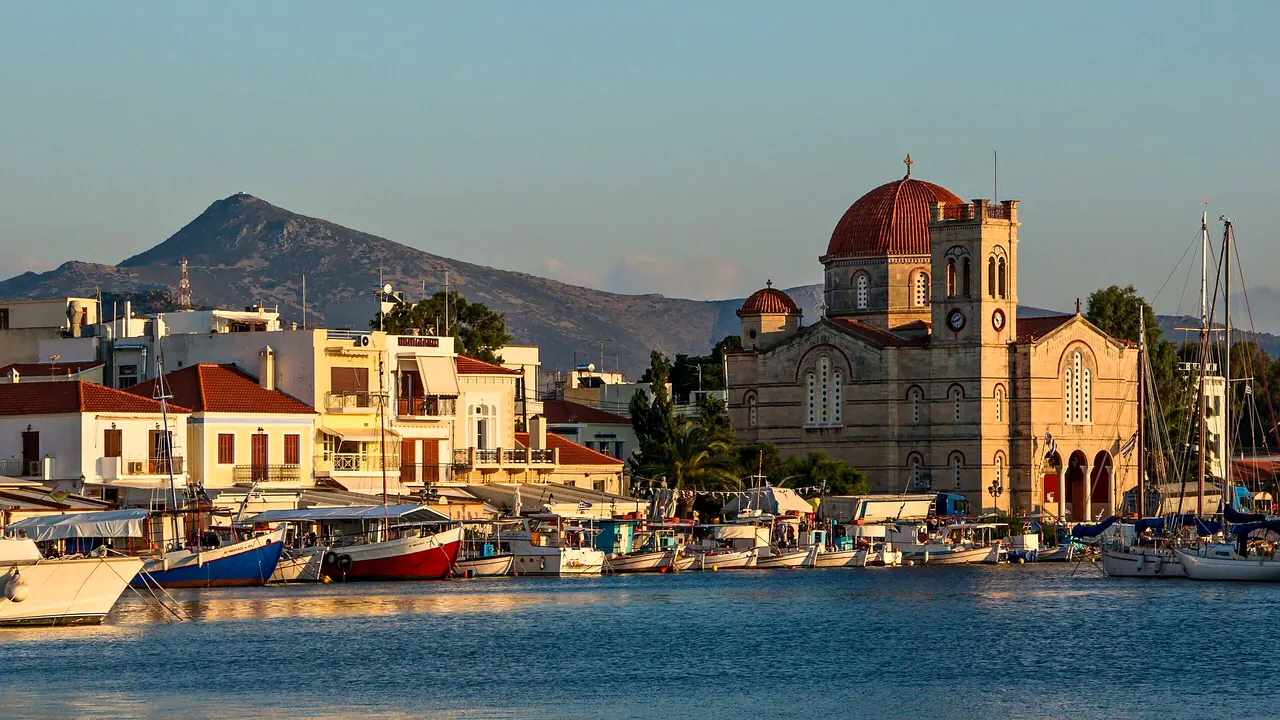
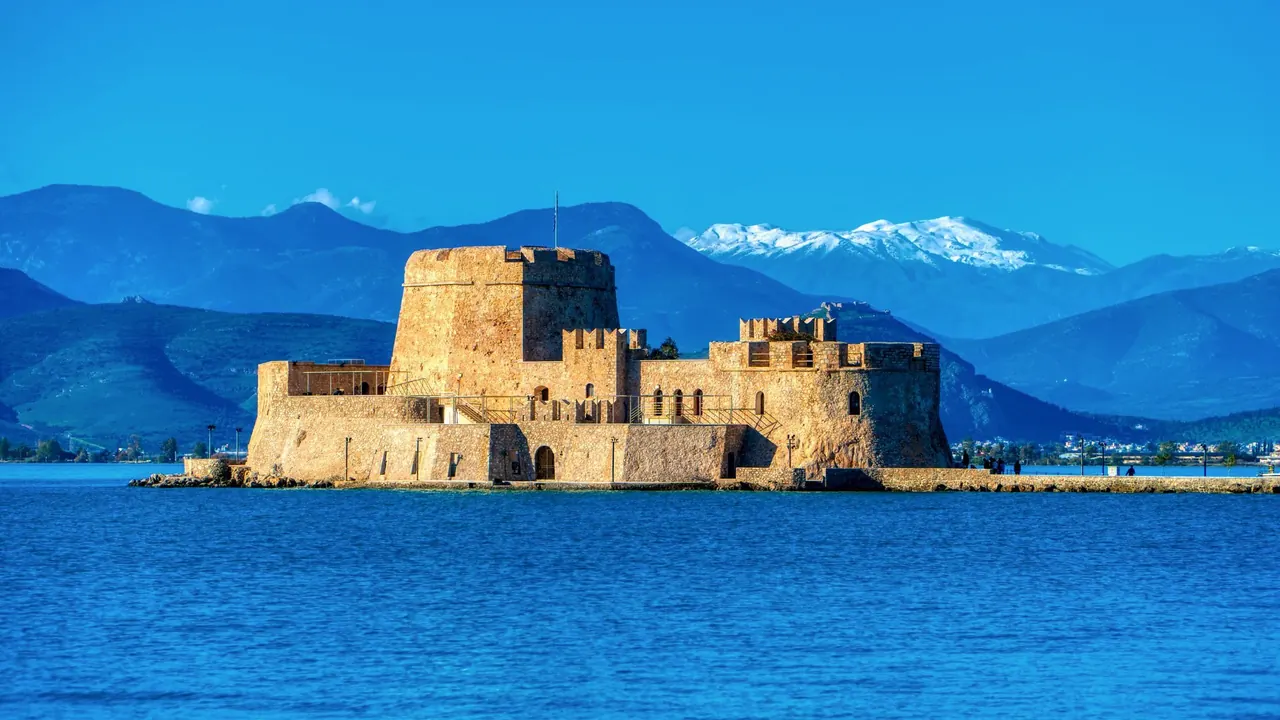
Photos: Aegina by Jebulon, CC0; Peloponnese by Alex Ravvas, Pexels License.
Aegina or Peloponnese?
Our verdict in twelve categories, each scored against the same fixed benchmark cities, and the climate month by month, so you can choose for your trip.
Choose Aegina for
- getting around
Aegina is the choice when the trip is built around Athens or kept short and simple. Forty minutes by fast boat from Piraeus, it gives you a compact harbour town, the Temple of Aphaia, pistachio orchards and calm coves without needing a car or a long drive. You can get around on a scooter or by bus, eat at Perdika's fish tavernas and be back in the capital for a museum the next morning. It suits a few slow days by the sea more than a full vacation.
Choose Peloponnese for
- culture and sights
- nature and the outdoors
- live music and the arts
The Peloponnese pays back the time it takes, and it takes a fair amount, mostly at the wheel. It has far more of almost everything: Olympia, Mycenae, Epidaurus and Mystras, long sandy beaches in Messinia and on Elafonisos, gorges and high mountains in Arcadia and the Taygetos, and the wines of Nemea. Choose it for a week or more of touring, with a rental car and two or three bases, if you want ancient sites, good swimming and hiking all in one trip.
Scoreboard
Twelve categories on one fixed scale from 0 to 100. The shaded stretch is the gap between the two.
Your match
Pick a travel style or drag the sliders, and both match scores follow your weighting.
Wins on getting around with your weighting.
Wins on culture and sights and nature and the outdoors with your weighting.
What matters to you?
Category by category
What the scores mean for a trip.
Beaches & swimming
Aegina's swimming is small-scale: coves at Marathonas and Aiginitissa, rocks to dive off near Perdika, the pine-backed pebble cove on Moni, and one proper sandy resort beach at Agia Marina. It is pleasant and easy to reach, but nowhere near the long white beaches the mainland can offer.
The Peloponnese has a coastline you can build a whole vacation around. There is the horseshoe of Voidokilia and the sands of Navarino Bay and north towards Kyparissia, the pale turquoise water off Elafonisos, and pebble coves below Mani villages such as Kardamyli. Outside high summer many of these beaches are nearly empty, something crowded little Aegina can rarely offer on a weekend.
Food & drink
Aegina's table is mostly seafood, meze and pistachios: octopus and sardines with ouzo in the lanes by the old fish market, fish on the quay at Perdika, and the island's nut in every pastry and spread. It is honest cooking, though narrow in range.
The Peloponnese cooks with a whole countryside behind it. There are Kalamata olives and oil, slow-cooked goat, wild greens and the Mani's cured pork, and wine that is part of the trip: Agiorgitiko reds in Nemea and Moschofilero whites from the Tripoli plateau. Kalamata's covered market and Nafplio's kitchens give you more choice than anywhere on Aegina, though neither place is somewhere to go for fine dining.
Culture & sights
Aegina's sights take a day or two. You have the Doric Temple of Aphaia on its pine-covered hill, the lone column at Kolona, the chapels of ruined Paleochora, and the neoclassical houses from the town's brief time as Greece's first capital. These are fine sights, but there are only a few of them.
The Peloponnese is one of the great regions of the ancient Greek world. Olympia, Mycenae with its Lion Gate, Tiryns, Epidaurus, Corinth, Messene and lonely Bassae sit alongside medieval Mystras, Monemvasia and the Venetian castles of Methoni and Koroni. You could spend a fortnight on its sites and still leave some out, with elegant Nafplio as the natural base for the Argolid.
Nightlife
Both are places for long dinners rather than late nights. On Aegina the harbour cafés and cocktail bars fill with weekend Athenians in summer, and the island goes quiet early the rest of the time.
The Peloponnese has a little more choice. Nafplio's waterfront stays up late in summer and Kalamata has busy local bars, while Patras, a university city, has the region's only real club scene. On Aegina the equivalent is the ferry back to Athens.
Nature & outdoors
Walking on Aegina means low hills and short outings. The Peloponnese has real mountains. The island's high point is the cone of Mount Oros, about 530m, a half-day climb past the old sanctuary of Zeus to a chapel on top. Beyond that, there are quiet back roads through the pistachio groves to cycle and the woods of Moni to wander.
Taygetos alone rises more than four times as high, to about 2,400m above Sparta. The Lousios gorge, the long Menalon Trail across Arcadia and the bare Mani running down to Cape Tainaron give you days of serious walking rather than a morning's stroll. Add winter skiing on Chelmos and birdwatching at the Gialova lagoon, and the mainland is the clear choice for an active trip in spring or autumn.
Day trips
Aegina's best outing is Athens itself: the Acropolis and the city's museums are a short boat ride away. Agistri, Poros and Hydra are also reachable by ferry. You plan around timetables, though, and usually see one place properly in a day.
The Peloponnese offers more, but nearly all of it by car. From Nafplio you can reach the Nemea wine villages, the ports for Spetses and Hydra, and Athens at about two hours. From the south and west you can reach Pylos, Methoni, the Mani villages, Monemvasia and Elafonisos, so the outings change completely as you move from one base to the next.
Good for families
Aegina works well for small children who are happy with simple days. The crossing is short, drives are brief, the water at Agia Marina and Marathonas shelves gently, and the peacocks and deer on Moni make a good half-day trip. Teenagers may run out of things to do.
The Peloponnese gives families a bit more: sandy shallow bays at Tolo and on Elafonisos, resort hotels in Messinia with kids' clubs and pools, and Mycenae or Olympia for older children who like a story. The price is long hours in the car, which Aegina spares you entirely.
Getting around
This is Aegina's one clear advantage. Boats cross from Piraeus all day, the harbour town is flat enough to walk, and nothing on the island is much more than half an hour away by scooter, car or one of the buses that run past Aphaia to Agia Marina or along the coast to Perdika.
The Peloponnese all but requires a car. Motorways reach Kalamata and Olympia quickly, but mountain and Mani roads are slow, buses rarely reach sites or beaches, and there are hardly any trains. Only the old towns such as Nafplio are easy on foot.
Shopping & style
Neither is a shopping destination, and Aegina has the least to offer: a bag of pistachios from a harbour shop is the usual souvenir, with a few ceramics on the side.
The Peloponnese has a little more variety. Nafplio's lanes have jewellery, worry beads and small boutiques, wineries in Nemea sell by the bottle, and the weekly markets in Kalamata and Tripoli are good for olives, honey and herbs.
Affordability
Both charge mainland Greek prices rather than the prices of the famous islands. The Peloponnese works out a little cheaper day to day, with village rooms in the Mani and Arcadia and inexpensive tavernas and wine, but the car hire and fuel you cannot avoid cut into the savings.
On Aegina, ferries, buses and scooters cost little and you need no car. Rooms are the expense, especially on summer weekends and in August, when Athenian families arrive. Midweek stays in June or September cost less at both.
Live music & performing arts
Aegina has almost no stage of its own: an open-air cinema, the odd summer concert and taverna music. For anything more you leave the island.
The Peloponnese is where islanders and Athenians go for it. Ancient drama is performed under the stars at Epidaurus on summer weekends in a theatre with famously clear acoustics, and there are concerts at the Little Theatre nearby and a dance festival in Kalamata in July. Outside summer, though, both are quiet.
Wellness & relaxation
Aegina relaxes you mainly by being slow: weekday lunches in Perdika, quiet evenings in the old town and the stillness of the chapels at Paleochora. Apart from a few small hotel spas, there are no treatments to book.
The Peloponnese has the same unhurried village pace, along with real bathing options: the old thermal towns of Loutraki and Methana, the warm sulphur lake at Kaiafas, and full spas in the large Messinian resorts. It is the better choice if the trip is meant to include some pampering.
When should you go?
Pick your month. The climate figures are measured averages, not a forecast.
Aegina in July
Peloponnese in July
Daytime high, °C
Rainfall in the month, mm
Where the figures come from
Aegina's temperatures are measured 32 km from the centre, at Athinai Airport.
Aegina has no rain gauge within 25 km of the centre, so its rainfall comes from a gridded climate dataset read at the destination rather than from a gauge further away.
Peloponnese's temperatures are measured 89 km from the centre, at Kalamata Airport.
Peloponnese has no rain gauge within 25 km of the centre, so its rainfall comes from a gridded climate dataset read at the destination rather than from a gauge further away.
Temperature and rainfall are climate normals, averaged over the years shown. Aegina: 1991-2020 normals, Athinai Airport (31.8 km from centre). Peloponnese: 1991-2020 normals, Kalamata Airport (89 km from centre).
The two share almost the same Greek summer. Both are dry and hot from June to September, with highs around 33°C on Aegina in July and August and a degree lower in the Peloponnese, too warm for walking streets or ancient sites at midday. The sea warms enough to swim from June and stays pleasant into October, reaching about 26°C in August at both. Aegina's summer is a touch sunnier and drier, with hardly any rain in July and August.
For sightseeing and hiking, the best months are May and late September into October, when the days are warm rather than fierce. That matters more in the Peloponnese, where walking country and open ancient sites are the main draw. Rain sets in from November at both, and harder in the Peloponnese, which gets around 95mm in November and December. Its winters are slightly milder, though neither place is at its best between December and February.
Which traveller are you?
On a culture and arts trip, the Peloponnese wins clearly. Olympia, Mycenae, Messene, Mystras and Monemvasia lie in one region, and summer brings ancient drama to Epidaurus. Aegina has the Temple of Aphaia and Paleochora, which you can see in one good day.
For an outdoors trip, choose the Peloponnese. The Lousios gorge, the long Menalon Trail, the 2,400m Taygetos and the rocky Mani make serious walking country, with kayaking and birdwatching on the coast. Aegina has one fine hill climb, Mount Oros, and quiet roads for cycling.
For a short city break, the Peloponnese is too spread out, while Aegina fits a few spare days around Athens. The boat from Piraeus is short, the harbour town is flat and walkable, and the temple, the coves and Perdika's tavernas are all within half an hour.
Before you go
| Measure | Aegina | Peloponnese |
|---|---|---|
| Official language | Greek | Greek |
| Currency | Euro (EUR) | Euro (EUR) |
| Sockets | CF230 V, 50 Hz | CF230 V, 50 Hz |
| Driving side | Right | Right |
| Time zone | UTC+2, UTC+3 in summer | UTC+2, UTC+3 in summer |
| Emergency number | 112 | 112 |
| Main airport | Athens Eleftherios Venizelos International Airport (ATH)176 non-stop destinations | Athens Eleftherios Venizelos International Airport (ATH)176 non-stop destinations |
| Public holidays this year | 15 days | 15 days |
By the numbers
| Measure | Aegina | Peloponnese |
|---|---|---|
| Population | 13,056 | - |
| People per km² | 149 | - |
| Swim season, months above 21 °C | 5 months | 5 months |
Where else could you go?
Every comparison below shares a destination with this one, so you can follow Aegina or Peloponnese somewhere new.