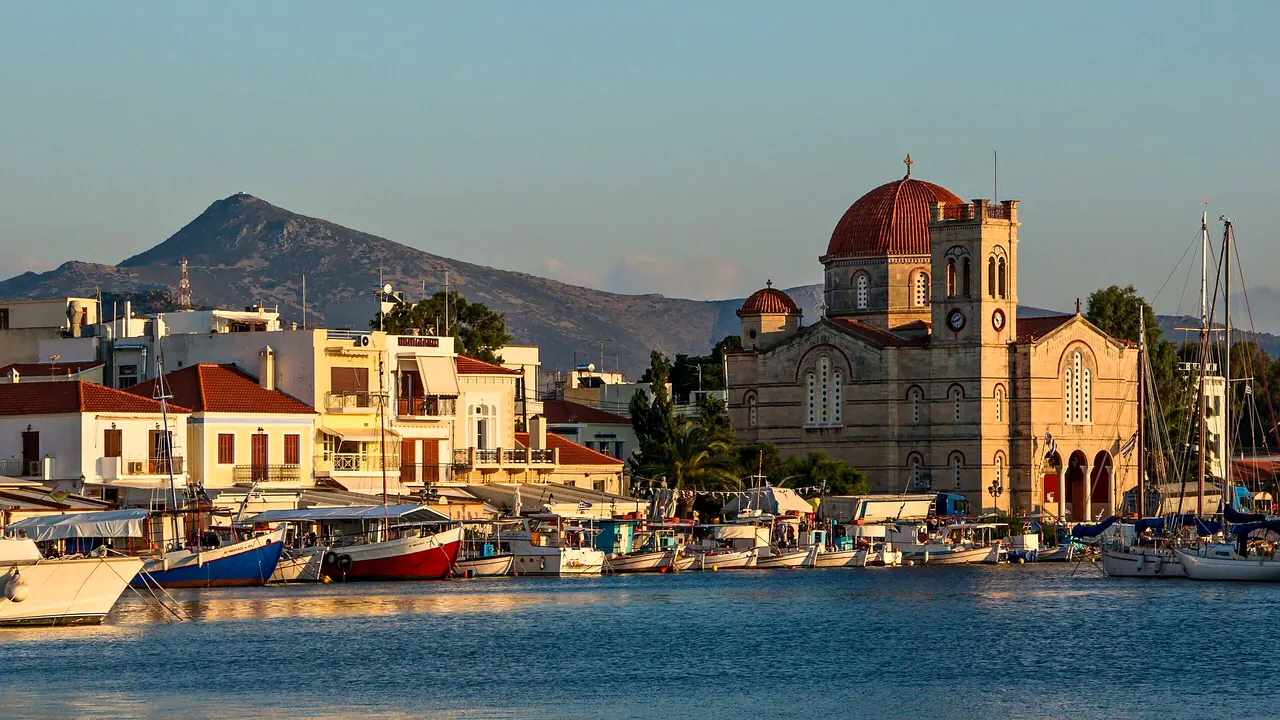
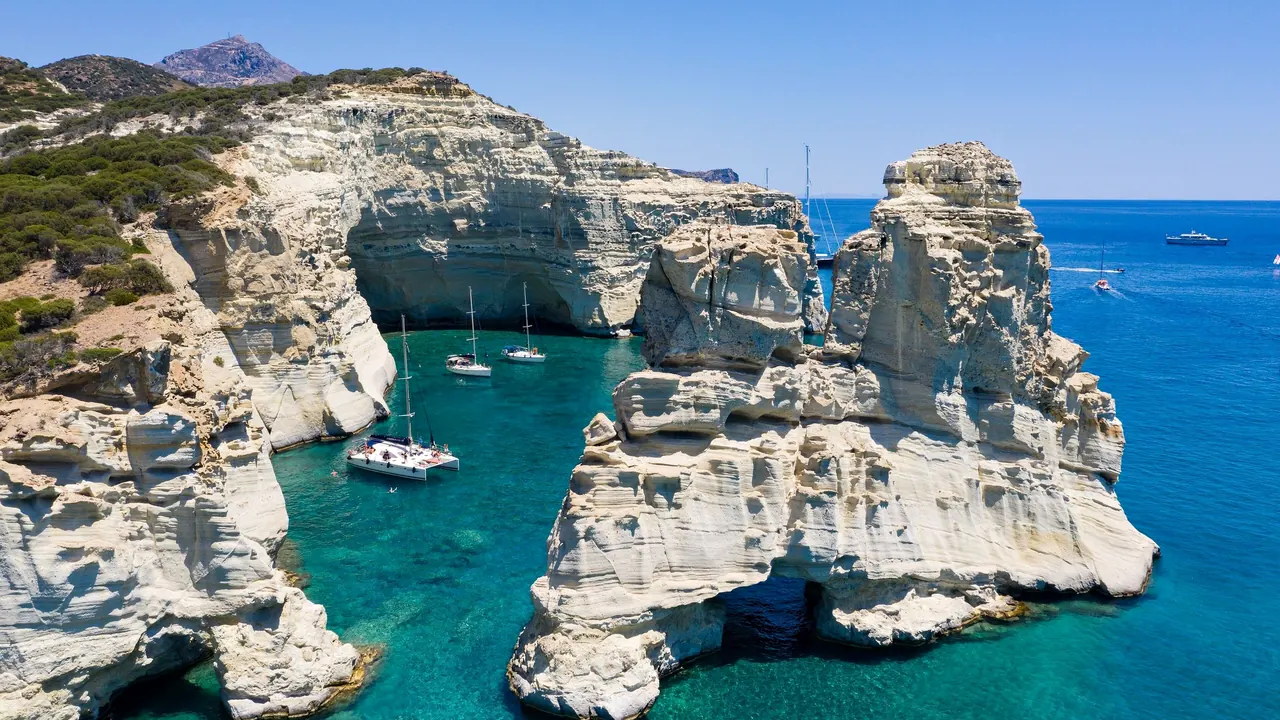
Photos: Aegina by Jebulon, CC0; Milos by dronepicr, CC BY 2.0, cropped.
Aegina or Milos?
Our verdict in twelve categories, each scored against the same fixed benchmark cities, and the climate month by month, so you can choose for your trip.
Choose Aegina for
- day trips
- prices
- getting around
Aegina is the easier island, and it gives you more history for less effort. The fast boat from Piraeus is short, the Temple of Aphaia is a real ancient site, and Athens is close enough to visit for a day. Rooms and meals cost what mainlanders pay, because most of the visitors are Greek. It suits a relaxed few days or a week combined with Athens, as long as you are happy with small coves and harbour rocks rather than long, striking beaches.
Choose Milos for
- beaches
- nature and the outdoors
- wellness
Choose Milos if the sea is the point of the trip. Its volcanic coast of white pumice, red cliffs and long south-coast sand is far more spectacular, and you can spend your days on boat trips to Kleftiko, snorkelling and soaking in hot springs. The cost is effort and money: a longer crossing, a hired car to reach most beaches, and expensive rooms in high summer. It rewards a longer stay focused on beaches better than a quick hop from Athens.
Scoreboard
Twelve categories on one fixed scale from 0 to 100. The shaded stretch is the gap between the two.
Your match
Pick a travel style or drag the sliders, and both match scores follow your weighting.
Too close to call, 1 point apart
Wins on day trips and prices with your weighting.
Wins on beaches and nature and the outdoors with your weighting.
What matters to you?
Category by category
What the scores mean for a trip.
Beaches & swimming
Aegina's swimming is pleasant but low-key. The best of it is in small coves around Marathonas and Aiginitissa, on the rocks near Perdika where people dive straight in, and on the pine-backed islet of Moni. Agia Marina is the one longer sandy resort beach.
Milos is in another league for beaches. The volcanic shore gives white, ochre and red rock and sand. Sarakiniko's pumice inlets are the famous sight, and Firiplaka, Tsigrado and Paliochori are long sandy beaches on the south coast. Some of them can only be reached by boat, and many have no sunbeds or shade, which suits people who want them unspoilt.
Food & drink
Both islands serve good, honest Greek island food in a narrow range, with very little beyond tavernas. On Aegina the local pistachio turns up in pastries, spreads and liqueurs. There are ouzeries behind the old fish market and fish tavernas along the quay at Perdika, and standards stay up because the diners are mostly Athenians.
Milos has its own Cycladic dishes, such as pitarakia cheese pies and ladenia flatbread, and a few more ambitious kitchens with sunset terraces in Plaka and Tripiti. In the busiest weeks, though, the waterfront places cater to the crowds, so the inland villages are often the better bet.
Culture & sights
Aegina has the more important monument. The Temple of Aphaia is one of the best-preserved Doric temples in Greece, standing on its pine-covered hill. The ruined town of Paleochora, with its frescoed chapels, the pilgrimage church of Agios Nektarios and the neoclassical houses from Aegina town's spell as Greece's first capital add up to a short but rewarding list.
Milos has a wider spread of smaller sights. There are the early Christian catacombs, the field where the Venus de Milo was found, a marble Roman theatre, Plaka's Venetian castle and the Bronze Age site at Phylakopi. The painted boathouses at Klima are as memorable as any of the ruins. None of these is a headline site, and two days covers them.
Nightlife
Neither island has clubs, and both keep evenings to dinner and a drink. Aegina's harbour cafés and cocktail bars stay busy past midnight when Athenians come over for the weekend, and Athens is a ferry ride away for a proper night out.
On Milos the evening centres on the sunset from Plaka's castle hill or a terrace in Tripiti, followed by a few late bars in Adamas in July and August.
Nature & outdoors
Milos has the more dramatic landscape, and you see most of it from the sea. There are red and yellow cliffs at Firopotamos and Papafragas, sea arches, and the rock towers and caves of Kleftiko. A sailing or kayak trip around the coast, with snorkelling along the way, is the highlight. Inland the island is dry and marked by old quarries.
Aegina's countryside is gentler and greener, with pistachio orchards, olive groves and pine woods. Its best walk is up the cone of Mount Oros, past the ruins of the sanctuary of Zeus, and its quiet roads are good for cycling. As outdoor experiences, though, these are milder than anything on the Milos coast.
Day trips
Aegina is much better placed for days out. Athens and Piraeus are about forty minutes away by fast boat, so the Acropolis is an easy day. Agistri is a short hop, and Poros and car-free Hydra make fuller days by ferry. With a car, Epidaurus can be reached from the mainland ports.
From Milos the choice is narrower. Quiet Kimolos is a short crossing from Pollonia, and Sifnos works as a day trip on the summer fast ferries. Everything else is too far, and the wind can upset ferry plans.
Good for families
Both islands are safe and relaxed with children, and neither has attractions built for them. Aegina is easier to manage. The crossing is short, buses run to the gently shelving sand at Agia Marina, and the peacocks and deer on Moni make a good half-day out.
Milos has the better beaches for children, such as Provatas and the sheltered village beach at Pollonia, but it takes more effort. The ferry is long and can be rough, a car is needed almost everywhere, and in July and August there is little shade.
Getting around
Aegina is far simpler. Fast boats cross from Piraeus throughout the day, Aegina town is flat and walkable, and no drive takes much over half an hour. Buses cover the main routes to Agia Marina and Perdika, though not often enough to rely on for everything.
On Milos the journey from Athens itself is a commitment: several hours by ferry, a shorter fast boat or a short flight. Once there, you really need a car or quad, since buses miss most of the coast. The western half is reached on dirt roads that some rental agreements exclude, and Kleftiko is easiest by boat.
Shopping & style
Aegina's shopping is mostly pistachios, sold roasted, as spreads and in pastries along the harbour, with a few ceramics and souvenir stores in the lanes behind. Plaka on Milos makes a slightly better browse, with small boutiques of linen clothing, jewellery and ceramics in the whitewashed lanes on the way up to the sunset.\n\nCapers, honey and island sweets are the things to take home from Milos. On both islands shopping is something to do on the way somewhere, not a reason to go.
Affordability
Aegina is noticeably cheaper. Most of its visitors are Greek, so tavernas and family-run guesthouses charge mainland prices, and ferries, buses and scooter hire are inexpensive. Rooms are the main expense, rising on summer weekends and through August.
Milos is expensive in July and August. Rooms in Pollonia, Plaka and Adamas cost a lot and book out early, and car hire and boat trips to Kleftiko add up. Taverna meals are fairly priced. On both islands, June and September bring the cost down.
Live music & performing arts
Aegina's summer evenings bring open-air cinema, the odd festival concert and live Greek music in some tavernas. For theatre, opera or the ancient-theatre festivals, Athens and Epidaurus are close enough to reach.\n\nOn Milos the music happens at the village panigyria, saints'-day feasts where people dance to violin and lute late into the night. There is also an occasional summer concert at the ancient theatre or in Adamas. Neither island has anything you would plan a trip around.
Wellness & relaxation
Milos has something Aegina lacks. Its volcano still warms the ground, so you can soak in the rustic baths at Lakkos in Adamas or the springs near Provatas, and at Paliochori the sand is warm underfoot where steam escapes. A few hotels add spas.
Aegina has no springs and only a few small hotel spas. Its restfulness comes from the slow pace: long lunches in Perdika and the quiet of the hillside chapels at Paleochora, especially on weekdays.
When should you go?
Pick your month. The climate figures are measured averages, not a forecast.
Aegina in July
Milos in July
Daytime high, °C
Rainfall in the month, mm
Where the figures come from
Aegina's temperatures are measured 32 km from the centre, at Athinai Airport.
Aegina has no rain gauge within 25 km of the centre, so its rainfall comes from a gridded climate dataset read at the destination rather than from a gauge further away.
Milos has no weather station within reach, so its figures come from a gridded climate model rather than a measured record, and read a broad area rather than one spot.
Temperature and rainfall are climate normals, averaged over the years shown. Aegina: 1991-2020 normals, Athinai Airport (31.8 km from centre). Milos: 2001-2020 normals, NASA POWER reanalysis grid, no weather station within 90 km.
Both islands can be swum from June to October, and both are almost rain-free from June to August. The summers feel very different, though. Aegina town gets properly hot, with daytime highs of 33°C in July and August and long, cloudless days, so you will want to sightsee early and spend the middle of the day in the water. On Milos the highs stay around 27°C even in August, which makes the hottest months easier to bear. The sea is about equally warm on both, peaking near 26°C off Aegina in late summer.
For walking and sightseeing, Aegina is at its best in April, May and October, when the heat has eased and the days are still sunny. Milos is pleasant over the same months. Its winters are noticeably wetter, with about 106mm of rain in December, while on Aegina the rain sets in from November at around 76mm a month. Neither island is a winter destination, but Aegina's winter days are a little drier.
Which traveller are you?
On a beach and sun trip, Milos is the clear choice. Its coloured volcanic coast, the pumice inlets at Sarakiniko and the long sandy beaches of the south coast are far more striking than Aegina's small coves, and the north wind always leaves one coast calm.
On a trip with a tight budget, Aegina goes further. Its tavernas and guesthouses charge ordinary mainland prices, and buses, scooters and the short ferry cost little. Milos charges heavily for rooms in summer, and you will probably need to hire a car on top.
On a culture and arts trip, Aegina has more to offer. The Temple of Aphaia and the chapels of Paleochora are on the island itself, and the Acropolis and the museums of Athens are about forty minutes away by fast boat. Milos has interesting sites, but none of the same importance.
Before you go
| Measure | Aegina | Milos |
|---|---|---|
| Official language | Greek | Greek |
| Currency | Euro (EUR) | Euro (EUR) |
| Sockets | CF230 V, 50 Hz | CF230 V, 50 Hz |
| Driving side | Right | Right |
| Time zone | UTC+2, UTC+3 in summer | UTC+2, UTC+3 in summer |
| Emergency number | 112 | 112 |
| Main airport | Athens Eleftherios Venizelos International Airport (ATH)176 non-stop destinations | Milos Airport (MLO)2 non-stop destinations |
| Public holidays this year | 15 days | 15 days |
By the numbers
| Measure | Aegina | Milos |
|---|---|---|
| Population | 13,056 | - |
| People per km² | 149 | - |
| Swim season, months above 21 °C | 5 months | 5 months |
Where else could you go?
Every comparison below shares a destination with this one, so you can follow Aegina or Milos somewhere new.