Greece
Aegina
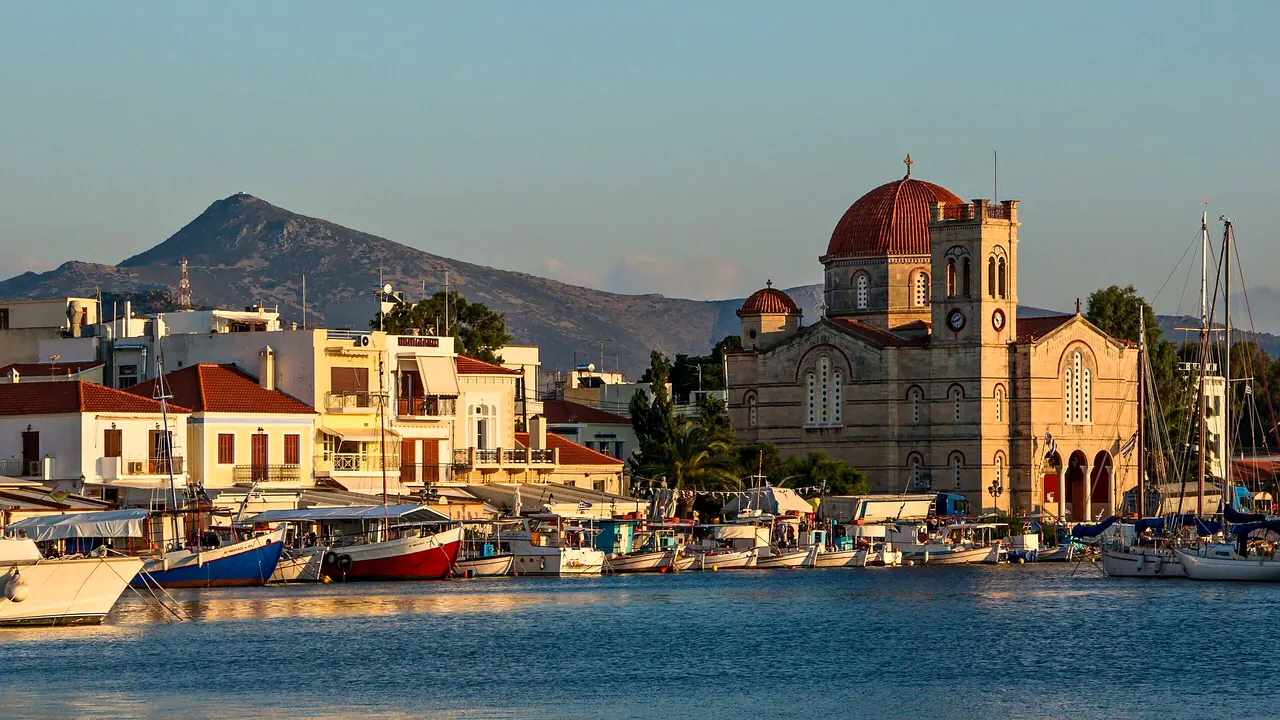
Aegina harbour and the church of Agios Nikolaos at sunset
- Day trips62
- Beaches60
- Getting around55
Match
42
Every category weighted equally
- Beach & sun45
- Culture & arts41
- Food & nightlife39
- Family trip48
- Outdoors47
- Relax & unwind44
- Shopping & style38
- On a budget44
Aegina in twelve categories
Our verdict on each, scored 0 to 100 against the same fixed benchmark cities, so a score means the same thing on every page.
Beaches & swimming. Scores 60 out of 100.
Food & drink. Scores 45 out of 100.
Culture & sights. Scores 48 out of 100.
Nightlife. Scores 27 out of 100.
Nature & outdoors. Scores 44 out of 100.
Day trips. Scores 62 out of 100.
Good for families. Scores 47 out of 100.
Getting around. Scores 55 out of 100.
Shopping & style. Scores 18 out of 100.
Affordability. Scores 55 out of 100.
Live music & performing arts. Scores 12 out of 100.
Wellness & relaxation. Scores 32 out of 100.
Aegina category by category
Beaches & swimming
60Aegina's beaches are modest, and most are easy to reach. The water is clean and calm and warms to about 25°C by late summer, so you can swim comfortably from June to October. The west and south coasts have the best of it: small coves around Marathonas and Aiginitissa, and the rocky swimming spots near Perdika, where people dive straight off the rocks into clear water. Agia Marina on the east coast is the island's main resort beach, a longer sandy stretch backed by sunbeds and hotels.
The best swimming is a short boat ride from Perdika, on the small islet of Moni, where pine trees come down to a pebbly cove. In and around Aegina town you mostly swim off small town beaches and harbour-side rocks. Beach life fills a summer stay here, but it is a low-key, local kind of swimming. Long white beaches are not what the island offers.
Food & drink
45Eating here means Greek island cooking done honestly. The island's own speciality is the pistachio: groves cover the interior, and the nuts turn up roasted, in pastries, in spreads and in liqueurs. In Aegina town, ouzeries and mezedopoleia line the waterfront and the lanes behind the old fish market, where small plates of octopus, sardines and fried courgette come with ouzo or tsipouro. In the evening the little fishing harbour at Perdika fills with fish tavernas along the quay.
The range is narrow. Outside Greek and seafood cooking there is little, and fine dining hardly exists. Many of the tavernas are good and few are touristy, though, because so many of the diners are Athenians over for the weekend.
Culture & sights
48The Temple of Aphaia is the reason to come. This Doric temple stands on a pine-covered hilltop in the northeast of the island and is one of the best-preserved temples of ancient Greece, with views across the Saronic Gulf to Athens. Its pediment sculptures are in Munich, but the building itself is remarkably complete. Near the harbour, Kolona has the single standing column of a temple of Apollo, along with the remains of the ancient town and a small museum.
Inland, Paleochora is a ruined medieval town scattered with dozens of small Byzantine chapels, some still holding frescoes. Below it stands the large pilgrimage church of Agios Nektarios. Aegina town was briefly the first capital of modern Greece after independence, and its neoclassical houses and public buildings date from that period. This is a short list, though a rewarding one.
Nightlife
27Evenings here are about long dinners and a drink on the waterfront. In summer, cafés and cocktail bars along Aegina town's harbour fill with Athenians who have come over for the weekend and stay up past midnight, and Agia Marina has a few beach bars. Clubbing barely exists. Outside July and August, and on weekday nights, the island goes to bed early. Anyone who wants a real night out takes the ferry back to Athens.
Nature & outdoors
44Aegina's landscape is gentle and Mediterranean: pistachio orchards, olive groves and pine woods on low volcanic hills. The best walk climbs Mount Oros in the south. The cone-shaped summit is about 530m high, has a chapel on top and looks out over the whole Saronic Gulf, and the path passes the ruins of an ancient sanctuary of Zeus on the way up. The quiet interior roads are good for cycling or a scooter ride through the orchards, and the small, wooded islet of Moni off Perdika makes a pleasant few hours on foot. Sailing in the sheltered gulf is easy. Apart from that, the outdoor offer is modest, and summer heat makes walking hard in the middle of the day.
Day trips
62The island's location is its great asset for outings. Athens and Piraeus are about forty minutes away by fast boat, so the Acropolis and the city's museums make an easy day out. Little Agistri is a short hop from Aegina town, with pine woods and a quiet village feel. Further along the Saronic Gulf, the island towns of Poros and car-free Hydra make fuller days out by ferry. With a car, the Methana peninsula and the ancient theatre at Epidaurus are within reach of the mainland ports.
For most outings you have to plan around the ferries, so you see one place properly in a day rather than several.
Good for families
47Aegina is an easy, safe island for a family vacation. The crossing from Piraeus is short, distances on the island are small, and Greek tavernas welcome children late into the evening. Agia Marina and Marathonas have gently shelving sandy water that suits small children, and the boat trip to Moni, home to peacocks and roaming deer, works well as a half-day outing. Nothing on the island is made specifically for children, though: no water parks, aquariums or museums aimed at them. The days come down to swimming, ice cream on the harbour and an early night, which suits young children better than teenagers.
Getting around
55Arriving is simple: ferries and fast boats cross from Piraeus throughout the day, and Aegina town is compact and flat enough to walk everywhere. The island itself is small, and no drive takes much over half an hour. Local buses link the town with Agia Marina via the Temple of Aphaia, and with Perdika along the west coast, but they are not frequent enough to rely on for everything. Most visitors rent a scooter, a car or a bicycle, and taxis wait at the harbour. Roads are narrow but quiet outside summer weekends, when the boats arrive full of Athenian cars.
Shopping & style
18Shopping here is a small affair. Along Aegina town's harbour and in the lanes behind it you find pistachio shops selling the island's nuts in every form, plus a few ceramics and souvenir stores and everyday Greek shops. Nobody comes to Aegina to shop. A bag of pistachios is the usual thing to take home.
Affordability
55Aegina is moderately priced for a Greek island. Most of its visitors are Greeks, not international tourists, so tavernas, cafés and family-run guesthouses charge ordinary mainland prices rather than what the famous resort islands ask. Grilled fish on the harbour, a plate of meze with ouzo and a morning coffee on the waterfront all feel fairly priced. The ferry crossing, the local buses and scooter rental are inexpensive.
Rooms are the main cost. They get scarcer and dearer on summer weekends and through August, when families from the mainland fill the island. On weekdays, and in June or September, the same stay costs noticeably less.
Live music & performing arts
12There is little formal performance here. In summer you might find open-air concerts, local festival evenings and the traditional open-air cinema, and some tavernas have live Greek music on summer nights. There is no theatre or regular concert programme. For opera, theatre or the ancient-theatre festivals, you go to Athens or Epidaurus.
Wellness & relaxation
32Aegina has no thermal springs, hammams or spa tradition. A few hotels have small spas, and that is all of it. What the island does offer is a slow pace, especially on weekdays and outside high summer: long lunches in Perdika, quiet evenings in the old town, and the stillness of Paleochora's hillside chapels. It works for a restful break close to Athens, but anyone looking for treatments or bathing culture will find almost nothing to book.
Where to stay in Aegina
Aegina town is the natural base for most visitors. The ferries from Piraeus arrive at its harbour, the old streets are flat and easy to walk, and the waterfront has the island's widest choice of meze places and its busiest evenings. It suits food lovers, travellers without a car and anyone planning day trips to Athens, Agistri or Hydra. Swimming here is limited to small town beaches and harbour-side rocks.
Agia Marina on the east coast is the resort choice. It has a longer sandy beach with sunbeds, shallow water for small children and a few beach bars, and the Temple of Aphaia is a short ride up the hill. On the west coast, the small coves around Marathonas and Aiginitissa suit families and a simple beach stay, with calm, gently shelving water. Perdika, at the southwest tip, is the place for a slow stay: a fishing harbour lined with fish tavernas, rocks to dive from, the boat to Moni and the climb up Mount Oros close by.
The island is small enough that one base covers everything, and no drive takes much over half an hour. Outside town, though, a scooter or car makes life much easier. Rooms are hardest to find on summer weekends and in August.
When should you go?
Pick a month to see what it is like. The climate figures are measured averages, not a forecast.
Aegina in July
Daytime high, °C
Rainfall in the month, mm
The whole year
Shaded against this destination’s own year: the deepest cell is its best month for that figure and the palest its weakest.
Where the figures come from
Aegina's temperatures are measured 32 km from the centre, at Athinai Airport.
Aegina has no rain gauge within 25 km of the centre, so its rainfall comes from a gridded climate dataset read at the destination rather than from a gauge further away.
Temperature and rainfall are climate normals, averaged over the years shown. Aegina: 1991-2020 normals, Athinai Airport (31.8 km from centre).
Before you go
| Measure | Aegina |
|---|---|
| Official language | Greek |
| Currency | Euro (EUR) |
| Sockets | CF230 V, 50 Hz |
| Driving side | Right |
| Time zone | UTC+2, UTC+3 in summer |
| Emergency number | 112 |
| Main airport | Athens Eleftherios Venizelos International Airport (ATH)176 non-stop destinations |
| Public holidays this year | 15 days |
By the numbers
| Measure | Aegina |
|---|---|
| Population | 13,056 |
| People per km² | 149 |
| Swim season, months above 21 °C | 5 months |
Compare Aegina with
Every comparison with a written verdict behind it.
- Corfu
- Crete
- Folegandros
- Halkidiki
- Hydra
- Ios
- Kefalonia
- Kos
- Lefkada
- Milos
- Mykonos
- Naxos
- Paros
- Paxos
- Peloponnese
- Rhodes
- Samos
- Santorini
- Sifnos
- Skiathos
- Skopelos
- Thassos
- Zakynthos