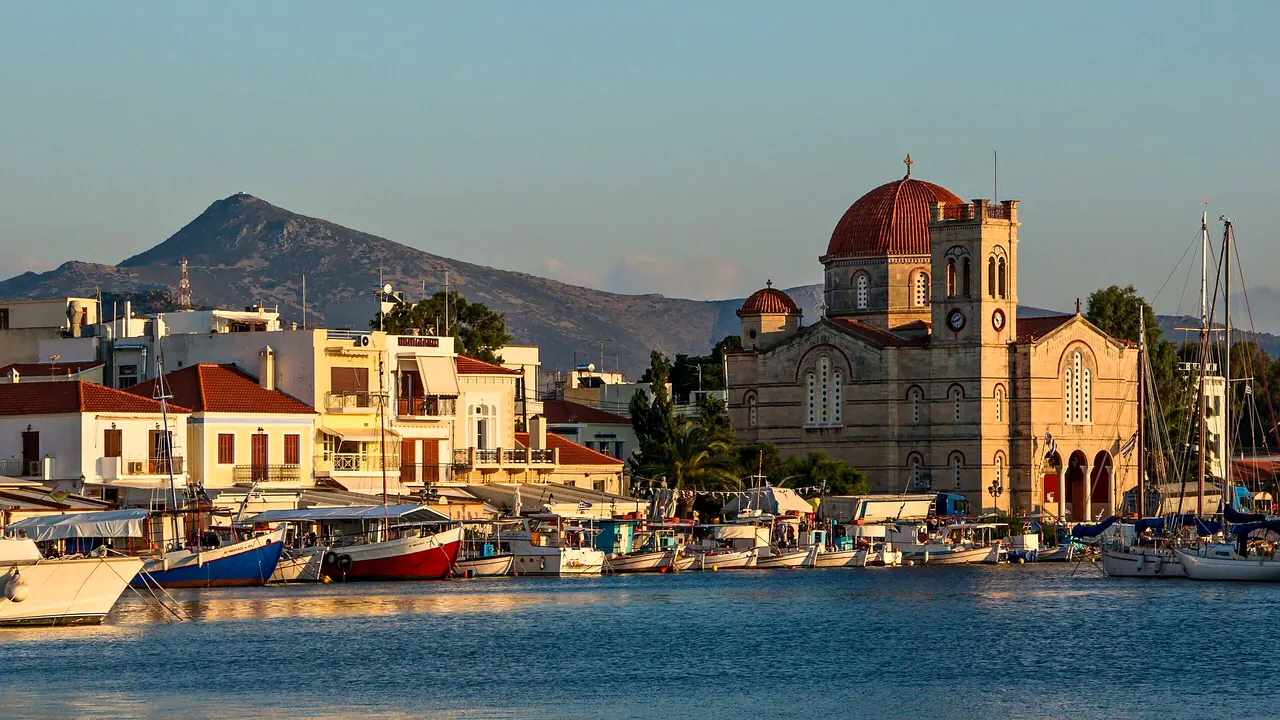
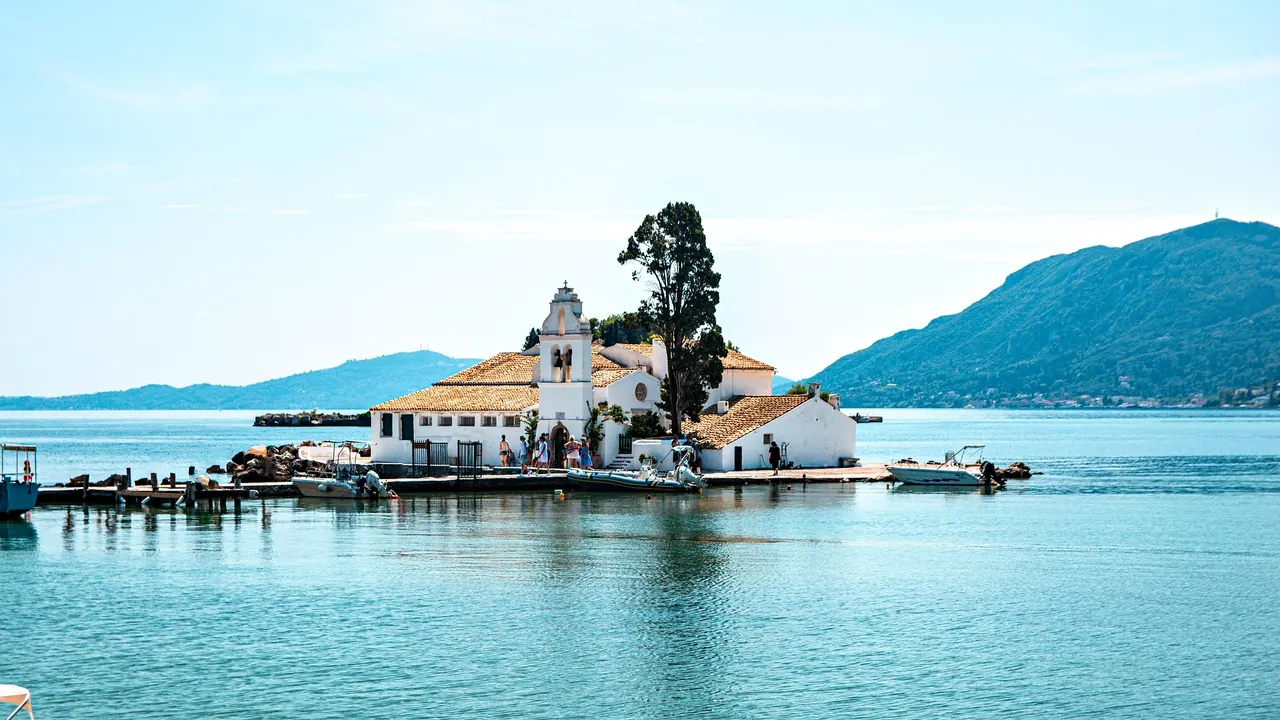
Photos: Aegina by Jebulon, CC0; Corfu by Nico Hartnauer, Pexels License.
Aegina or Corfu?
Our verdict in twelve categories, each scored against the same fixed benchmark cities, and the climate month by month, so you can choose for your trip.
Choose Aegina for
- getting around
- day trips
Aegina suits travellers who want a quiet island close to Athens. You can be there in well under an hour from Piraeus, get around easily and spend the days on modest coves, the Temple of Aphaia and fish suppers on the quay at Perdika. It works best as a slow few days, or as an add-on to a trip to Athens, for people who are content with small beaches and early nights.
Choose Corfu for
- nightlife
- live music and the arts
- families
Corfu is the island for a full vacation built around the sea. It has long sandy beaches on the west coast, gentle shallows in the north for children, and a Venetian old town that rewards a day or two of wandering. There is also real nightlife if you want it. The price is distance and effort: you need a car, the roads twist, and you have to choose your base carefully to avoid the crowded resort strips.
Scoreboard
Twelve categories on one fixed scale from 0 to 100. The shaded stretch is the gap between the two.
Your match
Pick a travel style or drag the sliders, and both match scores follow your weighting.
Wins on getting around and day trips with your weighting.
Wins on nightlife and live music and the arts with your weighting.
What matters to you?
Category by category
What the scores mean for a trip.
Beaches & swimming
Corfu has far more beach to choose from. It has long sandy stretches and sunsets on the west coast, dune-backed sands at Issos and Halikounas, shallow sandy water in the north and calm pebble bays facing Albania, with Antipaxos's clear bays a boat ride away.
Aegina's swimming is smaller and more local. It means coves around Marathonas, diving off the rocks near Perdika and the pebbly pine-fringed cove on Moni, with Agia Marina as the only real resort beach. The trade-off is that you avoid the summer crowds of Corfu's busiest resorts.
Food & drink
Corfu gives a food lover more to explore, because its kitchen is unlike the rest of Greece. Venice left spiced stews and garlicky sofrito, and the north adds kumquat liqueur and ginger beer. You do need to avoid the package-resort menus and eat in Corfu Town's lanes or in the inland villages.
Aegina keeps to straightforward island cooking: octopus and sardines with ouzo behind the old fish market, and fish tavernas on the Perdika quay. Pistachios turn up in everything. The range is narrower, but the Athenian weekend crowd keeps standards honest.
Culture & sights
Corfu Town alone outweighs Aegina's list. It is a UNESCO-listed Venetian old town with two fortresses, the Liston arcades, the Archaeological Museum's Gorgon pediment and the Asian art collection in the Palace of St Michael and St George. Further out are the Achilleion and Angelokastro.
Aegina's strength is a single great ancient monument. The Temple of Aphaia is one of the most complete Doric temples in Greece, and Kolona, the chapels of Paleochora and the neoclassical houses of Greece's first capital add a rewarding half-day or two.
Nightlife
Corfu can do a proper night out, and Aegina essentially cannot. On Corfu, Kavos parties until dawn, Ipsos and Dassia have beach bars and late venues, and Corfu Town has bars in the old lanes and clubs along the coast road.
On Aegina the evening means drinks on the harbour with weekending Athenians and a few beach bars at Agia Marina. Midweek and outside high summer the island goes to bed early.
Nature & outdoors
Corfu has the bigger and greener landscape. You can walk Mount Pantokrator's abandoned villages or the island-long Corfu Trail, explore the sea caves off Paleokastritsa by boat or with a snorkel, and watch birds at the Korission lagoon.
Aegina's outdoors is gentler and fits into a few outings. The main ones are the climb up Mount Oros past the sanctuary of Zeus, scooter rides through the pistachio orchards and a walk on Moni.
Day trips
The two islands are about level for outings, but they lead in different directions. From Aegina the big draw is Athens itself, with the Acropolis and the museums about forty minutes away by fast boat, plus Agistri, Hydra, Poros and Epidaurus.
Corfu's trips are all island and coast. They take you to Paxos and Antipaxos, to Parga and Sivota on the mainland, and across the strait to Albania for the ruins of Butrint. Many of these run only in the main season.
Good for families
Corfu is much better set up for families. It has wide, gently shelving beaches at Roda, Acharavi and Issos, resorts built around pools and kids' clubs, a water park and boat trips. Parents only need to steer clear of Kavos and Ipsos.
Aegina is easy and safe, and the peacocks and deer on Moni make a good half-day. Beyond that the days are swimming and ice cream, which suits small children for a short stay more than teenagers.
Getting around
Aegina is the easier island to get around. It is a short ferry from Piraeus, the town is flat and walkable, and no drive takes much over half an hour, so a scooter or even a bicycle covers it.
Corfu is about 60km long, with twisting roads in the north and west, rare buses and heavy summer traffic near the town and airport. A hire car is close to essential unless you stay in one resort.
Shopping & style
Neither island is a shopping destination, but Corfu Town gives you more to browse. Its old lanes around Nikiforou Theotoki sell olive-wood bowls, kumquat sweets, soaps and handmade jewellery. On Aegina, shopping is mostly a bag of pistachios from the harbour.
Affordability
Costs are broadly similar, but the pressure points differ. On Aegina, ordinary mainland prices hold in the tavernas, and rooms only get dear on summer weekends and in August, when Athenian families arrive.
On Corfu, the package resorts on the north and east coasts are reasonable, while Kassiopi's villas and Corfu Town in high summer cost more, and car hire adds up. Spring and autumn are cheaper on both islands.
Live music & performing arts
Corfu has a living musical tradition that Aegina lacks. Its historic philharmonic bands play in the Spianada and in village squares, Easter processions are led by brass bands, and kantades serenades survive in the tavernas. There are also classical evenings in the Old Fortress.
Aegina has open-air cinema and the odd summer concert. For theatre or the ancient-theatre festivals you cross to Athens or Epidaurus.
Wellness & relaxation
Neither island has a bathing culture, but Corfu has more to book. It has spas in its larger resort hotels and yoga retreats in the western and northern olive groves, as well as deeply quiet hill villages and the northeast coast.
Aegina's rest comes only from its pace: weekday lunches in Perdika and the stillness of Paleochora. A few small hotel spas are all there is for treatments.
When should you go?
Pick your month. The climate figures are measured averages, not a forecast.
Aegina in July
Corfu in July
Daytime high, °C
Rainfall in the month, mm
Where the figures come from
Aegina's temperatures are measured 32 km from the centre, at Athinai Airport.
Aegina has no rain gauge within 25 km of the centre, so its rainfall comes from a gridded climate dataset read at the destination rather than from a gauge further away.
Temperature and rainfall are climate normals, averaged over the years shown. Aegina: 1991-2020 normals, Athinai Airport (31.8 km from centre). Corfu: 1991-2020 normals, Kerkyra Airport (0.9 km from centre).
The two islands follow a similar curve through summer. Both are warm enough for the beach from June to early October, and the sea reaches about 26°C in August at both. July and August are hot at both, touching 33°C on Aegina, so walking in town or up the hills is best left to the early morning. May and late September are the more comfortable months for sightseeing on either island.
Rain is where they differ. Aegina sits in the dry Saronic Gulf, so autumn stays mild and fairly dry well into October. Corfu's wetter Ionian climate brings showers back sooner, with around 89mm in September, and its winters are much wetter, peaking near 188mm in November. That rain is what keeps Corfu so green in spring. Aegina is also slightly sunnier through the summer months.
Which traveller are you?
For a beach and sun trip, Corfu is the clear pick. It has long west-coast sands at Glyfada and Issos, clear coves at Paleokastritsa and boat trips to the turquoise bays of Antipaxos. Aegina offers small coves and rock swimming, pleasant but limited.
On a food and nightlife trip, Corfu again gives more. Its Venetian-influenced dishes such as pastitsada and sofrito set it apart from other Greek islands, and its evenings range from cocktails under the Liston to the clubs of Kavos. Aegina's evenings end early after meze on the harbour.
On a family trip with children, Corfu has gently shelving beaches in the north, resorts with pools and kids' clubs, and a water park inland. Aegina is safe and simple for toddlers, with shallow water at Agia Marina, but older children will run out of things to do.
Before you go
| Measure | Aegina | Corfu |
|---|---|---|
| Official language | Greek | Greek |
| Currency | Euro (EUR) | Euro (EUR) |
| Sockets | CF230 V, 50 Hz | CF230 V, 50 Hz |
| Driving side | Right | Right |
| Time zone | UTC+2, UTC+3 in summer | UTC+2, UTC+3 in summer |
| Emergency number | 112 | 112 |
| Main airport | Athens Eleftherios Venizelos International Airport (ATH)176 non-stop destinations | Corfu Ioannis Kapodistrias International Airport (CFU)88 non-stop destinations |
| Public holidays this year | 15 days | 15 days |
By the numbers
| Measure | Aegina | Corfu |
|---|---|---|
| Population | 13,056 | 100,854 |
| People per km² | 149 | 161 |
| Swim season, months above 21 °C | 5 months | 5 months |
Where else could you go?
Every comparison below shares a destination with this one, so you can follow Aegina or Corfu somewhere new.