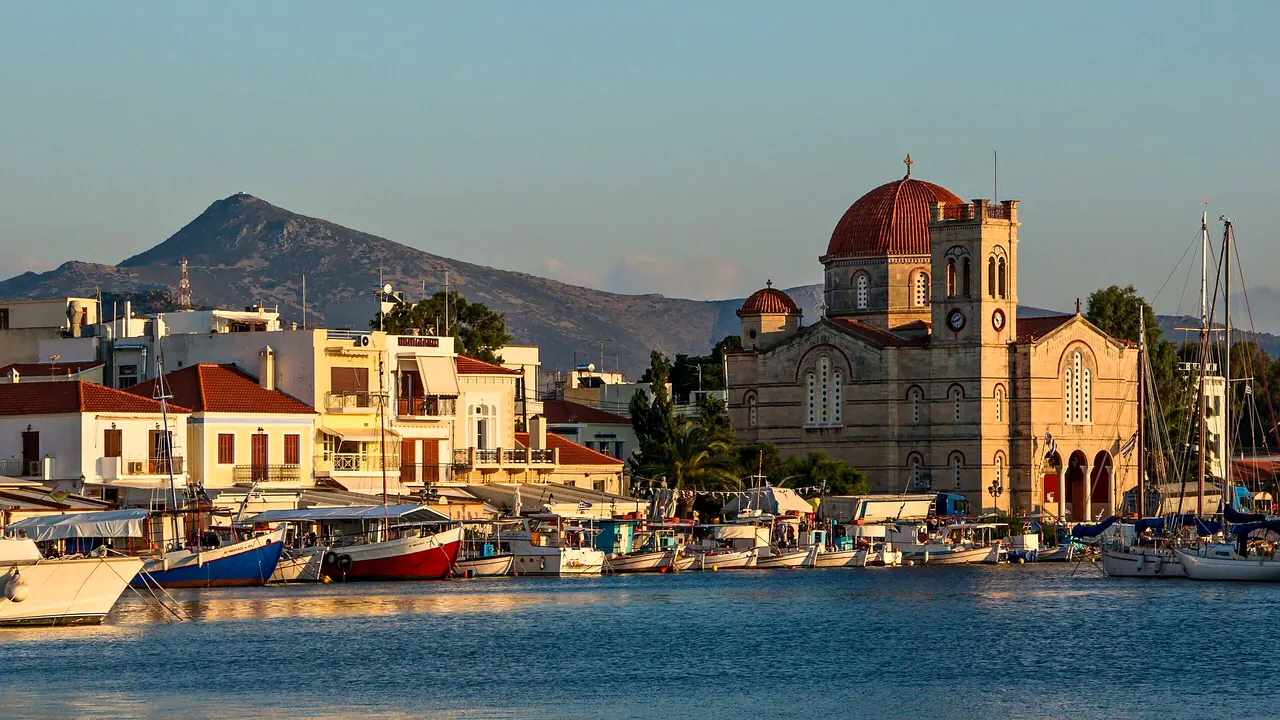
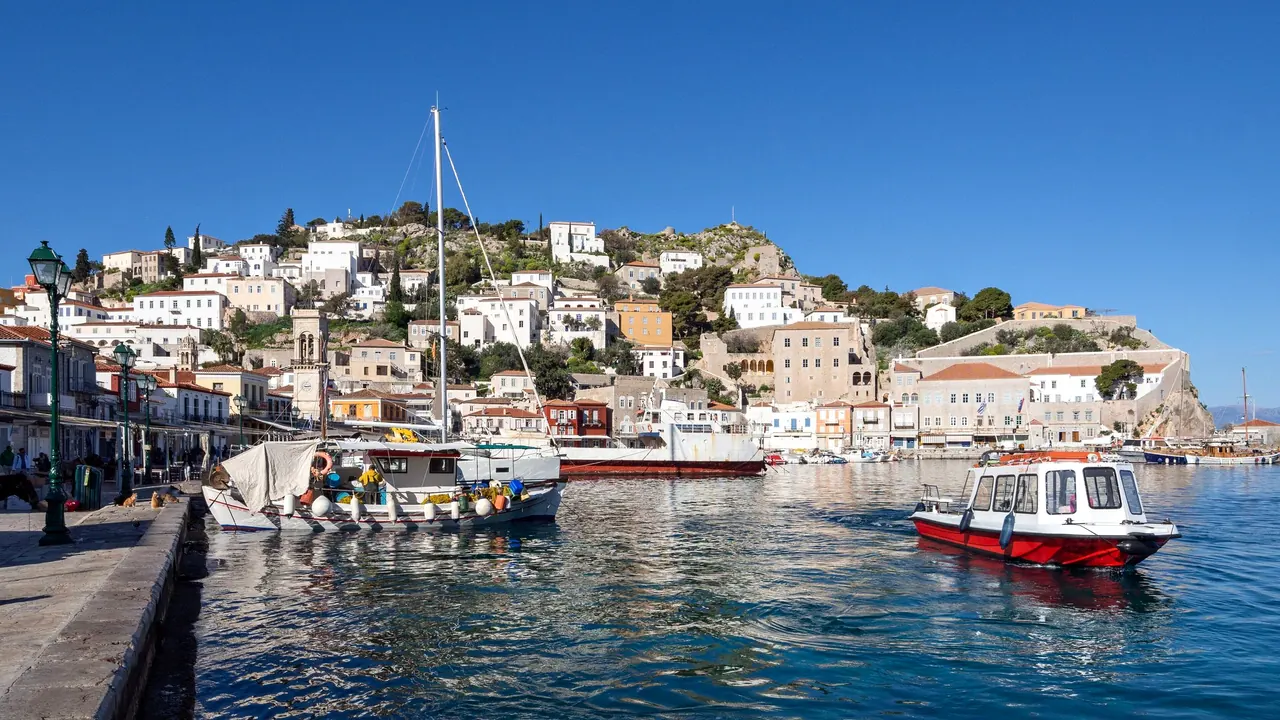
Photos: Aegina by Jebulon, CC0; Hydra by C messier, CC BY-SA 4.0, cropped.
Aegina or Hydra?
Our verdict in twelve categories, each scored against the same fixed benchmark cities, and the climate month by month, so you can choose for your trip.
Choose Aegina for
- day trips
- families
- prices
Aegina suits travellers who want an easy, unfussy island close to Athens. The fast boat is short, buses and rented scooters cover the whole island, and rooms and tavernas charge ordinary Greek prices because most visitors are Greek. It is the better base for families with young children, for anyone planning day trips to the Acropolis or along the Saronic Gulf, and for those who come to eat pistachios and meze rather than to be seen.
Choose Hydra for
- wellness
- shopping
- nightlife
Hydra is the choice for a quieter, more polished stay with no cars at all. Its protected stone harbour town, mule paths over a bare limestone ridge and evenings drinking beside the yachts give it an atmosphere Aegina doesn't have. You pay for that in higher room prices, a longer crossing and steep steps everywhere, so it works best for couples and adults who want to stay put and slow right down.
Scoreboard
Twelve categories on one fixed scale from 0 to 100. The shaded stretch is the gap between the two.
Your match
Pick a travel style or drag the sliders, and both match scores follow your weighting.
Wins on day trips and families with your weighting.
Wins on wellness and shopping with your weighting.
What matters to you?
Category by category
What the scores mean for a trip.
Beaches & swimming
Both islands offer good swimming rather than long beaches, but the swimming is different. Aegina has the softer options: the sandy resort strip at Agia Marina, small coves at Marathonas and Aiginitissa, and the pine-shaded pebble cove on Moni off Perdika. Several of these shelve gently.
Hydra is mostly about rocks and deep water. You climb down ladders from platforms west of the port, or take a water taxi to pine-backed coves like Bisti and Agios Nikolaos. The water is clearer and the setting more dramatic, but there is little sand to lie on.
Food & drink
Aegina has the edge at the table, mainly because of its waterfront ouzeries and the lanes around the old fish market. Octopus, sardines and fried courgette come there as small plates with ouzo, and the island's pistachios turn up in everything from pastries to liqueurs. Perdika's quay of fish tavernas makes a good evening, and the weekend Athenian crowd keeps standards honest.
Hydra's cooking is similar Greek taverna fare, but the harbour tables charge for the view. The better meals are in the back lanes or beside the water at Kamini and Vlychos. Rosewater almond sweets are its local treat, and on a longer stay the range feels thinner than Aegina's.
Culture & sights
The cultural interest is roughly equal, but it takes different forms. Aegina's appeal lies in separate sites spread across the island: the Doric Temple of Aphaia on its pine-covered hill, the lone column at Kolona, the chapel-strewn ruins of Paleochora and the neoclassical streets left from its spell as Greece's first capital. You need transport to see them all.
On Hydra the town itself is the monument. The shipowners' stone mansions around the harbour, the Monastery of the Dormition and the naval archives tell one story, the island's part in the War of Independence, all within a walk.
Nightlife
Neither island is for clubbing, but Hydra keeps the livelier evenings. Its harbour cocktail bars fill with Athenians and yachting visitors after dinner, and a few stay open into the small hours with music and some dancing.
Aegina's nights centre on long dinners and harbour cafés, plus a few beach bars at Agia Marina. Outside July and August the island goes to bed early.
Nature & outdoors
The two islands are similar for the outdoors, but the landscapes differ. Aegina is soft and farmed, with pistachio orchards, olive groves and low volcanic hills. The quiet roads suit a bicycle or scooter, and the one real climb is up the cone of Mount Oros, past the sanctuary of Zeus.
Hydra is a bare limestone ridge crossed only by mule paths, so the walking is longer and wilder. Routes run up to hilltop monasteries and to Mount Eros, close to 600m. Its cliffs also suit snorkelling and sea kayaking, but there is less shade than on Aegina.
Day trips
Aegina is far better placed for outings. Athens is about forty minutes away by fast boat, so a day at the Acropolis and the city's museums is easy. Agistri is a short hop, and Poros and Hydra are reachable along the gulf.
From Hydra, Spetses and Poros are the natural outings. Epidaurus and Nafplio across the strait take a boat, a car and some planning. Most visitors simply stay on the island.
Good for families
Aegina is clearly the better family island. Sandy, gently shelving water at Agia Marina and Marathonas, short drives and the animals on Moni suit small children well. Neither island has attractions built for children.
Hydra's car-free lanes and luggage-carrying donkeys charm children. But the steep steps rule out pushchairs, and most swimming is off ladders into deep water. It works best with older children who swim confidently.
Getting around
Aegina is the simpler island to reach and to cross. Boats from Piraeus are frequent and short, buses run to Agia Marina and Perdika, and with a rented scooter or car nothing is much over half an hour away.
Hydra has no cars, so you walk, hire a mule or take a water taxi. Almost every route off the harbour front is up or down stone steps. The crossing is longer, and wind or rough seas can cancel boats.
Shopping & style
Hydra is the better place to browse. Jewellery workshops, galleries selling work by resident artists, and linen and resort-wear boutiques fill the lanes behind the harbour, and the quality is above the island norm.
On Aegina, shopping mostly means pistachio shops, a little ceramics and everyday Greek stores. On either island, anything more serious waits for Athens.
Affordability
Aegina costs noticeably less. Its visitors are mostly Greek, so guesthouses, tavernas and cafés charge mainland prices, and the ferry, buses and scooter hire are cheap. Rooms only get tight on summer weekends and in August.
Hydra's few rooms are mostly boutique guesthouses and converted mansions, and they are dear in high summer. Harbour drinks, water taxis and porters add to the bill. Eating in the back lanes softens the cost, and May, June and late September bring better room prices.
Live music & performing arts
Both islands are thin on performance and point you to Athens or Epidaurus for real theatre. Aegina offers summer open-air concerts, local festival nights and its traditional open-air cinema. Hydra has the occasional recital and the Miaoulia festival in June, when a fireship is burned in the harbour.
Wellness & relaxation
Hydra is the more restful island, and not because of spas, which neither really has. With no cars or motorbikes, its days settle into a morning swim, a long lunch and a nap. The upper town and Kamini stay calm even when excursion boats crowd the harbour at midday.
Aegina can be slow too, in Perdika at lunch or among the chapels of Paleochora. But it has roads, scooters and weekend crowds, so the calm depends more on choosing weekdays and the shoulder months.
When should you go?
Pick your month. The climate figures are measured averages, not a forecast.
Aegina in July
Hydra in July
Daytime high, °C
Rainfall in the month, mm
Where the figures come from
Aegina's temperatures are measured 32 km from the centre, at Athinai Airport.
Aegina has no rain gauge within 25 km of the centre, so its rainfall comes from a gridded climate dataset read at the destination rather than from a gauge further away.
Hydra's temperatures are measured 66 km from the centre, at Athinai Airport.
Hydra has no rain gauge within 25 km of the centre, so its rainfall comes from a gridded climate dataset read at the destination rather than from a gauge further away.
Temperature and rainfall are climate normals, averaged over the years shown. Aegina: 1991-2020 normals, Athinai Airport (31.8 km from centre). Hydra: 1991-2020 normals, Athinai Airport (65.5 km from centre).
The two islands sit in the same gulf and share almost exactly the same weather. May is warm and dry enough for walking, and the sea is still cool. From June to September the days are hot, reaching about 33°C in July and August, with almost no rain. The sea is warmest at 26°C in August and stays pleasant for swimming into October. In high summer, walking is best done early or late, which matters most on Hydra, where every route climbs over stone steps with little shade.
Rain arrives in November and peaks in early winter. Hydra is a little wetter, at nearly 90mm in November and December, and its winter seas can stop the boats. For both islands the best months are June and September, when the water is warm and the heat is easier to bear, with May and October good for walks and sightseeing.
Which traveller are you?
On a family trip with young children, Aegina makes life simpler. The boat over is short, nothing is far once you land, and toddlers can paddle safely. Hydra asks more of small legs and non-swimmers, and suits older children better.
For a trip on a tight budget, Aegina goes further. Most visitors are Greek, so rooms and meals cost mainland prices and getting about is cheap. Hydra's few boutique rooms make it dearer, though back-lane tavernas stay fair.
On a relaxing and wellness trip, Hydra is the better pick. Neither island has real spas, but with no engines anywhere, Hydra slows you down without effort. On Aegina, real calm depends on coming midweek or outside high summer.
Before you go
| Measure | Aegina | Hydra |
|---|---|---|
| Official language | Greek | Greek |
| Currency | Euro (EUR) | Euro (EUR) |
| Sockets | CF230 V, 50 Hz | CF230 V, 50 Hz |
| Driving side | Right | Right |
| Time zone | UTC+2, UTC+3 in summer | UTC+2, UTC+3 in summer |
| Emergency number | 112 | 112 |
| Main airport | Athens Eleftherios Venizelos International Airport (ATH)176 non-stop destinations | Athens Eleftherios Venizelos International Airport (ATH)176 non-stop destinations |
| Public holidays this year | 15 days | 15 days |
By the numbers
| Measure | Aegina | Hydra |
|---|---|---|
| Population | 13,056 | 1,966 |
| People per km² | 149 | 40 |
| Swim season, months above 21 °C | 5 months | 5 months |
Where else could you go?
Every comparison below shares a destination with this one, so you can follow Aegina or Hydra somewhere new.