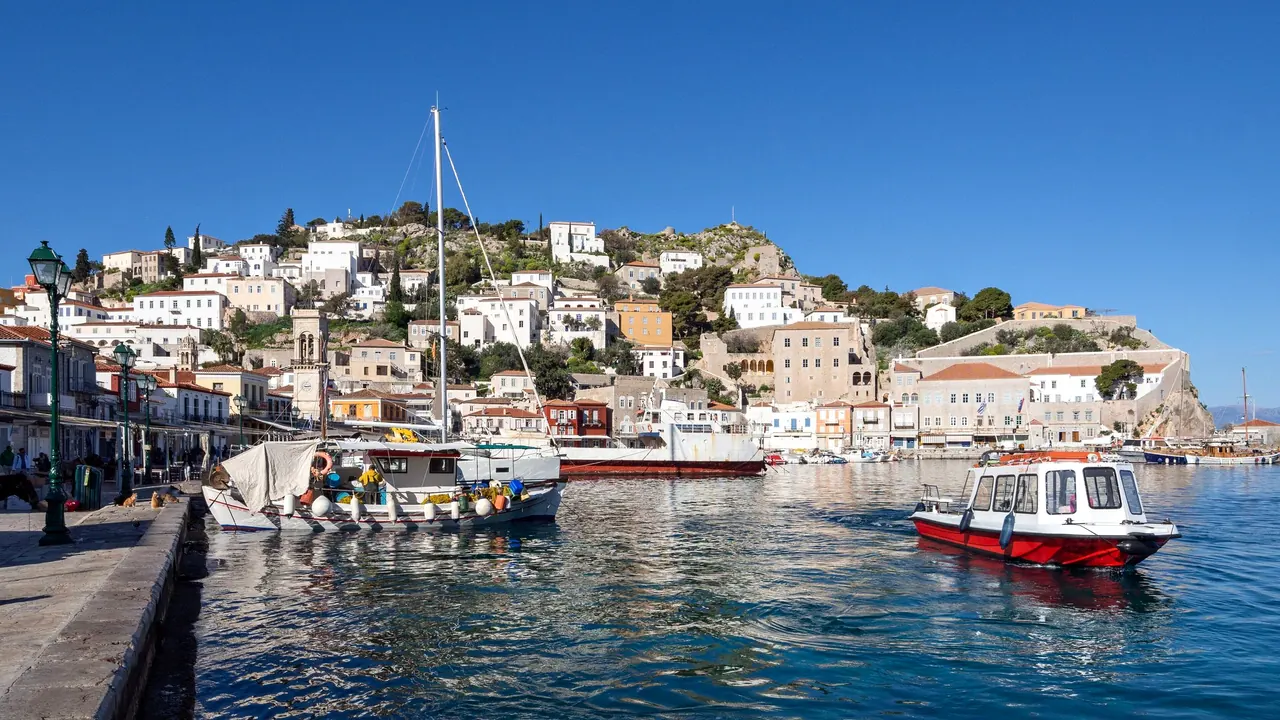
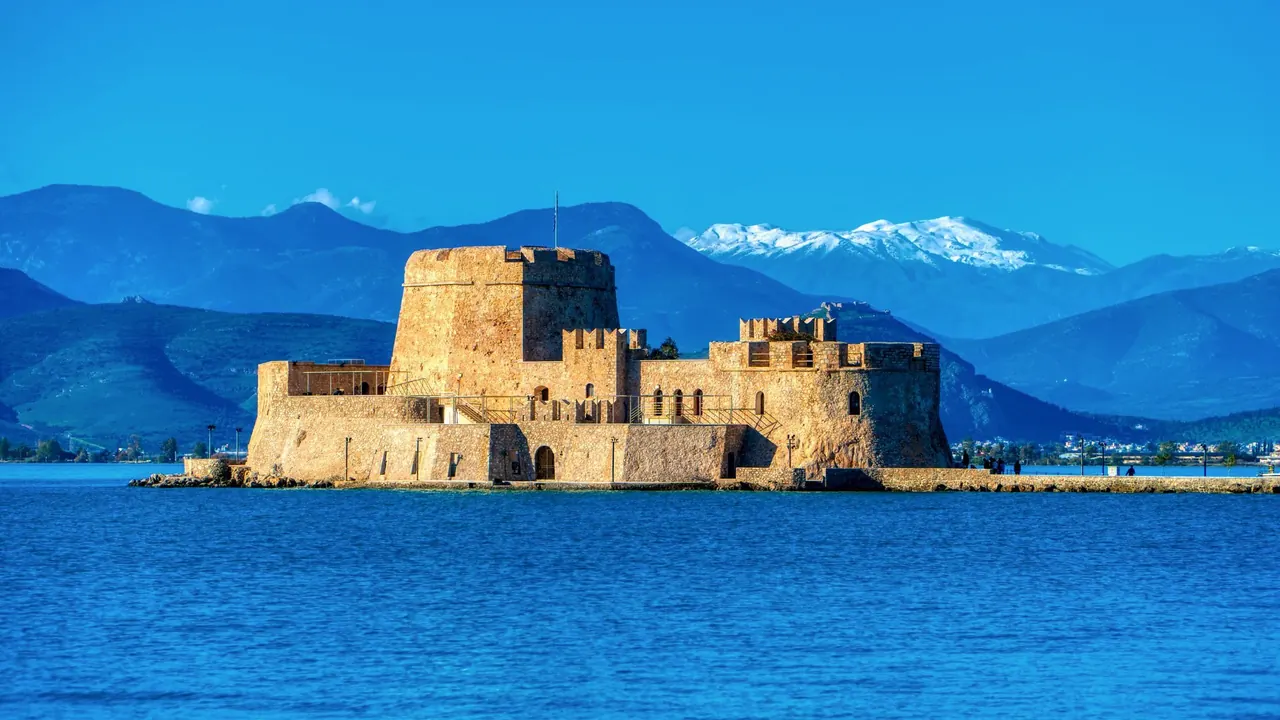
Photos: Hydra by C messier, CC BY-SA 4.0, cropped; Peloponnese by Alex Ravvas, Pexels License.
Hydra or Peloponnese?
Our verdict in twelve categories, each scored against the same fixed benchmark cities, and the climate month by month, so you can choose for your trip.
Choose Hydra for
Hydra does not lead in any category we score.
Hydra suits a short, slow stay in one beautiful place. With no cars, a single stone harbour town and swimming off rocks into very clear water, it works well for a few days of walking, swimming and long dinners by the boats, especially for couples who want quiet and don't mind paying for a room with a view. It's a place to settle into rather than explore, and two or three days covers what there is to see.
Choose Peloponnese for
- culture and sights
- day trips
- nature and the outdoors
The Peloponnese is the bigger trip, and the better one for almost anything beyond that. It needs a hire car and more planning, but you get Mycenae, Olympia, Mystras and Epidaurus, sandy bays in Messinia and on Elafonisos, mountain gorges in Arcadia and village food at lower cost. It suits a road trip of a week or more, families who want easy beaches, and anyone who would rather move between bases than stay put. Hydra itself is an easy day out from its eastern ports.
Scoreboard
Twelve categories on one fixed scale from 0 to 100. The shaded stretch is the gap between the two.
Your match
Pick a travel style or drag the sliders, and both match scores follow your weighting.
Has no clear advantage with the weighting you have chosen.
Wins on culture and sights and day trips with your weighting.
What matters to you?
Category by category
What the scores mean for a trip.
Beaches & swimming
Swimming on Hydra means jumping off rocks and concrete platforms west of the port into deep, very clear water. There are small pebble coves at Kamini and Vlychos, a sheltered bay at Mandraki, and pine-backed coves such as Bisti that you reach by water taxi. It's excellent for strong swimmers but has little sand.
The Peloponnese offers the full range. There's the sand horseshoe of Voidokilia and the long Messinian beaches towards Kyparissia, the pale turquoise shallows of Elafonisos, rocky Mani coves below Kardamyli and Stoupa, and easy sheltered bays at Tolo. You can spend whole beach days there, and outside high summer many beaches are nearly empty.
Food & drink
Hydra serves good taverna cooking, like grilled octopus and fish at Kamini or in the back lanes, plus the island's rosewater almond sweets. But there's no market and little variety, and on a longer stay the menus start to repeat.
The Peloponnese eats from its own land. You'll find Kalamata olives and oil, Mani cured pork, slow-cooked goat and wild greens in village tavernas. There's also Nemea's red Agiorgitiko, Moschofilero from the Tripoli plateau and a morning at Kalamata's covered market. It's still simple food rather than a fine-dining destination, but there's far more of it and more variety.
Culture & sights
Hydra's sight is a single ensemble: the shipowners' stone mansions around the harbour, the Monastery of the Dormition, the naval archives and the old cannon batteries. It's handsome and fully protected, but you'll have seen it within a couple of days.
The Peloponnese is one of the great historic regions of Greece. There's Bronze Age Mycenae and Tiryns, Epidaurus and Olympia, Ancient Corinth and Messene, and then a medieval layer of Mystras, Monemvasia and the Venetian castles at Methoni and Koroni. Nafplio puts the Argolid sites within an hour, though seeing the whole region means changing bases.
Nightlife
Neither is a party destination, but the evenings feel different. Hydra's nightlife is one compact strip of waterfront cocktail bars, filled in summer with smartly dressed Athenians and yacht crews, with a few places staying open late. It's all within a short walk, and almost all of it closes in winter.
The Peloponnese spreads its evenings out. There are café-bars in Nafplio's old town, local crowds on Kalamata's seafront and a few beach bars at Tolo. Patras, the university city on the north coast, is the only place in either destination with real clubs, but it's a long way from most beach bases.
Nature & outdoors
Hydra is good walking country on a small scale. Old mule paths climb through pine to the monasteries of Profitis Ilias and up Mount Eros at nearly 600m, and the cliffs below suit snorkelling and kayaking.
The Peloponnese works on a much larger scale. Taygetos rises to about 2,400m above Sparta, the Lousios gorge links cliff monasteries and Dimitsana, the Menalon Trail crosses Arcadia, and there's winter skiing on Chelmos. There's also the stark Mani down to Cape Tainaron and birdlife at the Gialova lagoon. It's a landscape for several days of hiking, not one morning.
Day trips
From Hydra, the easy outings are other islands. Spetses and Poros are each under an hour by boat. Reaching Epidaurus or Nafplio means crossing to Metochi and arranging a car or tour, so most visitors don't bother.
The Peloponnese has much more within a day's drive. There are the Nemea wineries, Pylos and Methoni, the Mani villages, Monemvasia and Elafonisos. Hydra itself is a short ferry ride from the southern Argolid ports. The catch is that nearly every outing needs a car.
Good for families
Hydra has small pleasures for children, such as traffic-free lanes, donkeys and water-taxi rides. But the stepped town makes pushchairs useless and most swimming is in deep water, so it really works only for older children who swim well and like to walk.
The Peloponnese is the easier family choice. Shallow sandy bays at Tolo, in Messinia and on Elafonisos let younger children paddle safely, the Messinian resorts have pools and kids' clubs, and Olympia and Mycenae catch older children's imagination. The trade-off is long hours in the car.
Getting around
These are two opposite systems that are equally demanding. On Hydra you walk everywhere, up and down stone steps, with donkeys for luggage and water taxis to the coves. Getting there depends on fast ferries from Piraeus, which strong winds can cancel.
The Peloponnese is car country. Motorways run quickly to Kalamata and Olympia, but mountain and Mani roads are slow, and buses barely reach the sites and beaches. Once you're parked, Nafplio and the old towns are pleasant to explore on foot.
Shopping & style
Neither is a shopping destination, but they offer different things to take home. On Hydra it comes down to a few lanes behind the harbour, where jewellery workshops and galleries selling work by the island's resident artists sit among linen boutiques and ceramics. The standard is higher than in most island ports, and browsing fits well into an evening walk. Beyond those lanes there's nothing, so any serious shopping is better done in Athens.
In the Peloponnese the best buys are things to eat and drink: Kalamata olives and oil, mountain honey, herbs and wine bought straight from the Nemea wineries. For objects, Nafplio's old lanes have the best mix of jewellery, worry beads and small boutiques, and the weekly street markets in Kalamata and Tripoli are good for an hour of local browsing.
Affordability
Hydra is the dearer trip. There are only a few rooms, mostly boutique guesthouses and converted mansions, and they fill early in summer. Harbour-front drinks and water taxis add up, though meals in the back-lane tavernas are fair value.
The mainland Peloponnese costs noticeably less. Family-run rooms in the Mani and Arcadian villages, taverna meals and local wine keep a long stay affordable. The car hire and fuel you'll almost certainly need is the main extra cost. In both places, May, June and September give the best value.
Live music & performing arts
Hydra offers little beyond occasional summer recitals, late taverna music and the Miaoulia festival in June, when a fireship is burnt in the harbour.
The Peloponnese has one of the great performing-arts experiences in Greece: ancient drama under the stars at the theatre of Epidaurus on summer weekends, with no need for amplification. There are also concerts at the Little Theatre nearby and Kalamata's dance festival in July. Out of summer, though, there's little in either place.
Wellness & relaxation
Both are restful in a similar measure, but in different ways. On Hydra the calm comes from the absence of engines. The only sounds are bells, donkeys and the sea, and the days fall into a rhythm of a swim, lunch and a nap, with a few hotel treatment rooms and yoga retreats. The Peloponnese has real thermal water instead, at Loutraki, on the Methana peninsula and in the sulphur-fed lake at Kaiafas, and the region's fullest spas are in the Messinian resorts.
When should you go?
Pick your month. The climate figures are measured averages, not a forecast.
Hydra in July
Peloponnese in July
Daytime high, °C
Rainfall in the month, mm
Where the figures come from
Hydra's temperatures are measured 66 km from the centre, at Athinai Airport.
Hydra has no rain gauge within 25 km of the centre, so its rainfall comes from a gridded climate dataset read at the destination rather than from a gauge further away.
Peloponnese's temperatures are measured 89 km from the centre, at Kalamata Airport.
Peloponnese has no rain gauge within 25 km of the centre, so its rainfall comes from a gridded climate dataset read at the destination rather than from a gauge further away.
Temperature and rainfall are climate normals, averaged over the years shown. Hydra: 1991-2020 normals, Athinai Airport (65.5 km from centre). Peloponnese: 1991-2020 normals, Kalamata Airport (89 km from centre).
The two run on almost the same calendar. On Hydra's harbour and along the main Peloponnese coasts, the sea is warm enough to swim from June to October and is at its warmest, about 26°C, in August. July and August are hot, with highs near 33°C on Hydra and a degree lower on the mainland. That makes midday walking hard in both, and hardest on Hydra's shadeless steps and hill paths. Summer is nearly dry, and Hydra gets slightly more sunshine at its height.
May, June, late September and October are the best months for combining swimming with walks and sightseeing, and they're the season for hiking in the Peloponnese mountains. Rain arrives in November and is heaviest through November and December, at around 90mm a month in both places. It then eases to about 65mm in January and February. The mainland is a degree or two milder in winter, but from November to April neither is a beach destination.
Which traveller are you?
On a culture and arts trip, choose the Peloponnese without hesitation. Mycenae, Epidaurus, Olympia, Messene and Byzantine Mystras are all within driving range, and there's drama in the ancient theatre in summer. Hydra's preserved harbour town takes two days to see.
For an outdoors trip, the Peloponnese has far more ground. There's Taygetos at about 2,400m, the Lousios gorge and the waymarked Menalon Trail through Arcadia. Hydra's car-free mule paths and snorkelling are lovely, but one bare ridge is soon walked.
On a family trip with children, the Peloponnese is much easier. It has shallow sandy bays at Tolo, Elafonisos and along the Messinian coast, and resort hotels with pools and kids' clubs. Hydra means steep steps, no use for a pushchair, and swimming off ladders into deep water.
Before you go
| Measure | Hydra | Peloponnese |
|---|---|---|
| Official language | Greek | Greek |
| Currency | Euro (EUR) | Euro (EUR) |
| Sockets | CF230 V, 50 Hz | CF230 V, 50 Hz |
| Driving side | Right | Right |
| Time zone | UTC+2, UTC+3 in summer | UTC+2, UTC+3 in summer |
| Emergency number | 112 | 112 |
| Main airport | Athens Eleftherios Venizelos International Airport (ATH)176 non-stop destinations | Athens Eleftherios Venizelos International Airport (ATH)176 non-stop destinations |
| Public holidays this year | 15 days | 15 days |
By the numbers
| Measure | Hydra | Peloponnese |
|---|---|---|
| Population | 1,966 | - |
| People per km² | 40 | - |
| Swim season, months above 21 °C | 5 months | 5 months |
Where else could you go?
Every comparison below shares a destination with this one, so you can follow Hydra or Peloponnese somewhere new.