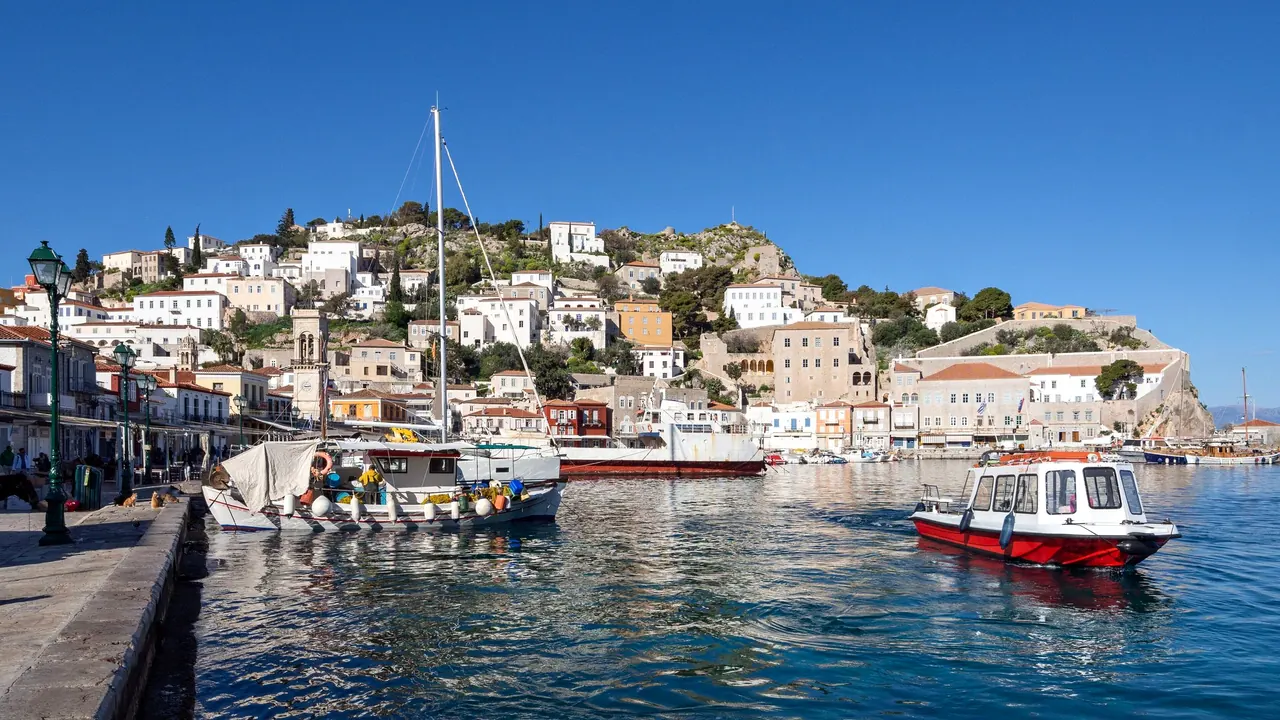
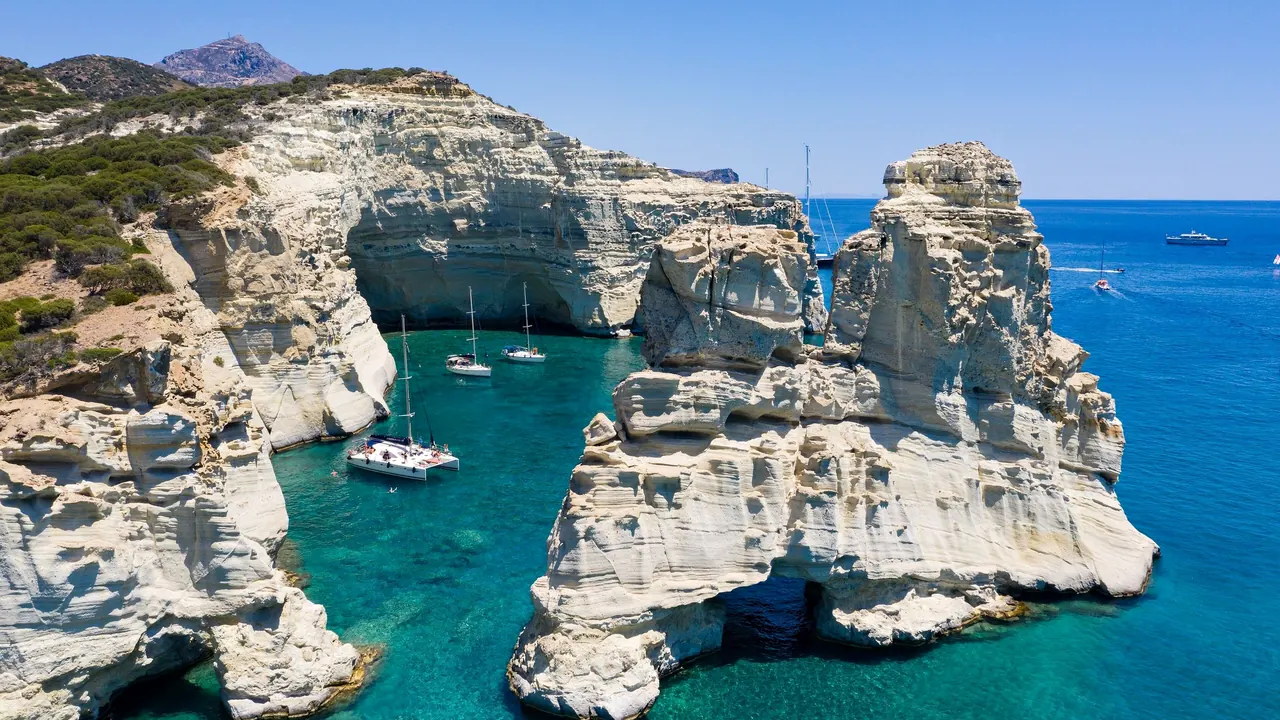
Photos: Hydra by C messier, CC BY-SA 4.0, cropped; Milos by dronepicr, CC BY 2.0, cropped.
Hydra or Milos?
Our verdict in twelve categories, each scored against the same fixed benchmark cities, and the climate month by month, so you can choose for your trip.
Choose Hydra for
- nightlife
- shopping
- culture and sights
Hydra suits travellers who want one beautiful harbour town and no need for wheels. With no cars on the island, you walk the stone lanes between shipowners' mansions, swim off the rocks below the town and spend evenings over a drink facing the boats. It is the closer of the two to Piraeus and has the livelier waterfront after dinner, though its shore is rocky and small.
Choose Milos for
- beaches
- families
- food and drink
Milos is the choice for a beach vacation. Its volcanic coast has long sandy bays on the south side, the white pumice of Sarakiniko and the sea caves of Kleftiko, and families find gentle water there that Hydra cannot offer. In return you need a car or boat to reach most of it, and the ferry crossing is longer.
Scoreboard
Twelve categories on one fixed scale from 0 to 100. The shaded stretch is the gap between the two.
Your match
Pick a travel style or drag the sliders, and both match scores follow your weighting.
Wins on nightlife and shopping with your weighting.
Wins on beaches and families with your weighting.
What matters to you?
Category by category
What the scores mean for a trip.
Beaches & swimming
This is where the two islands differ most. Hydra is for swimming rather than sunbathing. You climb down ladders from rocks and platforms west of the port into deep, clear water, or take a water taxi to pine-backed coves such as Bisti, and the shore is small and stony throughout.
Milos has proper beaches in real variety. Long sand at Firiplaka, Tsigrado and Provatas, white pumice at Sarakiniko and calm north-shore coves near Pollonia on still days give you a different beach every day. Many have no sunbeds or shade, so bring your own.
Food & drink
Both islands serve Greek taverna cooking with grilled fish and octopus, and neither is worth the trip for the food alone. Milos has more of a local table, with pitarakia cheese pies, ladenia flatbread and soft island cheeses, plus honest cooking in Klima and the inland villages.
On Hydra the choice is narrower. Avoid paying for the view on the harbour front and eat in the back lanes or by the water at Kamini and Vlychos, then take home the rosewater almond sweets from the town's bakeries.
Culture & sights
There is about as much to see on each, and two days covers either, but the heritage is of a different kind. On Hydra the town itself is the monument: a protected harbour of stone captains' mansions built on the naval wealth that drove the War of Independence, with the Historical Archives Museum and the harbour monastery to fill in the story.
Milos spreads its history across the island and further back in time. There are early Christian catacombs, the field where the Venus de Milo was found, a Roman theatre, Bronze Age Phylakopi and the painted boathouses of Klima, so you get more variety but have to travel between the sites.
Nightlife
Neither island is for clubbing, but Hydra has more going on after dinner. Its waterfront cocktail bars fill with Athenians and yacht crews, and a few keep the music going into the small hours on summer weekends.
On Milos the evening peaks earlier, with sunset from Plaka's castle hill, a long dinner and a drink in Adamas or Pollonia. Only a handful of bars in Adamas stay open late in July and August.
Nature & outdoors
Milos has the more striking landscape. Its volcanic coast of white ravines, red and yellow cliffs at Papafragas and the arches and caves of Kleftiko is best seen from a sailing or kayak trip. Inland it is flatter and marked by old quarries.
Hydra's strength is on foot. Mule paths climb from the car-free town through pine to the hilltop monasteries and Mount Eros at nearly 600m, with long views over the Saronic Gulf. Both islands are shadeless and too hot for summer walking.
Day trips
The day trips are much of a muchness, as on both islands they mean catching a boat. From Hydra, Spetses and Poros are each well under an hour away, and the Peloponnese across the strait opens up Epidaurus and Nafplio if you arrange a car.
From Milos, the short crossing to quiet Kimolos is the classic outing, and Sifnos works on summer fast ferries. Wind and timetables govern the Cyclades more strictly, so plan around them.
Good for families
Milos is the easier choice with children because of its sand. Beaches such as Provatas and Achivadolimni slope gently into calm water, and Pollonia has a sheltered beach in the village itself. On the other hand, you need a car, and some good beaches mean dirt tracks or steep paths.
Hydra's traffic-free lanes and donkeys delight children, but the town is all steep steps, useless with a pushchair, and swimming is mostly from rocks into deep water. It works for older children who swim well.
Getting around
The two are fairly even on getting around, but the systems are opposites. Hydra has no cars at all, so you walk everywhere, up and down stone steps, with donkeys carrying luggage and water taxis to the far coves. Arriving is easy, with fast boats from Piraeus in under two hours.
Milos needs wheels. A hired car or quad gets you anywhere in under an hour, but buses miss most of the coast and the west is rough dirt road. It is further to reach by ferry, though a short flight from Athens is an alternative.
Shopping & style
Hydra is a little better for browsing. Its lanes behind the harbour hold jewellery workshops and galleries selling work by resident artists, of better quality than most island ports.
On Milos the shopping is a few linen and ceramics boutiques in Plaka on the way to the sunset, plus capers and honey to take home. Neither replaces a day in Athens.
Affordability
Both are among the pricier islands in summer, and on each it is the room that costs. Hydra's few boutique guesthouses and mansion stays fill early, and Milos adds car hire and boat trips to Kleftiko on top of its costly rooms.
Taverna meals are fair on both if you avoid the view terraces. On Milos you can save by staying in simple rooms inland. On Hydra, May, June or late September are easier.
Live music & performing arts
Neither island has a stage life to plan around. Hydra has occasional summer recitals and the Miaoulia in June, when a fireship burns in the harbour. On Milos the real music is at the village panigyria, where people dance to violin and lute late into the night.
Wellness & relaxation
Both islands restore you through pace rather than spas. Hydra's gift is silence: with no engines, the days pass to bells, donkeys and the sea, best enjoyed in the upper town or at Kamini once the excursion boats leave.
Milos adds something Hydra lacks, volcanic heat. You can soak in the rustic springs at Lakkos and near Provatas, or lie on the warm sand at Paliochori.
When should you go?
Pick your month. The climate figures are measured averages, not a forecast.
Hydra in July
Milos in July
Daytime high, °C
Rainfall in the month, mm
Where the figures come from
Hydra's temperatures are measured 66 km from the centre, at Athinai Airport.
Hydra has no rain gauge within 25 km of the centre, so its rainfall comes from a gridded climate dataset read at the destination rather than from a gauge further away.
Milos has no weather station within reach, so its figures come from a gridded climate model rather than a measured record, and read a broad area rather than one spot.
Temperature and rainfall are climate normals, averaged over the years shown. Hydra: 1991-2020 normals, Athinai Airport (65.5 km from centre). Milos: 2001-2020 normals, NASA POWER reanalysis grid, no weather station within 90 km.
Both islands are summer places, and the swimming season runs from June to October on each. The big difference is heat. Around Hydra's harbour, July and August reach about 33°C, so steep step-climbing and hill walks are only for early morning, and you get a great deal of sun, more than 350 hours a month in high summer. Milos stays noticeably milder at about 27°C in August, because of the wind that sweeps the Cyclades, and it is the more comfortable island in midsummer.
May, early June and late September suit walking on both, and Hydra is already properly warm in May. Rain is rare from June to August on both islands. It returns in October and November, and winter is wetter on Milos, with over 100mm in December, when most of what both islands offer has shut.
Which traveller are you?
On a beach and sun trip, Milos is the clear pick. Hydra mostly means rock ladders and small pebble coves, while Milos has long sand on the south coast, the white pumice of Sarakiniko and a calm shore whichever way the wind blows.
On a family trip with young children, Milos still comes out ahead, but it takes some planning. Hydra is the shorter crossing and needs no car, though every bag has to climb steps. On Milos, arrange a hire car and think about flying from Athens rather than taking a rough ferry.
For a short city break, Hydra works better. The fast boat from Piraeus is quicker, everything in the car-free town is within walking distance, and its mansions, monastery and harbour fill two unhurried days with no car hire needed.
Before you go
| Measure | Hydra | Milos |
|---|---|---|
| Official language | Greek | Greek |
| Currency | Euro (EUR) | Euro (EUR) |
| Sockets | CF230 V, 50 Hz | CF230 V, 50 Hz |
| Driving side | Right | Right |
| Time zone | UTC+2, UTC+3 in summer | UTC+2, UTC+3 in summer |
| Emergency number | 112 | 112 |
| Main airport | Athens Eleftherios Venizelos International Airport (ATH)176 non-stop destinations | Milos Airport (MLO)2 non-stop destinations |
| Public holidays this year | 15 days | 15 days |
By the numbers
| Measure | Hydra | Milos |
|---|---|---|
| Population | 1,966 | - |
| People per km² | 40 | - |
| Swim season, months above 21 °C | 5 months | 5 months |
Where else could you go?
Every comparison below shares a destination with this one, so you can follow Hydra or Milos somewhere new.