Greece
Hydra
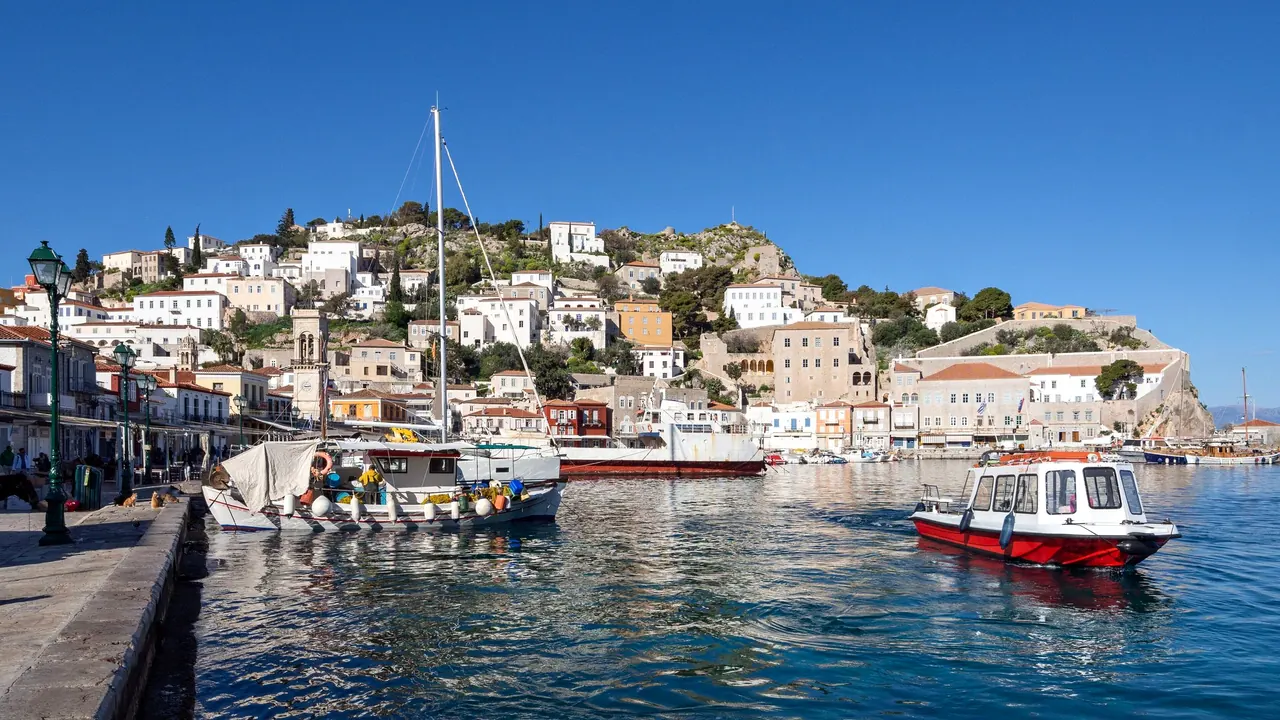
Hydra harbour, its clock tower and the town on the slope
- Beaches60
- Nature & outdoors48
- Wellness & relaxation46
Photo: C messier, CC BY-SA 4.0, cropped
Match
38
Every category weighted equally
- Beach & sun42
- Culture & arts37
- Food & nightlife36
- Family trip40
- Outdoors41
- Relax & unwind42
- Shopping & style36
- On a budget38
Hydra in twelve categories
Our verdict on each, scored 0 to 100 against the same fixed benchmark cities, so a score means the same thing on every page.
Beaches & swimming. Scores 60 out of 100.
Food & drink. Scores 38 out of 100.
Culture & sights. Scores 45 out of 100.
Nightlife. Scores 33 out of 100.
Nature & outdoors. Scores 48 out of 100.
Day trips. Scores 40 out of 100.
Good for families. Scores 28 out of 100.
Getting around. Scores 45 out of 100.
Shopping & style. Scores 28 out of 100.
Affordability. Scores 36 out of 100.
Live music & performing arts. Scores 14 out of 100.
Wellness & relaxation. Scores 46 out of 100.
Hydra category by category
Beaches & swimming
60Hydra is an island for swimming more than for lying on sand. Close to the harbour, people swim from rocks and concrete platforms cut into the shore west of the port, with ladders straight into deep, very clear water. Further along the coastal path, Kamini and Vlychos have small pebble coves with tavernas behind them, and Mandraki to the east is a sheltered bay.
The nicer coves on the south and west coasts, such as Bisti and Agios Nikolaos, are reached by water taxi or excursion boat and have pine trees behind them. The sea is warm enough from June to October and reaches about 25°C in August. Anyone who wants long, soft beaches for whole days will find the shore rocky and small.
Food & drink
38Eating on Hydra means Greek taverna cooking: grilled fish and octopus, slow-cooked meat, salads and mezedes, with chilled white wine in the evening. The harbour-front tables have the view and charge for it. The better meals tend to be in the lanes behind the port and in the small coves at Kamini and Vlychos, where you eat beside the water at dusk.
The island's own speciality is amygdalota, almond sweets flavoured with rosewater, sold in the town's bakeries. Apart from that the range is narrow: there are a few smarter modern Greek kitchens and cocktail terraces, no street food or market to speak of, and not much variety on a longer stay.
Culture & sights
45The sight here is the town itself. Grey and white stone mansions climb the hills around a horseshoe harbour. Shipowners built them in the eighteenth and nineteenth centuries, when Hydra's fleet was among the strongest in Greece and played a leading part in the War of Independence. The town is protected as a whole, and no cars or modern buildings break it up.
On the harbour, the Monastery of the Dormition has a marble bell tower and a quiet cloister. The Historical Archives Museum covers the naval history, and a few mansions, such as the Koundouriotis house, can be visited. Cannons still stand on the old batteries at the harbour mouth. Summer art exhibitions keep the island's long connection with painters and writers going. Two days is enough to see it all.
Nightlife
33Evenings on Hydra are spent drinking on the harbour. From late spring to early autumn, cocktail bars and cafés along the waterfront and up the first lanes fill after dinner, and a few stay open until the small hours with music and some dancing. The crowd is mostly well-dressed Athenians and yachting visitors, and summer weekends are noticeably busier.
There are no big clubs and nothing like a party-island scene. The night is more about a long drink with a view of the boats than about going out until dawn. From November to spring most of the bars close and the town is quiet early.
Nature & outdoors
48Hydra is a long, bare ridge of limestone. With no cars, the whole island is a network of old stone mule paths. From the town you can climb through pine and scrub to the hilltop monasteries of Profitis Ilias and Agia Efpraxia, keep going to Mount Eros, the highest point at nearly 600m, or follow the coast west to Kamini and Episkopi. You walk alone for hours with the Peloponnese and the Saronic islands spread out below.
The water is ideal for snorkelling and sea kayaking along the cliffs, and there is some diving. There is little shade, though, and the summer heat makes walking a job for early morning or for spring and autumn, when the hills are at their greenest.
Day trips
40Ferries and hydrofoils run along the Saronic Gulf, so other islands are the easy outings. Spetses, with its pine-backed town and horse carriages, and Poros, with its clock tower and the lemon groves facing it on the mainland, are each well under an hour away. Aegina, with its pistachio orchards and the Temple of Aphaia, takes longer.
The Peloponnese lies a short boat ride across the strait at Metochi. From there a car or a tour reaches Ermioni, the theatre at Epidaurus and the old town of Nafplio in about an hour and a half. Those trips are possible but take some arranging, and most visitors stay on the island.
Good for families
28Hydra has some charms for children: there is no traffic, lanes are safe to wander, donkeys carry luggage and the water taxis are an outing in themselves. Greek families eat late with children around the table. But there is nothing built for children at all, the town is a maze of steep stone steps where pushchairs are useless, and most swimming is off rocks and ladders into deep water.
Families with older children who swim well and like walking manage best, preferably based near the sheltered bay at Mandraki or the small coves at Kamini and Vlychos.
Getting around
45Hydra has no cars. You walk, hire a donkey or mule, or take a water taxi. The town is small and everything in it is within a short walk, but nearly every walk away from the harbour front is up or down stone steps, and luggage goes up by donkey or porter. A coastal path runs west to Kamini and Vlychos and east towards Mandraki. Water taxis wait on the harbour to take you to the more distant coves.
Getting to Hydra means a ferry. The fast boats from Piraeus take about an hour and a half to two hours, and they can be cancelled in strong summer winds or rough winter seas.
Shopping & style
28Shopping fills a few lanes behind the harbour. There are jewellery workshops, small galleries selling work by the island's resident artists, linen and resort-wear boutiques, ceramics and the usual sponges and souvenirs. The quality is higher than in most island ports, and browsing fits an evening walk well.
Beyond that there is nothing to shop for: no market, no department store, no wider range of fashion. Anyone who wants serious shopping should do it in Athens before or after the island.
Affordability
36Hydra is one of the dearer Greek islands in summer, and the main cost is the room. There are few places to stay, mostly small boutique guesthouses and converted stone mansions, and they fill early for July and August. The harbour-front cafés and cocktail bars charge for the view, and water taxis to the far coves or a donkey for your luggage add to the cost.
Everyday eating costs less than the rooms would suggest. A taverna meal of grilled fish, salads and house wine in the back lanes or at Kamini and Vlychos is fair value, swimming from the rocks near town is free, and the ferry from Piraeus is a modest part of the trip. Rooms are easier to find, and better value, in May, June and late September.
Live music & performing arts
14Hydra has little in the way of performance. In summer there are occasional open-air concerts and recitals, sometimes live Greek music in a taverna late in the evening, and the Miaoulia festival in June, a naval celebration with music and the burning of a fireship in the harbour. There is no theatre, concert hall or regular season. Anyone who wants an evening of music or theatre should look to Athens.
Wellness & relaxation
46Hydra has no spa or bathing tradition. Wellness means a few treatment rooms in boutique hotels, occasional yoga retreats and massage. What the island offers is quiet. With no cars or motorbikes, the only sounds are bells, donkeys and the sea, and the days settle into a slow routine of a morning swim, a long lunch and a nap through the heat.
The harbour gets crowded at midday in summer, when cruise and excursion boats come in, but it empties again by evening. The calmest stays are in the upper town or at Kamini, and in May, June and September.
Where to stay in Hydra
Most visitors stay in Hydra town itself, and the real choice is between the harbour and the lanes above it. Rooms on or just behind the waterfront put the cafés, cocktail bars and ferries at your door, which suits a short first visit and anyone who wants evenings out. The quay does fill at midday in summer when excursion boats arrive. The upper town is quieter and has the best views over the stone mansions, but every trip down and back is on steep steps, and your luggage goes up by donkey or porter.
Kamini, a short walk west along the coastal path, is a small fishing harbour with tavernas by the water and swimming off the rocks, and it is one of the calmest places to stay on the island. Vlychos, further along the same path, is quieter still, with a pebble cove and dinner beside the sea at dusk. Both suit couples, walkers and families with older children who swim well. Mandraki, east of town, has a sheltered bay with the gentlest water for younger swimmers, but little else around it.
The island is small and has no cars, so one base is enough for a whole stay. The far coves are a water taxi ride from the harbour. There are few rooms, and they fill early for July and August.
When should you go?
Pick a month to see what it is like. The climate figures are measured averages, not a forecast.
Hydra in July
Daytime high, °C
Rainfall in the month, mm
The whole year
Shaded against this destination’s own year: the deepest cell is its best month for that figure and the palest its weakest.
Where the figures come from
Hydra's temperatures are measured 66 km from the centre, at Athinai Airport.
Hydra has no rain gauge within 25 km of the centre, so its rainfall comes from a gridded climate dataset read at the destination rather than from a gauge further away.
Temperature and rainfall are climate normals, averaged over the years shown. Hydra: 1991-2020 normals, Athinai Airport (65.5 km from centre).
Before you go
| Measure | Hydra |
|---|---|
| Official language | Greek |
| Currency | Euro (EUR) |
| Sockets | CF230 V, 50 Hz |
| Driving side | Right |
| Time zone | UTC+2, UTC+3 in summer |
| Emergency number | 112 |
| Main airport | Athens Eleftherios Venizelos International Airport (ATH)176 non-stop destinations |
| Public holidays this year | 15 days |
By the numbers
| Measure | Hydra |
|---|---|
| Population | 1,966 |
| People per km² | 40 |
| Swim season, months above 21 °C | 5 months |
Compare Hydra with
Every comparison with a written verdict behind it.
- Aegina
- Corfu
- Crete
- Folegandros
- Halkidiki
- Ios
- Kefalonia
- Kos
- Lefkada
- Milos
- Mykonos
- Naxos
- Paros
- Paxos
- Peloponnese
- Rhodes
- Samos
- Santorini
- Sifnos
- Skiathos
- Skopelos
- Thassos
- Zakynthos