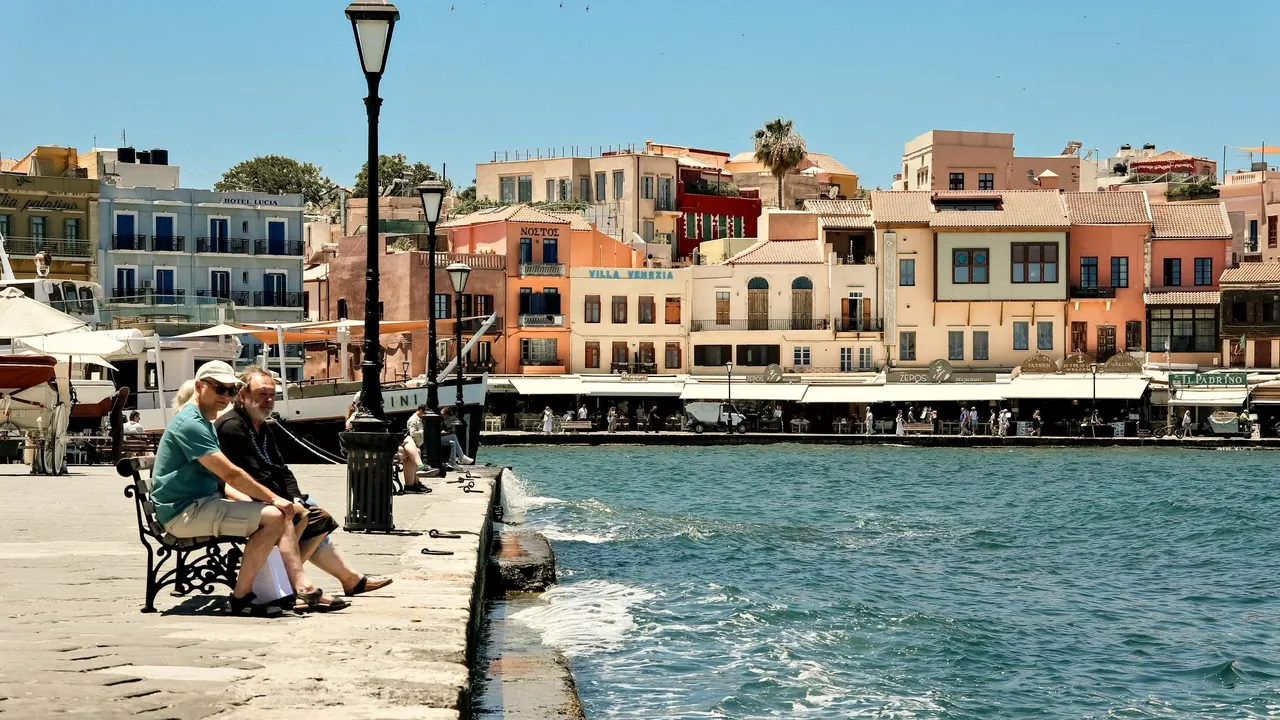
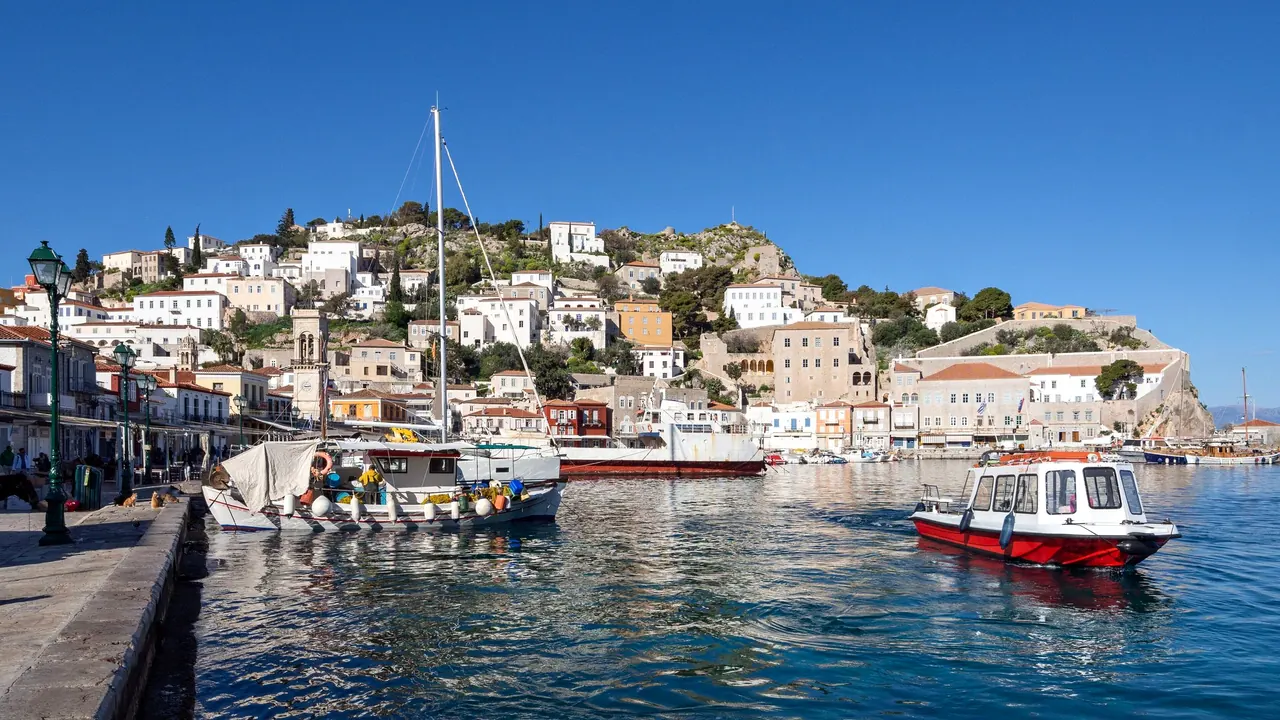
Photos: Crete by Piotr Baranowski, Pexels License; Hydra by C messier, CC BY-SA 4.0, cropped.
Crete or Hydra?
Our verdict in twelve categories, each scored against the same fixed benchmark cities, and the climate month by month, so you can choose for your trip.
Choose Crete for
- families
- food and drink
- nature and the outdoors
Crete is for a full, varied trip of a week or more. It has famous sand at Elafonissi and Balos, the Minoan palaces and the Heraklion Archaeological Museum, gorges cut through the White Mountains, and a regional cuisine worth eating your way across. It suits families who want gentle sandy water, walkers and anyone happy to drive, and once the rooms are counted it costs less than Hydra.
Choose Hydra for
- getting around
- wellness
Hydra suits travellers who want one small, beautiful place and very little to organise. The car-free stone town around its horseshoe harbour, swims off the rocks into deep clear water and long drinks watching the boats make a calm short stay a ferry ride from Athens. Couples and adults who value quiet over choice will be happiest there. Families with small children, beach loungers and anyone wanting varied food will feel its limits within a few days.
Scoreboard
Twelve categories on one fixed scale from 0 to 100. The shaded stretch is the gap between the two.
Your match
Pick a travel style or drag the sliders, and both match scores follow your weighting.
Wins on families and food and drink with your weighting.
Wins on getting around and wellness with your weighting.
What matters to you?
Category by category
What the scores mean for a trip.
Beaches & swimming
Crete has some of the best beaches in Greece and plenty of variety: the pink-tinged sand and lagoons of Elafonissi, Balos beneath the Gramvousa peninsula, the long sunset strand at Falassarna, the palm bay at Vai and easy resort beaches along the north coast. The south coast adds pebble coves reached by boat or on foot, Preveli among them.
Hydra is for swimming rather than sunbathing on sand. You climb down ladders from rocks and concrete platforms west of the port into very clear, deep water, or walk to the small pebble coves at Kamini, Vlychos and Mandraki. The prettier pine-backed coves such as Bisti need a water taxi, and there is no soft beach to settle on for a whole day.
Food & drink
Crete's food is a reason to go in itself. Its own olive oil, wild greens, graviera and mizithra cheeses, slow-cooked lamb and dakos are at their best in village tavernas and in the backstreets of Chania and Rethymno, and Heraklion adds a market street and wines from the vineyards to its south.
Hydra eats well but narrowly. Grilled fish, octopus and mezedes by the water at Kamini or Vlychos at dusk are a pleasure, and the rosewater almond sweets from the town bakeries are its one speciality. There is no market or street food, though, and a week of similar taverna menus starts to repeat.
Culture & sights
Crete offers several thousand years of history across the island: Knossos and the Heraklion Archaeological Museum with its frescoes and the Phaistos Disc, the palaces of Phaistos and Malia, Roman Gortyn, then Chania's Venetian harbour, Rethymno's fortress and mosques, Spinalonga and Arkadi. Seeing it properly takes days of driving.
Hydra's culture is a single intact townscape. The shipowners' stone mansions above the harbour, the Monastery of the Dormition, the Historical Archives Museum on the island's naval past and the Koundouriotis mansion make a lovely, coherent picture with no cars or modern buildings, and two days covers it.
Nightlife
Crete has both ends of the scale. Malia and Hersonissos are loud package-resort party strips for young groups, while Chania's harbour, Rethymno's waterfront and Heraklion's café-bar quarter offer cocktail bars and late terraces shared with Greek students and locals.
Hydra has only the gentler half. After dinner the harbour cocktail bars fill with well-dressed Athenians and yacht crews, and a few stay open late with some dancing, but there are no clubs, and from November to spring the town goes quiet early.
Nature & outdoors
Crete has real mountains. The White Mountains and Psiloritis both rise above 2,400m, and gorges cut through them, with Samaria running all the way down to the Libyan Sea. A European long-distance path crosses the whole island, the coast path between Loutro, Sfakia and Agia Roumeli is a classic walk, climbers head for Agiofarago, and vultures and the wild kri-kri goat live in the west.
Hydra is smaller and simpler: a bare limestone ridge crossed by old mule paths to the hilltop monasteries and up Mount Eros, a modest summit next to Crete's peaks, with the Peloponnese spread out below. You walk straight from your door, often alone for hours, and the cliffs are excellent for snorkelling and sea kayaking, but there is little shade.
Day trips
From a base on Crete the outings mostly stay on the island and need a car: the other old towns, the wine villages around Peza and Archanes, the potters of Margarites, Anogia and the Amari valley. Boats reach Chrissi and Gramvousa, and the fast ferry to Santorini makes a long but popular day.
From Hydra the obvious trips are by boat to other islands. Spetses and Poros are each under an hour away and Aegina a little further. Epidaurus and Nafplio on the Peloponnese can be reached via Metochi, but they take some arranging, so most visitors simply stay put.
Good for families
Crete is built for a family beach vacation. The north coast and the area around Chania have sandy beaches with gentle shelving water, resort hotels with pools and children's clubs, and several waterparks, and Elafonissi's warm lagoon is ideal for toddlers. The downsides are midsummer heat and long drives on winding roads.
Hydra has its charms, with traffic-free lanes, luggage carried by donkey and water taxis that children enjoy, but nothing is made for them. Steep steps defeat pushchairs and most swimming is in deep water, so it works only for older children who swim and walk well.
Getting around
Neither island is effortless, but in opposite ways. Crete is large and mountainous, so a hire car is close to essential. Buses link the north-coast towns reliably, but the roads south are steep and slow and some villages are reached only by summer boats.
Hydra has no cars at all. Everything in town is a short walk, though usually up or down stone steps, with donkeys for luggage and water taxis to the far coves. Getting there means a ferry from Piraeus of under two hours, which strong winds can cancel.
Shopping & style
Crete gives you more to browse, all of it local rather than fashion: Chania's leather-makers' lane, knife-makers and cross-shaped covered market, Heraklion's market street of cheeses, herbs and raki, and ceramics from Margarites. Thyme honey and olive oil are the things to bring home.
Hydra fills only a few lanes behind the harbour with jewellery workshops, artists' galleries and linen boutiques. The quality is good for an island port and suits an evening stroll, but there is no market, and anything more serious waits for Athens.
Affordability
Crete is the easier island on the wallet. Family-run rented rooms and village tavernas are good value, with generous meals and free raki. Costs climb around the famous western beaches, Chania's old town and Elounda, and car hire is the unavoidable extra.
On Hydra the room is the big expense. Places to stay are few, mostly boutique guesthouses and converted mansions that fill early for high summer, and water taxis and porters add up. Back-lane taverna meals are fair, and May, June and late September bring rooms within easier reach.
Live music & performing arts
Crete has a living music tradition: the lyra and lute, improvised mantinades verses and circle dances, heard in the music tavernas of Rethymno and Chania, at summer saints' day festivals and in Anogia, plus summer festivals in Heraklion's and Chania's fortresses. Formal theatre and opera are thin.
Hydra has very little. The highlight is the Miaoulia festival in June, with music and a fireship burned in the harbour. Beyond that there are occasional open-air recitals and the odd late taverna song, and for any real programme you would look to Athens.
Wellness & relaxation
For rest the two islands are much the same, and neither has a bathing tradition. They differ in what rest means. Crete has proper resort spas, gathered around Elounda and the Gulf of Mirabello, and slow corners such as boat-access Loutro and the olive-grove hill villages.
Hydra has only a few hotel treatment rooms and occasional yoga retreats, but the whole island is quiet. With no engines, the sounds are bells, donkeys and the sea. The midday cruise crowd leaves by evening, and the upper town and Kamini are calmest.
When should you go?
Pick your month. The climate figures are measured averages, not a forecast.
Crete in July
Hydra in July
Daytime high, °C
Rainfall in the month, mm
Where the figures come from
Hydra's temperatures are measured 66 km from the centre, at Athinai Airport.
Hydra has no rain gauge within 25 km of the centre, so its rainfall comes from a gridded climate dataset read at the destination rather than from a gauge further away.
Temperature and rainfall are climate normals, averaged over the years shown. Crete: 1991-2020 normals, Heraklion Airport (3.6 km from centre). Hydra: 1991-2020 normals, Athinai Airport (65.5 km from centre).
The two islands follow the same Greek pattern of dry, sunny summers, with a sea warm enough to swim from June to October and about 25°C in August at both. The real difference is the summer heat. Hydra climbs to around 33°C in July and August, so its stepped lanes and shadeless hill paths are hard going except early in the morning. On Crete the highs stay nearer 29°C, so midsummer is easier there, though still too hot for the long gorge walks.
For walking and sightseeing, April, May and October are kinder on both islands. May is warm and dry, but the sea is still cool at about 19°C, so June and September are the months that combine properly warm water with heat that is easier to bear. Winters are mild but cool and wet. Hydra's rain peaks in November and December, while Crete is wettest in December and January at about 95mm a month, and snow lingers on its high mountains into spring.
Which traveller are you?
On a family trip with young children, choose Crete and base yourselves on the north coast between Heraklion and Agios Nikolaos, or near Chania, so the beach is close and car journeys stay short. June or September avoids the worst heat. Hydra is better kept for families with older children who swim well.
For a beach and sun trip, go to Crete. Stay in the west around Chania if you want the famous sands, and reach them early before the midday crowds, or on the north coast if you want a beach beside the hotel. Hydra suits strong swimmers happy with rocks and water taxis.
On a relaxing and wellness trip, Hydra makes rest simple. Take a room in the upper town or at Kamini in May, June or September, leave planning behind and let the days slow down. On Crete you get the same calm by choosing one quiet south-coast village and staying put.
Before you go
| Measure | Crete | Hydra |
|---|---|---|
| Official language | Greek | Greek |
| Currency | Euro (EUR) | Euro (EUR) |
| Sockets | CF230 V, 50 Hz | CF230 V, 50 Hz |
| Driving side | Right | Right |
| Time zone | UTC+2, UTC+3 in summer | UTC+2, UTC+3 in summer |
| Emergency number | 112 | 112 |
| Main airport | Heraklion International Nikos Kazantzakis Airport (HER)129 non-stop destinations | Athens Eleftherios Venizelos International Airport (ATH)176 non-stop destinations |
| Public holidays this year | 15 days | 15 days |
By the numbers
| Measure | Crete | Hydra |
|---|---|---|
| Population | 623,065 | 1,966 |
| People per km² | 75 | 40 |
| Swim season, months above 21 °C | 5 months | 5 months |
Where else could you go?
Every comparison below shares a destination with this one, so you can follow Crete or Hydra somewhere new.