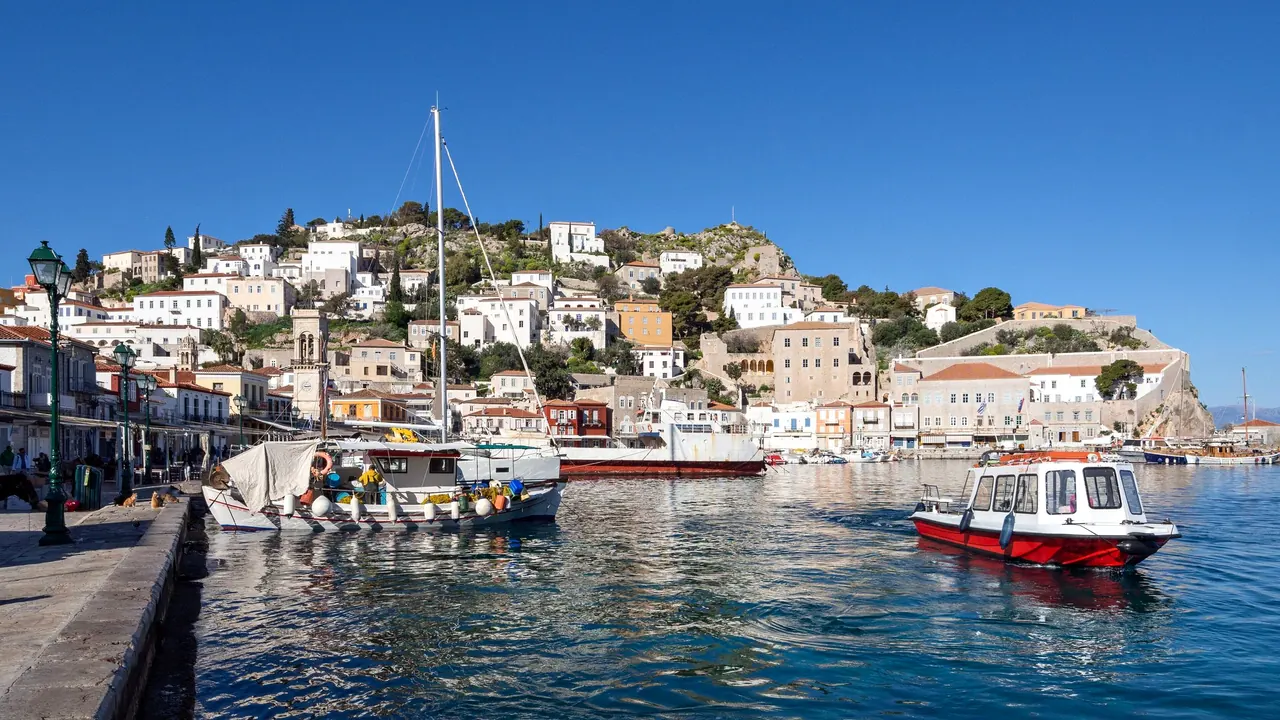
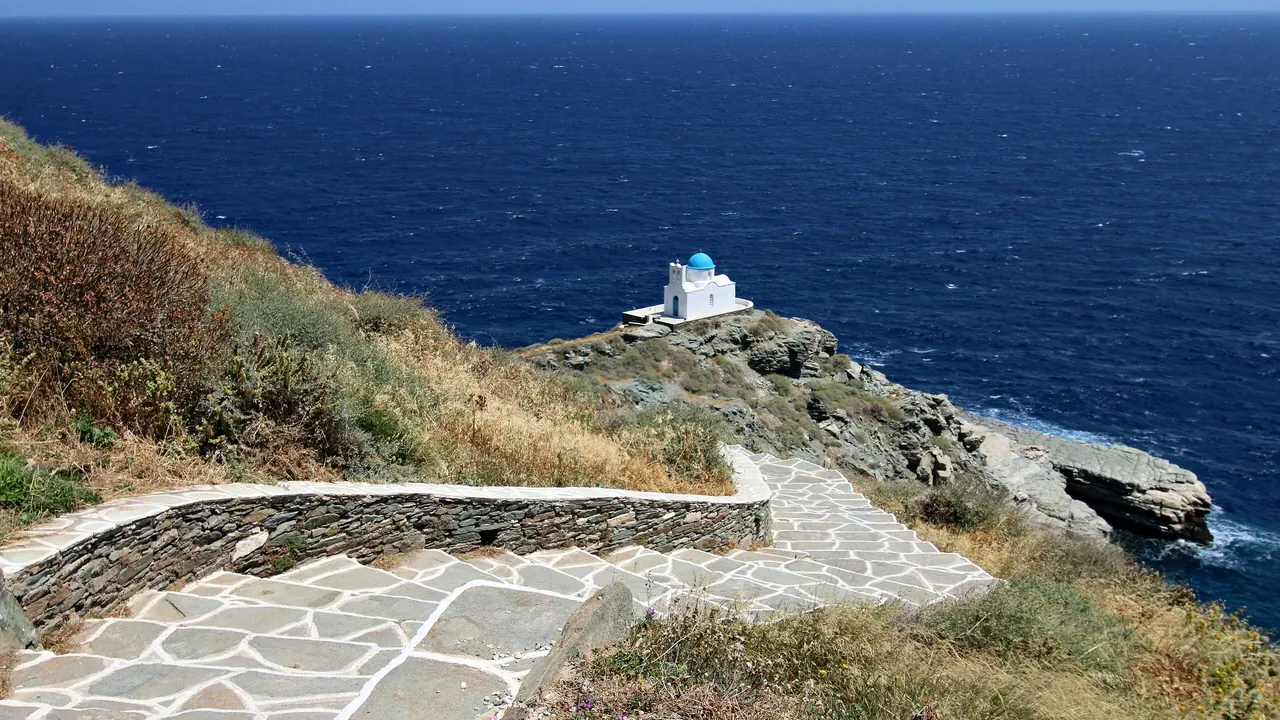
Photos: Hydra by C messier, CC BY-SA 4.0, cropped; Sifnos by Zde, CC BY-SA 4.0, cropped.
Hydra or Sifnos?
Our verdict in twelve categories, each scored against the same fixed benchmark cities, and the climate month by month, so you can choose for your trip.
Choose Hydra for
- culture and sights
- nightlife
- wellness
Hydra suits travellers who want the place itself to be the attraction: a single harbour town of stone captains' mansions with no cars at all, where you climb mule paths in the morning, swim off the rocks by lunch and spend the evening over a drink beside the boats. It is the closer of the two to Athens, so it works for a shorter stay, and it has more history to see. In exchange it has smaller, rockier swimming, a narrower table and very little for young children.
Choose Sifnos for
- food and drink
- families
- beaches
Sifnos is the better choice if your days revolve around beaches and meals. It has real sand at Platis Gialos, Vathi and Kamares, shallow water for children, the most respected cooking in the Cyclades and a good network of waymarked paths between white villages. The ferry from Piraeus takes longer, and you trade Hydra's single grand town for a spread of villages and coves, which suits a slower week better than a few days.
Scoreboard
Twelve categories on one fixed scale from 0 to 100. The shaded stretch is the gap between the two.
Your match
Pick a travel style or drag the sliders, and both match scores follow your weighting.
Wins on culture and sights and nightlife with your weighting.
Wins on food and drink and families with your weighting.
What matters to you?
Category by category
What the scores mean for a trip.
Beaches & swimming
These are two different kinds of swimming. On Hydra you climb down ladders from rocks and concrete platforms west of the port into deep, very clear water, or walk to the small pebble coves at Kamini and Vlychos. The pine-backed coves at Bisti and Agios Nikolaos need a water taxi.
Sifnos has real beaches. Platis Gialos is broad, fine sand over shallow water, Vathi is an almost enclosed bay that stays calm in the meltemi, and Kamares gives you an easy sandy beach right at the port. Anyone who wants to spend whole days on sand should choose Sifnos.
Food & drink
Sifnos is the island to choose for eating. It has its own cooking tradition in clay pots: chickpeas baked overnight in wood ovens, lamb with wine and dill in mastelo, manoura cheese aged in wine lees, and old bakeries in Artemonas. At Cheronissos the catch is landed beside the tables.
Hydra offers sound taverna grills and mezedes, with the best meals in the back lanes or at Kamini and Vlychos at dusk, plus its rosewater almond sweets. Beyond that the choice is narrow and starts to repeat itself over a longer stay.
Culture & sights
Hydra has more to see, and it is all in one place. The horseshoe harbour is ringed by mansions built by the shipowners whose fleet fought in the War of Independence. You can visit the Monastery of the Dormition, the Historical Archives Museum and houses such as the Koundouriotis mansion within a couple of days.
On Sifnos the sights are spread across the island. There is the medieval cliff village of Kastro, the white villages of Apollonia and Artemonas, Chrysopigi on its rock, and Mycenaean and Hellenistic remains in the hills. It is a gentler set to take in over several days.
Nightlife
Neither island is for clubbing, and the evenings differ mostly in setting. Hydra's nights take place along the harbour, where cocktail bars fill with well-dressed Athenians and yacht crews and a few stay open late with some dancing. On Sifnos the going-out runs along one narrow lane in Apollonia, inland, with sunset drinks at Kamares, and outside July and August it is quiet soon after dinner.
Nature & outdoors
Sifnos has the better walking. Its waymarked network of stone-paved mule tracks lets you cross much of the island on foot, linking villages, watchtowers and bays among terraces of thyme and olive trees, up to Profitis Ilias at about 680m.
Hydra's paths are wilder and emptier. They climb a bare limestone ridge to the hilltop monasteries and Mount Eros, with long views of the Peloponnese, but there is little shade. Hydra's cliffs are also good for sea kayaking, which Sifnos does not offer in the same way.
Day trips
Hydra can reach the mainland and Sifnos cannot. A short boat across the strait lands you at Metochi, and from there a car or tour reaches the ancient theatre at Epidaurus and the old town of Nafplio in about an hour and a half. Closer to hand, Spetses and Poros are each well under an hour by hydrofoil, and Aegina's Temple of Aphaia makes a longer day.
From Sifnos every outing is to another island, and only while the summer ferries run. Milos, about an hour by fast boat, is the best of them, with its hilltop Plaka and painted boathouses. Serifos and its striking chora lie just to the north, and quiet Kimolos is reached by excursion boat. When the wind is strong, connections from either island thin out.
Good for families
Sifnos is much easier with children. Platis Gialos, Kamares and Vathi have sand and shallow water for small swimmers, and the short distances mean no long drives. Its villages are stepped too, but there is a bus or a car to reach the beach.
Hydra does have some charms for children, with no traffic, donkeys and water taxi rides. Even so, the whole town is steep steps, and the swimming is from rocks into deep water, so it really works only for older children who swim and walk confidently.
Getting around
Getting about is about equally easy on both islands, in different ways. Hydra has no cars at all: you walk, take a donkey or catch a water taxi, and everything in town is close, though up and down steps. It is also the nearer island, under two hours by fast boat from Piraeus.
Sifnos takes a few hours by ferry and has no airport. Once you are there, summer buses link the main villages and beaches, and a hired car or scooter reaches the remoter coves on narrow roads.
Shopping & style
On Hydra you buy art and jewellery. Small workshops and galleries in the lanes behind the harbour sell pieces by the island's resident artists, alongside linen and resort wear, and the standard is higher than in most island ports.
On Sifnos you buy pottery. Workshops around Kamares, Vathi and Platis Gialos still throw the clay casseroles and jugs used in the island's own cooking, and shops in Apollonia sell capers, honey, manoura and almond sweets to take home. On either island the browse takes an evening, and real shopping means Athens.
Affordability
Both are upmarket islands where the room is the big cost in July and August, and the cost of a stay is much the same. On Hydra the extras come from harbour-front prices, water taxis and porters, while back-lane taverna meals are fair. On Sifnos buses and hiking keep the days cheap and the cooking is worth what it costs. On both islands June and September bring better-value rooms.
Live music & performing arts
Neither island has a stage of any kind, so what each offers is folk occasions. Hydra has the Miaoulia in June, a naval festival with music and a fireship burned in the harbour, plus occasional summer recitals. Sifnos has its panigyria, saints' day feasts at chapels and monasteries where violin and lute music and circle dancing go on through the night and visitors can join in.
Wellness & relaxation
Neither island is a spa destination. Apart from a few treatment rooms in boutique hotels, and the odd yoga retreat on Hydra, rest on both comes from the pace. What differs is where the quiet sits. On Hydra it is all in one place: a single town with no engines anywhere, so once you step back from the harbour front the stillness is all around you. That suits a short retreat where you hardly move, as long as you stay in the upper town or out at Kamini, away from the day-trip crowds at midday.
On Sifnos the calm is spread across several villages and many bays. Resting there means picking a different empty cove each day and spending the evening in the car-free lanes of Apollonia and Artemonas. It suits a longer, looser week better than Hydra does, though August fills its villages and best-known beaches, and the island is gentlest in June and September.
When should you go?
Pick your month. The climate figures are measured averages, not a forecast.
Hydra in July
Sifnos in July
Daytime high, °C
Rainfall in the month, mm
Where the figures come from
Hydra's temperatures are measured 66 km from the centre, at Athinai Airport.
Hydra has no rain gauge within 25 km of the centre, so its rainfall comes from a gridded climate dataset read at the destination rather than from a gauge further away.
Sifnos has no weather station within reach, so its figures come from a gridded climate model rather than a measured record, and read a broad area rather than one spot.
Temperature and rainfall are climate normals, averaged over the years shown. Hydra: 1991-2020 normals, Athinai Airport (65.5 km from centre). Sifnos: 2001-2020 normals, NASA POWER reanalysis grid, no weather station within 90 km.
Both islands are dry from June to August and have sea warm enough to swim from June into October. Heat is what separates them. Hydra lies close to the mainland and gets much hotter, with July and August highs of around 33°C, so the steps and mule paths are for early mornings only. Sifnos, out in the Cyclades, stays nearer 27°C in high summer, which makes village walks easier, although the meltemi can stir up the exposed beaches then. Hydra's sea also ends up slightly warmer, at about 26°C in August.
For walking, May and late September into October suit both islands. Hydra already has long, sunny days by May. Rain returns in November. It is heavier on Sifnos, which gets about 107mm in both December and January, and winter on either island is mild but damp.
Which traveller are you?
On a beach and sun trip, Sifnos is the clear pick. Platis Gialos has a long curve of fine sand, and Vathi's enclosed bay stays calm when the wind gets up. Hydra means ladders off rocks and small pebble coves, so it suits swimmers more than sunbathers.
For a culture and arts trip, Hydra gives more. The whole town is a protected set of eighteenth and nineteenth century shipowners' mansions, with a naval archive, a harbour monastery and a long link with painters. Sifnos has Kastro and its chapels, but less to see.
On a family trip with children, Sifnos works far better. It has sandy, shallow bays at Kamares and Platis Gialos, and buses or a short drive between them. Hydra's steep stepped lanes defeat pushchairs, and most of its swimming is into deep water.
Before you go
| Measure | Hydra | Sifnos |
|---|---|---|
| Official language | Greek | Greek |
| Currency | Euro (EUR) | Euro (EUR) |
| Sockets | CF230 V, 50 Hz | CF230 V, 50 Hz |
| Driving side | Right | Right |
| Time zone | UTC+2, UTC+3 in summer | UTC+2, UTC+3 in summer |
| Emergency number | 112 | 112 |
| Main airport | Athens Eleftherios Venizelos International Airport (ATH)176 non-stop destinations | Milos Airport (MLO)2 non-stop destinations |
| Public holidays this year | 15 days | 15 days |
By the numbers
| Measure | Hydra | Sifnos |
|---|---|---|
| Population | 1,966 | - |
| People per km² | 40 | - |
| Swim season, months above 21 °C | 5 months | 5 months |
Where else could you go?
Every comparison below shares a destination with this one, so you can follow Hydra or Sifnos somewhere new.