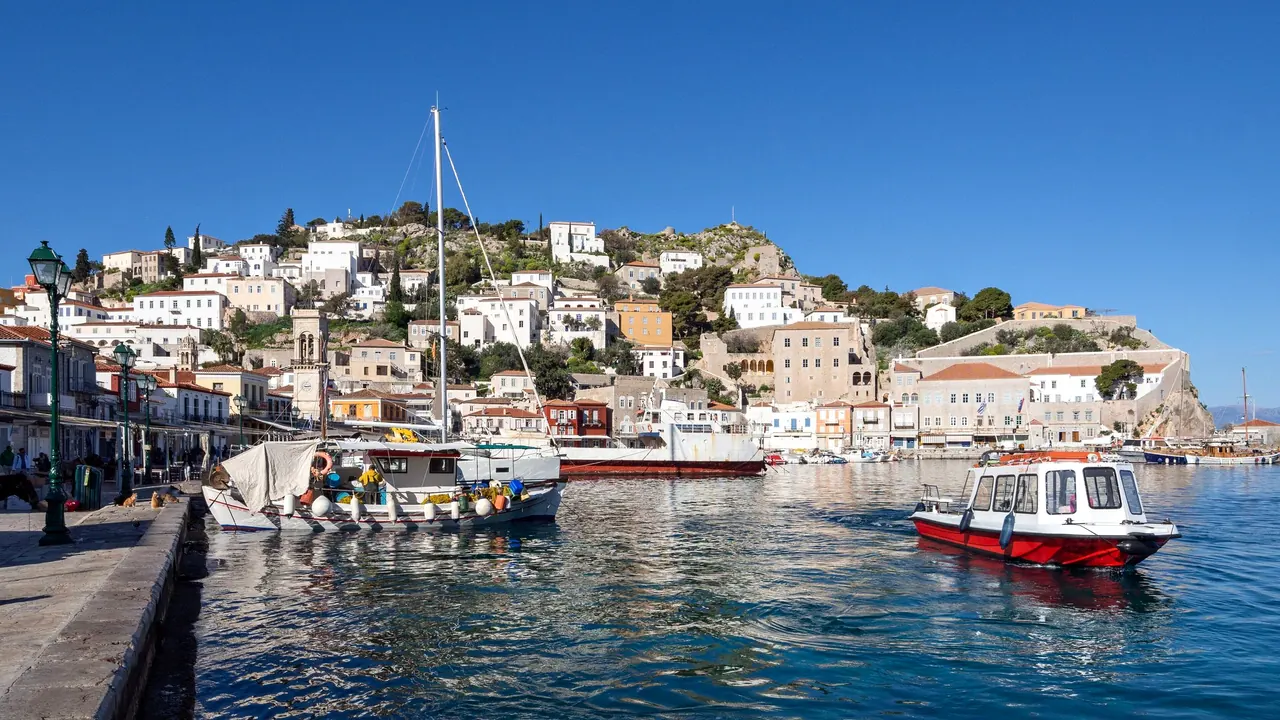
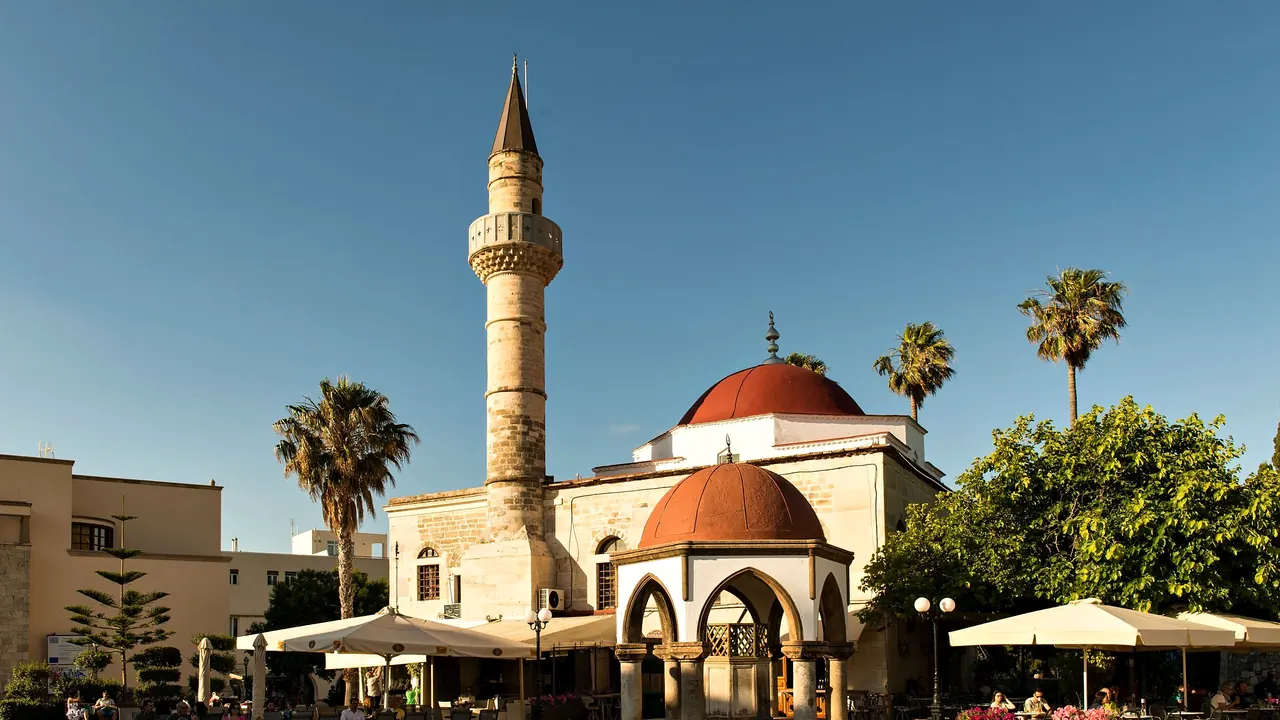
Photos: Hydra by C messier, CC BY-SA 4.0, cropped; Kos by Wolfgang Weiser, Pexels License.
Hydra or Kos?
Our verdict in twelve categories, each scored against the same fixed benchmark cities, and the climate month by month, so you can choose for your trip.
Choose Hydra for
- nature and the outdoors
- shopping
- wellness
Hydra suits a traveller who wants stillness and beauty more than activity. Its harbour town of stone mansions has no cars at all, the days run to a morning swim off the rocks, a long lunch in a cove and an evening drink by the boats, and old mule paths lead up to hilltop monasteries. Couples, walkers and anyone happy with a small place for a few days will love it, provided they accept steep steps, rocky swimming, a narrow choice of food and summer rooms that cost a good deal.
Choose Kos for
- families
- beaches
- nightlife
Kos is the easier and more varied choice for a classic island vacation. It has long sandy beaches and shallow water on the north coast, resorts built around children, nightlife in Kos Town and Kardamena, buses and cycle paths, and boat trips to Bodrum, Nisyros and Kalymnos. It also costs less. What it lacks is Hydra's intimacy: the resorts are made for package travel, and the island's charm sits in its ruins, hill villages and the far south-west rather than in one picture-perfect town.
Scoreboard
Twelve categories on one fixed scale from 0 to 100. The shaded stretch is the gap between the two.
Your match
Pick a travel style or drag the sliders, and both match scores follow your weighting.
Wins on nature and the outdoors and shopping with your weighting.
Wins on families and beaches with your weighting.
What matters to you?
Category by category
What the scores mean for a trip.
Beaches & swimming
Kos is the beach island of the two. Its north coast runs in long sandy strands with shallow water at Tigaki, Marmari and Mastichari, the south around Kardamena is more sheltered, and Paradise Beach and Agios Stefanos on the Kefalos peninsula are its finest bays. The one catch is the meltemi, which can make the north coast choppy in high summer.
Hydra is about swimming rather than sunbathing. People swim from rock and concrete platforms west of the port, straight into very clear, deep water, and the pine-backed coves at Bisti and Agios Nikolaos take a boat ride. It is lovely for a dip, but no good for long days on soft sand.
Food & drink
Both islands serve Greek taverna cooking, grilled fish, octopus and meze, but Kos gives more to explore. It has local dishes such as pitaroudia and krasotyri, village tavernas in Zia and Pyli, fishing-harbour meals at Mastichari and Kamari, and a few wineries near Kefalos. The resort food aimed at package tourists is the weak spot.
On Hydra the range is narrower. The pleasures are a waterside dinner at Kamini or Vlychos and the rosewater almond sweets called amygdalota, but there is no market or street food, and the menus start to feel the same on a longer stay.
Culture & sights
The two are evenly matched, but they offer very different things. On Hydra the sight is the whole town: shipowners' mansions around a horseshoe harbour, protected as one piece and untouched by cars, along with the Monastery of the Dormition and the naval archives that recall the island's part in the War of Independence.
Kos offers archaeology instead. Roman and Hellenistic ruins lie scattered through Kos Town, the Knights' Neratzia Castle guards the harbour, and the Asklepieion sanctuary sits on its hillside outside town. Hydra is the one to stroll and soak up, and Kos the one to tour site by site.
Nightlife
Kos has much more going on after dark. The old-quarter lanes of Kos Town stay loud into the small hours, there are beach clubs at Lambi, and Kardamena is a full party resort with late clubs and a young crowd.
Hydra's evenings are a long cocktail on the harbour among well-dressed Athenians and yacht visitors, with a little dancing in a few bars late on. There are no clubs, and the island suits people who want a drink with a view rather than a night out until dawn.
Nature & outdoors
Neither island is a landscape destination, and they come out about level, but the outdoors feels different on each. Hydra is a bare limestone ridge crossed by car-free mule paths, so you can walk for hours to Profitis Ilias or up Mount Eros, and kayak or snorkel along the cliffs.
Kos is gentler and more varied: pine woods on the Dikeos range above Zia, peacocks in the Plaka forest and flamingos on the Alikes salt lake. The meltemi also makes Marmari and Tigaki good for windsurfing and kitesurfing, which Hydra cannot offer.
Day trips
Kos has the more tempting outings. Bodrum, with its crusader castle and bazaar, is a short ferry ride away in Turkey, so bring a passport. Boats also run to the volcanic crater on Nisyros and to the sponge-diving harbour of Kalymnos.
From Hydra the easy trips are to Spetses and Poros, both under an hour by boat. Epidaurus and Nafplio on the Peloponnese are within reach, but only with a car or a tour from Metochi, so most visitors stay on the island.
Good for families
Kos is far easier with children. The north-coast beaches shelve gently, resorts come with pools and kids' clubs, there is a water park near Marmari, and the flat coast is good for family bike rides. Families who want quiet nights should simply avoid Kardamena.
Hydra's car-free lanes and donkeys delight children, but the town is all steep steps, nothing is built for them, and the swimming is into deep water. It works for older children who swim confidently and like to walk.
Getting around
Kos is simpler to move around. Kos Town is flat, cycle lanes lead to the beaches on either side, buses run the main road to the resorts, and a hire car for a day or two takes you to the hill villages and the far south-west.
Hydra has no roads to speak of. You walk, take a donkey or hop on a water taxi, and nearly every route off the harbour front climbs stone steps. That is part of its charm, but it is tiring in the heat, and the ferry from Piraeus can be cancelled when the wind blows hard.
Shopping & style
Neither island is a shopping destination, and anyone who wants fashion should shop in Athens or at home. Hydra's few lanes have better quality, with jewellery workshops, galleries showing resident artists, linen and ceramics. Kos has more souvenir trade in its old quarter, but the Italian-era market hall on Eleftherias Square adds local herbs, spices and produce that Hydra lacks.
Affordability
Kos is noticeably cheaper. Because it is built for package travel, it has plenty of mid-range rooms and apartments in Kardamena, Tigaki and Marmari, and buses, bike hire and back-street tavernas are all reasonably priced.
Hydra's cost is mostly the room. There are few places to stay, mostly boutique guesthouses in old mansions that fill early for high summer, and water taxis and porters add to the bill. Its tavernas are fair value, though, and May, June or late September make the trip easier on the budget.
Live music & performing arts
Both are thin on performance, and anyone after a theatre or concert season will not find it on either island. Kos at least has a summer festival, the Hippokrateia, with concerts and drama staged at the Asklepieion, the Odeon and the castle. Hydra's big event is the June Miaoulia, a naval celebration that ends with a fireship burning in the harbour.
Wellness & relaxation
The two are level, but they relax you in different ways. Hydra's gift is silence: no engines, a slow rhythm of swim, lunch and siesta, and a harbour that empties once the day boats leave. Its treatments are limited to a few hotel rooms and yoga retreats.
Kos has the more tangible offer. At Therma a hot sulphur spring runs into the sea, and bathers stack stones to make warm pools, and spas are common at the larger resorts. For real calm on Kos, though, you need to stay in Kefalos, Mastichari or the hill villages.
When should you go?
Pick your month. The climate figures are measured averages, not a forecast.
Hydra in July
Kos in July
Daytime high, °C
Rainfall in the month, mm
Where the figures come from
Hydra's temperatures are measured 66 km from the centre, at Athinai Airport.
Hydra has no rain gauge within 25 km of the centre, so its rainfall comes from a gridded climate dataset read at the destination rather than from a gauge further away.
Kos has no rain gauge within 25 km of the centre, so its rainfall comes from a gridded climate dataset read at the destination rather than from a gauge further away.
Temperature and rainfall are climate normals, averaged over the years shown. Hydra: 1991-2020 normals, Athinai Airport (65.5 km from centre). Kos: 1993-2020 (rainfall 1991-2020) normals, Kos Airport (23.2 km from centre).
Both islands are warm enough for the beach from June to October, and the sea is at its warmest in August, about 26°C off Hydra and a degree less off Kos. Hydra runs hotter. June is already hot there and July and August reach 33°C, and there is little shade on its paths, so walking is for the early morning. Hydra also has long, very sunny days from May to August. Kos stays a couple of degrees cooler all summer, and the meltemi on its north coast takes some of the edge off the heat.
For walking and sightseeing, May and late September into October suit Hydra best. Kos is slightly cooler, so it stays pleasant a little further into June. In winter the two are about the same temperature, cool rather than cold, and the difference is rain. Hydra stays fairly dry through October, while on Kos the rain arrives a month earlier. In November the two are equally wet, with about 90mm each. After that Kos is far wetter, with around 170mm in January, roughly twice what Hydra gets in December and nearly three times its January rain.
Which traveller are you?
For a beach and sun trip, Kos is the clear pick. Its long sandy strands from Tigaki to Mastichari give room to spread out, and the bays around Kefalos are lovely, while Hydra offers rocky platforms and small pebble coves reached by water taxi.
On a family trip with young children, choose Kos. Shallow north-coast water, resorts with pools and kids' clubs, a water park and flat cycle paths make days easy. Hydra's steep stone steps defeat pushchairs, and most swimming is from ladders into deep water.
For a relaxing and wellness trip, Hydra has the edge in atmosphere. With no cars or motorbikes, the island's sounds are bells, donkeys and the sea. Kos does have the hot spring at Therma and resort spas, but around its resorts the pace is busier.
Before you go
| Measure | Hydra | Kos |
|---|---|---|
| Official language | Greek | Greek |
| Currency | Euro (EUR) | Euro (EUR) |
| Sockets | CF230 V, 50 Hz | CF230 V, 50 Hz |
| Driving side | Right | Right |
| Time zone | UTC+2, UTC+3 in summer | UTC+2, UTC+3 in summer |
| Emergency number | 112 | 112 |
| Main airport | Athens Eleftherios Venizelos International Airport (ATH)176 non-stop destinations | Kos International Airport "Ippokratis" (KGS)75 non-stop destinations |
| Public holidays this year | 15 days | 15 days |
By the numbers
| Measure | Hydra | Kos |
|---|---|---|
| Population | 1,966 | 33,387 |
| People per km² | 40 | 115 |
| Swim season, months above 21 °C | 5 months | 5 months |
Where else could you go?
Every comparison below shares a destination with this one, so you can follow Hydra or Kos somewhere new.