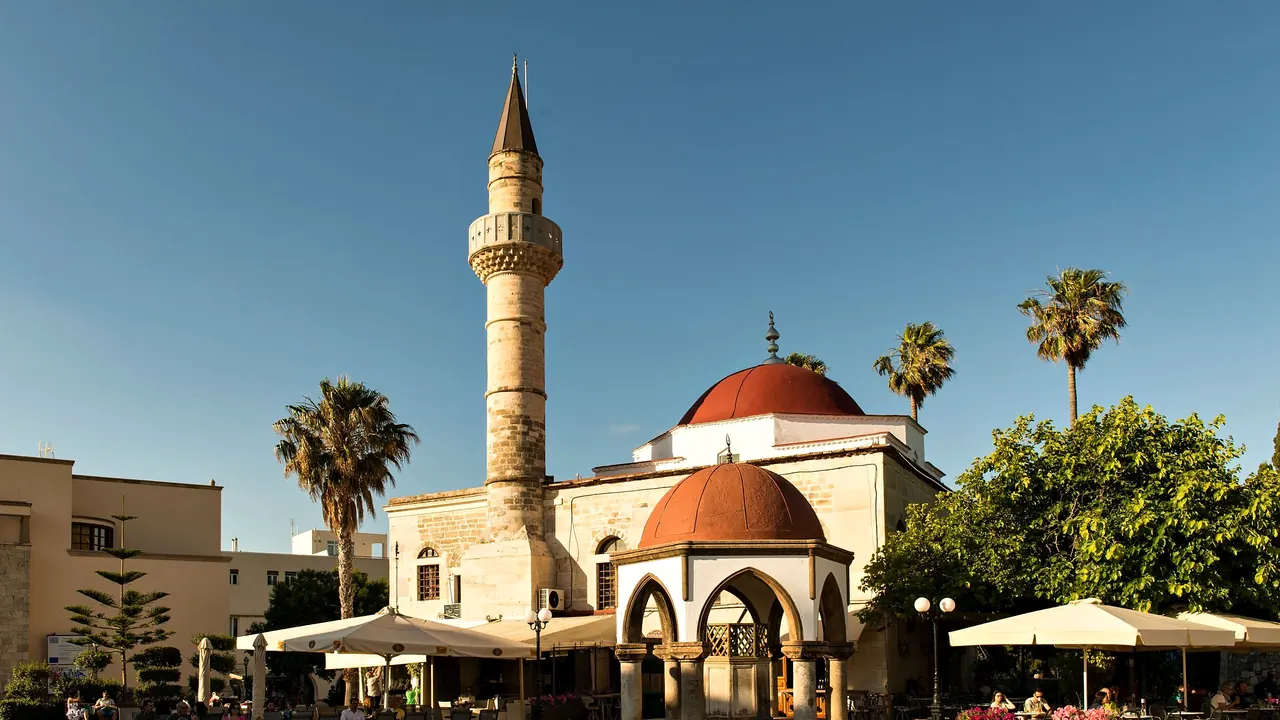
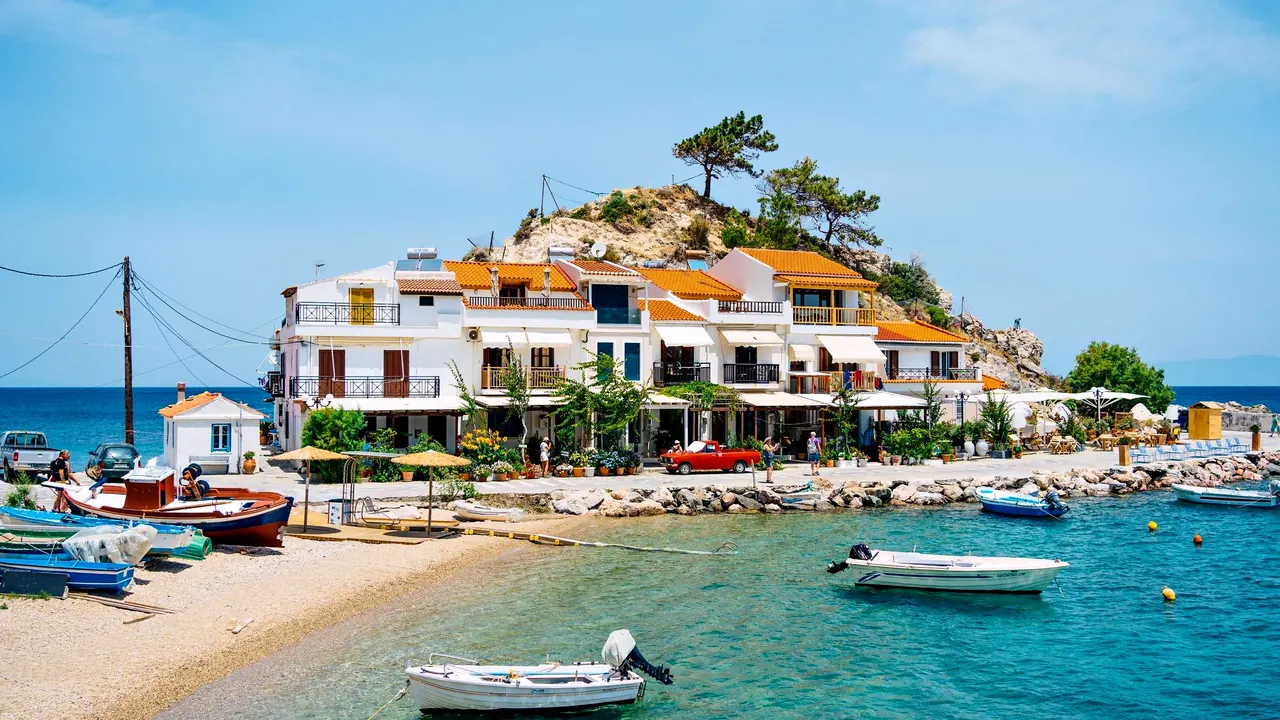
Photos: Kos by Wolfgang Weiser, Pexels License; Samos by Thomas Ronveaux, Pexels License.
Kos or Samos?
Our verdict in twelve categories, each scored against the same fixed benchmark cities, and the climate month by month, so you can choose for your trip.
Choose Kos for
- nightlife
- getting around
- families
Kos suits travellers who want the beach vacation to run smoothly. Its long sandy strands on the north coast shelve gently, the resorts are built around pools and kids' clubs, and buses and cycle paths link Kos Town to the beaches, so you can manage with only a day or two in a hire car. It is also the island for going out, with late bars in Kos Town's old quarter and the clubs of Kardamena. You give up real landscape and some depth of history.
Choose Samos for
- nature and the outdoors
- culture and sights
- food and drink
Samos is for those who would rather explore than lie still. It is greener and steeper, with forested ridges, Mount Kerkis and old mule paths between stone villages. Around Pythagoreio it has a far stronger ancient core in the Heraion and the Tunnel of Eupalinos. Evenings are long dinners and village festivals rather than clubs, the beaches are mostly pebble coves, and you will need a car for most of your stay.
Scoreboard
Twelve categories on one fixed scale from 0 to 100. The shaded stretch is the gap between the two.
Your match
Pick a travel style or drag the sliders, and both match scores follow your weighting.
Wins on nightlife and getting around with your weighting.
Wins on nature and the outdoors and culture and sights with your weighting.
What matters to you?
Category by category
What the scores mean for a trip.
Beaches & swimming
Both are strong swimming islands, and the main difference is underfoot. Kos is a sand island. Its long, open strands run from Tigaki to Mastichari, and Paradise Beach and Agios Stefanos lie on the Kefalos peninsula. Samos is mostly fine pebble or sand and shingle, in coves backed by pines and olive groves. Its water is at its most striking around Kokkari and Lemonakia, and Psili Ammos is its sandy exception.
On both islands the meltemi wind whips up the north coast in high summer, so the south is the calm side: Kardamena on Kos, and Psili Ammos or Votsalakia on Samos. Samos adds the Seitani bays, which you can only reach on foot.
Food & drink
Neither island is a reason to travel for food, and on both you eat grilled fish and octopus at taverna tables. Samos has the clearer local identity: sweet Muscat wine from the terraces around Vourliotes and Manolates, and slow-cooked goat in the mountain villages. Kos has its pitaroudia and wine-matured krasotyri in Zia and Pyli, but its big resorts lean on all-inclusive dining and menus in several languages, so you have to look a little harder for a good meal.
Culture & sights
Samos has the deeper ancient heritage. The Heraion sanctuary and the Tunnel of Eupalinos, dug through a mountain from both ends, form a UNESCO site around Pythagoreio, and the museum in Vathy holds a kouros about 5m tall.
On Kos the appeal is how much history sits inside the town itself: the Ancient Agora, the Odeon, Casa Romana and the Neratzia Castle are all within a stroll, with the Asklepieion on the hillside just outside. Both islands fill two or three days, but on Samos those days are built around sights of real international weight.
Nightlife
Kos is the island for going out. The lanes of Kos Town's old quarter are packed with bars that stay loud into the small hours, there are beach clubs at Lambi, and Kardamena is a full party resort with late clubs and a young crowd.
Samos has no club scene. A night out there means a long dinner, then cocktails on the Pythagoreio harbour or one of the short strips of music bars in Kokkari and Vathy. Its best evenings are the summer village festivals, with dancing in the square. On both islands most places close outside the summer.
Nature & outdoors
Samos is the walker's island. It has the forested Ampelos ridge, the limestone mass of Mount Kerkis at about 1,430m, old mule paths between the hill villages and the Potami gorge with its waterfalls. Monk seals are sometimes seen off the protected Seitani coast.
Kos is low and dry. Its high point for walkers is the climb through pine woods to Mount Christos for the sunset, along with the peacocks of Plaka and the flamingos on the Alikes salt lake. The island is better suited to flat cycling and kitesurfing at Marmari than to serious hiking.
Day trips
Both islands look across to Turkey and to their neighbours, so the choice comes down to which outings appeal more. From Samos, the boat to Kusadasi leads on to Ephesus, and Patmos, with its Monastery of St John, makes a fine island day. From Kos, Bodrum and its crusader castle are only a short ferry ride away, Nisyros lets you stand on the rim of a volcanic crater, and Kalymnos shows a sponge-diving harbour town. On both islands you need a passport for Turkey, and everything depends on the boats.
Good for families
Kos makes life easier with children. The north-coast beaches at Tigaki, Marmari and Mastichari shelve gently, many resorts have pools and kids' clubs, there is a water park near Marmari, and families cycle the flat paths around Kos Town together.
Samos works if you base yourself on the south coast, where Psili Ammos has warm, shallow water and Pythagoreio is flat and compact. Beyond that, its prettier northern beaches are pebbly and windy, a car is needed to reach them, and there is nothing built for children. Neither island has a zoo or an aquarium.
Getting around
Kos is the easier island without a car. Kos Town is flat, cycle lanes lead to the beaches either side of it, and buses run the length of the main road to Tigaki, Kardamena and Kefalos. Most visitors hire a car only for a day or two, for the hill villages and the far south-west.
Samos is compact, and Vathy, Kokkari and Pythagoreio are close together, but buses are sparse and miss most beaches and villages. A car or scooter is close to essential, and the roads up to the villages and out towards Kerkis are narrow and winding. Ferries leave from three different ports, so check which one your boat uses.
Shopping & style
Neither island is a shopping destination, but Kos at least gives you a browse. The old-quarter lanes of Kos Town sell leather, sandals and sponges alongside some better olive oil and ceramics, and the Italian-era market hall on Eleftherias Square has herbs and local produce. Samos is almost all about things to eat and drink: Muscat wine, thyme honey and oil from Vathy and the wine villages.
Affordability
Costs come out much the same, but for different reasons. Kos owes its moderate prices to package tourism, with plenty of mid-range rooms in Kardamena, Tigaki and Marmari and cheap buses and bike hire, so you can manage without a car. Samos has family-run studios and moderate taverna meals inland, but hiring a car is close to unavoidable and the ferry to Turkey is the costliest outing. Both get more expensive in August.
Live music & performing arts
Performance is a summer-only affair on both islands, and much of it takes place among ancient stones. Kos has the Hippokrateia festival, staged at the Asklepieion, the Roman Odeon and the castle. Samos holds open-air concerts and plays at the Pythagoreio castle and around the Heraion. Both have saints' day festivals with live Greek music, and Kos adds resort Greek-night shows. Neither has a year-round programme.
Wellness & relaxation
Kos has one thing Samos lacks: the hot sulphur spring at Therma, where bathers build stone pools on a pebble beach for the hot water to mix with the sea. Samos has no thermal bathing at all. It relies on its pace instead, with shaded village squares, long lunches and the quiet south coast around Marathokampos. Spas on both islands are limited to the larger resort hotels.
When should you go?
Pick your month. The climate figures are measured averages, not a forecast.
Kos in July
Samos in July
Daytime high, °C
Rainfall in the month, mm
Where the figures come from
Kos has no rain gauge within 25 km of the centre, so its rainfall comes from a gridded climate dataset read at the destination rather than from a gauge further away.
Samos's sunshine is measured 82 km from the centre, at Aydin.
Temperature and rainfall are climate normals, averaged over the years shown. Kos: 1993-2020 (rainfall 1991-2020) normals, Kos Airport (23.2 km from centre). Samos: 1991-2020 normals, Samos Airport (2.4 km from centre).
Both islands have the same Aegean pattern of dry summers and wet winters, and on both the sea is warm enough to swim from June to October. On Kos the water is a little warmer, reaching about 25°C in August, and daytime highs reach about 31°C in July and August. Samos has the slightly cooler sea but the hotter land, at about 33°C in the same months, which makes walking its slopes hard work in midsummer.
May is a good month on both islands for walking and sightseeing, though the sea is still too cool for most swimmers. June and September bring warm water and days that are comfortable for exploring. On Kos the first rain comes back in September, and October is clearly wetter. Samos stays almost dry and very sunny through September and gets its first showers in October. On both islands the heavy rain sets in from November. Kos has the wetter winter, with around 170mm in January, and neither island is really a winter destination.
Which traveller are you?
On a family trip with young children, Kos asks less of parents. Its sandy beaches are gentle for small swimmers, the resorts are set up to keep children busy, and you can get around without driving every day. Samos suits families happy to settle at one south-coast beach base.
For an outdoors trip, Kos is good for easy cycling and wind sports but has little real hill country. Samos is the better choice if you want to spend your days on foot, with mountains, woods and gorges enough for several days of walking, best in spring or autumn.
On a food and nightlife trip, Kos wins once dinner is over, with late bars in its main town and a full party resort on the south coast. Samos eats a little more locally and has the better wine, but its evenings end early.
Before you go
| Measure | Kos | Samos |
|---|---|---|
| Official language | Greek | Greek |
| Currency | Euro (EUR) | Euro (EUR) |
| Sockets | CF230 V, 50 Hz | CF230 V, 50 Hz |
| Driving side | Right | Right |
| Time zone | UTC+2, UTC+3 in summer | UTC+2, UTC+3 in summer |
| Emergency number | 112 | 112 |
| Main airport | Kos International Airport "Ippokratis" (KGS)75 non-stop destinations | Samos Airport (SMI)20 non-stop destinations |
| Public holidays this year | 15 days | 15 days |
By the numbers
| Measure | Kos | Samos |
|---|---|---|
| Population | 33,387 | 32,642 |
| People per km² | 115 | 69 |
| Swim season, months above 21 °C | 5 months | 5 months |
Where else could you go?
Every comparison below shares a destination with this one, so you can follow Kos or Samos somewhere new.