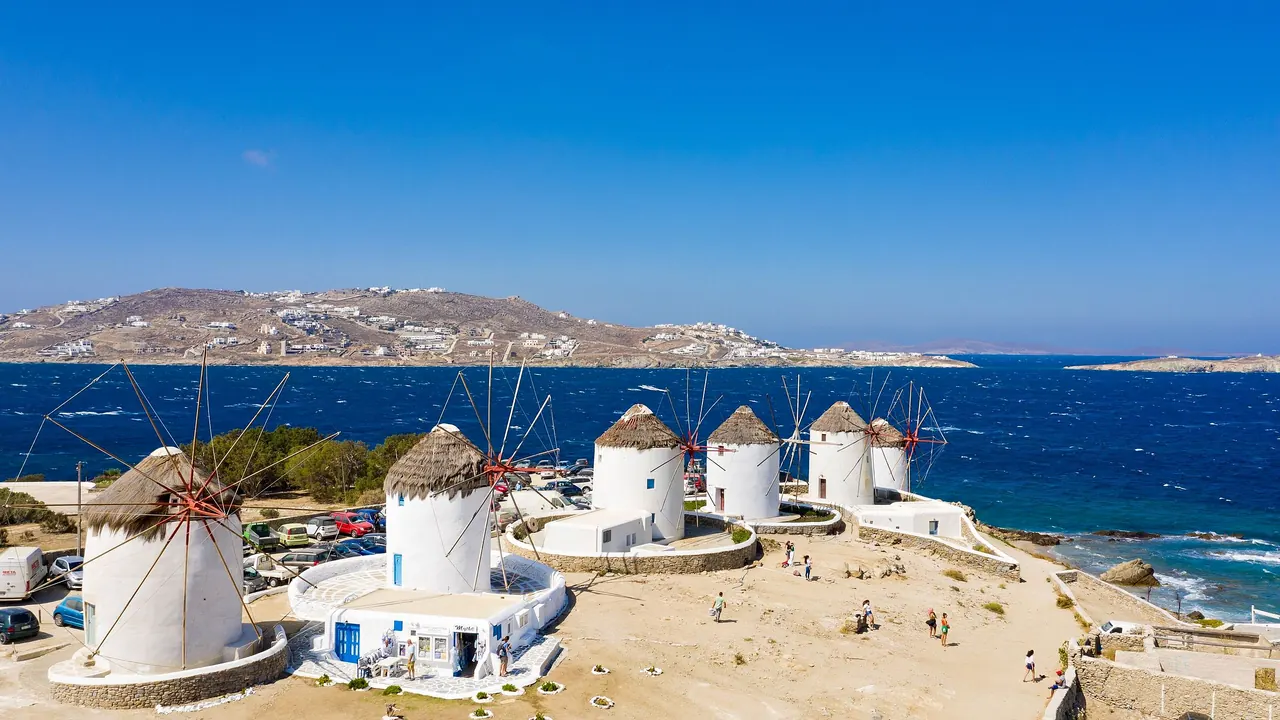
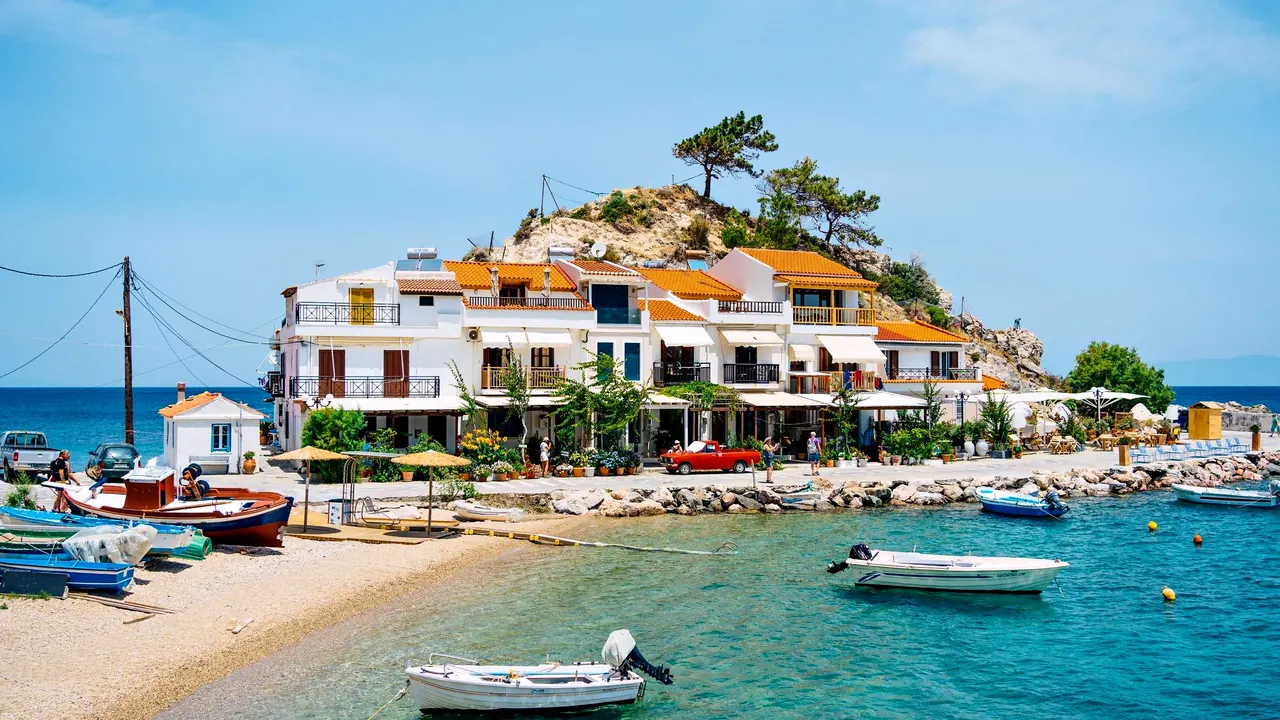
Photos: Mykonos by dronepicr, CC BY 2.0, cropped; Samos by Thomas Ronveaux, Pexels License.
Mykonos or Samos?
Our verdict in twelve categories, each scored against the same fixed benchmark cities, and the climate month by month, so you can choose for your trip.
Choose Mykonos for
- nightlife
- shopping
- getting around
Mykonos is the island for a summer of sand, style and very late nights. Its south coast lines up sandy bays of every mood, from sheltered Ornos to the party beaches at Paradise, the lanes of Chora carry the boutiques and the bars, and Delos lies a short boat ride away. Go knowing that it is one of Europe's most expensive places to stay, that the landscape is bare and wind-blown, and that the island is built for adults out until dawn.
Choose Samos for
- prices
- nature and the outdoors
- families
Samos suits travellers who would rather swap the beach club for a mountain path and a taverna in a hill village. It is greener and steeper, with forested ridges, the Potami gorge and Mount Kerkis to walk, and it costs far less, which matters for a longer stay or a family. The nights are quiet and the beaches more often pebble than sand, but the pace is easier, the Heraion and the Eupalinos tunnel hold their own against most ancient sites, and Ephesus is within reach across the strait.
Scoreboard
Twelve categories on one fixed scale from 0 to 100. The shaded stretch is the gap between the two.
Your match
Pick a travel style or drag the sliders, and both match scores follow your weighting.
Too close to call, 2 points apart
Wins on nightlife and shopping with your weighting.
Wins on prices and nature and the outdoors with your weighting.
What matters to you?
Category by category
What the scores mean for a trip.
Beaches & swimming
Mykonos has the stronger beach offer, mainly because its south coast is a chain of genuinely sandy bays, each with its own crowd: sheltered Ornos and Agios Ioannis near town, sunbed-lined Psarou and Platis Gialos, the party sands of Paradise and Super Paradise, and roomier Elia and Kalafatis. The trade-off is that many of them are given over to organised loungers and beach clubs.
Samos has clear water too, with coves almost everywhere along the coast, but most of it is fine pebble or sand and shingle under pines and olives. Psili Ammos near Pythagoreio is the sandy, shallow exception, and the Seitani bays reward those prepared to walk in. On both islands the meltemi roughens the north coast in summer, so swimmers head south on windy days.
Food & drink
The two are much of a level for eating, but in very different ways. On Mykonos the draw is the setting, with grilled octopus at the water's edge in Little Venice and a large, polished scene of sushi and celebrity-chef dining, plus island specialities such as kopanisti cheese and louza.
Samos is plainer and more rooted: slow-cooked goat and stuffed vegetables in the hill villages, local honey and wild greens, and its sweet Muscat wine from the terraces around Vourliotes. The cooking is more local, but there is little to choose from beyond the tavernas.
Culture & sights
Mykonos has the edge, largely thanks to Delos, a whole island of ruins that was among the holiest places of the ancient Greek world and fills a morning by itself. Chora adds a townscape worth wandering, with the Kato Mili windmills and the Paraportiani church.
Samos answers with an ensemble that serious visitors to ancient sites will value just as much: the Heraion and the Tunnel of Eupalinos, dug through a mountain from both ends, and the colossal kouros in the Vathy museum. Its other sights, monasteries and stone villages, are more modest, and both islands are covered in two or three days.
Nightlife
This is the widest gap between the two. Mykonos is one of the Mediterranean's great party islands in summer, with beach-club sessions, sunset drinks, dance bars in Chora's lanes and big clubs with international DJs running until sunrise.
On Samos an evening means a long dinner and a cocktail on Pythagoreio's harbour or a music bar in Kokkari, with no clubs at all. Its best nights are the village festivals, dancing in the square, which have a charm the Mykonos scene does not.
Nature & outdoors
Samos is much the better island for anyone who wants landscape. Pine and chestnut forest covers the Ampelos ridge, Mount Kerkis rises to about 1,430m in the west, and the northwest holds the Potami gorge, waterfalls and a protected coast where monk seals are sometimes seen. Spring adds orchids and birdwatching by the salt lake.
Mykonos is low, rocky and nearly treeless, its appeal lying in the light and the sea. Its outdoor strengths are on the water: kitesurfing at Korfos Bay and Kalafatis, and diving around reefs and wrecks.
Day trips
The two are evenly matched for outings, and both depend on ferries and the wind. From Mykonos every trip is a Cycladic island: pilgrimage Tinos, neoclassical Ermoupoli on Syros, and Paros and Naxos on fast boats.
Samos offers more contrast. Kusadasi in Turkey and the ruins of Ephesus make a day in another country, passport in hand, and Patmos, with its Monastery of St John, is the most rewarding of the nearby islands.
Good for families
Samos is the easier choice with children. Psili Ammos has warm, shallow sand, Pythagoreio is flat and compact for evening strolls, and the island as a whole feels unhurried, though there are no attractions built for children.
Mykonos can work at a calm south-coast bay such as Agios Stefanos or Ornos, and it has a water park near Elia. But the island revolves around adult nights out, Chora gets loud and crowded late in high summer, and families do best avoiding July and August.
Getting around
Mykonos is easier to manage without a car. Buses link Chora with the main south-coast beaches and Ano Mera, and sea taxis shuttle between Platis Gialos, Ornos and the party beaches. Taxis are scarce and summer traffic around Chora is heavy, though, and the north and east still need a hired vehicle.
On Samos, a car or scooter is close to essential, since the sparse buses miss most beaches and villages. The coastal road is good, but the climbs to the hill villages and around Kerkis are slow, and ferries use three different ports.
Shopping & style
Mykonos is far better for shopping, though only within its narrow range. The lanes around Matoyianni Street are full of resort wear, linen, swimwear, fine Greek jewellery and galleries, open late into the evening in summer.
Samos has no fashion to speak of. What it offers is produce to take home: Muscat wine from the wine villages, thyme honey, olive oil and herbs, plus a little ceramics in Vathy's backstreets.
Affordability
Samos costs a fraction of what Mykonos does. Its family-run studios and taverna meals stay moderate, and the main extras are a hired car and the ferry to Turkey.
Mykonos in season ranks among Europe's priciest vacations, from hotel rooms to sunbeds and cocktails. Staying inland or at Ano Mera, eating at bakeries and visiting in June or late September softens the bill but never makes it cheap.
Live music & performing arts
Neither island is a place to plan around a performance. Samos has a little more: a summer season of open-air concerts and plays at the Pythagoreio castle and near the Heraion, and live Greek bands at the village festivals. On Mykonos the music is mostly club DJ sets, with only the odd concert or village festival.
Wellness & relaxation
Samos is better for switching off. Not because of its spas, which are few, but because of its pace: shaded squares in the hill villages, long lunches and quiet coves around Marathokampos.
Mykonos offers more polished treatments and sea-view yoga in its upmarket hotels, but the summer rhythm of beach clubs and late nights works against rest. For calm there, head to Agios Sostis, Ftelia or the bays beyond Kalafatis.
When should you go?
Pick your month. The climate figures are measured averages, not a forecast.
Mykonos in July
Samos in July
Daytime high, °C
Rainfall in the month, mm
Where the figures come from
Mykonos has no weather station within reach, so its figures come from a gridded climate model rather than a measured record, and read a broad area rather than one spot.
Samos's sunshine is measured 82 km from the centre, at Aydin.
Temperature and rainfall are climate normals, averaged over the years shown. Mykonos: 2001-2020 normals, NASA POWER reanalysis grid, no weather station within 90 km. Samos: 1991-2020 normals, Samos Airport (2.4 km from centre).
Both islands are swimming destinations from June into October, with the sea at about 24°C by August on each. The difference is the heat on land. Mykonos stays mild for a Greek island, peaking around 25°C in July and August, and the meltemi wind keeps Chora's lanes comfortable to walk even in midsummer. Samos is far hotter, reaching about 33°C in July and August under almost constant sun, so the hill walks and the climb up Kerkis are best left to May, early June and late September into October.
Both islands are almost rainless from June to August. Rain comes back in October and November and peaks in midwinter, and Samos is the wetter of the two, with around 147mm in December. Spring is warmer earlier on Samos, which makes April and May its best months for wild flowers and walking. On Mykonos, a spring or autumn visit means cooler but still pleasant days for the town and Delos, with the sea too cool for most swimmers until June.
Which traveller are you?
On a food and nightlife trip, Mykonos is the clear pick. Afternoon sessions at Paradise run into sunset in Little Venice, dance bars and a long-established gay scene in Chora, and clubs going until sunrise. Samos offers long dinners and a waterfront drink, little more.
On a tight budget, Samos is far kinder. Family-run studios in Kokkari and the south coast villages and moderate taverna meals with local wine keep costs down, whereas Mykonos stays expensive in summer even if you eat gyros and ride the buses.
For an outdoors trip, choose Samos. Mule paths link the wine villages on the Ampelos ridge, Kerkis makes a long day's climb, and the Potami gorge and the Seitani coast are wild country. Mykonos is low and bare, good mainly for kitesurfing and diving.
Before you go
| Measure | Mykonos | Samos |
|---|---|---|
| Official language | Greek | Greek |
| Currency | Euro (EUR) | Euro (EUR) |
| Sockets | CF230 V, 50 Hz | CF230 V, 50 Hz |
| Driving side | Right | Right |
| Time zone | UTC+2, UTC+3 in summer | UTC+2, UTC+3 in summer |
| Emergency number | 112 | 112 |
| Main airport | Mykonos Island National Airport (JMK)44 non-stop destinations | Samos Airport (SMI)20 non-stop destinations |
| Public holidays this year | 15 days | 15 days |
By the numbers
| Measure | Mykonos | Samos |
|---|---|---|
| Population | 10,134 | 32,642 |
| People per km² | 96 | 69 |
| Swim season, months above 21 °C | 5 months | 5 months |
Where else could you go?
Every comparison below shares a destination with this one, so you can follow Mykonos or Samos somewhere new.