Greece
Samos
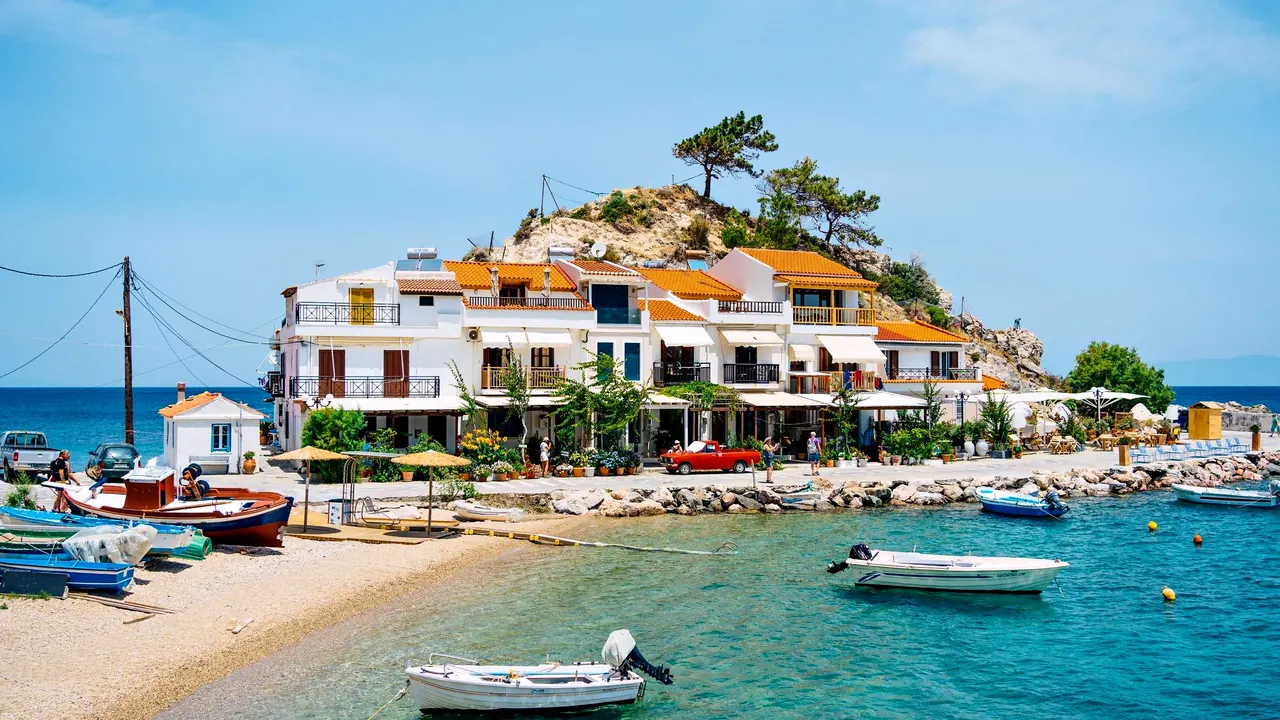
Kokkari's white houses, fishing boats and turquoise water
- Beaches78
- Nature & outdoors60
- Culture & sights58
Photo: Thomas Ronveaux, Pexels License
Match
46
Every category weighted equally
- Beach & sun51
- Culture & arts43
- Food & nightlife41
- Family trip52
- Outdoors53
- Relax & unwind50
- Shopping & style40
- On a budget47
Samos in twelve categories
Our verdict on each, scored 0 to 100 against the same fixed benchmark cities, so a score means the same thing on every page.
Beaches & swimming. Scores 78 out of 100.
Food & drink. Scores 50 out of 100.
Culture & sights. Scores 58 out of 100.
Nightlife. Scores 30 out of 100.
Nature & outdoors. Scores 60 out of 100.
Day trips. Scores 58 out of 100.
Good for families. Scores 50 out of 100.
Getting around. Scores 38 out of 100.
Shopping & style. Scores 17 out of 100.
Affordability. Scores 58 out of 100.
Live music & performing arts. Scores 15 out of 100.
Wellness & relaxation. Scores 40 out of 100.
Samos category by category
Beaches & swimming
78Samos is a swimming island first. The water is clear and warm enough to swim from June to October, reaching about 24°C in August, and almost every stretch of coast has a cove or a longer bay within reach of a road. Most beaches are fine pebble or a mix of sand and shingle, backed by pines or olive groves rather than dunes.
The north coast around Kokkari, Lemonakia and Tsamadou has the most striking water but catches the summer meltemi wind, so on breezy days the south is calmer. There, Psili Ammos near Pythagoreio is sandy and shallow, and the long shore below Marathokampos at Votsalakia stays quiet. Walkers reach the two Seitani bays in the northwest, among the most beautiful on the island.
Food & drink
50Eating on Samos means tavernas: grilled fish and octopus on the harbours at Kokkari and Pythagoreio, slow-cooked goat and stuffed vegetables in the mountain villages, and plenty of local olive oil, honey and wild greens. The island's sweet Muscat wine, grown on terraces around Vourliotes and Manolates, is its one famous product, and the dry whites made from the same grape are worth trying with a meal.
The best meals tend to be in the hill villages on summer evenings, where the cooking is plainer and more local than on the busier waterfronts. Range is narrow: there is little fine dining, few international kitchens and no real street-food culture, so the pleasure is in good simple food rather than discovery.
Culture & sights
58Samos holds one of the Aegean's great ancient ensembles. Around Pythagoreio, the Heraion sanctuary to Hera and the Tunnel of Eupalinos, a 6th-century BC aqueduct dug through a mountain from both ends, form a UNESCO site, and the town itself sits on the ancient harbour with stretches of city wall above it. The Archaeological Museum in Samos town (Vathy) holds a colossal archaic kouros, about 5m tall, and fine finds from the sanctuary.
Beyond these, the heritage is modest: Byzantine monasteries in the hills, the Lykourgos Logothetis castle at Pythagoreio, stone villages such as Manolates and Vourliotes, and a small wine museum in Vathy. Two or three days cover the main sights comfortably.
Nightlife
30Nights on Samos are mostly long dinners followed by a drink on the waterfront. Pythagoreio has the liveliest harbour, with cocktail bars that stay busy past midnight in July and August, and Kokkari and the port of Vathy each have a short strip of music bars. Summer village festivals, with dancing in the square until late, are the most memorable nights out.
There is no club scene to speak of, and outside the peak summer weeks most places close early. Anyone looking for a party island will find this one too calm.
Nature & outdoors
60Samos is greener and steeper than most Aegean islands. Two mountain masses run across it: the forested Ampelos ridge in the centre, with pine and chestnut above the wine terraces, and the bare limestone bulk of Mount Kerkis in the west, rising to about 1,430m and climbable in a long day from Marathokampos or Kallithea. Old mule paths link the hill villages, and spring brings wild orchids and good birdwatching around the salt lake near Psili Ammos.
The northwest is the wildest part: the Potami gorge with its small waterfalls, and the protected coast around the Seitani bays, where Mediterranean monk seals are sometimes seen. Spring and autumn are the walking seasons, as midsummer heat is hard work on the slopes. Sailing and windsurfing on the windy north coast round out the offer.
Day trips
58The outstanding day out is across the strait to Turkey: a ferry from Vathy or Pythagoreio reaches Kusadasi in about an hour and a half, and the ruins of Ephesus lie a short drive inland. A passport is needed, and the trip runs mainly in the summer season.
Other outings are by boat to neighbouring islands. Patmos, with its fortified Monastery of St John and the Cave of the Apocalypse, is the most rewarding, a couple of hours away by fast boat. Ikaria and the small fishing island of Fourni suit a slower day, and caiques from the south coast run to the islet of Samiopoula for a swim and lunch. Every trip depends on ferries and the weather.
Good for families
50Samos works well for a simple beach vacation with children. The south coast is the place to stay: Psili Ammos has warm, shallow, sandy water ideal for small swimmers, and Pythagoreio is a flat, compact harbour town with easy evening strolls. Greek tavernas welcome children at any hour, and the island feels safe and unhurried.
There is little built for children, though: no theme parks, aquariums or zoos, and the Eupalinos tunnel is too narrow for the very young. Many of the prettiest north coast beaches are pebbly and exposed to wind, and a car is needed to move between them. Families who want structured entertainment will run out of ideas within a few days.
Getting around
38Samos is compact, with Vathy, Kokkari and Pythagoreio all under half an hour apart, and the airport sits just outside Pythagoreio. Each of those towns is easy to walk, and a bus links the main coastal places, but services are sparse and miss most beaches and villages.
In practice a hired car or scooter is the way to see the island. The main coastal road is good, while the climbs to the hill villages and the drive to the far west around Kerkis are narrow and winding. Inter-island ferries leave from Vathy, Karlovasi and Pythagoreio, so it is worth checking which port a boat uses.
Shopping & style
17Shopping on Samos is about taking home local produce: bottles of Muscat wine, thyme honey, olive oil and herbs, sold in Vathy, Pythagoreio and the wine villages. Vathy's backstreets have the island's few everyday shops and some ceramics and jewellery, while the resort strips sell beachwear and souvenirs. There is nothing in the way of fashion or design, and nobody chooses the island to shop.
Affordability
58Samos is one of the more reasonably priced Greek islands. Family-run studios and small hotels in Kokkari, Pythagoreio and the quieter south coast villages cost noticeably less in summer than on the best-known Cycladic islands, and taverna meals with local wine stay moderate, especially inland. Prices rise in August, when Greek visitors fill the island.
The main extras are a hired car, which most visitors need, and ferries for day trips, with the boat to Turkey the costliest outing. Sights are inexpensive.
Live music & performing arts
15Live performance on Samos is a summer affair. A season of concerts and plays runs in open-air settings such as the castle at Pythagoreio and the Heraion area, and the panigiria, village saints' day festivals in July and August, bring live Greek bands and dancing that visitors are welcome to join. For the rest of the year there is little to attend beyond the odd concert in Vathy.
Wellness & relaxation
40Samos has no thermal springs or bathing tradition, and spa treatments are limited to a handful of larger resort hotels near Pythagoreio and Kokkari. What it does offer is pace: shaded village squares, long lunches and quiet coves make it an easy place to switch off, above all in the hill villages and along the south coast around Marathokampos. June and September are the calmest months, with warm days and fewer people.
Where to stay in Samos
Samos is compact enough for a single base, and most visitors choose between three towns less than half an hour apart. Pythagoreio, on the south coast beside the airport, is the natural first choice: a flat harbour town on the ancient site, with the Heraion and the Eupalinos tunnel close by, the island's liveliest evenings and the shallow sand of Psili Ammos a short drive east. It suits families and anyone who wants sights and beach days together.
Kokkari, a former fishing village on the north coast, puts the clearest coves and the wine villages of Vourliotes and Manolates within easy reach, with grilled fish on the harbour and a few music bars. The meltemi can make its beaches breezy in summer, so it suits walkers and swimmers happy to drive south on windy days. Vathy, the capital and main port, is more of a working town, with the museum, the island's everyday shops and ferries, and it is handy for the day trip to Turkey.
For a quiet stay, the long shore below Marathokampos at Votsalakia in the west is calm and close to Mount Kerkis, though you need a car to get around from there. A few nights in a hill village suit a slower second visit built around food and walking.
When should you go?
Pick a month to see what it is like. The climate figures are measured averages, not a forecast.
Samos in July
Daytime high, °C
Rainfall in the month, mm
The whole year
Shaded against this destination’s own year: the deepest cell is its best month for that figure and the palest its weakest.
Where the figures come from
Samos's sunshine is measured 82 km from the centre, at Aydin.
Temperature and rainfall are climate normals, averaged over the years shown. Samos: 1991-2020 normals, Samos Airport (2.4 km from centre).
Before you go
| Measure | Samos |
|---|---|
| Official language | Greek |
| Currency | Euro (EUR) |
| Sockets | CF230 V, 50 Hz |
| Driving side | Right |
| Time zone | UTC+2, UTC+3 in summer |
| Emergency number | 112 |
| Main airport | Samos Airport (SMI)20 non-stop destinations |
| Public holidays this year | 15 days |
By the numbers
| Measure | Samos |
|---|---|
| Population | 32,642 |
| People per km² | 69 |
| Swim season, months above 21 °C | 5 months |
Compare Samos with
Every comparison with a written verdict behind it.
- Aegina
- Corfu
- Crete
- Folegandros
- Halkidiki
- Hydra
- Ios
- Kefalonia
- Kos
- Lefkada
- Milos
- Mykonos
- Naxos
- Paros
- Paxos
- Peloponnese
- Rhodes
- Santorini
- Sifnos
- Skiathos
- Skopelos
- Thassos
- Zakynthos