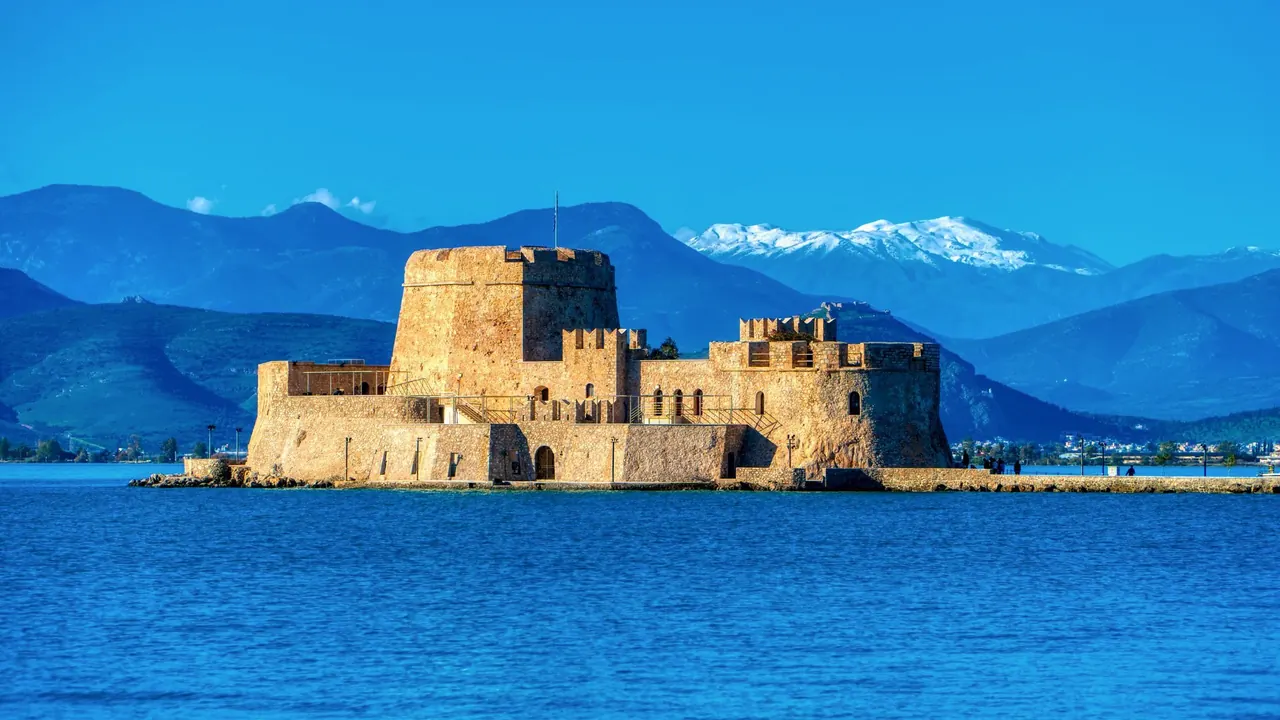
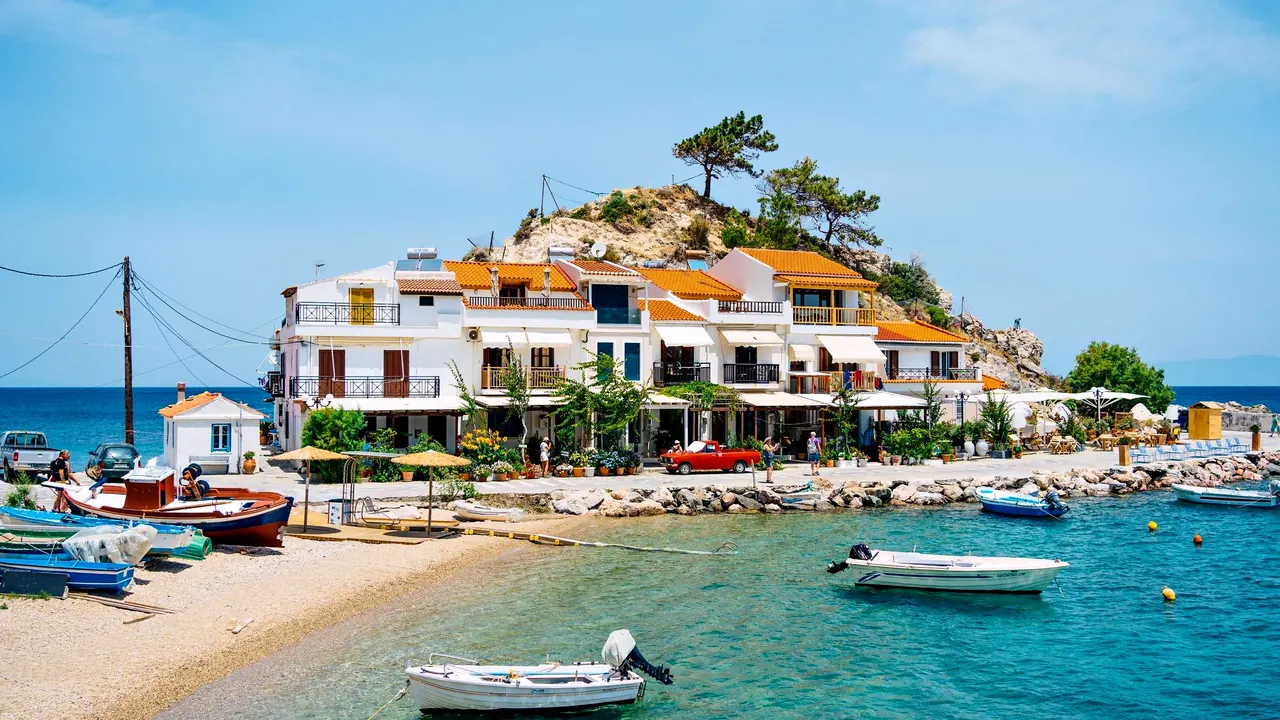
Photos: Peloponnese by Alex Ravvas, Pexels License; Samos by Thomas Ronveaux, Pexels License.
Peloponnese or Samos?
Our verdict in twelve categories, each scored against the same fixed benchmark cities, and the climate month by month, so you can choose for your trip.
Choose Peloponnese for
- culture and sights
- live music and the arts
- nature and the outdoors
The Peloponnese suits travellers who want to cover ground. Mycenae, Epidaurus, Olympia and Byzantine Mystras are all here, along with the mountain trails of Arcadia and Taygetos and a coastline long enough to change beaches every few days. It works best as a road trip with a hire car and two or three bases. The food and wine are also better, thanks to Nemea, the Arcadian plateau and the olive groves around Kalamata.
Choose Samos for
Samos does not lead in any category we score.
Samos is for a slower, simpler week on one island. The swimming is just as good, the distances are short and one base can cover most of it. The Heraion and the Tunnel of Eupalinos give a couple of days of history without long drives. Add a ferry to Ephesus or Patmos and the trip becomes varied enough. Travellers after depth in culture, food or evenings out will find it thinner than the mainland.
Scoreboard
Twelve categories on one fixed scale from 0 to 100. The shaded stretch is the gap between the two.
Your match
Pick a travel style or drag the sliders, and both match scores follow your weighting.
Wins on culture and sights and live music and the arts with your weighting.
Has no clear advantage with the weighting you have chosen.
What matters to you?
Category by category
What the scores mean for a trip.
Beaches & swimming
The swimming is equally good in both places, but the beaches differ. The Peloponnese has more sand and more variety: the horseshoe bay of Voidokilia, Navarino Bay, the long Messinian shore and the white sand of Elafonisos, plus pebble coves under the Mani villages. These are spread along a long coast, so you either pick one stretch or keep moving.
Samos has mostly fine pebble and sand-and-shingle beaches backed by pines and olive trees, and almost all of them are a short drive apart. The north coast around Kokkari and Lemonakia has the clearest water but catches the summer wind. On breezy days the south, with sandy Psili Ammos and quiet Votsalakia, is the place to go.
Food & drink
The Peloponnese eats and drinks noticeably better. It has three wine traditions in one trip: red Agiorgitiko from Nemea, Moschofilero whites from the plateau around Tripoli and the historic sweet wine of Monemvasia. Add Kalamata olives, Mani cured pork and the covered market in Kalamata. Kalamata and Nafplio also offer a wider range of places to eat.
Samos is a narrower taverna island. Grilled octopus on the harbours and goat in the hill villages are good. Its Muscat wine from Vourliotes and Manolates is the one thing it is known for, and there is little beyond simple cooking.
Culture & sights
Here the gap is widest. The Peloponnese holds Olympia, Mycenae and Tiryns, Epidaurus, Ancient Corinth, Messene and the lone temple at Bassae. It also has a medieval layer of Mystras, Monemvasia, the Venetian castles at Methoni and Koroni, and the Mani tower houses. Nafplio makes an elegant base for the Argolid, though you need several bases to see it all.
Samos has one excellent group of sights: the Heraion, the Tunnel of Eupalinos and the ancient harbour at Pythagoreio, plus the 5m kouros in the Vathy museum. After that come monasteries and stone villages, and two or three days covers it.
Nightlife
Neither is a party destination, but the Peloponnese has more on offer after dark. Patras is a university city with real bar and club streets and a famous carnival. Kalamata's seafront is busy with locals, and Nafplio's waterfront stays lively late in summer.
On Samos, the evening scene is the harbour cocktail bars at Pythagoreio and short strips in Kokkari and Vathy. In practice the best nights are the summer village festivals with dancing in the square, and most places close early outside peak season.
Nature & outdoors
The Peloponnese has a whole mountain interior to explore. Taygetos rises above Sparta, the Lousios gorge links cliff monasteries and stone villages, the waymarked Menalon Trail crosses Arcadia, the Vouraikos gorge has its rack railway and Chelmos has winter skiing. The Gialova lagoon adds birdwatching, and the Mani has bare walking country down to Cape Tainaron.
Samos packs good walking into a smaller area: the forested Ampelos ridge, a long day up Mount Kerkis, and the Potami gorge and protected Seitani coast in the wild northwest, where monk seals are sometimes seen. It is greener than most Aegean islands, but you will run through it faster.
Day trips
The Peloponnese offers more outings, and most of them are a drive away. From Nafplio the Nemea wine villages are under an hour off, Athens is about two hours by road, and car-free Hydra and Spetses are a short ferry ride from the ports of the southern Argolid. In the south and west, Monemvasia, Elafonisos, Pylos and the Mani villages each make a good day, though nearly every outing needs a car.
Samos has fewer trips, but its best one is unusual: a ferry to Kusadasi and on to the ruins of Ephesus in Turkey, which needs a passport. Patmos and its monastery are the other highlight, and Ikaria and Fourni are good for slower days. Every outing depends on boats and the weather.
Good for families
Neither has theme parks or aquariums, and both are best for a beach vacation with children. The Peloponnese has a slight edge thanks to the shallow sand at Tolo and on Elafonisos, kids' clubs at the big Messinian resorts and sites like Mycenae and Olympia for older children. The cost is long hours in the car.
Samos keeps things simpler. Psili Ammos is ideal for small swimmers, flat Pythagoreio is easy to stroll in the evening and drives are short. Families who want variety, though, will run out of things to do sooner.
Getting around
You need a car in both, but the Peloponnese makes better use of one. Fast motorways from the Corinth Canal to Kalamata and along the north coast mean the main towns are quick to reach, even if the mountain and Mani roads are slow.
On Samos, distances are short, with Vathy, Kokkari and Pythagoreio under half an hour apart. However, the buses are sparse, the roads to the hill villages and around Kerkis are narrow and winding, and ferries leave from three different ports.
Shopping & style
Nafplio gives the Peloponnese the edge. Its old lanes have jewellery, worry beads, ceramics and a few small boutiques among the souvenir shops, and the weekly markets in Kalamata and Tripoli are worth a browse. The best buys are still things to eat and drink: olive oil, mountain honey and wine bought at the Nemea wineries.
Samos has even less. People take home Muscat wine, thyme honey and olive oil, Vathy's backstreets have a few ceramics and some jewellery, and there are no fashion or design shops at all.
Affordability
Costs are much the same in both, and both are cheaper than the best-known Greek islands. The Peloponnese is cheapest in the village rooms of the Mani and Arcadia, but fuel adds up on long drives and the big ancient sites charge entry. Samos has cheap sights and moderate studios, but ferries add to the bill, especially the boat to Turkey. In both, rooms cost more in August.
Live music & performing arts
The Peloponnese has one of Greece's great summer experiences: ancient drama performed at night in the theatre of Epidaurus, where the acoustics are so good the actors need no microphones. There are also concerts at the Little Theatre nearby and a dance festival in Kalamata in July.
On Samos, live performance means a short open-air season at the Pythagoreio castle and the Heraion, plus the village saints' day festivals with Greek bands. Outside high summer there is very little.
Wellness & relaxation
The Peloponnese has the thermal waters Samos lacks. Loutraki and the volcanic Methana peninsula are old spa towns, warm sulphur springs feed the lake at Kaiafas, and the Messinian resorts have the most complete spas.
Samos offers only quiet. Shaded squares in the hill villages and the south coast around Marathokampos make it easy to switch off, but spa treatments are limited to a few resort hotels.
When should you go?
Pick your month. The climate figures are measured averages, not a forecast.
Peloponnese in July
Samos in July
Daytime high, °C
Rainfall in the month, mm
Where the figures come from
Peloponnese's temperatures are measured 89 km from the centre, at Kalamata Airport.
Peloponnese has no rain gauge within 25 km of the centre, so its rainfall comes from a gridded climate dataset read at the destination rather than from a gauge further away.
Samos's sunshine is measured 82 km from the centre, at Aydin.
Temperature and rainfall are climate normals, averaged over the years shown. Peloponnese: 1991-2020 normals, Kalamata Airport (89 km from centre). Samos: 1991-2020 normals, Samos Airport (2.4 km from centre).
The two follow the same pattern through the year. The sea is warm enough to swim from June to October. July and August are too hot for walking ruins or village lanes in the middle of the day, with highs of about 32°C to 33°C. April, May and October are the comfortable months for sightseeing and hiking, warm and sunny without the summer heat. The Peloponnese sea gets slightly warmer, reaching about 26°C in high summer against 24°C off Samos.
The rain is where they differ. Samos is almost completely dry from June to September but has much wetter winters, about 147mm in December, so it is very much a summer island. The Peloponnese gets the odd summer shower and some rain again in September, but its winters are less wet. That makes it the more forgiving choice for a trip in late autumn or early spring.
Which traveller are you?
On a culture and arts trip, choose the Peloponnese. Mycenae, Olympia, Messene, Mystras and Monemvasia give it far more history than Samos. In summer you can also watch ancient drama in the theatre at Epidaurus, which nothing on the island matches.
For an outdoors trip, the Peloponnese is the stronger choice. It has the 2,400m Taygetos range, the Lousios gorge, the long Menalon Trail and the walking country of the Mani. Kerkis and the Potami gorge on Samos make good days out, but on a much smaller scale.
On a beach and sun trip from a single base, Samos is the easier option. The swimming is as good as the mainland's and you can reach sandy Psili Ammos, the north coast coves and Votsalakia from one stay. In the Peloponnese, the best beaches are far apart.
Before you go
| Measure | Peloponnese | Samos |
|---|---|---|
| Official language | Greek | Greek |
| Currency | Euro (EUR) | Euro (EUR) |
| Sockets | CF230 V, 50 Hz | CF230 V, 50 Hz |
| Driving side | Right | Right |
| Time zone | UTC+2, UTC+3 in summer | UTC+2, UTC+3 in summer |
| Emergency number | 112 | 112 |
| Main airport | Athens Eleftherios Venizelos International Airport (ATH)176 non-stop destinations | Samos Airport (SMI)20 non-stop destinations |
| Public holidays this year | 15 days | 15 days |
By the numbers
| Measure | Peloponnese | Samos |
|---|---|---|
| Population | - | 32,642 |
| People per km² | - | 69 |
| Swim season, months above 21 °C | 5 months | 5 months |
Where else could you go?
Every comparison below shares a destination with this one, so you can follow Peloponnese or Samos somewhere new.
- Aeginavs Peloponnese
- Hydravs Peloponnese
- Kosvs Samos
- Mykonosvs Samos
- Naxosvs Samos
- Zakynthosvs Peloponnese