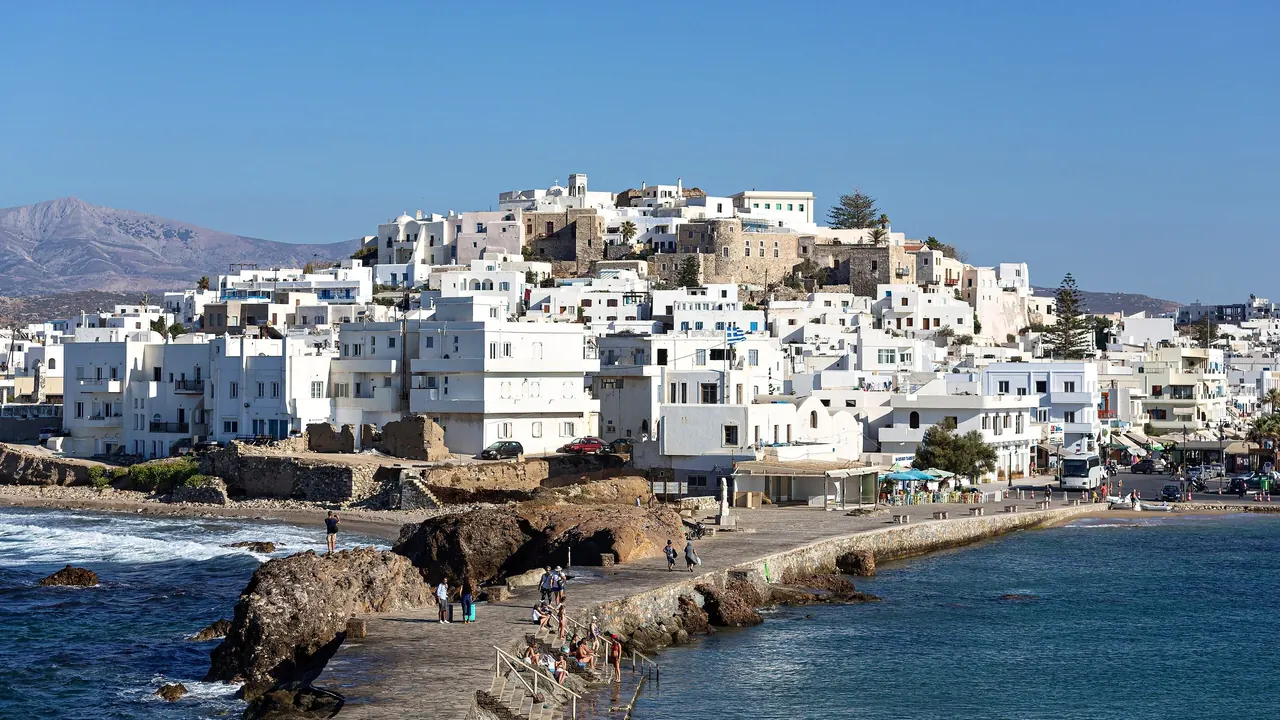
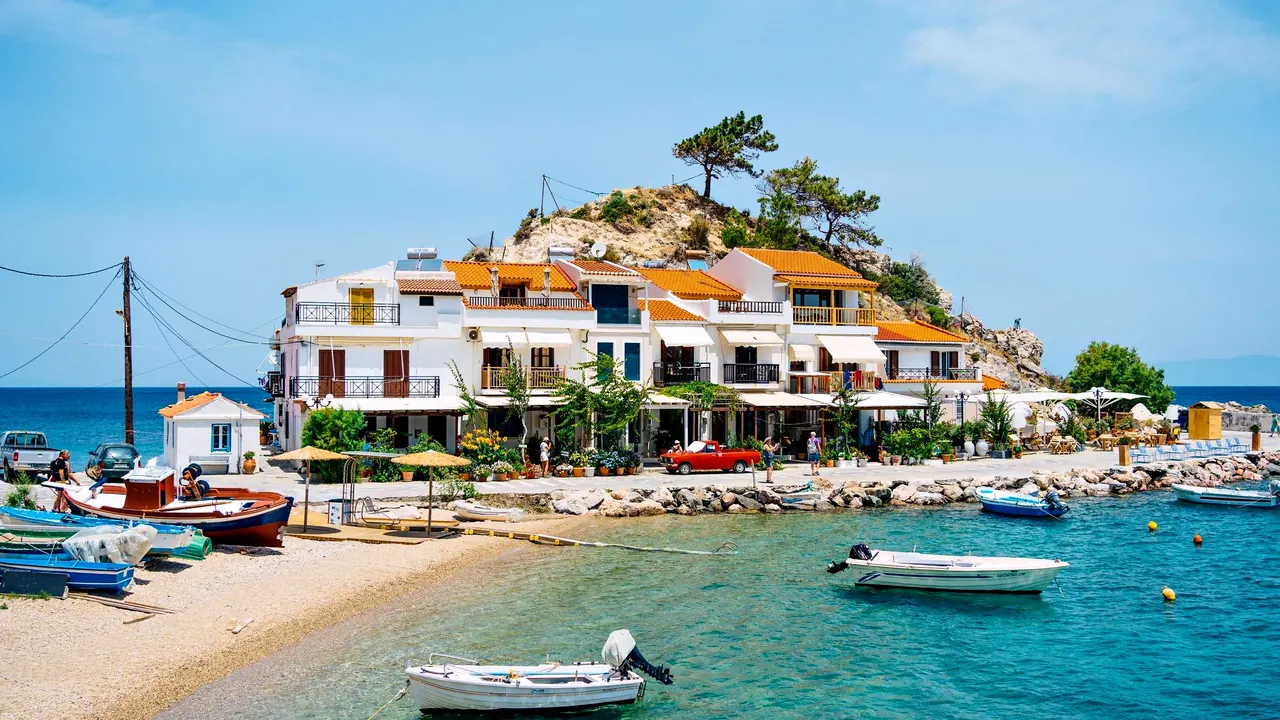
Photos: Naxos by Manfred Werner (Tsui), CC BY-SA 4.0, cropped; Samos by Thomas Ronveaux, Pexels License.
Naxos or Samos?
Our verdict in twelve categories, each scored against the same fixed benchmark cities, and the climate month by month, so you can choose for your trip.
Choose Naxos for
- families
- getting around
- shopping
Naxos is the island for travellers whose trip turns on sand. Its west coast is one long run of fine, pale beaches with shallow water, which makes it the easier choice with children. Stay in Chora or Agios Prokopios and you can manage on foot and by bus. It also eats better, thanks to its own cheeses, meat and potatoes, and as the central island of the Cyclades it puts Paros, Delos and the Small Cyclades within a short boat ride.
Choose Samos for
- prices
- wellness
- culture and sights
Samos suits a slower, slightly cheaper stay where pine-backed coves and shaded village squares matter more than a perfect beach. Its ancient sights are gathered around Pythagoreio, its western mountain is wilder than anything on Naxos, and it offers the one day trip Naxos cannot match: across the strait to Ephesus. The trade-off is that you will want a hired car to get anywhere beyond the three main towns.
Scoreboard
Twelve categories on one fixed scale from 0 to 100. The shaded stretch is the gap between the two.
Your match
Pick a travel style or drag the sliders, and both match scores follow your weighting.
Too close to call, 2 points apart
Wins on families and getting around with your weighting.
Wins on prices and wellness with your weighting.
What matters to you?
Category by category
What the scores mean for a trip.
Beaches & swimming
Naxos has the stronger beaches, and the reason is the sand. South of Chora the west coast runs almost unbroken from Agios Georgios through Agios Prokopios and Agia Anna to the dune-backed strands of Plaka, Mikri Vigla and Alyko. The sand is fine, the water is shallow and you can always find a quiet stretch.
Samos is more varied but less soft underfoot. Most of its coves are fine pebble or sand and shingle under pines and olives, with the most striking water on the north coast at Kokkari, Lemonakia and Tsamadou, and walk-in bays at Seitani. The meltemi hits both islands. On Naxos you can retreat to a sheltered beach a short way along the same coast, while on Samos you head south to sandy Psili Ammos or Votsalakia.
Food & drink
Naxos eats a little better because it grows so much of its own food. The cheeses include graviera, arseniko and xinomyzithra, the potatoes are known across Greece and kitron liqueur is distilled in Halki. The meals to seek out are in the mountain villages of Halki, Filoti, Apiranthos and Koronos, where tavernas serve grilled meat and slow stews.
Samos has one famous product, the sweet Muscat wine from the terraces around Vourliotes and Manolates. Its cooking runs to harbour octopus, slow-cooked goat and wild greens. On both islands the range is narrow and the beach-strip menus are predictable, so you eat best inland.
Culture & sights
The two islands are broadly level on culture, but their heritage is laid out very differently. Samos keeps its best sights together around Pythagoreio: the Heraion sanctuary and the Tunnel of Eupalinos, which together make a UNESCO site, plus the colossal 5m kouros in the museum at Vathy. Two or three days cover them.
Naxos has fewer headline sights but more to find. The Portara gateway and the Venetian kastro are in Chora. Inland are unfinished kouroi lying in the quarries at Flerio and Apollonas, the Temple of Demeter near Sangri and frescoed Byzantine chapels across the Tragaea valley, and seeing them means several days of driving.
Nightlife
Neither island is a party island, and summer evenings on both mean dinner and then a drink by the water. Naxos has slightly more variety: a couple of clubs in Chora stay open into the small hours and the beach bars at Agios Prokopios and Plaka hold sunset sessions. Samos has no clubs. Its liveliest spot is the harbour at Pythagoreio, and its best nights are the village festivals with dancing in the square. Both go quiet early outside the summer months.
Nature & outdoors
The two are close for the outdoors, but the landscapes differ in kind. Samos is the more mountainous and wooded. Mount Kerkis rises to about 1,430m in the west, the Ampelos ridge is covered in pine and chestnut, and the wild northwest has the Potami gorge and the protected Seitani coast, where monk seals are sometimes seen.
Naxos is gentler but has the better water sports. The walk up Mount Zas gives views across the Cyclades, mule paths link the Tragaea villages, and the meltemi makes Mikri Vigla one of the Aegean's best kitesurfing and windsurfing spots.
Day trips
For day trips the islands are evenly matched, and both depend on ferries and wind, but they look in different directions. Naxos sits at the centre of the Cyclades. Paros is under an hour away, the quiet Small Cyclades lie to the south, Mykonos is the route to Delos, and Santorini is possible on a long day.
From Samos the obvious trip is to Turkey: a ferry to Kusadasi and then Ephesus, passport in hand. Patmos, with its fortified monastery, is the best island outing, and Ikaria and Fourni suit a slower day.
Good for families
Naxos is clearly the easier island with children. Almost the whole west coast offers soft sand that shelves gently, so toddlers can paddle far out, and sheltered Agios Georgios is walkable from Chora.
Samos has one excellent family beach in Psili Ammos and a flat, easy harbour town in Pythagoreio. Beyond those, many of its prettiest beaches are pebbly and windy, and you need a car to reach them. Neither island has anything built for children, so days on both revolve around the beach, boats and ice cream.
Getting around
Naxos is easier without a car. In summer buses run from Chora's harbour down the west-coast beaches to Plaka and up to the main mountain villages, so if you are based in Chora or Agios Prokopios you can manage on foot and by bus. You only need a car or scooter for the interior and the empty north and east.
Samos's main towns are close together, under half an hour apart, but its buses are sparse and miss most beaches and villages, so a hired car is close to essential. Ferries leave from three different ports, so check which one your boat uses.
Shopping & style
Neither island is for shoppers, but Naxos gives you more to browse. The old market lanes below the kastro in Chora have small jewellery, ceramic and linen shops, and Apiranthos and Halki sell local weaving and marble work. On Samos shopping comes down to buying Muscat wine, thyme honey and olive oil, plus a few everyday shops in the backstreets of Vathy. Both islands' best souvenirs are edible.
Affordability
Samos is the cheaper of the two. Its family-run studios in Kokkari, Pythagoreio and the south coast villages cost noticeably less than Cycladic rooms in summer, and village tavernas stay moderate. Part of that saving goes on the hired car most visitors need, and the Turkey crossing is the costliest outing.
Naxos is moderately priced. Village rooms and buses keep costs down, but the boutique hotels around Chora and Plaka are mid to upper range. On both islands August is the dearest month.
Live music & performing arts
Formal performance is thin on both islands, and the most memorable music on each comes from the summer panigyria, the village saints' day festivals where bands play and everyone dances late. The settings for staged events differ. On Naxos a summer festival uses a restored Venetian tower inland and recitals are held in Chora's kastro, while Samos puts on open-air concerts and plays at the castle in Pythagoreio and around the Heraion.
Wellness & relaxation
Samos is the more restful island, though neither has thermal springs or a bathing tradition. Its shaded village squares, quiet coves and the south coast around Marathokampos make it easy to slow down, and a few resort hotels near Pythagoreio and Kokkari offer spa treatments.
Naxos can be just as unhurried in the hills around Halki or on its emptier southern beaches. Outside that, treatments are limited to a few yoga retreats on the southwest coast, and the west-coast beach villages are much less calm in August.
When should you go?
Pick your month. The climate figures are measured averages, not a forecast.
Naxos in July
Samos in July
Daytime high, °C
Rainfall in the month, mm
Where the figures come from
Naxos's temperatures are measured 79 km from the centre, at Santorini Island / Monólithos.
Naxos has no rain gauge within 25 km of the centre, so its rainfall comes from a gridded climate dataset read at the destination rather than from a gauge further away.
Samos's sunshine is measured 82 km from the centre, at Aydin.
Temperature and rainfall are climate normals, averaged over the years shown. Naxos: 2000-2025, 12 years observed (rainfall 1991-2020) normals, Santorini Island / Monólithos (78.8 km from centre). Samos: 1991-2020 normals, Samos Airport (2.4 km from centre).
Both islands are dry and warm from June to September, and the sea is swimmable from June to October, reaching about 24°C in August on both. The difference is in the extremes. Around the main resort areas, midsummer on Samos is hotter, with highs near 33°C in July and August against about 30°C on Naxos, so on Samos sightseeing and hill walks really need early starts. Samos also has long, very sunny summers.
Winter separates them more clearly. Samos is far wetter, with around 147mm of rain in December, while Naxos peaks at about 83mm in January. Spring and autumn are the walking seasons on both. Late April, May and October give mild days, though in May Samos is already a few degrees warmer and on both islands the rain returns in October.
Which traveller are you?
On a family trip with young children, Naxos asks less of parents. One base on the west coast covers swimming, meals and outings by bus or boat. Samos works too, but it keeps you on the south coast and behind the wheel.
For a trip on a tight budget, Naxos costs more to sleep in, though buses and walking can stand in for a car. Samos still makes the money go further over a week, as long as you share the car and keep ferry outings few.
On a relaxing and wellness trip, Naxos gives you softer sand but a livelier coast in summer. Samos slows you down more easily, best in June or September either side of its fiercest heat, as long as you are happy with pebbly coves.
Before you go
| Measure | Naxos | Samos |
|---|---|---|
| Official language | Greek | Greek |
| Currency | Euro (EUR) | Euro (EUR) |
| Sockets | CF230 V, 50 Hz | CF230 V, 50 Hz |
| Driving side | Right | Right |
| Time zone | UTC+2, UTC+3 in summer | UTC+2, UTC+3 in summer |
| Emergency number | 112 | 112 |
| Main airport | Naxos Island National Airport (JNX)3 non-stop destinations | Samos Airport (SMI)20 non-stop destinations |
| Public holidays this year | 15 days | 15 days |
By the numbers
| Measure | Naxos | Samos |
|---|---|---|
| Population | 17,930 | 32,642 |
| People per km² | 42 | 69 |
| Swim season, months above 21 °C | 5 months | 5 months |
Where else could you go?
Every comparison below shares a destination with this one, so you can follow Naxos or Samos somewhere new.