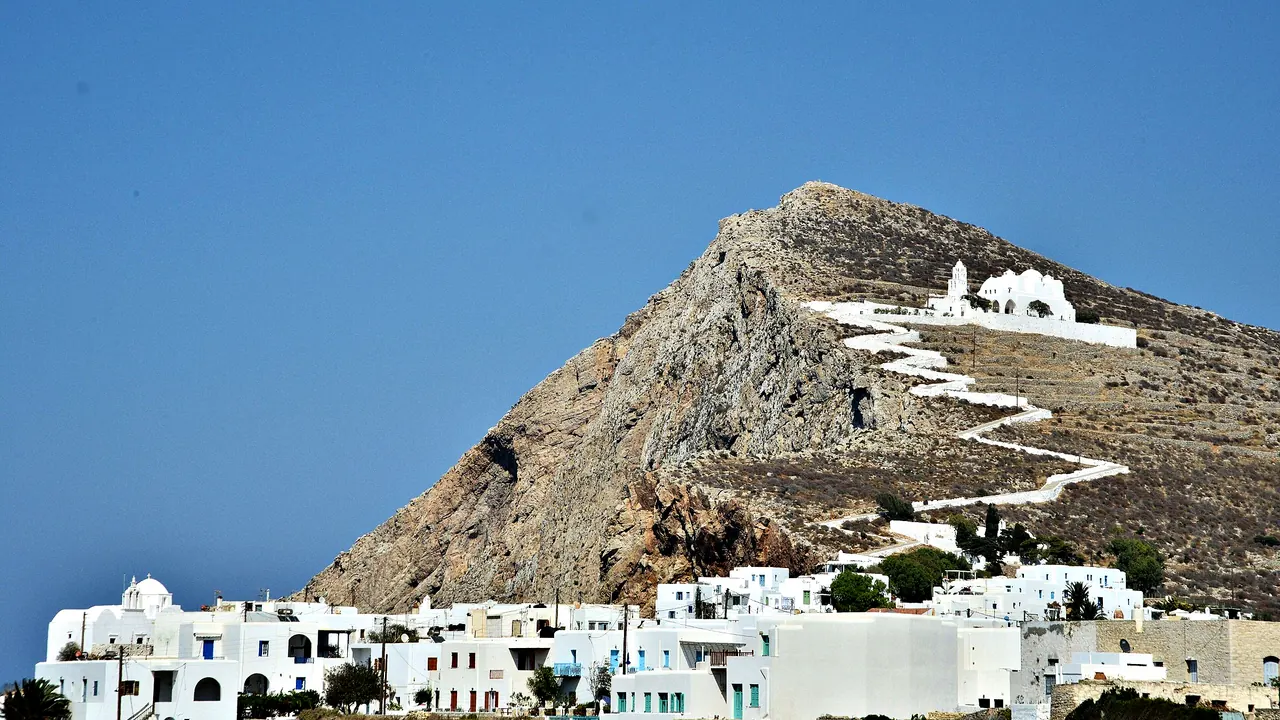
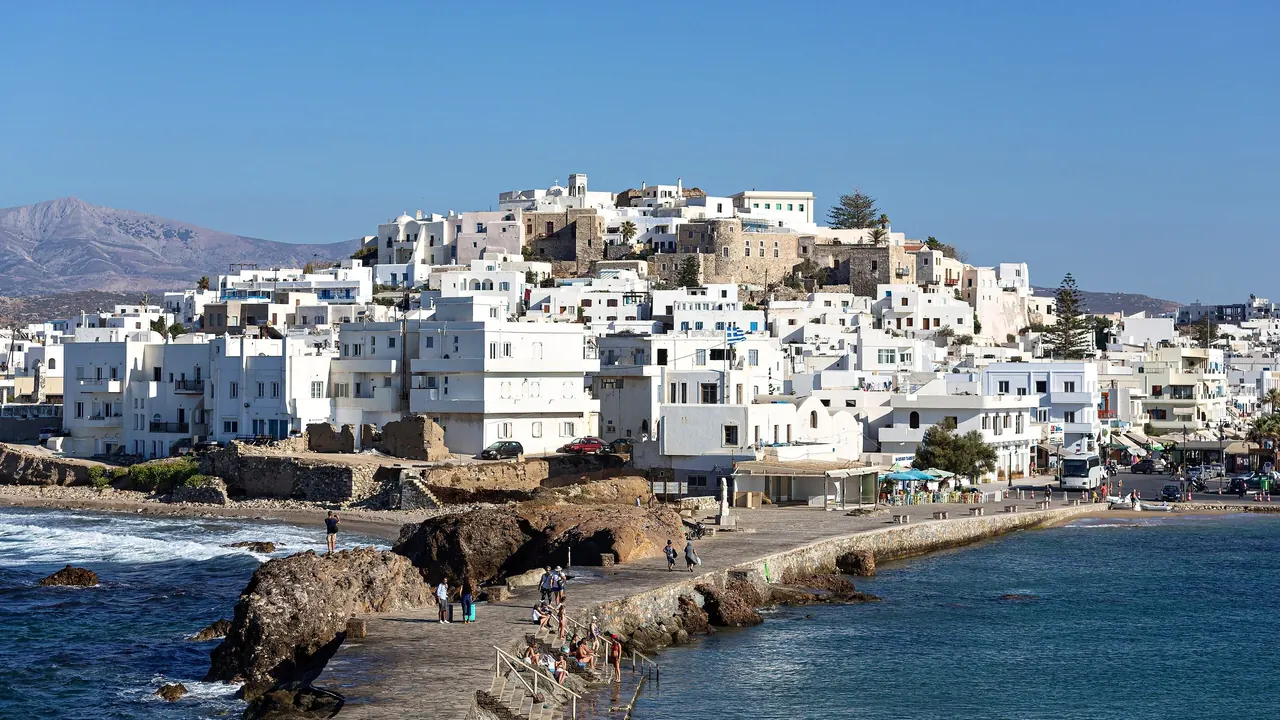
Photos: Folegandros by Chris Kar, CC BY-SA 4.0, cropped; Naxos by Manfred Werner (Tsui), CC BY-SA 4.0, cropped.
Folegandros or Naxos?
Our verdict in twelve categories, each scored against the same fixed benchmark cities, and the climate month by month, so you can choose for your trip.
Choose Folegandros for
- wellness
Folegandros suits travellers who want a small island and nothing else to do: a cliff-top village with no cars, a few coves of shingle and sand reached on foot or by boat, and evenings spent in tree-shaded squares. Couples and walkers looking for real rest will like it, as long as they don't mind a short list of sights, a handful of kitchens and almost no nightlife.
Choose Naxos for
- families
- day trips
- culture and sights
Naxos is the larger, fuller island and wins on most counts. Its west coast is a long run of soft, gently shelving sand that suits families, and its mountain villages, Venetian kastro and inland ruins are worth several days of driving. It also has better food, and ferries from its harbour reach Paros, Mykonos and the Small Cyclades. Choose it for a varied trip, with children, or on a tighter budget.
Scoreboard
Twelve categories on one fixed scale from 0 to 100. The shaded stretch is the gap between the two.
Your match
Pick a travel style or drag the sliders, and both match scores follow your weighting.
Wins on wellness with your weighting.
Wins on families and day trips with your weighting.
What matters to you?
Category by category
What the scores mean for a trip.
Beaches & swimming
On Folegandros, swimming means small coves under bare cliffs. The easy ones are at Karavostasis and Agali, and the island's best, Katergo, is a pale shingle bay reached by boat or a rough walk. The water is very clear, but shade is rare and getting down to the sea takes effort.
Naxos has the longer and easier coastline. South of Chora, the west coast is an almost continuous chain of soft sand, through Agios Prokopios, Agia Anna, Plaka and Mikri Vigla, with shallow water and room to spread out. You can stay with the beach at your door instead of hiking to it.
Food & drink
Folegandros eats well for its size, and in summer dinner is in Chora's squares. Try matsata pasta with rooster or rabbit, soft souroto cheese and watermelon pie. There are only a few places, though, and most close outside the summer.
Naxos has more depth because it grows so much of its own food: potatoes, graviera and arseniko cheeses, and kitron liqueur from Halki. The mountain tavernas of Filoti, Apiranthos and Koronos, and the fish places on Chora's harbourfront, give you far more meals worth travelling for.
Culture & sights
The main sight on Folegandros is the setting of Chora on its cliff, with its Kastro of houses joined into a wall and the climb to the Panagia church. Add the folklore museum at Ano Meria and you have seen it all in an afternoon.
Naxos has thousands of years of history to explore. The Portara stands over the harbour, and above it the Venetian kastro holds Catholic churches and Cycladic figurines. Inland are the Temple of Demeter, unfinished kouroi lying in the quarries, and frescoed Byzantine chapels in the Tragaea valley, enough to fill several days.
Nightlife
Neither island is for clubbing. On Folegandros, evenings stay in Chora's squares or move to a few small bars on the cliff edge, with no clubs at all.
Naxos has a little more going on in summer. There are cocktail and music bars along Chora's harbour and below the kastro, a couple of clubs that stay open late, and sunset sessions at the beach bars of Agios Prokopios and Plaka.
Nature & outdoors
Both islands are good for walking, but the landscapes are different. Folegandros is a narrow, treeless ridge of stone terraces, with some of the tallest sea cliffs in the Cyclades and boat trips to the Chrysospilia cave.
Naxos is green and mountainous by comparison. You can climb Mount Zas to about 1,000m, follow mule paths through the olive groves of the Tragaea, and explore the empty east coast. Its summer wind also makes Mikri Vigla a real kitesurfing and windsurfing spot, which Folegandros doesn't offer.
Day trips
Folegandros is an island you stay on. Summer ferries reach Sikinos, Milos and Santorini, but routes don't run every day and the wind can stop them, so most people move on rather than come back the same day.
Naxos sits in the middle of the Cyclades and makes a proper base. Paros is under an hour away, Mykonos and Delos make a day out, and Koufonisia and Schinoussa are easy trips. A drive through the hill villages to Apollonas fills another day without a boat.
Good for families
Folegandros is quiet and safe, but it suits older children who swim and walk more than toddlers. Only Livadi and Agali are really easy, and the cliffs and strong winds call for care.
Naxos is much simpler with small children. Its beaches shelve gently over soft sand, Agios Georgios is sheltered from the wind, and there is space even in August. Neither island has anything built for children, so on both the days are spent at the beach.
Getting around
Both islands have summer buses and walkable main towns, but the scale is different. Folegandros is small and car-free in Chora, with one bus line from the port, and paths or caiques for the further coves. It has no airport, so you arrive by ferry.
Naxos needs more planning. Buses cover the west-coast beaches and the main villages, but seeing the interior and the empty coasts properly means hiring a car on narrow, winding roads.
Shopping & style
Shopping on Folegandros means a short browse through Chora's lanes for jewellery, linen, capers and honey after dinner.
Naxos has a bit more to look at. The old market below the kastro has more shops, Apiranthos and Halki sell weaving and marble work, and you can take home graviera and kitron from village co-operatives. Neither island is a reason to come and shop.
Affordability
Naxos is the easier island on the wallet. Family-run studios and village rooms stay within reach even in summer, and food and buses are reasonable.
Folegandros is built around small boutique hotels with cliff views around Chora, and these book out early in July and August. Simpler rooms near Karavostasis or in Ano Meria help, and on both islands June and September cost noticeably less.
Live music & performing arts
Folegandros has no stage at all. The music you'll hear comes from the summer panigyria, the saints' day festivals, and from the Easter procession of the Panagia icon.
Naxos has the same village festivals, with violin and lute playing into the night. It also has a summer cultural festival in a restored Venetian tower and small recitals in the kastro, which gives you at least something to plan an evening around.
Wellness & relaxation
Neither island has springs, hammams or much in the way of spas, so rest comes from the pace. Here Folegandros is the stronger choice. It has no big resorts, its village is car-free and the whole island is small, so the calm is hard to escape, especially in June and September.
Naxos can be just as unhurried in the hills around Halki or on its emptier southern beaches. It also has a few yoga retreats on the southwest coast. But it is busier overall, and in August the beach villages are full.
When should you go?
Pick your month. The climate figures are measured averages, not a forecast.
Folegandros in July
Naxos in July
Daytime high, °C
Rainfall in the month, mm
Where the figures come from
Folegandros has no weather station within reach, so its figures come from a gridded climate model rather than a measured record, and read a broad area rather than one spot.
Naxos's temperatures are measured 79 km from the centre, at Santorini Island / Monólithos.
Naxos has no rain gauge within 25 km of the centre, so its rainfall comes from a gridded climate dataset read at the destination rather than from a gauge further away.
Temperature and rainfall are climate normals, averaged over the years shown. Folegandros: 2001-2020 normals, NASA POWER reanalysis grid, no weather station within 90 km. Naxos: 2000-2025, 12 years observed (rainfall 1991-2020) normals, Santorini Island / Monólithos (78.8 km from centre).
The two islands follow the same Cycladic pattern: a dry summer, a wet winter, and a sea warm enough for swimming from June to October, reaching about 24°C at both in August. The real difference is heat. Around Chora on Folegandros, high summer stays a few degrees cooler, near 27°C at its peak. Naxos reaches 30°C in July and August, which makes walking its villages and hills a job for the early morning.
For walking, May and late September to October are the best months on either island. From November the rain sets in, and it is heavier on Folegandros, close to 100mm in January. Winter on both is mild but grey, and most of what makes them worth visiting is closed until late spring.
Which traveller are you?
On a family trip with young children, Folegandros asks a lot of small legs and suits teenagers better. Naxos makes the easier week, with simpler beach days, village drives and ferry outings to vary it, and rooms that cost less.
For a relaxing and wellness trip, Folegandros is the better pick. With so little to see or do, nothing pulls you away from a cove and the evening square. Naxos can be slow as well, but its sights and ferries keep tempting you on.
On a culture and arts trip, Folegandros gives you one striking cliff-top village and not much more. Naxos is clearly ahead, with ancient marble, Venetian lanes and frescoed chapels spread across the island, worth a hired car and several days.
Before you go
| Measure | Folegandros | Naxos |
|---|---|---|
| Official language | Greek | Greek |
| Currency | Euro (EUR) | Euro (EUR) |
| Sockets | CF230 V, 50 Hz | CF230 V, 50 Hz |
| Driving side | Right | Right |
| Time zone | UTC+2, UTC+3 in summer | UTC+2, UTC+3 in summer |
| Emergency number | 112 | 112 |
| Main airport | Santorini International Airport (JTR)60 non-stop destinations | Naxos Island National Airport (JNX)3 non-stop destinations |
| Public holidays this year | 15 days | 15 days |
By the numbers
| Measure | Folegandros | Naxos |
|---|---|---|
| Population | - | 17,930 |
| People per km² | - | 42 |
| Swim season, months above 21 °C | 5 months | 5 months |
Where else could you go?
Every comparison below shares a destination with this one, so you can follow Folegandros or Naxos somewhere new.