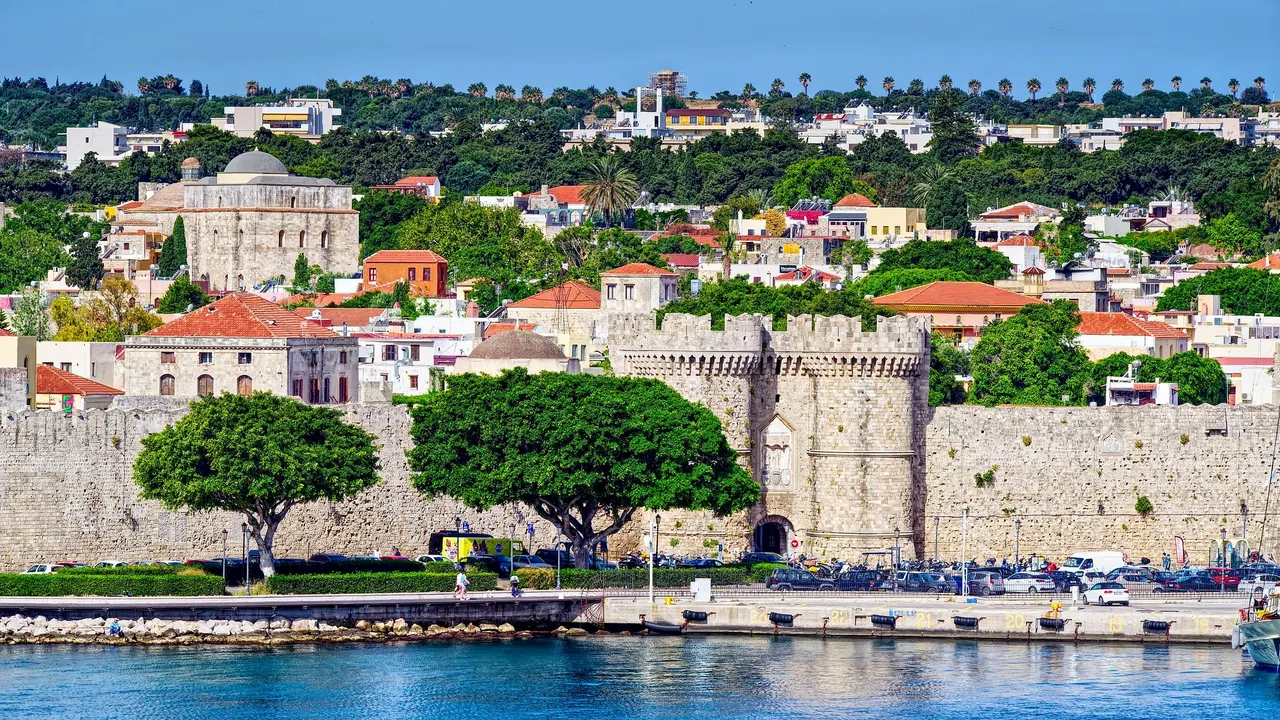
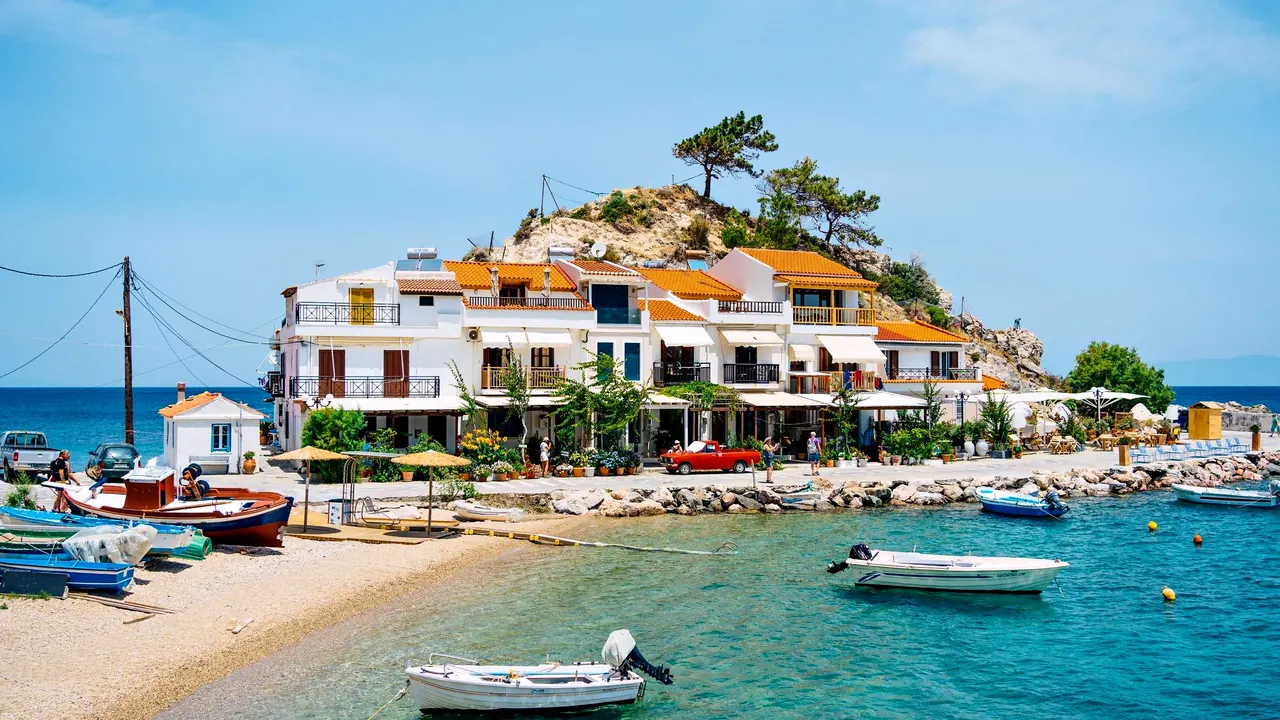
Photos: Rhodes by Mark Thomas, Pexels License; Samos by Thomas Ronveaux, Pexels License.
Rhodes or Samos?
Our verdict in twelve categories, each scored against the same fixed benchmark cities, and the climate month by month, so you can choose for your trip.
Choose Rhodes for
- nightlife
- families
- culture and sights
Rhodes is the island for a fuller, busier vacation. It pairs a long run of sheltered east coast bays with a walled medieval Old Town that takes days to explore, and it adds Lindos, a real summer party scene and resort hotels made for children. Getting about is easier too, with buses down the east coast and a walkable main town. It suits families, first-timers to Greece and anyone who wants sights and evenings out as well as a sunbed.
Choose Samos for
- prices
- nature and the outdoors
- wellness
Samos is the better pick for a quieter, greener trip at a slightly gentler cost. Its mountains, mule paths and wild northwest coast reward walkers, and its evenings are long taverna dinners and village festivals rather than clubs. You trade Rhodes' depth of sights and its family attractions for pace, pine-backed coves and the chance to cross to Ephesus. You will need a car to make the most of it.
Scoreboard
Twelve categories on one fixed scale from 0 to 100. The shaded stretch is the gap between the two.
Your match
Pick a travel style or drag the sliders, and both match scores follow your weighting.
Wins on nightlife and families with your weighting.
Wins on prices and nature and the outdoors with your weighting.
What matters to you?
Category by category
What the scores mean for a trip.
Beaches & swimming
These are both strong swimming islands, and the difference lies in the type of shore. Rhodes puts its beaches in one long chain down the sheltered east coast, from Faliraki to Lindos, with wide bays of sand and fine shingle, snorkelling inlets at Anthony Quinn Bay and the twin seas of Prasonisi in the south. The trade-off is crowding, with rows of sunbeds on the busiest stretches in high summer.
Samos spreads its coves all round the coast. Most are fine pebble backed by pines or olives, and you choose the north or the south depending on the meltemi. Kokkari and Lemonakia have the most striking water, Psili Ammos is the sandy, shallow one, and the Seitani bays reward those who walk to them. The sea is a few degrees warmer on Rhodes in late summer.
Food & drink
Neither island is a destination for food in its own right, but Rhodes gives you a little more choice. Away from the buffets of its hotel belt, it has meze places in the newer parts of Rhodes Town, dishes such as pitaroudia and matsi pasta, and a small upmarket tier around Lindos.
Samos is plainer taverna cooking, with grilled octopus on the harbours and goat in the hill villages. Its one famous product is the sweet Muscat wine from the terraces around Vourliotes and Manolates, and it is the best thing to drink on either island.
Culture & sights
Rhodes has far more to see. The Old Town built by the Knights of St John, with the Street of the Knights, the Palace of the Grand Master, mosques and the dry moat, would justify a trip alone. Then come Lindos on its cliff, Kamiros, Filerimos and the stadium on Monte Smith.
Samos has one superb cluster around Pythagoreio: the Heraion and the Tunnel of Eupalinos, cut through a mountain from both ends, plus the giant kouros in the Vathy museum. Beyond that the heritage thins to monasteries and stone villages, and two or three days cover it.
Nightlife
If going out matters, Rhodes is the clear choice. Faliraki is a full party strip for young crowds, Rhodes Town has a late Old Town lane plus clubs and cocktail bars around Mandraki, and Lindos draws an older crowd to rooftop and courtyard bars.
Samos ends most nights with a drink on the harbour at Pythagoreio or a short strip of music bars in Kokkari and Vathy. Its best nights are the summer village festivals with dancing in the square. There are no clubs to speak of.
Nature & outdoors
Samos is the wilder and more rewarding island for walkers. The forested Ampelos ridge, the bare bulk of Mount Kerkis, the waterfalls of the Potami gorge and the protected Seitani coast, where monk seals are sometimes seen, make it greener and steeper than Rhodes. Spring adds orchids and birdlife around the salt lake.
Rhodes is mostly low pine hills, with Attavyros as its single real climb and gentle valleys such as the Valley of the Butterflies and Seven Springs. Where it beats Samos is wind: Prasonisi is one of the Mediterranean's best-known kitesurfing and windsurfing spots.
Day trips
Both islands make their best outings by sea, and both offer a crossing to Turkey. From Rhodes the hop is to Marmaris and back. From Samos the ferry to Kusadasi puts the ruins of Ephesus within reach, which makes it the more substantial day abroad.
Among the Greek islands, Rhodes sends you to Symi's pastel harbour and the monastery of Panormitis, or quiet Halki. Samos offers Patmos and its Monastery of St John, slow days on Ikaria or Fourni, and swimming trips to Samiopoula. On both, the schedule depends on the boats and the summer seas.
Good for families
Rhodes is much better set up for children. Its calm, gently shelving east coast bays at Tsambika, Afandou and Kolymbia sit beside resort hotels with pools and kids' clubs, and there is a water park above Faliraki and an aquarium in Rhodes Town for days off the beach.
Samos can manage a simple beach week, best based on the south coast around Psili Ammos and flat Pythagoreio. But there are no parks or aquariums, the north coast beaches are pebbly and windy, and you need a car to move between them.
Getting around
Rhodes is easier without a car. The car-free Old Town and the new town are walkable, and buses run reasonably well down the east coast to Faliraki and Lindos. You only really need a car for a few days to reach the south and the inland villages.
Samos is small, with its three main towns within half an hour of each other, but buses are sparse and miss most beaches. A car or scooter is almost essential, and the roads up to the hill villages and around Kerkis are narrow and winding.
Shopping & style
Rhodes at least offers a proper browse. You can wander Sokratous Street's stalls, try the ordinary high-street fashion and few boutiques around Mandraki, and look for Lindian-style ceramics made in Archangelos. Samos has almost nothing beyond Vathy's backstreets, and what you take home is edible: Muscat wine, thyme honey and olive oil.
Affordability
Samos is a little kinder to the wallet. Family-run studios in Kokkari, Pythagoreio and the southern villages stay moderate, and inland taverna meals are good value. The catch is that most visitors add a hired car and ferry fares.
Rhodes is middle-priced, held down by its large stock of package and all-inclusive hotels on the north and east coasts. Lindos and the Old Town's boutique hotels push costs up sharply, but the buses mean you can often manage without a car.
Live music & performing arts
Neither island has an opera, an orchestra or a theatre season, so live performance on both comes down to summer events in historic settings. Rhodes has a seasonal folk dance company in the Old Town and concerts in the moat and the ancient stadium. Samos has open-air plays at the Pythagoreio castle and the Heraion, and its panigiria, where visitors join the dancing to live Greek bands, are the more spontaneous experience.
Wellness & relaxation
Neither island has a bathing tradition, and spa treatments on both mean the larger resort hotels. Kallithea's rotunda on Rhodes is a sight, not a spa. The real difference is in how you slow down. On Rhodes you head south to villages such as Lahania and Asklipio, away from the noisy north. On Samos the whole island runs at that pace, with shaded hill village squares and the quiet shore around Marathokampos.
When should you go?
Pick your month. The climate figures are measured averages, not a forecast.
Rhodes in July
Samos in July
Daytime high, °C
Rainfall in the month, mm
Where the figures come from
Rhodes has no rain gauge within 25 km of the centre, so its rainfall comes from a gridded climate dataset read at the destination rather than from a gauge further away.
Samos's sunshine is measured 82 km from the centre, at Aydin.
Temperature and rainfall are climate normals, averaged over the years shown. Rhodes: 1991-2020 normals, Rhodes Airport (12.6 km from centre). Samos: 1991-2020 normals, Samos Airport (2.4 km from centre).
Both islands are dry from June to September, with almost no rain in July and August. Rhodes is the milder of the two in high summer, peaking around 31°C in August. Samos reaches about 33°C in July and August under long, almost unbroken sunshine, which makes midday walking around its villages and ruins hard work. Rain returns to both islands in October, but more of it falls on Rhodes. Its winter is also the wetter one, with about 170mm in both December and January, while Samos has the cooler winter.
For swimming, Rhodes has the edge. Its sea is warm enough from late May, reaches about 27°C in August and stays warm through October. Samos tops out near 24°C and is comfortable from June to October. For sightseeing and hiking, May and late September suit both islands, with warm days and less of the midsummer heat.
Which traveller are you?
For a food and nightlife trip, Rhodes is the stronger choice. Faliraki parties until dawn, Lindos has rooftop bars, and Rhodes Town mixes Old Town bars with meze places where locals eat. Samos offers waterfront drinks and village festivals but no clubs.
On a family trip with children, Rhodes has more to fill the days. There are shallow sandy bays at Tsambika and Kolymbia, resort hotels with kids' clubs, a water park and an aquarium. Samos has gentle Psili Ammos but little built for children.
For an outdoors trip, Samos has the edge. Mount Kerkis is a proper day's climb, old mule paths link the wine villages, and the Potami gorge and Seitani coast are wild country. Rhodes is gentler hill country, its real outdoor draw being the wind at Prasonisi.
Before you go
| Measure | Rhodes | Samos |
|---|---|---|
| Official language | Greek | Greek |
| Currency | Euro (EUR) | Euro (EUR) |
| Sockets | CF230 V, 50 Hz | CF230 V, 50 Hz |
| Driving side | Right | Right |
| Time zone | UTC+2, UTC+3 in summer | UTC+2, UTC+3 in summer |
| Emergency number | 112 | 112 |
| Main airport | Rhodes International Airport "Diagoras" (RHO)136 non-stop destinations | Samos Airport (SMI)20 non-stop destinations |
| Public holidays this year | 15 days | 15 days |
By the numbers
| Measure | Rhodes | Samos |
|---|---|---|
| Population | 127,613 | 32,642 |
| People per km² | 91 | 69 |
| Swim season, months above 21 °C | 6 months | 5 months |
Where else could you go?
Every comparison below shares a destination with this one, so you can follow Rhodes or Samos somewhere new.