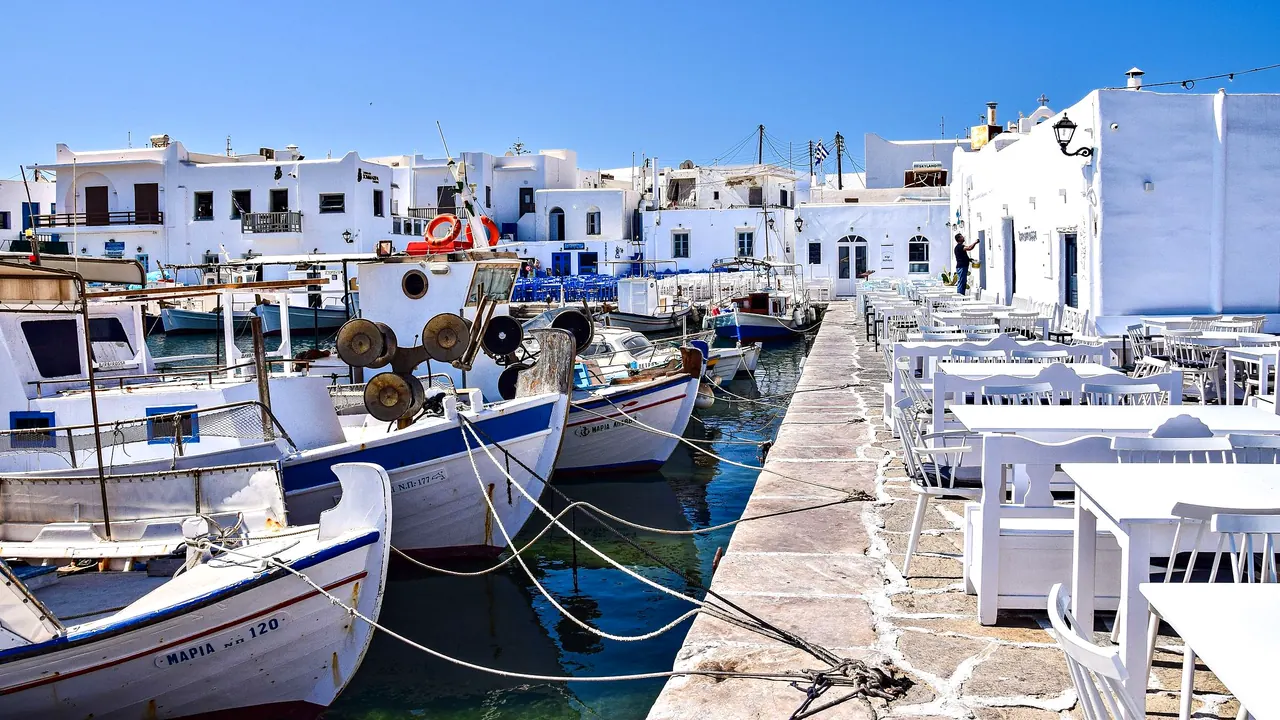
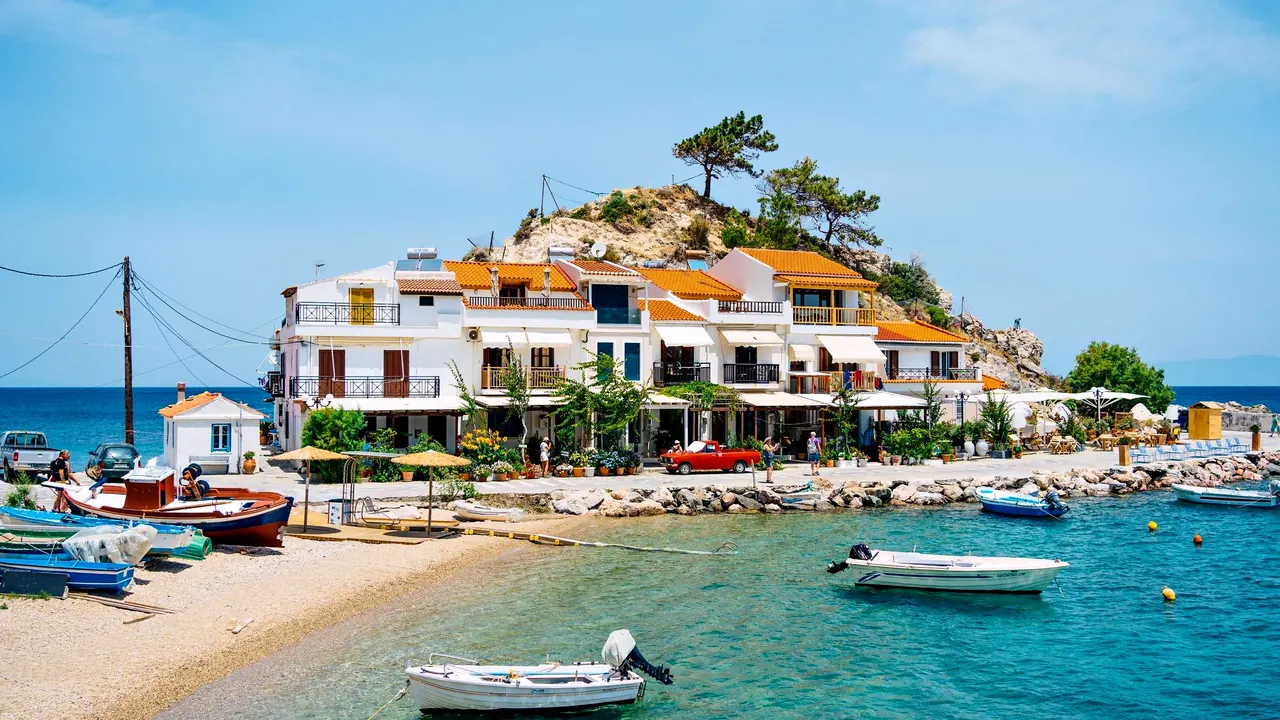
Photos: Paros by AXP Photography, Pexels License; Samos by Thomas Ronveaux, Pexels License.
Paros or Samos?
Our verdict in twelve categories, each scored against the same fixed benchmark cities, and the climate month by month, so you can choose for your trip.
Choose Paros for
- nightlife
- shopping
- getting around
Paros is the better choice if you want a classic Cycladic beach island with a social evening attached. Its sandy bays are among the best in the Aegean, Naoussa's harbour gives you a proper night out without turning into a party island, and a decent summer bus network means you can manage without a car. The catch is cost: high summer here is expensive, and the shops and tavernas lean towards resort prices.
Choose Samos for
- prices
- nature and the outdoors
- culture and sights
Samos suits travellers who want more landscape and more history for their money. It is green and mountainous where Paros is dry and low, with forested ridges, gorges and Mount Kerkis to walk, plus the UNESCO-listed Heraion and the Eupalinos tunnel near Pythagoreio. Nights are quieter and a hired car is close to essential, but rooms and meals cost noticeably less, and Ephesus is a ferry ride away.
Scoreboard
Twelve categories on one fixed scale from 0 to 100. The shaded stretch is the gap between the two.
Your match
Pick a travel style or drag the sliders, and both match scores follow your weighting.
Wins on nightlife and shopping with your weighting.
Wins on prices and nature and the outdoors with your weighting.
What matters to you?
Category by category
What the scores mean for a trip.
Beaches & swimming
These are two excellent swimming islands with the same warm summer sea, and what tells them apart is what lies underfoot. Paros has sand almost everywhere, from the granite-boulder coves of Kolymbithres to the long, gently shelving bays of Golden Beach and Drios, and Antiparos adds more sandy coves a short crossing away.
On Samos the beaches are mostly fine pebble or a mix of sand and shingle, backed by pines and olive groves. The striking water is on the north coast at Kokkari and Lemonakia, while sandy Psili Ammos is the exception in the south. On both islands the meltemi makes it worth picking the sheltered side on windy days.
Food & drink
Paros eats better. It has the classic harbour tables in Naoussa, a handful of more ambitious modern Greek restaurants, its own wines from Monemvasia and Mandilaria grapes, and cheaper home cooking inland at Lefkes and Marpissa.
Samos offers simpler fare. You get grilled fish on the waterfronts, slow-cooked goat in the hill villages and the famous sweet Muscat from Vourliotes and Manolates. It is honest and local, but there is little fine dining or variety, so you go for good plain meals rather than discovery.
Culture & sights
Samos has the weightier sights. The Heraion sanctuary and the Tunnel of Eupalinos, dug through a mountain from both ends in the 6th century BC, together form a UNESCO site, and the museum in Vathy holds a kouros about 5m tall. That is enough for two or three days of real sightseeing.
On Paros the standout is the Ekatontapiliani in Parikia, one of Greece's oldest churches. The rest is village fabric: Naoussa's Venetian fort, the windmills of Lefkes and the ancient marble quarries at Marathi. They make pleasant half-days rather than a programme.
Nightlife
Paros is the livelier island by some distance. Naoussa fills with well-dressed crowds in harbour cocktail bars until late, Parikia's seafront has a looser scene with a few clubs, and beach bars throw parties on the coast.
Samos is a dinner-and-a-drink island. Pythagoreio's harbour bars stay busy in high summer and Kokkari and Vathy have short strips of music bars, but there are no clubs. The best nights are dancing at the village festivals.
Nature & outdoors
Samos is the island for landscape. Two mountain masses cross it, the pine- and chestnut-covered Ampelos ridge and the limestone bulk of Mount Kerkis at about 1,430m, and the wild northwest has the Potami gorge, waterfalls and a protected coast where monk seals are sometimes seen.
Paros is low, dry Cycladic terrain of terraces and thyme. Its one great walk is the Byzantine path from Lefkes to Prodromos. Its real strength is wind: Golden Beach, New Golden Beach and Pounta are among the Aegean's best spots for windsurfing and kitesurfing.
Day trips
Both islands rely on ferries, and both have rewarding outings, though they differ in kind. From Paros you can island-hop through the Cyclades: Antiparos and its cave are a short hop, Naxos's Chora and Portara are under an hour away, and in summer you can reach Mykonos, Ios, Delos and Santorini.
Samos looks towards Turkey. A ferry to Kusadasi and a short drive bring you to Ephesus, so bring your passport. Patmos, with its Monastery of St John, makes the other great day. On both islands, sailings thin out after the summer and the wind can disrupt them.
Good for families
Paros is the easier family island, mainly because its shallow sandy bays are spread around the coast, at Livadia, Golden Beach, Logaras and Piso Livadi, and buses reach many of them. Parikia or the east-coast villages make calm bases.
Samos also works, but it narrows to the south coast: Psili Ammos and flat little Pythagoreio are ideal, while many north-coast beaches are pebbly and windy, and you need a car to move around. Neither island has zoos, aquariums or theme parks.
Getting around
Paros is simpler to get around without a car. In summer, buses run from Parikia's port to Naoussa, Lefkes, the east coast and the main beaches, and small boats cross the bay to Kolymbithres. A hired car or scooter helps for the smaller coves.
On Samos the main towns are close together and walkable, but buses are sparse and miss most beaches and villages, so a hired car is the realistic option. The roads up to the hill villages and out to the far west around Kerkis are narrow and winding. Also check which of the three ports your ferry uses.
Shopping & style
Neither island is a shopping destination, but Paros gives you more to browse. The lanes of Naoussa and Parikia's old market street have boutiques with linen, resort wear, Greek designer jewellery and ceramics, though Naoussa is pricey.
On Samos, what you take home is produce: Muscat wine, thyme honey and olive oil from Vathy and the wine villages. Beyond a few ceramics and jewellery shops in Vathy's backstreets, there is little in the way of fashion or design.
Affordability
Samos is the more affordable island. Studios and small hotels in Kokkari, Pythagoreio and the south coast villages cost noticeably less than in the Cyclades, and meals stay moderate, especially inland. The main extras are a hired car and the ferry to Turkey.
Paros is expensive in July and August, especially in Naoussa and at the famous beaches, where sunbeds and ferry hops add up. You can save by staying in Parikia or the inland villages, travelling by bus and coming in June or September.
Live music & performing arts
Both islands are thin on formal performance, and on both the music that matters is traditional, at summer village feast days. Paros has the great mid-August feast at the Ekatontapiliani and Naoussa's pirate-raid festival with fireworks.
Samos has more of a staged season, with open-air concerts and plays at the castle in Pythagoreio and around the Heraion. On both islands there is next to nothing outside the summer.
Wellness & relaxation
Paros has a little more organised calm on offer, with hotel spas, a handful of yoga and retreat centres and massages near the beaches, while Samos keeps treatments to a few larger resort hotels near Pythagoreio and Kokkari. On Paros the real rest is in the quiet villages of Lefkes, Marpissa and Prodromos, or across the water on Antiparos, well away from Naoussa in August.
Samos, like Paros, has no thermal springs or bathing tradition, so switching off there means shaded squares in the hill villages and quiet coves along the south coast around Marathokampos. On both islands, June and September are the calmer weeks.
When should you go?
Pick your month. The climate figures are measured averages, not a forecast.
Paros in July
Samos in July
Daytime high, °C
Rainfall in the month, mm
Where the figures come from
Paros's temperatures are measured 82 km from the centre, at Santorini Island / Monólithos.
Paros has no rain gauge within 25 km of the centre, so its rainfall comes from a gridded climate dataset read at the destination rather than from a gauge further away.
Samos's sunshine is measured 82 km from the centre, at Aydin.
Temperature and rainfall are climate normals, averaged over the years shown. Paros: 2000-2025, 12 years observed (rainfall 1991-2020) normals, Santorini Island / Monólithos (81.8 km from centre). Samos: 1991-2020 normals, Samos Airport (2.4 km from centre).
Both islands have the same Aegean pattern: dry, hot summers and wet winters, with the sea warm enough to swim from June to early October and peaking at about 24°C in August on both. The difference is in degree. Samos runs hotter in midsummer, with July and August highs around 33°C against Paros's 30°C, which makes its mountain walks hard going then. It is also much wetter in winter, with December bringing close to 147mm of rain compared with about half that on Paros.
For a beach trip, June to September works on either island. For walking and sightseeing, May and late September into October are the better months, especially on Samos, where the slopes are greener and the heat has eased. Samos is very sunny through the summer months. From November to March both islands are cool and rainy, and Samos is the gloomier and wetter of the two.
Which traveller are you?
For a food and nightlife trip, Paros is the clear pick. Naoussa's harbour combines good tavernas, octopus drying in the sun and polished modern Greek kitchens with cocktail bars open past midnight, and Parikia adds a younger strip with a few late clubs.
On a trip on a tight budget, Samos stretches the money further. Family-run studios in Kokkari, Pythagoreio and the south coast villages cost noticeably less than on Paros, and taverna meals with local wine stay moderate, though you will need to budget for a hired car.
For an outdoors trip, Samos has far more to offer. You can climb Mount Kerkis, follow mule paths between the hill villages, walk the Potami gorge and the Seitani coast, and watch birds in spring. On Paros the outdoor highlight is windsurfing rather than walking.
Before you go
| Measure | Paros | Samos |
|---|---|---|
| Official language | Greek | Greek |
| Currency | Euro (EUR) | Euro (EUR) |
| Sockets | CF230 V, 50 Hz | CF230 V, 50 Hz |
| Driving side | Right | Right |
| Time zone | UTC+2, UTC+3 in summer | UTC+2, UTC+3 in summer |
| Emergency number | 112 | 112 |
| Main airport | Paros National Airport (PAS)5 non-stop destinations | Samos Airport (SMI)20 non-stop destinations |
| Public holidays this year | 15 days | 15 days |
By the numbers
| Measure | Paros | Samos |
|---|---|---|
| Population | 13,715 | 32,642 |
| People per km² | 71 | 69 |
| Swim season, months above 21 °C | 5 months | 5 months |
Where else could you go?
Every comparison below shares a destination with this one, so you can follow Paros or Samos somewhere new.