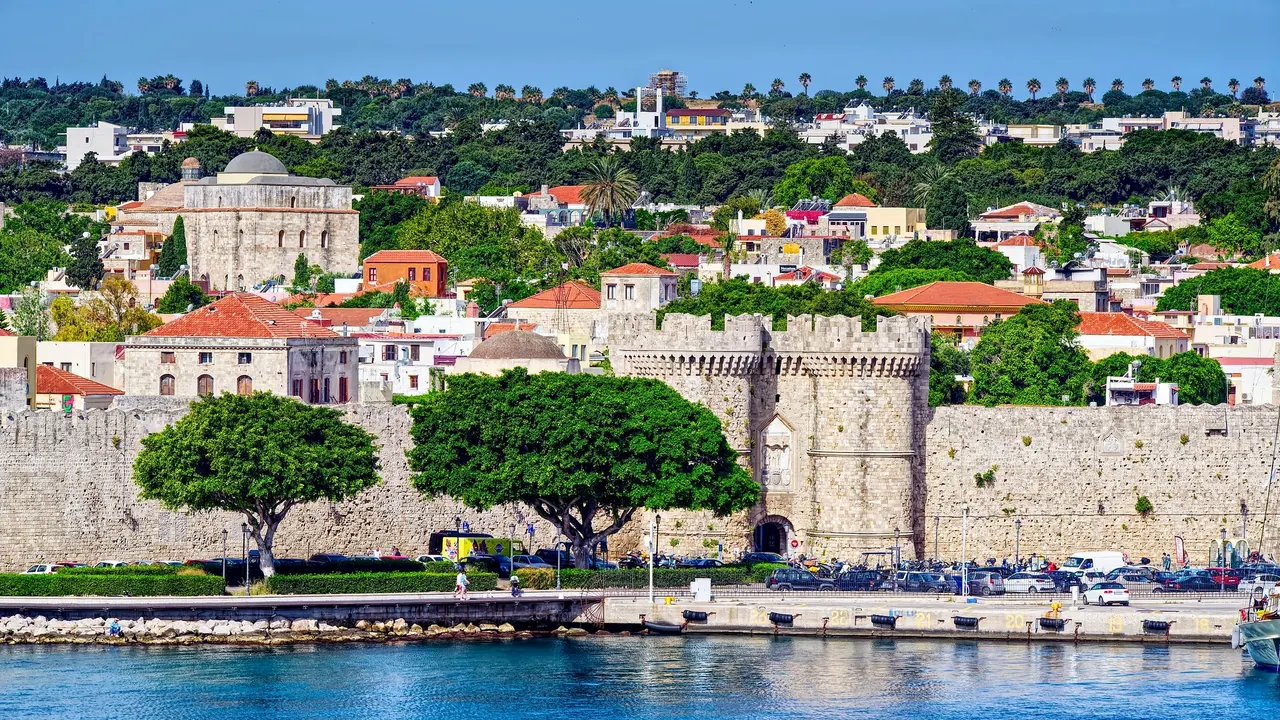

Photos: Rhodes by Mark Thomas, Pexels License; Kos by Wolfgang Weiser, Pexels License.
Rhodes or Kos?
Our verdict in twelve categories, each scored against the same fixed benchmark cities, and the climate month by month, so you can choose for your trip.
Choose Rhodes for
- culture and sights
- food and drink
- nature and the outdoors
Choose Rhodes if you want a beach vacation with more to it. The medieval Old Town and the acropolis above Lindos give you several days of real sightseeing, and the inland villages, the wine slopes of Embonas and the wind at Prasonisi give you reasons to leave your sunbed. The food is also a step up once you get away from the resort strips. The cost is more driving and more crowding in the busiest spots in high summer.
Choose Kos for
- wellness
- getting around
- prices
Kos suits a simple, easy-going beach vacation. The island is long, narrow and mostly flat, so you can cycle from Kos Town to the beaches, reach any corner in about an hour's drive and spend the rest of the time on the long sandy north coast or in the hot spring at Therma. Its Roman ruins and the Asklepieion fill a couple of rewarding days, but the main reason to come is a slow pace and plenty of sand.
Scoreboard
Twelve categories on one fixed scale from 0 to 100. The shaded stretch is the gap between the two.
Your match
Pick a travel style or drag the sliders, and both match scores follow your weighting.
Wins on culture and sights and food and drink with your weighting.
Wins on wellness and getting around with your weighting.
What matters to you?
Category by category
What the scores mean for a trip.
Beaches & swimming
These are two equally strong beach islands, but the beaches are different in kind. Kos has long, open stretches of real sand along the north coast from Tigaki to Mastichari, with shallow water and plenty of space. The catch is the summer meltemi, which can make the sea choppy there. For calmer, clearer water you go south to Kardamena or out to the Kefalos bays, Paradise Beach and Agios Stefanos with its little chapel islet.
On Rhodes the sheltered side is the east coast, which you will probably be staying on anyway. It is a string of bays and coves from Faliraki to Lindos, where the sand is often mixed with fine shingle. There is better snorkelling among the rocks at Anthony Quinn Bay and Ladiko, though the busiest beaches fill with rows of sunbeds in high summer.
Food & drink
On both islands you need to get away from the resort strips to eat well, but Rhodes rewards the effort more. Locals eat in the meze places of Rhodes Town's newer districts, and village tavernas serve matsi pasta, slow-cooked goat and anise souma alongside wine and honey from Embonas. There is also a small upmarket tier around Lindos.
Kos offers plainer island cooking. The best of it is in Zia and Pyli and by the harbours at Mastichari and Kamari, and krasotyri, a cheese matured in red wine, is worth looking for. You can eat pleasantly, but there is less to seek out.
Culture & sights
This is where Rhodes pulls clearly ahead. Its Old Town is a whole fortified medieval city that is still lived in, with the inns of the Knights, mosques, a synagogue and Byzantine churches inside the walls. Beyond the town are the cliff-top acropolis at Lindos, the hillside city of Kamiros and Filerimos, enough for several days.
The Knights of St John also built on Kos, at the Neratzia Castle, but the island's strength is older. Its Roman and Hellenistic remains lie scattered among the streets of Kos Town, and the terraced Asklepieion looks across to Turkey. It is rewarding but compact, and two or three days cover it.
Nightlife
The two scenes are close in size and follow the same pattern, a summer party resort plus late bars in the main town. On Kos the resort is Kardamena, and in town the bar lanes of the old quarter are joined by a few beach clubs at Lambi. Rhodes has Faliraki as its loud strip, but it also has Lindos, whose rooftop and courtyard bars suit an older crowd. The quieter resorts on both islands wind down early, and both scenes largely close outside summer.
Nature & outdoors
Rhodes has the more varied landscape. Mount Attavyros rises well above anything on Kos, the pine hills are cut by shady places such as the Valley of the Butterflies and Seven Springs, and Prasonisi's sandbar between two seas draws windsurfers from across the Mediterranean. There is also diving off the east coast.
Kos is lower and drier, with its outdoor appeal on a smaller scale. The Dikeos hills offer a pine-wood walk up to the sunset views from Mount Christos, peacocks roam the Plaka forest and flamingos winter on the Alikes salt lake. The meltemi makes Marmari and Tigaki good for kitesurfing without a long drive.
Day trips
Both islands are best used as a base for trips by boat, and the choice comes down to where you want to go. From Kos you can visit Bodrum's castle and bazaar, the volcanic crater on Nisyros and the sponge-diving harbour of Kalymnos, which makes for a geologically striking set of outings.
From Rhodes the classic outing is to Symi's pastel harbour, often combined with Panormitis monastery, with Halki and Marmaris as alternatives. Rhodes also has more to see by car, such as the castles at Monolithos and Kritinia and the potters of Archangelos.
Good for families
Both islands suit young families, with gently shelving sand, resort pools and kids' clubs, and tavernas where children are welcome late in the evening. Kos is easier to get around with small children: the coast is flat, families cycle together around Kos Town and nowhere is far away. However, apart from a water park near Marmari, there is little made especially for children.
Rhodes adds an aquarium in Rhodes Town to its water park above Faliraki, and children usually enjoy the Old Town ramparts. On the other hand, the steep lanes of Lindos are hard work with a pushchair.
Getting around
Kos is easier to get around simply because of its shape. It is long, narrow and mostly flat, nowhere is much more than an hour's drive away, and cycle lanes run from Kos Town to the beaches on either side. You will still want a car or scooter for Paradise Beach and the hill villages.
Rhodes is bigger. The car-free Old Town is a pleasure on foot and buses run well to Lindos, but the far south takes about an hour and a half to reach by car. Parking near Lindos and the city walls is tight in summer.
Shopping & style
Rhodes has more variety. Sokratous Street in the Old Town is full of souvenirs, the new town around Mandraki has Greek high-street fashion and a few boutiques, and Archangelos and Lindos sell hand-painted Lindian ceramics. On Kos, shopping is mostly souvenirs, sandals and sponges in the old quarter lanes. The best stop is the Italian-era market hall on Eleftherias Square, for herbs, honey and spices.
Affordability
Costs are much the same on both islands, kept moderate by the package and all-inclusive trade, and on both prices rise in July and August. On Kos the mid-range rooms in Kardamena, Tigaki and Marmari, together with cheap bike hire, make it easy to keep a budget under control. Rhodes has one notably expensive spot, Lindos, along with the boutique hotels of the Old Town, but staying in the new town or a quieter resort brings it back in line.
Live music & performing arts
Neither island has a year-round programme of theatre or concerts, so on both it is mostly summer events in historic settings. Kos has the Hippokrateia festival, staged at the Asklepieion, the Roman Odeon and the castle, along with music at village saints' day festivals. On Rhodes you can see an established folk dance company in a small Old Town theatre in season, and open-air concerts in the medieval moat and the ancient stadium.
Wellness & relaxation
Kos has something Rhodes lacks: Therma, where a hot sulphur spring runs onto a pebble beach and bathers build stone pools to mix it with the sea. It is basic but memorable, and the quieter coast around Kefalos and the villages of Zia and Pyli keep the pace slow.
On Rhodes, Kallithea's old spa rotunda is now a sight rather than somewhere to bathe, so relaxing means hotel spas or a stay in the southern villages such as Lahania and Asklipio. Those villages offer long, quiet evenings far from the northern resort strip.
When should you go?
Pick your month. The climate figures are measured averages, not a forecast.
Rhodes in July
Kos in July
Daytime high, °C
Rainfall in the month, mm
Where the figures come from
Rhodes has no rain gauge within 25 km of the centre, so its rainfall comes from a gridded climate dataset read at the destination rather than from a gauge further away.
Kos has no rain gauge within 25 km of the centre, so its rainfall comes from a gridded climate dataset read at the destination rather than from a gauge further away.
Temperature and rainfall are climate normals, averaged over the years shown. Rhodes: 1991-2020 normals, Rhodes Airport (12.6 km from centre). Kos: 1993-2020 (rainfall 1991-2020) normals, Kos Airport (23.2 km from centre).
The two islands have almost the same year. From June to August both are hot and almost rainless, with daytime highs of about 31°C at the height of summer. That suits the beach but makes midday walks around ruins hard going. On Kos the sea becomes pleasant for swimming in June, and around the main resorts it reaches about 25°C in August. Rhodes warms a little sooner and stays a little warmer, so you can swim comfortably from late May, and the water reaches about 27°C in August. Both stay swimmable through October.
For walking and sightseeing, April, May and late September into October are the best times on both islands, warm without the summer heat. Kos sees the first autumn showers slightly sooner, in September, but from October Rhodes is the wetter of the two. From December to February both are cool and wet, with about 170mm of rain in each of December and January.
Which traveller are you?
On a culture and arts trip, choose Rhodes. Its walled Old Town, with the Street of the Knights and the Grand Master's Palace, plus Lindos, Kamiros and Monte Smith, will keep you busy for several days. On Kos the Roman sites and the Asklepieion take two or three.
On a relaxing and wellness trip, Kos is the gentler choice. You can sit in the warm sulphur pools at Therma where the spring meets the sea, then spend unhurried days in Zia, Pyli or around Kefalos. Wellness on Rhodes mostly means hotel spas.
On an outdoors trip, Rhodes offers more. Mount Attavyros is a proper climb, the Valley of the Butterflies and Seven Springs are shady walks, and Prasonisi is a famous windsurfing spot. Kos has easy cycling and windy beaches, but gentler hills.
Before you go
| Measure | Rhodes | Kos |
|---|---|---|
| Official language | Greek | Greek |
| Currency | Euro (EUR) | Euro (EUR) |
| Sockets | CF230 V, 50 Hz | CF230 V, 50 Hz |
| Driving side | Right | Right |
| Time zone | UTC+2, UTC+3 in summer | UTC+2, UTC+3 in summer |
| Emergency number | 112 | 112 |
| Main airport | Rhodes International Airport "Diagoras" (RHO)136 non-stop destinations | Kos International Airport "Ippokratis" (KGS)75 non-stop destinations |
| Public holidays this year | 15 days | 15 days |
By the numbers
| Measure | Rhodes | Kos |
|---|---|---|
| Population | 127,613 | 33,387 |
| People per km² | 91 | 115 |
| Swim season, months above 21 °C | 6 months | 5 months |
Where else could you go?
Every comparison below shares a destination with this one, so you can follow Rhodes or Kos somewhere new.