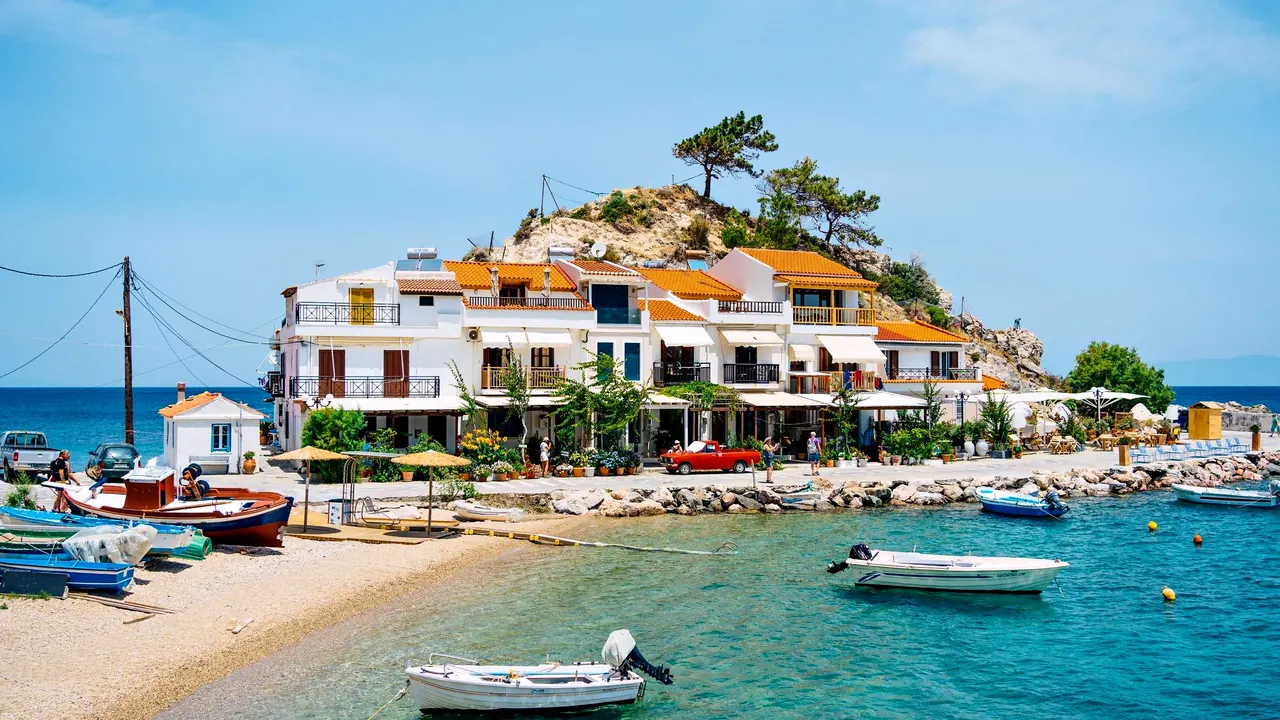
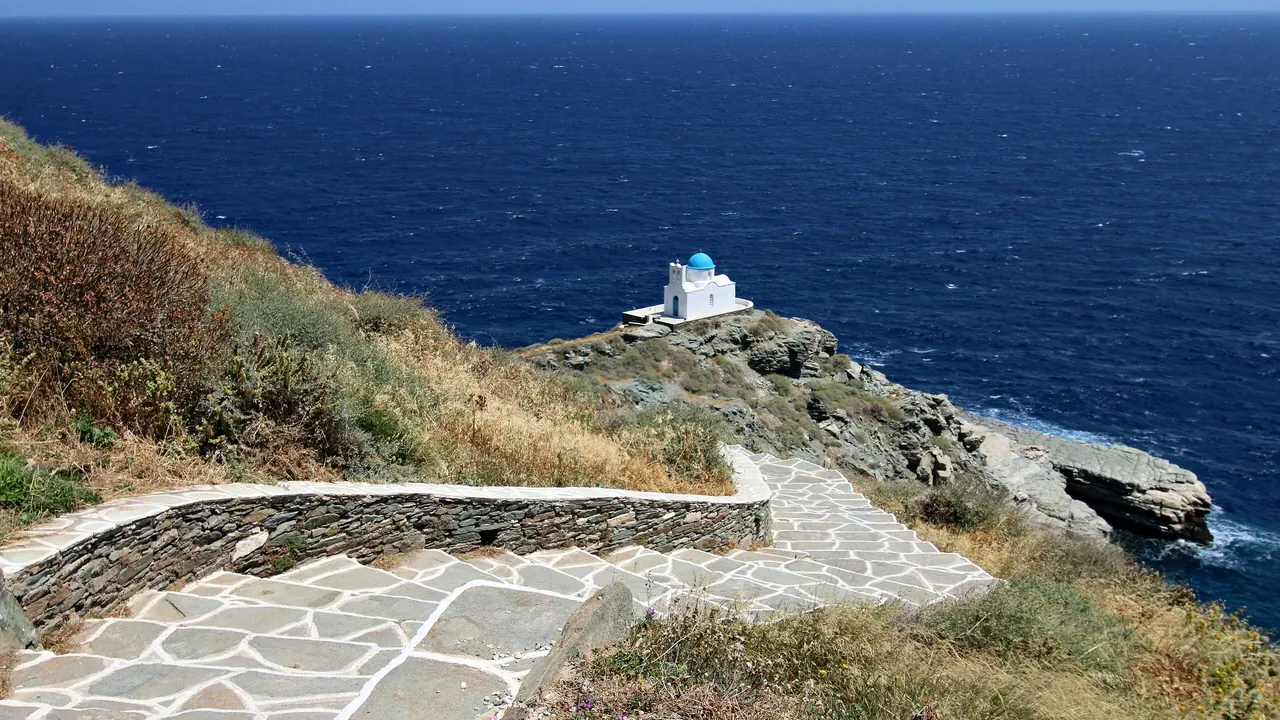
Photos: Samos by Thomas Ronveaux, Pexels License; Sifnos by Zde, CC BY-SA 4.0, cropped.
Samos or Sifnos?
Our verdict in twelve categories, each scored against the same fixed benchmark cities, and the climate month by month, so you can choose for your trip.
Choose Samos for
- prices
- culture and sights
- day trips
Samos suits travellers who want a bigger, greener island with plenty to do away from the beach. The Heraion and the Tunnel of Eupalinos give it real ancient weight, Mount Kerkis and the Potami gorge give walkers wilder ground, and the boat to Kusadasi puts Ephesus within a day. It is also the cheaper of the two and has its own airport, though you will want a car once you land.
Choose Sifnos for
- shopping
- getting around
- food and drink
Choose Sifnos if the table matters more than the ruins. Its clay-pot cooking, from overnight revithia to mastelo, is reason enough to come, and the island is small enough to explore by bus and on foot from Apollonia, with car-free village lanes and pottery workshops along the way. In return you take a ferry from Piraeus and pay noticeably more for a summer room.
Scoreboard
Twelve categories on one fixed scale from 0 to 100. The shaded stretch is the gap between the two.
Your match
Pick a travel style or drag the sliders, and both match scores follow your weighting.
Too close to call, 2 points apart
Wins on prices and culture and sights with your weighting.
Wins on shopping and getting around with your weighting.
What matters to you?
Category by category
What the scores mean for a trip.
Beaches & swimming
Both are first-rate swimming islands with the same warm sea, so the difference lies in the shore. Samos has far more coastline, mostly fine pebble or sand and shingle under pines. Its clearest water is on the windy north coast at Kokkari and Lemonakia, and the Seitani bays can be reached only on foot.
Sifnos is smaller but sandier. Platis Gialos is a long curve of fine sand, and the almost enclosed bay at Vathi stays calm when the meltemi blows. On Samos that sheltered role falls to the south coast around Psili Ammos.
Food & drink
Sifnos is the island to eat on. Its clay-pot tradition gives meals a character all its own: revithia baked overnight in a wood oven, mastelo with red wine and dill, manoura cheese and the old bakeries of Artemonas. A few more ambitious kitchens add some range.
Samos eats well but more plainly, with grilled octopus on the harbours at Kokkari and Pythagoreio and slow-cooked goat in the hill villages. Its real strength is in the glass: the sweet Muscat from the terraces around Vourliotes and Manolates.
Culture & sights
Samos has much the deeper history. At Pythagoreio the Heraion and the Tunnel of Eupalinos, dug through a mountain from both ends in the 6th century BC, together form a UNESCO site. The colossal kouros in the Vathy museum is worth the trip on its own.
Sifnos offers atmosphere rather than monuments. There is the fortified cliff-top village of Kastro, the white lanes and dovecotes of Apollonia and Artemonas, and Chrysopigi on its rock. Its Mycenaean acropolis and Hellenistic towers are ruins to walk out to, not a major site.
Nightlife
Neither is a party island, and on both the night ends with a drink after a long dinner. The difference is the setting. On Samos the bars are on the water, mainly around Pythagoreio's harbour, with short strips of music bars in Kokkari and Vathy. Sifnos gathers its bars along one pedestrian lane in hilltop Apollonia, and Kamares is the only place for a sunset drink by the sea.
Nature & outdoors
Both are good walking islands in spring and autumn, but the ground is different. Samos is green and steep, with pine and chestnut on the Ampelos ridge and Mount Kerkis rising to about 1,430m. It also has the small waterfalls of the Potami gorge and monk seals off the Seitani coast.
Sifnos is drier and gentler, a terraced hillside of thyme and stone walls. Its waymarked mule tracks let you cross much of the island on foot, from village to bay. Profitis Ilias, the highest point at about 680m, is a far more modest climb than Kerkis.
Day trips
Samos has the better outings because of where it sits. The ferry to Kusadasi takes about an hour and a half and puts Ephesus within a day, as long as you bring a passport. Patmos, with its Monastery of St John, is a couple of hours away by fast boat, and Ikaria and Fourni suit slower days.
Sifnos is limited to its Cycladic neighbours: Milos with its fishing villages and painted boathouses, the hilltop chora of nearby Serifos, and little Kimolos. All depend on summer ferries, and once those thin out, Sifnos is your whole trip.
Good for families
Both islands suit a simple beach vacation with small children, and neither has anything built for them. On Samos the base is the south coast: Psili Ammos has shallow, sandy water and flat Pythagoreio is easy for evening strolls, but you need a car to get between beaches.
On Sifnos the sandy, shallow bays of Platis Gialos, Kamares and Vathi are a short drive apart. The stepped village lanes are hard work with a pushchair, though, and the ferry from the mainland can be rough.
Getting around
Once you are there, Sifnos is the easier island. It is small, summer buses run from Apollonia to the main villages and beaches, and footpaths link the villages, so a car is optional. The catch is getting there: there is no airport, and the ferry from Piraeus takes a few hours and can be delayed by wind.
Samos is the reverse. Its airport sits beside Pythagoreio, but buses are sparse and miss most beaches, so a hired car is close to essential. The climbs to the hill villages and the far west are narrow and winding, and ferries leave from three different ports.
Shopping & style
Sifnos gives you something real to take home: pottery from the workshops around Kamares, Vathi and Platis Gialos, which still make the clay casseroles used in its kitchens. Apollonia adds a few boutiques. On Samos you mostly buy local produce, such as Muscat wine, thyme honey and olive oil, and Vathy has the island's few everyday shops. Neither is a place to go shopping.
Affordability
Samos is noticeably easier on the budget. Family-run studios in Kokkari, Pythagoreio and the south coast villages cost less than rooms on the famous Cycladic islands, and taverna meals inland stay moderate. A hire car and the boat to Turkey are the main extra costs.
Sifnos is an upmarket island in summer, with boutique hotels and stylish houses that book out early for July and August. The buses and footpaths cost little, and in June or September room rates drop while the sea stays just as good.
Live music & performing arts
Neither island has much of a stage life, and on both the night to remember is a village saint's day feast in summer. Samos adds a summer season of open-air concerts and plays at the castle in Pythagoreio and around the Heraion. On Sifnos the feasts centre on traditional violin and lute music, with circle dancing that can go on all night.
Wellness & relaxation
Neither island has thermal springs, and spa treatments are found only in a few hotels, so resting here means slowing down. On Samos that means shaded squares in the hill villages and the quiet south coast around Marathokampos. On Sifnos it means car-free lanes and the evening walk between Apollonia and Artemonas. On both, June and September are the calmest months.
When should you go?
Pick your month. The climate figures are measured averages, not a forecast.
Samos in July
Sifnos in July
Daytime high, °C
Rainfall in the month, mm
Where the figures come from
Samos's sunshine is measured 82 km from the centre, at Aydin.
Sifnos has no weather station within reach, so its figures come from a gridded climate model rather than a measured record, and read a broad area rather than one spot.
Temperature and rainfall are climate normals, averaged over the years shown. Samos: 1991-2020 normals, Samos Airport (2.4 km from centre). Sifnos: 2001-2020 normals, NASA POWER reanalysis grid, no weather station within 90 km.
Samos runs hotter. Summer highs reach 33°C in July and August, with almost no rain and long sunny days. That is fine for the beach but hard going on the climbs to the hill villages or up Kerkis in the middle of the day. Sifnos stays gentler, peaking around 27°C, so midsummer walks between its villages are easier. On both islands the sea is warm enough to swim from June to October and reaches about 24°C in August.
For walking on Samos, May and the stretch from late September into October are warm without the summer heat. Rain sets in on both islands from November, more heavily on Samos, where December brings about 147mm against roughly 107mm on Sifnos. Neither works as a winter beach destination.
Which traveller are you?
On a culture and arts trip, Samos gives you a real programme: mornings at an ancient sanctuary and a major museum, afternoons among Byzantine monasteries and stone villages. On Sifnos you would mostly wander white villages and chapels, which is pleasant but thin for a sightseer.
For a food and nightlife trip, choose Sifnos and plan your days around meals, from Sunday lunch out of the wood oven to fish landed beside your table at Cheronissos. Samos eats more simply. On both islands the bars are lively only in the peak summer weeks, and neither has a club scene.
On a tight budget, Samos makes your money last. Rooms and taverna meals stay moderate and sightseeing costs little. On Sifnos the same money buys a shorter stay, and there are few simple places to stay if the stylish ones are beyond reach.
Before you go
| Measure | Samos | Sifnos |
|---|---|---|
| Official language | Greek | Greek |
| Currency | Euro (EUR) | Euro (EUR) |
| Sockets | CF230 V, 50 Hz | CF230 V, 50 Hz |
| Driving side | Right | Right |
| Time zone | UTC+2, UTC+3 in summer | UTC+2, UTC+3 in summer |
| Emergency number | 112 | 112 |
| Main airport | Samos Airport (SMI)20 non-stop destinations | Milos Airport (MLO)2 non-stop destinations |
| Public holidays this year | 15 days | 15 days |
By the numbers
| Measure | Samos | Sifnos |
|---|---|---|
| Population | 32,642 | - |
| People per km² | 69 | - |
| Swim season, months above 21 °C | 5 months | 5 months |
Where else could you go?
Every comparison below shares a destination with this one, so you can follow Samos or Sifnos somewhere new.