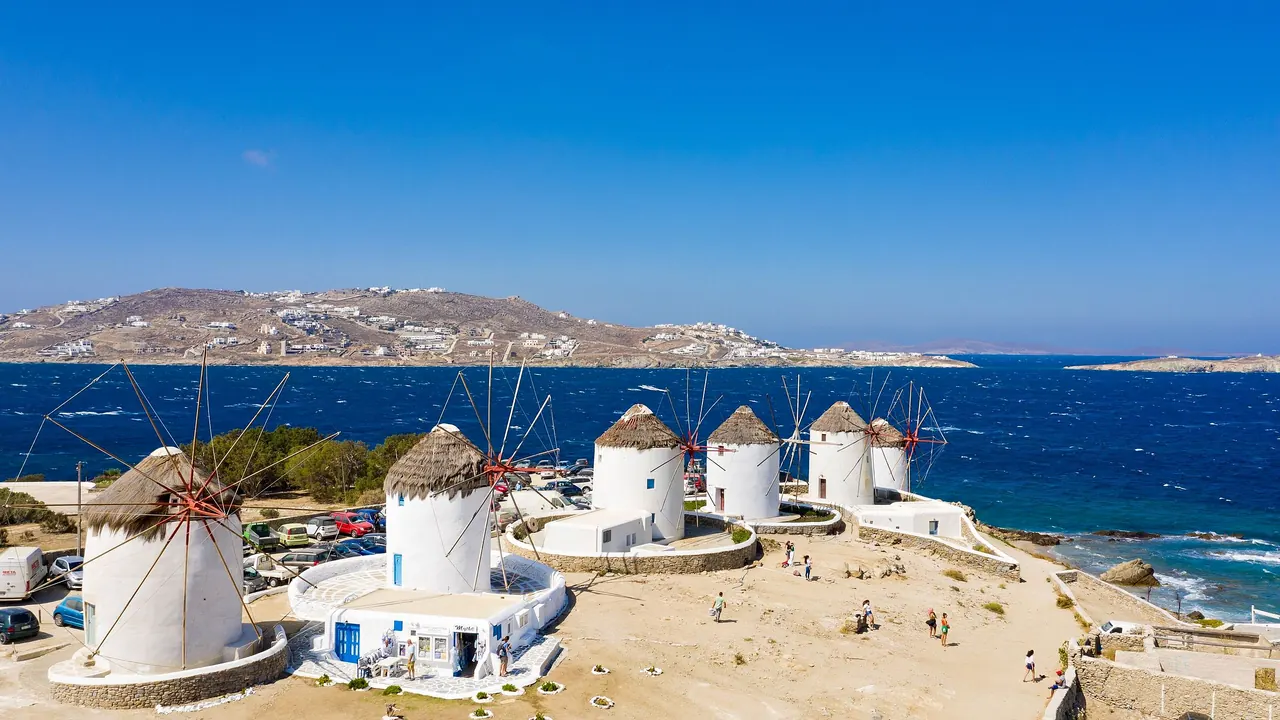
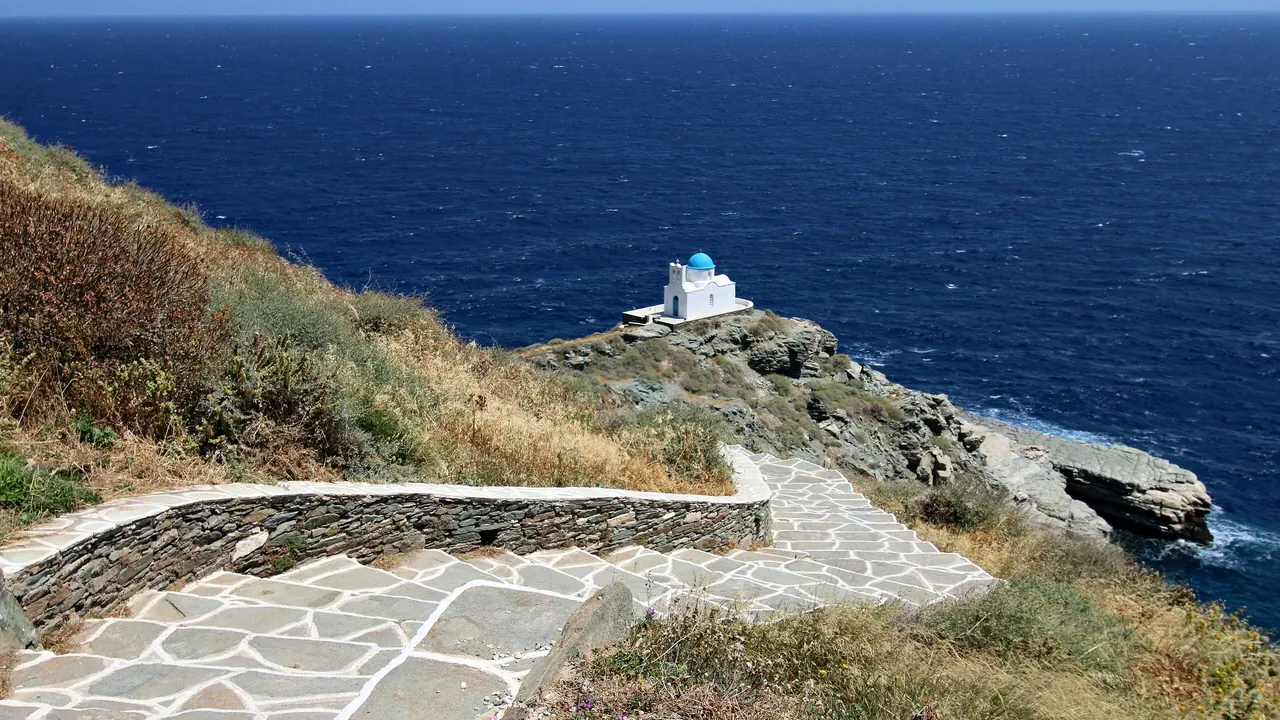
Photos: Mykonos by dronepicr, CC BY 2.0, cropped; Sifnos by Zde, CC BY-SA 4.0, cropped.
Mykonos or Sifnos?
Our verdict in twelve categories, each scored against the same fixed benchmark cities, and the climate month by month, so you can choose for your trip.
Choose Mykonos for
- nightlife
- culture and sights
- shopping
Mykonos is the island for a summer of beach clubs by day and dance bars until sunrise. Its south coast gives you a different bay for every mood, Delos lies a short boat ride from Chora, and the boutiques of Matoyianni Street stay open late into the night. It suits groups, couples out to celebrate and anyone who wants glamour and noise. The price is high: you pay a lot, and you get very little calm in July and August.
Choose Sifnos for
- prices
- nature and the outdoors
- wellness
Sifnos is for a slower stay built around long taverna lunches, sheltered swimming and walks along old mule tracks between white villages. Travellers who care more about clay-pot cooking and a quiet bay than about a club will be happier here, and so will families who want calm water and safe villages. Expect evenings that end with a drink in Apollonia, and a ferry from the mainland, because there is no airport.
Scoreboard
Twelve categories on one fixed scale from 0 to 100. The shaded stretch is the gap between the two.
Your match
Pick a travel style or drag the sliders, and both match scores follow your weighting.
Wins on nightlife and culture and sights with your weighting.
Wins on prices and nature and the outdoors with your weighting.
What matters to you?
Category by category
What the scores mean for a trip.
Beaches & swimming
Mykonos has the wider range. Its south coast goes from sheltered bays close to Chora to the party beaches of Paradise and Super Paradise and longer, roomier stretches such as Elia, so you can pick a different mood each day. Beach clubs and rows of sunbeds line much of it, and the quieter coves at the eastern end take some effort to reach.
Sifnos has fewer beaches and keeps them low-key, with no resort strips and no party scene. Its Platis Gialos, not the Mykonos bay of the same name, is a broad curve of fine sand in shallow water, and Vathi is an almost enclosed bay where the sea stays calm. It is the better choice for an easy, quiet swim rather than a day out at a beach club.
Food & drink
The two are broadly level, but they feed you in very different ways. Mykonos sells the setting: grilled octopus at the water's edge in Little Venice, and a large high-end scene of sushi, fusion and celebrity-chef dining built for the summer crowd. Its own kopanisti cheese and louza cured pork are worth seeking out, and Ano Mera's square feels more local.
On Sifnos the cooking itself is the reason to go. Revithia chickpeas are baked overnight in clay pots and mastelo lamb is cooked with red wine and dill, and in Cheronissos the fish comes ashore beside the tables. You will not find an international scene there, but the island's own food is done with real care.
Culture & sights
Delos gives Mykonos the clear advantage. It was one of the great religious centres of the ancient Greek world, and its Terrace of the Lions, mosaic-floored houses and theatres are a short boat ride from Chora. On Mykonos itself there are the windmills at Kato Mili, the Paraportiani church and a handful of small museums.
Sifnos has nothing on that scale. Its pleasures are quieter: the cliff-top fortified village of Kastro, the monastery of Chrysopigi on its rocky islet, the Mycenaean acropolis at Agios Andreas, and Hellenistic watchtowers from the days of the island's mines. They reward a slow few days rather than a single famous excursion.
Nightlife
This is where the two islands differ most. In summer Mykonos is one of the Mediterranean's great party islands. Afternoon sessions at Paradise and Super Paradise lead into sunset drinks in Little Venice, then a long-established gay scene in Chora's lanes, and big clubs where international DJs play until sunrise.
Sifnos has no clubs at all. An evening there means a long dinner and then a drink in the small cocktail and music bars along Apollonia's pedestrian lane, which stay busy late only in July and August.
Nature & outdoors
Sifnos is much the better island for walking. Old stone-paved mule tracks link its villages, monasteries and bays, terraced hillsides of thyme and olive trees turn green in spring, and Profitis Ilias gives views across the western Cyclades.
Mykonos is low, brown and nearly bare, and walking there amounts to country lanes and the path out to the Armenistis lighthouse. What it does have is wind and water: the meltemi makes Korfos Bay and Kalafatis good spots for kitesurfing and windsurfing, and there are reefs and wrecks to dive.
Day trips
From Mykonos the ferries reach more islands, and more varied ones. Pilgrimage Tinos is half an hour away, the neoclassical port of Ermoupoli on Syros about an hour, and Paros and Naxos can be reached quickly on fast boats.
Sifnos has a shorter list, though a good one. Milos is the best outing, with its hilltop Plaka and painted boathouses, and Serifos's chora is very close. Connections thin out quickly in strong wind or outside high season, so most visitors simply stay put.
Good for families
Sifnos suits families better, mainly because of its calm. Platis Gialos, Kamares and Vathi have shallow sand, the villages are safe and relaxed, and the drives are short. Nothing is built for children, though, and the stepped village lanes are hard work with a pushchair.
Mykonos has a little more to entertain children, with a water park near Elia and the boat trip to Delos. But the island is built around adult nights out, and Chora gets loud late in high summer. Families do best at a quiet south-coast bay such as Agios Stefanos or Ornos.
Getting around
Once you are on either island, getting about is much the same: both are small, with car-free village lanes, summer buses to the main beaches, and narrow roads where a hired car or scooter helps. Mykonos adds sea taxis along its south coast, but it is short of taxis in summer and traffic around Chora gets heavy.
The real difference is arriving. Mykonos has its own airport. Sifnos has none, so you reach it by ferry from Piraeus, a crossing of a few hours that strong winds can delay.
Shopping & style
Mykonos has much more to shop for. The lanes around Matoyianni Street are full of designer resort wear, linen, swimwear, fine Greek jewellery and galleries, and they open late for evening browsing. Nearly all of it is summer fashion, though, and there are no local crafts.
Sifnos has the one thing Mykonos lacks: a centuries-old pottery tradition. Workshops around Kamares and Vathi still make the clay casseroles used in its kitchens. Add capers, honey and almond sweets from Apollonia, and you have a short browse with real local character.
Affordability
Neither island is cheap in summer, but Mykonos is in another bracket: it is one of Europe's most expensive places to vacation. Hotel rooms, beach-club sunbeds, cocktails and taxis are all priced for a luxury crowd, and gyros counters, buses and rooms inland at Ano Mera only soften the bill.
Sifnos is upmarket too, with boutique hotels that book out early, but a day there costs noticeably less. Taverna meals are fair for their quality, and hiking and buses cost little. On both islands, June and September bring rooms down.
Live music & performing arts
Neither island has a stage season, and on Mykonos the music is mostly the DJ sets of its clubs, with only the occasional summer concert or village festival. Sifnos offers a little more that is its own: the panigyri, a chapel's saint's-day feast where violin and lute music and circle dancing can go on all night, and visitors are welcome to join in.
Wellness & relaxation
Sifnos is the more restful island, though it has no spa culture to speak of. Its calm comes from the pace: long lunches, evening walks between Apollonia and Artemonas, and bays with nothing planned.
Mykonos has more treatments to offer, in the spas and terrace yoga of its upmarket hotels. Its summer rhythm of beach clubs and late nights works against rest, though, so anyone after quiet should stay out near Agios Sostis, Ftelia or beyond Kalafatis.
When should you go?
Pick your month. The climate figures are measured averages, not a forecast.
Mykonos in July
Sifnos in July
Daytime high, °C
Rainfall in the month, mm
Where the figures come from
Mykonos has no weather station within reach, so its figures come from a gridded climate model rather than a measured record, and read a broad area rather than one spot.
Sifnos has no weather station within reach, so its figures come from a gridded climate model rather than a measured record, and read a broad area rather than one spot.
Temperature and rainfall are climate normals, averaged over the years shown. Mykonos: 2001-2020 normals, NASA POWER reanalysis grid, no weather station within 90 km. Sifnos: 2001-2020 normals, NASA POWER reanalysis grid, no weather station within 90 km.
On Mykonos, where most visitors stay, June to August is almost rainless, with highs around 25°C at the height of summer. The sea is warm enough to swim from June into early October and is at its warmest, about 24°C, in August. April and May are dry and mild, which makes them good months for wandering Chora's lanes. March and October are both pleasant but showery, with a similar amount of rain. After that the wet season sets in: November is clearly wetter, and December and January are the wettest months, at around 100mm each, with cool days and no beach weather.
Sifnos follows the same pattern but runs a little warmer, with highs near 27°C in July and August, so walking at midday is hard work. Its sea keeps its August warmth through September, so swimming lasts well into October. April and May are the best months for its footpaths. Sifnos is wetter than Mykonos at both ends of the year: March and October bring more rain there, and December and January are slightly wetter again.
Which traveller are you?
On a food and nightlife trip, Mykonos is the choice. Sifnos eats every bit as well, but after dinner it offers only a lane of bars in Apollonia, while Mykonos moves from beach-club afternoons to Little Venice sunsets and clubs open until dawn.
For a culture and arts trip, Mykonos wins because of Delos, the sacred island of Apollo, which takes a full morning to explore and is reached by a short boat ride. Add Chora's windmills and churches, and you have more to see than in Sifnos's modest villages.
On an outdoors trip, Sifnos suits far better. Waymarked stone mule tracks cross the island between monasteries, watchtowers and bays, up to Profitis Ilias at about 680m. On bare Mykonos, walking is limited to lanes, although the wind there is good for kitesurfing.
Before you go
| Measure | Mykonos | Sifnos |
|---|---|---|
| Official language | Greek | Greek |
| Currency | Euro (EUR) | Euro (EUR) |
| Sockets | CF230 V, 50 Hz | CF230 V, 50 Hz |
| Driving side | Right | Right |
| Time zone | UTC+2, UTC+3 in summer | UTC+2, UTC+3 in summer |
| Emergency number | 112 | 112 |
| Main airport | Mykonos Island National Airport (JMK)44 non-stop destinations | Milos Airport (MLO)2 non-stop destinations |
| Public holidays this year | 15 days | 15 days |
By the numbers
| Measure | Mykonos | Sifnos |
|---|---|---|
| Population | 10,134 | - |
| People per km² | 96 | - |
| Swim season, months above 21 °C | 5 months | 5 months |
Where else could you go?
Every comparison below shares a destination with this one, so you can follow Mykonos or Sifnos somewhere new.