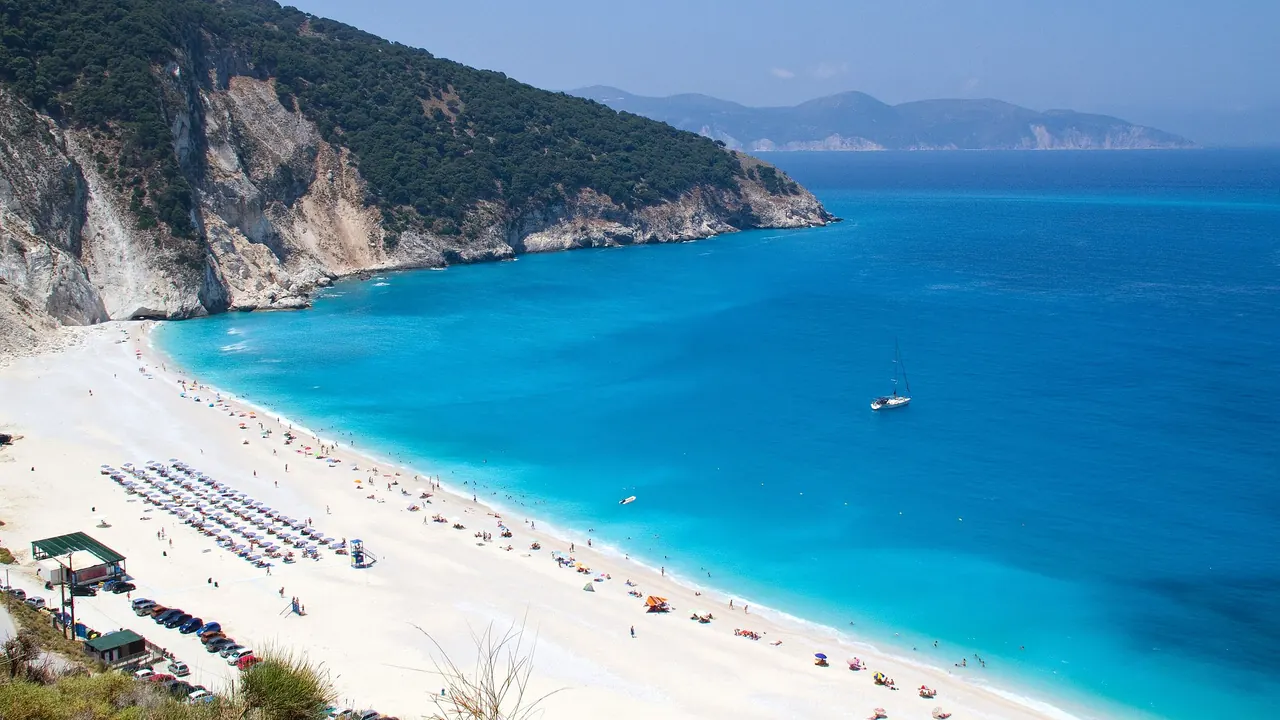
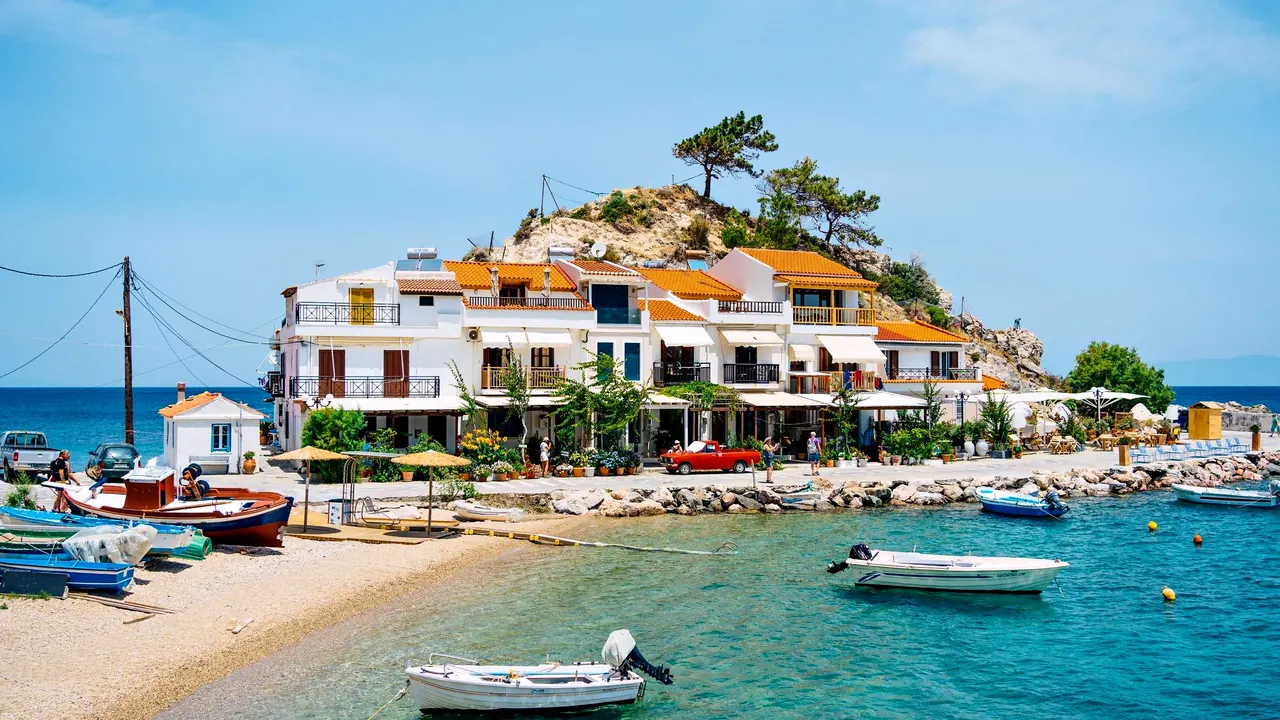
Photos: Kefalonia by Tony Hisgett from Birmingham, UK, CC BY 2.0, cropped; Samos by Thomas Ronveaux, Pexels License.
Kefalonia or Samos?
Our verdict in twelve categories, each scored against the same fixed benchmark cities, and the climate month by month, so you can choose for your trip.
Choose Kefalonia for
- nature and the outdoors
- beaches
- food and drink
Kefalonia suits travellers who come for the coast and the landscape. Its beaches are more varied and more dramatic, from the white pebbles under Myrtos's cliffs to the red sand at Xi, and the island has more to explore inland: the fir forest of Mount Ainos, the Melissani lake cave and turtles in Argostoli harbour. In return you get thin history, since the 1953 earthquake rebuilt most towns, and long drives between coasts.
Choose Samos for
- culture and sights
- day trips
- nightlife
Samos is the better pick if you want ancient sites alongside your swimming, or a trip that goes a little easier on the wallet. The Heraion and the Tunnel of Eupalinos near Pythagoreio give it real depth, the ferry to Kusadasi puts Ephesus within a day, and the main towns sit close together. Its beaches are fine pebble and mixed shingle rather than anything showpiece, and the north coast catches the summer wind.
Scoreboard
Twelve categories on one fixed scale from 0 to 100. The shaded stretch is the gap between the two.
Your match
Pick a travel style or drag the sliders, and both match scores follow your weighting.
Wins on nature and the outdoors and beaches with your weighting.
Wins on culture and sights and day trips with your weighting.
What matters to you?
Category by category
What the scores mean for a trip.
Beaches & swimming
Kefalonia is the more spectacular beach island. Myrtos's white pebble crescent below the cliffs, Petani on the Paliki peninsula and Antisamos in its green bowl near Sami are the postcard views, while Xi, Skala and Lourdas add sand and shallow water. The catch is that the best beaches are spread across different coasts, so you choose a base for one kind of beach and drive to the rest.
Samos has coves almost everywhere a road reaches the sea, mostly fine pebble or sand and shingle under pines. The clearest water is on the north coast at Kokkari, Lemonakia and Tsamadou, but the meltemi wind can whip it up, so on windy days you head south to sandy Psili Ammos or quiet Votsalakia. The Seitani bays, reached on foot, are its wildest swims.
Food & drink
Food on the two islands is much the same: family tavernas, local honey and olive oil, and not much beyond Greek cooking. Kefalonia has more dishes of its own, such as the spiced meat pie, bourbourelia soup and aliada with salt cod, plus the dry Robola white from the Omala valley wineries and a fish market in Argostoli.
Samos is known for sweet Muscat wine from the terraces around Vourliotes and Manolates, and its best eating is slow-cooked goat and stuffed vegetables in the hill villages rather than on the harbour fronts of Kokkari and Pythagoreio.
Culture & sights
Kefalonia lost almost all its old buildings in the 1953 earthquake, and Argostoli and most villages were rebuilt in plain style. What remains is scattered: the pastel Venetian-era harbour at Fiskardo, the fortress ruins on the Assos peninsula, the Castle of Agios Georgios above the south and the Mycenaean tomb at Tzanata. They fill a few pleasant afternoons, but nobody picks the island for them.
Samos is well ahead here. Around Pythagoreio, the Heraion sanctuary and the Tunnel of Eupalinos, an archaic aqueduct dug through a mountain from both ends at once, form a UNESCO site, and the town still sits on its ancient harbour below stretches of city wall. Add the towering kouros in the museum at Vathy and you have several days of serious sightseeing.
Nightlife
Neither island is for partying, but Samos stays up a little later. Pythagoreio's harbour cocktail bars stay busy past midnight in high summer, Kokkari and Vathy have short strips of music bars, and the village panigiria with dancing in the square make for the best nights out.
On Kefalonia the evening is dinner and a drink by the water. The Lithostroto and Argostoli's main square fill up in summer and Lassi has a run of beach bars, but clubs are few and most places go quiet early outside July and August.
Nature & outdoors
Kefalonia has more for outdoor lovers. Mount Ainos is a national park, with dark forests of Greek fir, semi-wild horses and views to Ithaca and Zakynthos. Below ground there are the Melissani lake cave and the Drogarati chamber, loggerhead turtles feed in Argostoli harbour, and you can kayak the north-east coast or sail the channel to Ithaca.
Samos is green and steep too, with the wooded Ampelos ridge and the bare limestone of Mount Kerkis, a long day's climb. Its best natural sights are smaller: the Potami gorge waterfalls, spring orchids and birds by the salt lake, and the monk seal coast around Seitani.
Day trips
Samos offers the more memorable day out. A ferry to Kusadasi puts the ruins of Ephesus within reach (bring your passport), and fast boats run to Patmos and its Monastery of St John. Ikaria, Fourni and the islet of Samiopoula suit slower days.
From Kefalonia, the best outing is the short ferry from Sami to Ithaca, with Vathy, Kioni and the sites linked to Odysseus. Summer boats also cross to northern Zakynthos and Lefkada, but after those the choices run out. On both islands most crossings run only in the warmer months.
Good for families
Families will find the two much alike: easy tavernas, a few gentle sandy beaches and no theme parks or aquariums. On Kefalonia, stay at Skala, Lourdas or Xi, where the Melissani boat ride and turtle spotting are reliable hits, though reaching them means long, winding drives.
On Samos the obvious base is the south coast, where Psili Ammos has warm, shallow water and Pythagoreio is flat and compact for evening strolls. Distances are shorter, but there is a little less to do with children.
Getting around
Either way you will want a hire car, since buses on both run too rarely to plan around. The difference is scale. Kefalonia is large and mountainous, and the drive from Argostoli to Fiskardo takes about an hour and a half on cliff and ridge roads, although the summer ferry across the bay to Lixouri helps.
Samos is more compact. Vathy, Kokkari and Pythagoreio are less than half an hour apart and the airport sits by Pythagoreio, and only the hill villages and the far west around Kerkis involve slow driving. A scooter is a realistic option there.
Shopping & style
Neither island is a shopping destination, and on both the best things to take home are edible. Kefalonia has a little more browsing, with Argostoli's Lithostroto and the boutiques around Fiskardo's harbour, plus mandoles, Robola and thyme honey to buy. On Samos you are mostly buying Muscat wine, herbs and oil, with some ceramics and jewellery in Vathy's backstreets.
Affordability
Kefalonia is middling for a Mediterranean island in summer. Taverna meals are reasonable and the resorts at Skala, Lourdas and Lassi give fair value, but the island is big and its best beaches lie on different coasts, so the long drives add up. July and August are the dearest weeks, and June and September bring calmer prices while the sea is still warm.
Samos makes your money go further. Rooms cost noticeably less than on the best-known Cycladic islands, a taverna meal with local wine stays moderate, especially in the inland villages, and the Heraion and the Eupalinos tunnel cost little to visit. The extra to plan for is the ferries, since boats take you on the best outings, and the crossing to Kusadasi for Ephesus is the most expensive excursion. Prices peak in August, when Greek visitors fill the island.
Live music & performing arts
Both islands offer summer evenings outdoors rather than a regular performing arts calendar. Kefalonia's heritage is musical: kantades serenades with guitar and mandolin and Argostoli's long philharmonic band tradition, heard in town squares and at village festivals. Samos puts on open-air concerts and plays at the Pythagoreio castle and near the Heraion, and in July and August its panigiria bring live Greek bands you can dance to.
Wellness & relaxation
Neither island has a spa or bathing tradition, so pampering means a resort hotel. Both are good places to slow down. On Kefalonia, the quiet places are the Paliki peninsula, the north-east coast and harbour evenings in Assos. On Samos, they are the shaded hill villages and the coast around Marathokampos. June and September are the calmest months on both, and Samos's drier September makes it the safer choice late in the season.
When should you go?
Pick your month. The climate figures are measured averages, not a forecast.
Kefalonia in July
Samos in July
Daytime high, °C
Rainfall in the month, mm
Where the figures come from
Kefalonia's temperatures are measured 59 km from the centre, at Zakinthos / Agrilia.
Kefalonia has no rain gauge within 25 km of the centre, so its rainfall comes from a gridded climate dataset read at the destination rather than from a gauge further away.
Samos's sunshine is measured 82 km from the centre, at Aydin.
Temperature and rainfall are climate normals, averaged over the years shown. Kefalonia: 1991-2020 normals, Zakinthos / Agrilia (58.6 km from centre). Samos: 1991-2020 normals, Samos Airport (2.4 km from centre).
Both islands follow the same summer rhythm. The sea is warm enough to swim from June to October, and July and August bring highs around 33°C, which makes midday walking and hiking hard work on either. Kefalonia's sea runs slightly warmer, about 26°C in August against 24°C off Samos, and its midsummer is a touch sunnier. May and early June, and the second half of September, are the comfortable months for exploring on foot.
Where they part is the autumn. On Kefalonia the rain returns in September, with about 65mm, and October and November are properly wet. Samos stays almost dry through the summer and has only about 12mm in September, so it holds its settled weather a few weeks longer. In winter both are cool and rainy and better suited to walking than to the beach.
Which traveller are you?
On a beach and sun trip, Kefalonia has the edge. Myrtos, Petani and Antisamos are some of the most striking swimming spots in the Ionian, and the sandy shores at Skala and Lourdas give you an easy alternative when you want long, gentle beaches.
For a culture and arts trip, Samos is clearly the stronger island. The UNESCO-listed Heraion and Tunnel of Eupalinos, the giant kouros in the Vathy museum and a day trip to Ephesus give it an ancient world that earthquake-rebuilt Kefalonia cannot match.
On a trip with a tight budget, Samos stretches your money further. Family-run studios in Kokkari and the south coast villages stay moderate, whereas on Kefalonia the prettiest bases, Fiskardo and Assos, are the expensive ones. Car hire is a cost on both.
Before you go
| Measure | Kefalonia | Samos |
|---|---|---|
| Official language | Greek | Greek |
| Currency | Euro (EUR) | Euro (EUR) |
| Sockets | CF230 V, 50 Hz | CF230 V, 50 Hz |
| Driving side | Right | Right |
| Time zone | UTC+2, UTC+3 in summer | UTC+2, UTC+3 in summer |
| Emergency number | 112 | 112 |
| Main airport | Kefalonia International Airport "Anna Pollatou" (EFL)41 non-stop destinations | Samos Airport (SMI)20 non-stop destinations |
| Public holidays this year | 15 days | 15 days |
By the numbers
| Measure | Kefalonia | Samos |
|---|---|---|
| Population | 36,064 | 32,642 |
| People per km² | 49 | 69 |
| Swim season, months above 21 °C | 5 months | 5 months |
Where else could you go?
Every comparison below shares a destination with this one, so you can follow Kefalonia or Samos somewhere new.