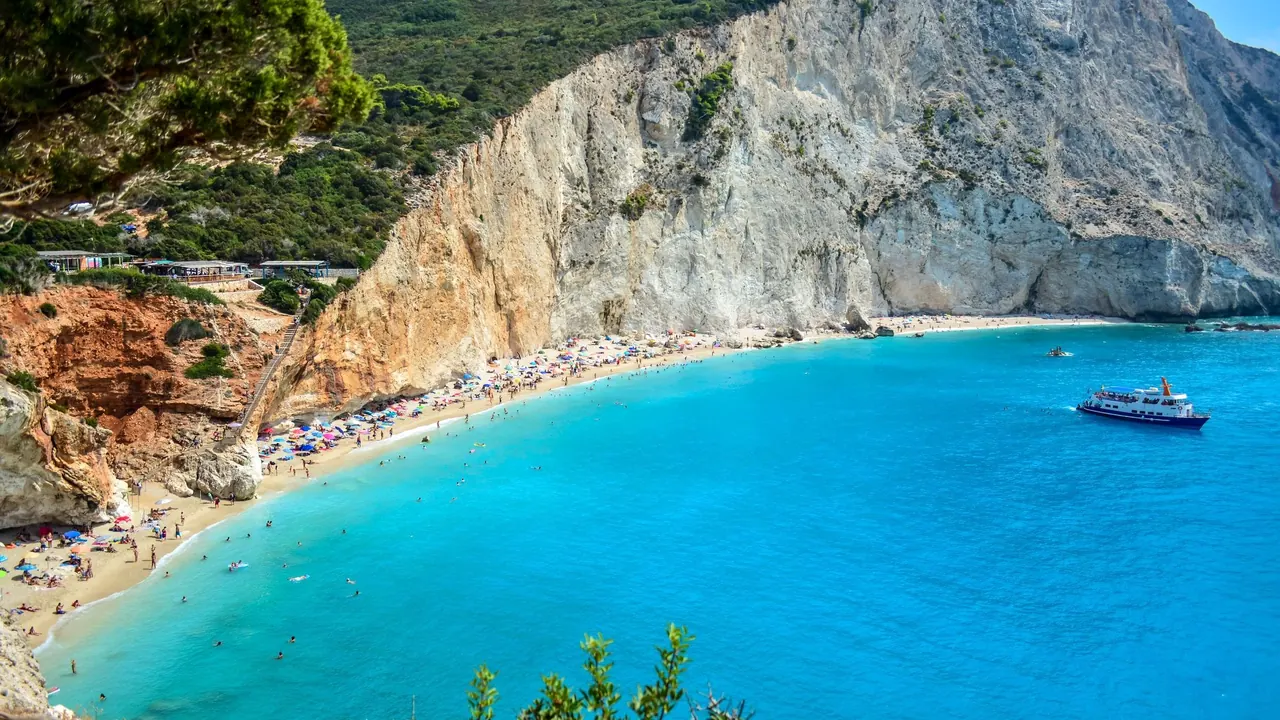
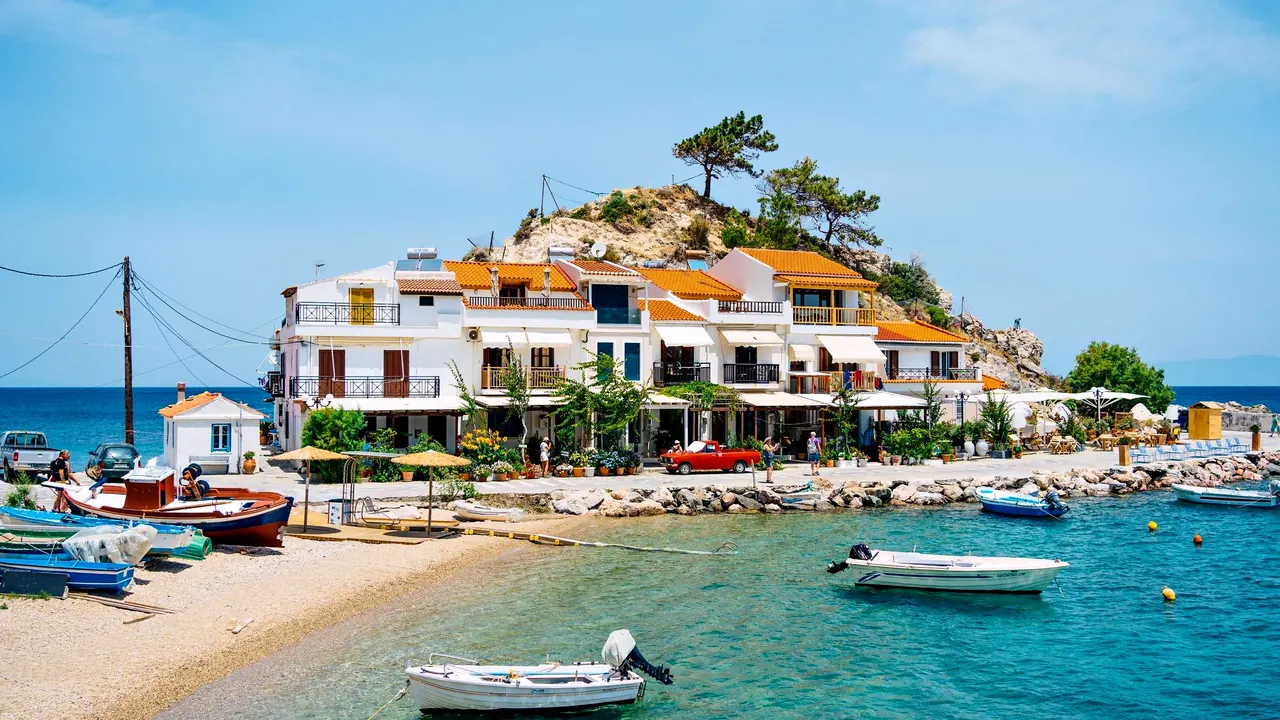
Photos: Lefkada by Antone Adi, Pexels License; Samos by Thomas Ronveaux, Pexels License.
Lefkada or Samos?
Our verdict in twelve categories, each scored against the same fixed benchmark cities, and the climate month by month, so you can choose for your trip.
Choose Lefkada for
- shopping
- beaches
- nature and the outdoors
Lefkada is the choice when the beach itself is the point of the trip. Its west coast of white cliffs and turquoise water is among the most striking shorelines in Greece, and the island suits people who want to spend their days on the water, windsurfing at Vasiliki or sailing the channels to the islets off the east coast. Getting there is easy too, with a causeway from the mainland and no ferry to catch, and the mainland is close enough for a drive to Parga or Nikopolis.
Choose Samos for
- culture and sights
- prices
- food and drink
Travellers who want some history between swims will do better on Samos. The Heraion and the Tunnel of Eupalinos around Pythagoreio give it a real ancient site, Ephesus is a ferry ride away, and the Muscat villages in the hills add a wine to the trip. It is also the gentler on the wallet, and its drier, sunnier summer suits anyone who wants as few clouds as possible.
Scoreboard
Twelve categories on one fixed scale from 0 to 100. The shaded stretch is the gap between the two.
Your match
Pick a travel style or drag the sliders, and both match scores follow your weighting.
Too close to call, 1 point apart
Wins on shopping and beaches with your weighting.
Wins on culture and sights and prices with your weighting.
What matters to you?
Category by category
What the scores mean for a trip.
Beaches & swimming
Lefkada's beaches are the more dramatic. The long west-coast strands at Porto Katsiki, Egremni, Gialos and Kathisma lie below tall limestone cliffs in vivid turquoise water, though they face the open sea, shelve steeply, get waves in the afternoon and fill up in midsummer. The east coast around Nikiana and Nidri gives calmer swimming.
Samos is more about choice than spectacle. Most of its beaches are fine pebble or sand and shingle, backed by pines, and on windy days you swap the clear north coast around Kokkari and Lemonakia for sandy, shallow Psili Ammos or the long quiet shore at Votsalakia in the south. The two Seitani bays, reached on foot, are its closest thing to Lefkada's wild coves.
Food & drink
Both islands mean simple, good taverna food rather than a dining scene, with grilled fish on the harbours and slow-cooked meat in the mountain villages. What sets them apart is the local produce. Lefkada has the small lentils of the Eglouvi plateau and a cured salami, while Samos has its famous Muscat wine from the terraces around Vourliotes and Manolates, so its village dinners come with a glass of something made just up the hill.
Culture & sights
Samos has a real ancient site and Lefkada does not. Around Pythagoreio, the Heraion sanctuary and the Tunnel of Eupalinos, dug through a mountain from both ends in the 6th century BC, together make a UNESCO site. The museum in Vathy, with its kouros about 5m tall, is worth a morning of its own.
Lefkada's sights work as breaks from the beach: the fortress of Santa Maura at the causeway, the painted church ceilings and earthquake-proof timber houses of Lefkada town, the Faneromeni monastery and the cliff at Cape Lefkatas tied to Sappho's leap. A couple of short outings cover them.
Nightlife
Neither island is for clubbing, and both go quiet early outside July and August. On Lefkada the evenings feel younger and more Greek in Lefkada town's narrow lanes, with sailing crews on the Nidri harbour and windsurfers in Vasiliki. On Samos the cocktail bars of Pythagoreio harbour are the main focus, and the village festivals with dancing in the square make the best nights.
Nature & outdoors
The two are close as outdoor islands, but Lefkada's strength is on the water and Samos's is on land. Vasiliki's steady afternoon wind makes it one of the Mediterranean's best-known windsurfing bays, Agios Ioannis draws kitesurfers, and the sheltered channels to the satellite islands are classic yacht waters. Ashore there are the Dimosari waterfall and the west-coast cliffs.
Samos is the island for hiking. Mount Kerkis rises to about 1,430m and can be climbed in a long day, mule paths cross the forested Ampelos ridge, and the northwest has the Potami gorge and a protected coast where monk seals sometimes appear. Spring orchids and birds at the salt lake near Psili Ammos add to it.
Day trips
Both make good bases, but their outings are different. Lefkada offers more variety: excursion boats from Nidri to Meganisi, Kalamos and Kastos, ferries to Fiskardo and Ithaca, and, because the causeway links it to the mainland, drives to Roman Nikopolis, Parga and the oracle site on the Acheron.
Samos has one day out that stands above the rest: the ferry to Kusadasi and the ruins of Ephesus, for which you need a passport. Patmos, with its monastery and the Cave of the Apocalypse, is the other highlight, but everything there depends on boats and the weather.
Good for families
Both islands suit a simple beach vacation with children and little else built for them. On Lefkada, families should stay on the east coast around Nikiana and Ligia, since the famous west-coast beaches have surf, steep shelving and long cliff staircases. On Samos the place to stay is the south coast, where sandy, shallow Psili Ammos and the flat harbour town of Pythagoreio are easier for small children than the windy, pebbly north.
Getting around
On both islands you will want a hired car or scooter, as the buses run too rarely to reach the beaches. Lefkada is easier to arrive at, by causeway from Aktion airport with no ferry, but its winding west-coast and mountain roads are slow and Nidri gets jammed in high summer. On Samos the main towns are all within half an hour of each other along a good coastal road, and the airport is right by Pythagoreio, though boats leave from three different ports.
Shopping & style
Lefkada has slightly more to browse. Its evening stroll along the pedestrian main street of Lefkada town passes small clothing shops and jewellers, and Karya sells traditional hand embroidery. Shopping on Samos means taking home Muscat wine, thyme honey and olive oil, with a little ceramics in Vathy's backstreets and nothing in the way of fashion.
Affordability
Samos is the cheaper of the two. Its studios and small hotels in Kokkari, Pythagoreio and the south coast villages cost less than on the better-known islands, and wine with dinner inland stays moderate. The boat to Turkey is the one outing that costs a lot.
Lefkada is mid-range for a Greek island, and its prices climb most for rooms near the famous west-coast beaches in August. On both islands car hire and boat trips are the main extra costs, and June or September is easier on the budget.
Live music & performing arts
Neither island has much to attend outside summer. Lefkada's highlight is its long-running international folklore festival in August, with dance groups from abroad on open-air stages. Samos has a summer season of concerts and plays in settings such as the castle at Pythagoreio and the Heraion, as well as village saints' day festivals where visitors join the dancing.
Wellness & relaxation
Both islands offer slow days rather than spas, with treatments limited to a few larger hotels. Samos is a little easier to unwind on, with shaded squares in the hill villages and the quiet south coast around Marathokampos. On Lefkada the calm is in the interior villages and the small east-coast harbours, but its busiest resorts in August feel anything but restful.
When should you go?
Pick your month. The climate figures are measured averages, not a forecast.
Lefkada in July
Samos in July
Daytime high, °C
Rainfall in the month, mm
Where the figures come from
Lefkada has no rain gauge within 25 km of the centre, so its rainfall comes from a gridded climate dataset read at the destination rather than from a gauge further away.
Samos's sunshine is measured 82 km from the centre, at Aydin.
Temperature and rainfall are climate normals, averaged over the years shown. Lefkada: 1998-2020 (rainfall 1991-2020) normals, Aktion Airport (24.3 km from centre). Samos: 1991-2020 normals, Samos Airport (2.4 km from centre).
The two islands are both wet from November to February and mild in spring, but their dry seasons are different lengths. Lefkada is reliably dry only from June to August, while Samos stays almost rainless from late May through September. On Lefkada the sea is warm enough for swimming from June to early October and reaches about 26°C in August, a degree or two warmer than on Samos, where the water is comfortable from June to October. On land Samos is hotter, with highs near 33°C in July and August and long, almost cloudless days. That heat makes the hill villages and the climb up Kerkis hard work in the middle of the day.
The difference shows most in autumn. Lefkada's rain returns in September, with about 77mm, and October is wetter still, so the end of the season can bring stormy spells. April and May are its best months for walking. Samos has only about 12mm in September and stays fairly dry into October, so it is the safer choice for a late-season beach trip, and both May and October suit walking there.
Which traveller are you?
On a beach and sun trip, Lefkada has the more memorable shoreline: Porto Katsiki, Egremni and Kathisma under white cliffs on the west coast, with calm east-coast bays when the afternoon surf picks up. Samos has good coves, but none quite as spectacular.
For a culture and arts trip, Samos is clearly the better pick. The UNESCO-listed Heraion and Eupalinos tunnel, the colossal kouros in the Vathy museum and a ferry to Ephesus give several days of real sightseeing, where Lefkada offers only a castle and some churches.
On a trip on a tight budget, Samos stretches money further. Its family-run studios and village tavernas cost less than on better-known islands, while Lefkada sits mid-range and its summer rooms near the famous west-coast beaches push costs up.
Before you go
| Measure | Lefkada | Samos |
|---|---|---|
| Official language | Greek | Greek |
| Currency | Euro (EUR) | Euro (EUR) |
| Sockets | CF230 V, 50 Hz | CF230 V, 50 Hz |
| Driving side | Right | Right |
| Time zone | UTC+2, UTC+3 in summer | UTC+2, UTC+3 in summer |
| Emergency number | 112 | 112 |
| Main airport | Aktion National Airport (PVK)47 non-stop destinations | Samos Airport (SMI)20 non-stop destinations |
| Public holidays this year | 15 days | 15 days |
By the numbers
| Measure | Lefkada | Samos |
|---|---|---|
| Population | 22,652 | 32,642 |
| People per km² | 64 | 69 |
| Swim season, months above 21 °C | 5 months | 5 months |
Where else could you go?
Every comparison below shares a destination with this one, so you can follow Lefkada or Samos somewhere new.