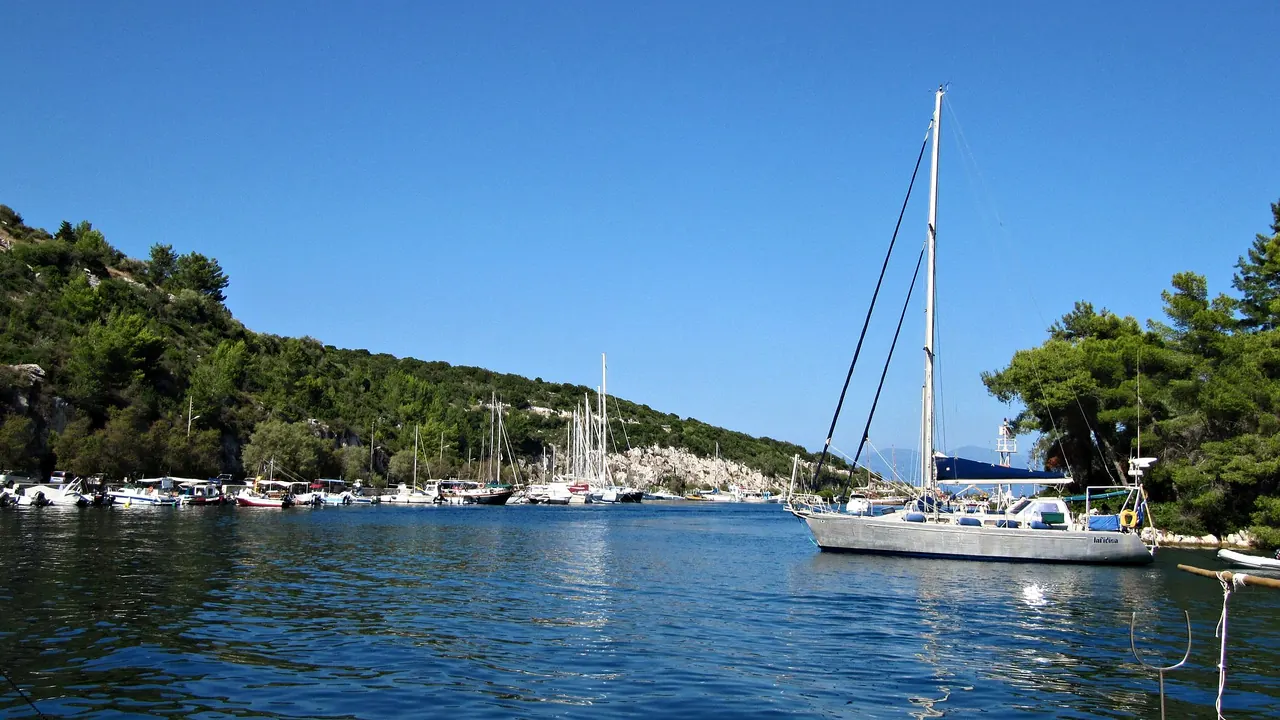
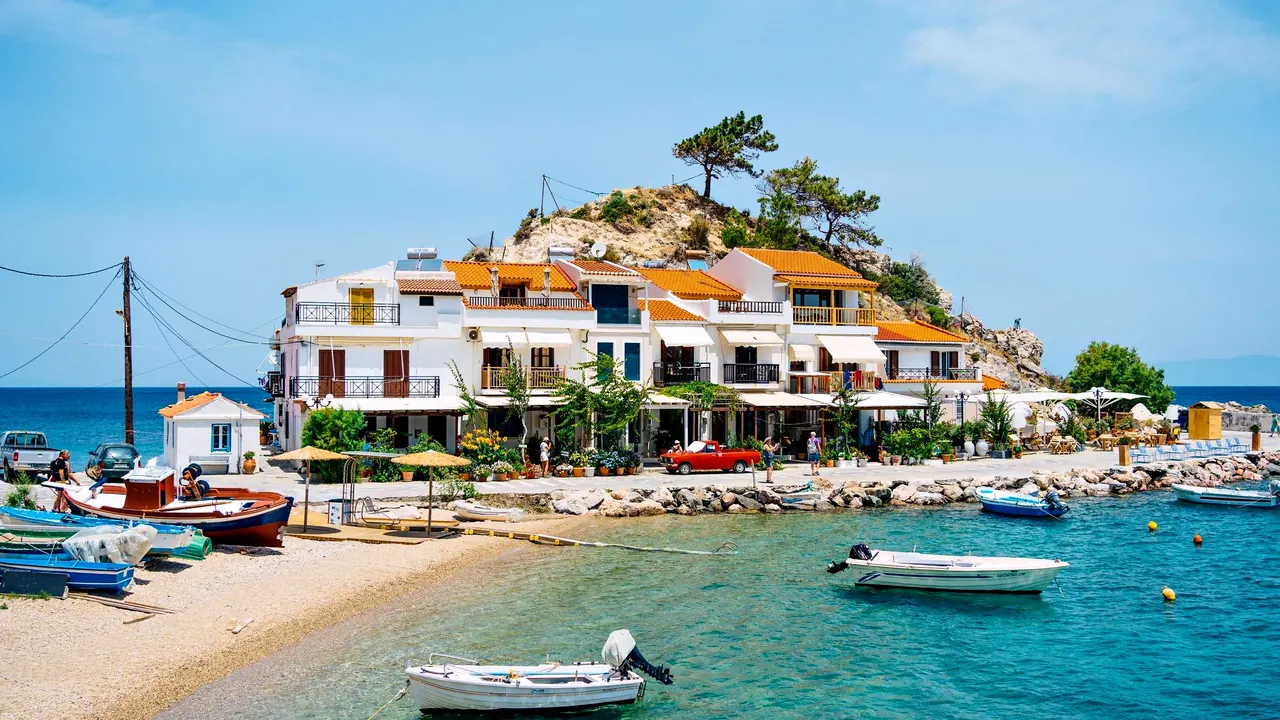
Photos: Paxos by Poiesia, CC BY-SA 4.0, cropped; Samos by Thomas Ronveaux, Pexels License.
Paxos or Samos?
Our verdict in twelve categories, each scored against the same fixed benchmark cities, and the climate month by month, so you can choose for your trip.
Choose Paxos for
- wellness
- getting around
- beaches
Paxos suits travellers who want a small, slow island where the sea is the whole programme. You stay in a villa among the olive groves, hire a little boat and spend the days moving between the coves of the east coast and the pale sand of Antipaxos, then eat on the harbour at Gaios or Lakka. It is quieter, more polished and dearer, and it asks you to accept that there is little to see or do once you are out of the water.
Choose Samos for
- culture and sights
- prices
- day trips
Samos gives a fuller and cheaper trip for anyone who wants more than swimming. Beyond its beaches there are the Heraion and the Tunnel of Eupalinos at Pythagoreio, mountain walking on Kerkis and the Ampelos ridge, hill villages with Muscat wine, and a boat across to Ephesus. It is the better choice for a longer stay, for curious travellers and for budgets that need to stretch.
Scoreboard
Twelve categories on one fixed scale from 0 to 100. The shaded stretch is the gap between the two.
Your match
Pick a travel style or drag the sliders, and both match scores follow your weighting.
Wins on wellness and getting around with your weighting.
Wins on culture and sights and prices with your weighting.
What matters to you?
Category by category
What the scores mean for a trip.
Beaches & swimming
The swimming is equally good on both, but it works in different ways. On Paxos the beaches are small pebble coves along the sheltered east coast, with calm sandy shallows at Lakka. The best sand is on Antipaxos, at Voutoumi and Vrika, reached by boat, so a hired motorboat becomes part of the beach day.
Samos has far more coastline within reach of a road, mostly fine pebble or sand and shingle backed by pines. The north coast at Kokkari and Lemonakia has the most striking water but catches the meltemi, while the south around Psili Ammos stays calmer. The Seitani bays reward those willing to walk.
Food & drink
Samos eats better and more variedly. Its hill villages serve slow-cooked goat, stuffed vegetables and wild greens, and its sweet Muscat wine from the terraces around Vourliotes and Manolates gives meals a local character Paxos cannot match.
Paxos cooks carefully for its villa guests, with grilled fish, bourdeto and sofrito dressed in island olive oil, but the harbourside menus in Gaios, Lakka and Loggos tend to repeat one another and many kitchens close out of season.
Culture & sights
This is where the two islands differ most. Paxos offers the ruined Venetian fort and the Panagia monastery on islets off Gaios, a small folk museum and old olive presses along the lanes, pleasant to pass but not worth planning a day around.
Samos has a UNESCO-listed ancient site at Pythagoreio, with the Heraion sanctuary and the Tunnel of Eupalinos, dug through a mountain from both ends in the 6th century BC. Add the colossal kouros in the Vathy museum, Byzantine monasteries and the stone wine villages, and there are two or three full days of sightseeing.
Nightlife
Neither is a party island, but Samos has more going on after dinner. Pythagoreio's harbour cocktail bars stay busy past midnight in high summer, Kokkari and Vathy have short strips of music bars, and village festivals bring dancing in the square. Paxos offers a drink by the moored yachts in Gaios or Lakka and goes quiet early outside July and August.
Nature & outdoors
Samos is the more rewarding island for the outdoors. It has real mountains, with pine and chestnut forest on the Ampelos ridge and the bare summit of Kerkis at about 1,430m, plus the Potami gorge, spring orchids, birdwatching by the salt lake and monk seals off the Seitani coast.
Paxos is low and gentle, covered in old olive groves crossed by mule tracks and an end-to-end trail. Its finest scenery is the white cliff coast in the west, with the Erimitis cliffs, the Tripitos arch and sea caves best explored by boat or kayak.
Day trips
Samos has the more remarkable outings. A ferry to Kusadasi puts the ruins of Ephesus within a day, passport in hand, and fast boats reach Patmos and its Monastery of St John, with Ikaria and Fourni for slower days.
From Paxos the best day out is Corfu Town, about an hour by fast ferry, with its Venetian fortresses and UNESCO-listed old town. Excursion boats also go to Parga and the coves around Sivota, but after those and Antipaxos the options run out.
Good for families
The sheltered, shallow bay at Lakka is the one place on Paxos really made for small children. Elsewhere the beaches are pebble with steep paths down, villas up in the olive groves mean driving to the sea, and there is little to fall back on when the weather turns. The island suits older children who love snorkelling and a day on a boat between coves.
Psili Ammos gives Samos the better base for young families, with warm, shallow, sandy water, and flat, compact Pythagoreio is easy for an evening stroll with a pushchair. Samos has no theme parks or aquariums either, and the narrow Eupalinos tunnel is no place for toddlers, so a stay works best kept to the south coast.
Getting around
Both need a hired car or scooter, but the logistics differ. Paxos has no airport, so arrival depends on a ferry that rough seas can cancel; once there, the island is only about 10km long, footpaths link the villages and a small boat is often the most useful way of getting about.
Samos has its own airport by Pythagoreio and a good coastal road, but it is a much larger island, with narrow, winding climbs to the hill villages and the far west. Ferries use three different ports, which needs checking.
Shopping & style
Neither island is a place to shop, and on both the best things to take home come from the land. On Paxos that means olive oil from the groves that cover its hillsides, with local honey and preserves. In the lanes behind the harbours at Gaios and Lakka, summer boutiques sell linen, jewellery, beachwear and ceramics, but for anything practical beyond groceries you have to take the boat to Corfu.
Samos sends visitors home with sweet Muscat from the wine villages, thyme honey and herbs. Its crafts are just as modest: some ceramics and jewellery in the backstreets of Vathy, and beachwear and souvenirs along the resort strips. What it adds is a handful of everyday shops in Vathy, so you can buy the basics without leaving the island.
Affordability
Samos is clearly the cheaper island. Family-run studios in Kokkari, Pythagoreio and the south coast villages and moderate taverna meals keep costs down, with August the main exception and car hire and the Turkey ferry the main extras.
Paxos is among the dearer Greek islands, with villas that fill early, harbourside restaurants priced for their clientele, and ferry crossings and boat hire on top. Self-catering and the shoulder months of May, June and September help.
Live music & performing arts
Both are thin on performance, and both come alive at the summer saints' day festivals with Greek music and dancing late into the night. Paxos has a small chamber music festival at the end of summer, held in churches and village squares. Samos instead has open-air concerts and plays in settings such as the castle at Pythagoreio and the Heraion area.
Wellness & relaxation
Calm is what both islands offer, not treatments, and neither has baths or a spa tradition. On Paxos the day starts slowly, with harbours that come to life late in the morning. In May, June and September the excursion boats from Corfu thin out and the island is at its stillest. Some estates hold yoga and retreat weeks, and a few villas and hotels have massage rooms.
Samos finds its quiet in the shaded squares of the hill villages, in long lunches and in the south coast around Marathokampos, with June and September its calmest months. Its spa treatments are found only in a handful of resort hotels near Pythagoreio and Kokkari. The island is bigger and has more going on, so you have to choose your corner to get the same feeling of retreat.
When should you go?
Pick your month. The climate figures are measured averages, not a forecast.
Paxos in July
Samos in July
Daytime high, °C
Rainfall in the month, mm
Where the figures come from
Paxos's temperatures are measured 52 km from the centre, at Kerkyra Airport.
Paxos has no rain gauge within 25 km of the centre, so its rainfall comes from a gridded climate dataset read at the destination rather than from a gauge further away.
Samos's sunshine is measured 82 km from the centre, at Aydin.
Temperature and rainfall are climate normals, averaged over the years shown. Paxos: 1991-2020 normals, Kerkyra Airport (52.1 km from centre). Samos: 1991-2020 normals, Samos Airport (2.4 km from centre).
Both islands follow the same summer: swimming from June to October, and July and August hot enough, at around 32°C, that walking is best kept to mornings and evenings. Paxos has the warmer sea at its peak, about 26°C in August against 24°C off Samos. The real difference comes at the end of summer. On Paxos the rain returns in September, with 91mm, and October and November are properly wet. Samos stays almost dry until October, with only 12mm in September, so its swimming and walking season runs on more reliably into autumn.
In spring both islands are green and pleasant for walking from April, with the sea still cool until June. Winter is mild but wet and grey on both, and neither is a winter destination.
Which traveller are you?
On a culture and arts trip, Samos is the clear choice. The Heraion, the Tunnel of Eupalinos and the giant kouros in the Vathy museum give it real ancient history, while Paxos has little beyond a harbour fort and sends history lovers to Corfu.
For a trip on a tight budget, Samos stretches money much further. Family-run studios and inland tavernas stay moderate, whereas Paxos relies on villas, harbourside restaurants, boat hire and ferry crossings that all add up quickly.
On a relaxing and wellness trip, Paxos has the edge in atmosphere. It is tiny, with few cars, no high-rise building and villas set among olive trees above the sea, so the pace slows down even further than in the quiet hill villages of Samos.
Before you go
| Measure | Paxos | Samos |
|---|---|---|
| Official language | Greek | Greek |
| Currency | Euro (EUR) | Euro (EUR) |
| Sockets | CF230 V, 50 Hz | CF230 V, 50 Hz |
| Driving side | Right | Right |
| Time zone | UTC+2, UTC+3 in summer | UTC+2, UTC+3 in summer |
| Emergency number | 112 | 112 |
| Main airport | Corfu Ioannis Kapodistrias International Airport (CFU)88 non-stop destinations | Samos Airport (SMI)20 non-stop destinations |
| Public holidays this year | 15 days | 15 days |
By the numbers
| Measure | Paxos | Samos |
|---|---|---|
| Population | 2,300 | 32,642 |
| People per km² | 91 | 69 |
| Swim season, months above 21 °C | 5 months | 5 months |
Where else could you go?
Every comparison below shares a destination with this one, so you can follow Paxos or Samos somewhere new.