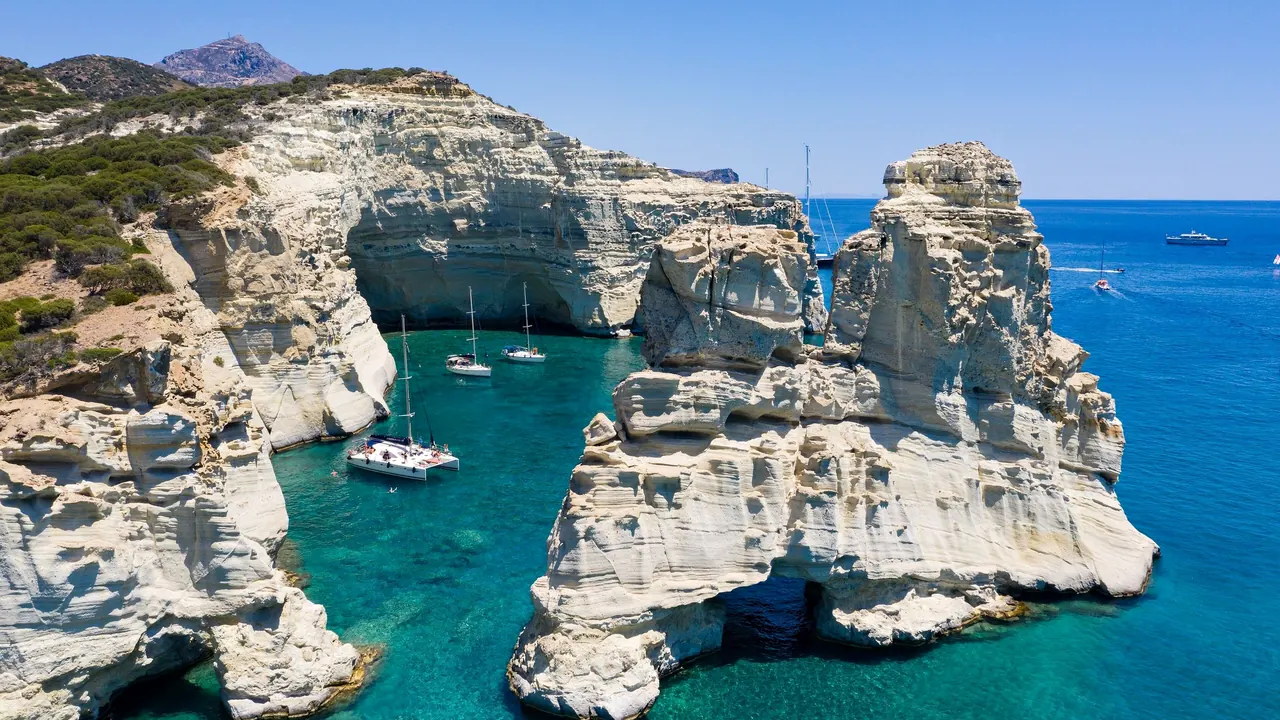
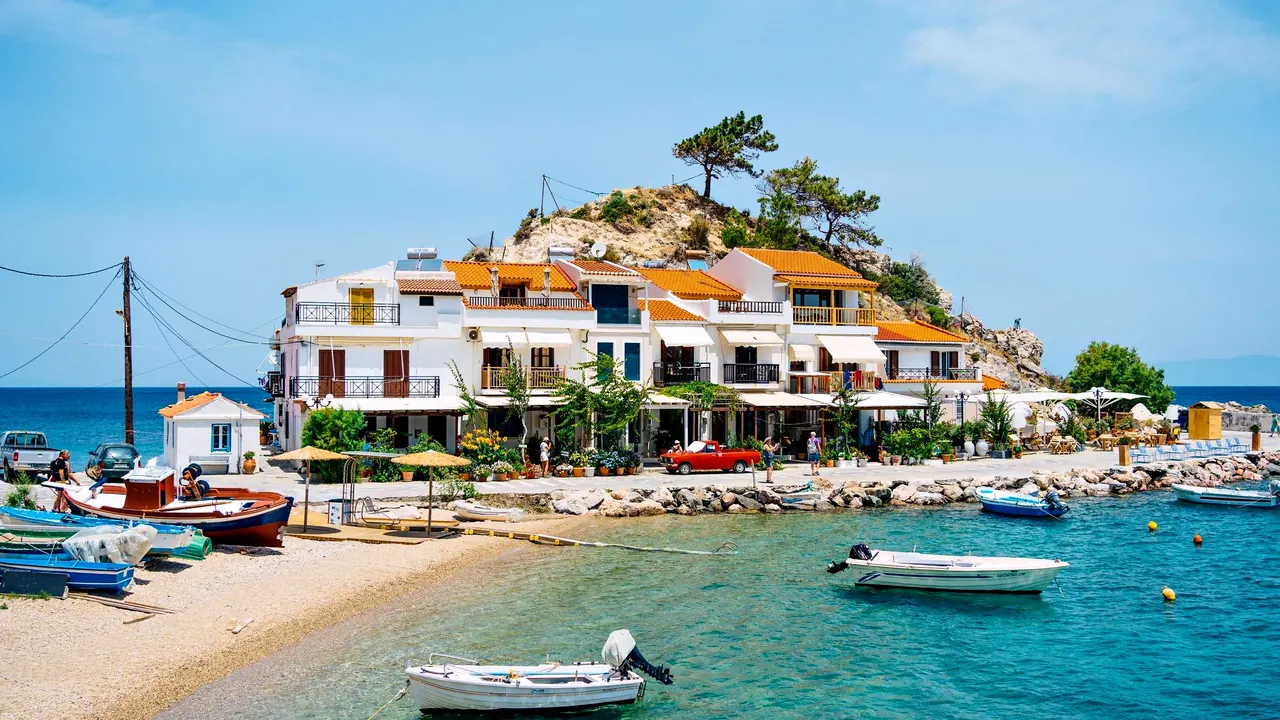
Photos: Milos by dronepicr, CC BY 2.0, cropped; Samos by Thomas Ronveaux, Pexels License.
Milos or Samos?
Our verdict in twelve categories, each scored against the same fixed benchmark cities, and the climate month by month, so you can choose for your trip.
Choose Milos for
- beaches
- wellness
- shopping
Milos is for the traveller who puts the swimming first. Its volcanic coast gives white pumice inlets, red and ochre cliffs and long south-coast sands, some reached only by boat, and the water is very clear. Days revolve around choosing a beach by the wind, a boat trip to Kleftiko and sunset from Plaka. You pay well for the rooms in summer, and the island has less to see and fewer trips beyond its shores.
Choose Samos for
- prices
- day trips
- culture and sights
Samos rewards a broader, more varied island stay and a gentler budget. The Heraion and the Tunnel of Eupalinos give it real ancient sights, the forested Ampelos ridge and Mount Kerkis make it greener and higher for walking, and a ferry to Ephesus in Turkey or a boat to Patmos adds days out that Milos cannot match. Its beaches are mostly pebble and shingle, good rather than spectacular, and the summer heat is fiercer.
Scoreboard
Twelve categories on one fixed scale from 0 to 100. The shaded stretch is the gap between the two.
Your match
Pick a travel style or drag the sliders, and both match scores follow your weighting.
Wins on beaches and wellness with your weighting.
Wins on prices and day trips with your weighting.
What matters to you?
Category by category
What the scores mean for a trip.
Beaches & swimming
Milos has the edge, and it comes from geology. The volcanic shore gives Sarakiniko's white pumice inlets for rock-jumping, and a run of long sandy beaches along the south coast at Firiplaka, Tsigrado and Paliochori, some reachable only by boat. Many have no sunbeds or shade at all.
Samos is mostly fine pebble and sand-and-shingle, backed by pines and olives, with sandy, shallow water at Psili Ammos and the walk-in Seitani bays in the northwest. On both islands the meltemi makes the north rough in summer and the south the calm side, so you choose your beach by the wind either way.
Food & drink
The two eat much alike: Greek tavernas, grilled octopus and fish on the harbour, little fine dining and narrow range. The difference is in the local specialities. Milos has its pitarakia cheese pies, ladenia flatbread and a few more ambitious sunset kitchens in Plaka and Tripiti. Samos has slow-cooked goat in the mountain villages and its sweet Muscat wine from the terraces around Vourliotes and Manolates.
Culture & sights
Samos is the better island for sightseeing. The Heraion sanctuary and the Tunnel of Eupalinos, an aqueduct dug through a mountain from both ends, make up a UNESCO site around Pythagoreio, and the museum in Vathy holds a kouros around 5m tall.
Milos has more than most small islands, with catacombs below Plaka, the field where the Venus de Milo was found and the Bronze Age site at Phylakopi. But nothing there matches the scale of the Samos sites, and its colourful syrmata boathouses at Klima are as memorable as any ruin.
Nightlife
Neither island is for clubbing, and evenings on both mean a long dinner and a drink by the water. Milos centres its evenings on sunset from Plaka's castle hill and a few late bars in Adamas. Samos has a little more going on at the cocktail bars on Pythagoreio's harbour and the short strips of music bars in Kokkari and Vathy.
Nature & outdoors
The outdoors is equally good on both but looks very different. Milos is about its coast: the rock towers and caves of Kleftiko, the coloured cliffs at Papafragas, best seen by sailing or kayaking, while the dry, quarry-scarred interior offers only modest walks.
Samos is green and mountainous inland, with pine and chestnut on the Ampelos ridge, a long day's climb up Mount Kerkis, mule paths between villages and the Potami gorge with its waterfalls. Walkers will prefer Samos, and those who would rather explore from the water will prefer Milos.
Day trips
Samos has far more to offer beyond its shores. Ephesus in Turkey, reached by ferry to Kusadasi and a short drive, is a major ancient site within a day, and Patmos with its Monastery of St John is a couple of hours away by fast boat. Bring a passport for the Turkish crossing.
From Milos the choice is smaller: the short hop to quiet Kimolos from Pollonia, or Sifnos by fast ferry in summer. On both islands everything depends on the boats and the wind.
Good for families
Families will find the two much alike: welcoming tavernas, safe villages and nothing built for children. Milos is the harder island to get around with small ones, with many beaches down dirt tracks or steep paths and a long ferry to get there. Samos makes it a little easier, with flat, compact Pythagoreio as a base, shallow Psili Ammos nearby and an airport just outside town.
Getting around
On both islands a hired car or scooter is close to essential, as buses run only between the main places. On Milos the difficulty is the rough dirt roads of the western half, which some rental agreements exclude, and the boat-only beaches. On Samos the roads are paved but narrow and winding into the hills and towards Kerkis, and ferries use three different ports.
Shopping & style
Neither is a place to shop. Plaka's whitewashed lanes on Milos have a few more boutiques with linen, jewellery and ceramics. Samos is more about bottles of Muscat wine, thyme honey and olive oil from Vathy and the wine villages.
Affordability
Milos is the dearer island, and most of the gap is in where you sleep. Rooms in July and August are costly and need booking early, and on top of that come the car or quad almost everyone hires and the boat trip to Kleftiko that most visitors take. Eating out is the gentler part, though a table on a Plaka sunset terrace costs more for the view. Going in June or September brings the bill down noticeably while the sea is still warm.
Samos asks less across the board, and the savings on a room leave more for getting out and about. A hired car is just as necessary here, and the ferry to Kusadasi for Ephesus is the costliest single outing. Entry to the Heraion and the Eupalinos tunnel costs little. August is the month to watch, when Greek visitors fill the island and prices climb.
Live music & performing arts
Performance is thin on both, and the best live music on each comes from the summer saints'-day feasts in the villages, with dancing late into the night. Samos adds a short open-air season of concerts and plays at the castle in Pythagoreio and near the Heraion. On Milos there is only the occasional concert at the ancient theatre.
Wellness & relaxation
The two are about equally restful, but Milos has something Samos lacks: volcanic heat. You can soak in rustic hot springs at Lakkos in Adamas and near Provatas, and the sand at Paliochori is warm underfoot. Samos has no thermal waters, and its calm comes from the shaded squares of the hill villages and the quiet south coast around Marathokampos.
When should you go?
Pick your month. The climate figures are measured averages, not a forecast.
Milos in July
Samos in July
Daytime high, °C
Rainfall in the month, mm
Where the figures come from
Milos has no weather station within reach, so its figures come from a gridded climate model rather than a measured record, and read a broad area rather than one spot.
Samos's sunshine is measured 82 km from the centre, at Aydin.
Temperature and rainfall are climate normals, averaged over the years shown. Milos: 2001-2020 normals, NASA POWER reanalysis grid, no weather station within 90 km. Samos: 1991-2020 normals, Samos Airport (2.4 km from centre).
Both islands have their swimming season from June to October, with seas at their warmest in August, around 25°C on Milos and a degree cooler on Samos. The big difference is the heat on land. Milos stays fairly moderate in midsummer, with highs in the mid twenties, so walking Plaka's lanes in July is bearable. Samos is far hotter, reaching 33°C in July and August with almost no rain and very long sunny days, which makes the hill paths and ruins hard going at midday.
Spring warms sooner on Samos, already pleasant for walking in April and May, while Milos is still cool then. Both turn wet from November, and Samos gets the heavier winter rain, close to 150mm in December. For a mix of swimming and sightseeing, June and September suit both, and Samos is at its most comfortable in those shoulder months rather than at the height of summer.
Which traveller are you?
On a beach and sun trip, Milos is the stronger pick. Its coves come in white pumice, red rock and long south-coast sand over very clear water, with boat-only beaches beneath the cliffs. The pebble bays of Samos are pleasant but less striking.
For a culture and arts trip, Samos wins clearly. The Heraion, the Tunnel of Eupalinos and the giant kouros in the Vathy museum outclass what Milos offers in its catacombs and Roman theatre, and Ephesus lies within a day's reach by ferry.
On a trip on a tight budget, Samos goes much further. Family-run studios in Kokkari and on the south coast cost well below summer rooms in Pollonia or Plaka, and taverna meals with local wine stay moderate, especially in the hill villages.
Before you go
| Measure | Milos | Samos |
|---|---|---|
| Official language | Greek | Greek |
| Currency | Euro (EUR) | Euro (EUR) |
| Sockets | CF230 V, 50 Hz | CF230 V, 50 Hz |
| Driving side | Right | Right |
| Time zone | UTC+2, UTC+3 in summer | UTC+2, UTC+3 in summer |
| Emergency number | 112 | 112 |
| Main airport | Milos Airport (MLO)2 non-stop destinations | Samos Airport (SMI)20 non-stop destinations |
| Public holidays this year | 15 days | 15 days |
By the numbers
| Measure | Milos | Samos |
|---|---|---|
| Population | - | 32,642 |
| People per km² | - | 69 |
| Swim season, months above 21 °C | 5 months | 5 months |
Where else could you go?
Every comparison below shares a destination with this one, so you can follow Milos or Samos somewhere new.