Greece
Milos
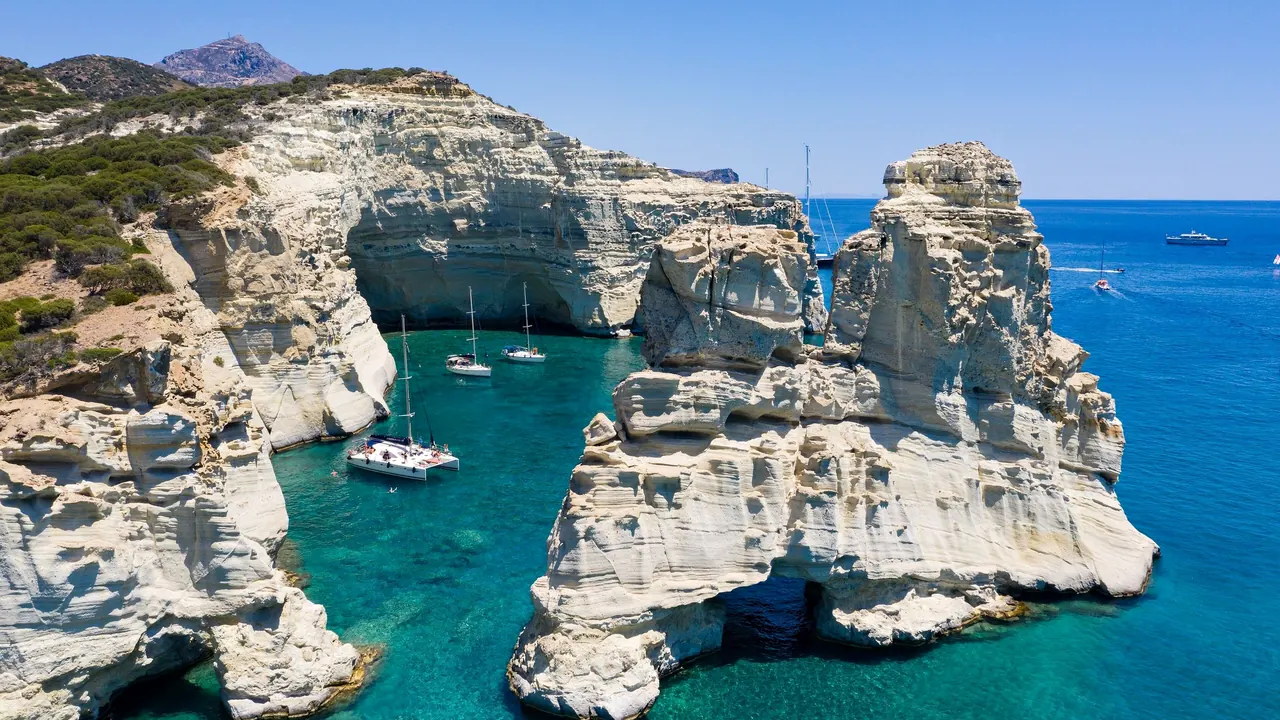
Sailing yachts by the sea caves of Kleftiko
- Beaches85
- Nature & outdoors58
- Food & drink48
Match
41
Every category weighted equally
- Beach & sun47
- Culture & arts35
- Food & nightlife36
- Family trip46
- Outdoors46
- Relax & unwind46
- Shopping & style36
- On a budget40
Milos in twelve categories
Our verdict on each, scored 0 to 100 against the same fixed benchmark cities, so a score means the same thing on every page.
Beaches & swimming. Scores 85 out of 100.
Food & drink. Scores 48 out of 100.
Culture & sights. Scores 40 out of 100.
Nightlife. Scores 25 out of 100.
Nature & outdoors. Scores 58 out of 100.
Day trips. Scores 38 out of 100.
Good for families. Scores 46 out of 100.
Getting around. Scores 40 out of 100.
Shopping & style. Scores 20 out of 100.
Affordability. Scores 33 out of 100.
Live music & performing arts. Scores 10 out of 100.
Wellness & relaxation. Scores 45 out of 100.
Milos category by category
Beaches & swimming
85Beaches are the reason most people come to Milos, and the island repays them generously. The coastline is volcanic, so the sand and rock come in white, ochre, red and grey, and the water over them is very clear. Sarakiniko's white pumice inlets are the famous image, best for swimming and rock-jumping early in the day. On the south coast, Firiplaka, Tsigrado, Paliochori, Provatas and Agia Kyriaki are long sandy beaches with clear water, and some cannot be reached by road, only by boat.
The north wind decides where to swim. When it blows in high summer, the south coast stays calm and the north turns rough, and on still days the north-shore coves around Pollonia and Mandrakia are at their best. The sea is swimmable from June to October and reaches about 24°C in August. Many beaches have no sunbeds or shade at all, which suits people who want them unspoilt and less so those who want facilities.
Food & drink
48Food on Milos means Cycladic island cooking in tavernas, and it is good without being a reason to come. In Pollonia and Adamas the fish tavernas sit on the waterfront. Klima and the other fishing villages serve grilled octopus and the morning's catch. The island has its own dishes too: small cheese pies called pitarakia, ladenia flatbread with tomato and onion, a watermelon pie, and local soft cheeses. Plaka and Tripiti have a few more ambitious kitchens with sunset terraces. Range is narrow, and international food and fine dining hardly exist. In the busiest weeks the waterfront places cater to the crowds, and the inland villages often cook more honestly.
Culture & sights
40Milos has more heritage than most small islands, though none of it is a headline site. Below Plaka are the early Christian catacombs, among the largest in Greece. Nearby are the field where the Venus de Milo was found in 1820 and a marble Roman theatre looking over the bay. Plaka itself is a white Cycladic hill village topped by the ruins of a Venetian castle, with a small archaeological museum and a folk museum. Klima, Mandrakia and Fourkovouni have the colourful syrmata, boathouses cut into the shore with rooms above. There are also the Bronze Age site at Phylakopi and a mining museum in Adamas that tells the island's long story of obsidian, sulphur and minerals. Two days covers it.
Nightlife
25Milos is a quiet island after dark, and that is how most of its visitors like it. Evenings start with the sunset from Plaka's castle hill or a bar terrace in Tripiti. Then comes a long taverna dinner and a drink on the harbour in Adamas or the waterfront at Pollonia. Adamas has a few bars that stay open late in July and August, but there is no real club scene. Anyone wanting to dance until dawn will find the island sleeps well before that.
Nature & outdoors
58Milos is shaped by its volcano. The coast has white pumice ravines at Sarakiniko, cliffs streaked red and yellow at Firopotamos and Papafragas, sea arches, and the rock towers and caves of Kleftiko on the south-west tip. The best way to see it is a sailing trip or a kayak tour around the island, and the island has a small sailing and snorkelling scene. Inland the landscape is dry, low and scarred by old quarries. The waymarked trails to the abandoned sulphur mines at Paliorema and up Profitis Ilias, the highest point, are pleasant rather than dramatic. Spring and autumn are the times for walking, as midsummer is hot and treeless.
Day trips
38The best day out is Kimolos, a short ferry crossing from Pollonia. It is a small, unhurried island with a fortified village and a few tavernas, and it shows what the Cyclades are like with few visitors. In summer the fast ferries also make Sifnos possible as a day trip, about an hour away, with hill villages and a strong pottery and cooking tradition. Folegandros and Serifos are further and fit better into a multi-island trip. Everything depends on ferry times and the wind, so day trips have to be planned around the boats.
Good for families
46Milos suits families who want simple beach days. Children are welcome in every taverna, the villages are safe, and the sandy south-coast beaches such as Provatas, Paliochori and Achivadolimni shelve gently into calm water. Pollonia, with a sheltered beach right in the village, is the easiest base with small children. There are no attractions made for children at all. Many of the best beaches are reached by dirt tracks, steep paths or boat. Shade is scarce in July and August, and a car is needed to get almost anywhere. The ferry from the mainland is long, and rough seas can make it hard going for children.
Getting around
40Milos is small, and nowhere is more than about forty minutes' drive from Adamas, so with a hired car or quad it is easy to manage. Summer buses link Adamas with Plaka, Pollonia and some of the main beaches, but they do not reach most of the coast, so visitors without wheels miss a lot. The western half of the island is reached on rough dirt roads that some rental agreements exclude. Kleftiko and several beaches are easiest by boat. Getting there is the hard part: a ferry of several hours from Piraeus, a shorter trip on the fast boats, or a short flight from Athens to the small airport.
Shopping & style
20Shopping here is a browse, not a reason to come. Plaka's whitewashed lanes have a few small boutiques with linen clothing, jewellery, ceramics and island-made goods, and they are pleasant to walk through on the way to the sunset. Adamas has souvenir shops, beachwear and the practical stores near the port. Local food products such as capers, honey and sweets make the most characteristic things to bring home.
Affordability
33Milos is an expensive island in summer, mostly because of the rooms. In July and August accommodation in Pollonia, Plaka and Adamas is costly and books out early, and car hire and boat trips to Kleftiko add up as well. Eating is the gentler part: an ordinary taverna meal is fairly priced, while the sunset terraces in Plaka charge for the view. June and September cost noticeably less and the sea is still warm. Simple rooms in the inland villages or away from the waterfront are the way to save.
Live music & performing arts
10There is almost no formal performance life on Milos. The real live music is at the summer panigyria. These are saints'-day feasts in the villages and chapels, where locals and visitors eat, drink and dance to violin and lute late into the night. The ancient theatre and Adamas sometimes host a summer concert, but no one should plan a visit around the stage.
Wellness & relaxation
45Milos is restful rather than a spa destination. The volcano still warms the ground, and hot springs rise in several places. The old public baths at Lakkos in Adamas and the springs near Provatas are simple, rustic places to soak. At Paliochori the sand and seabed are warm to the touch where steam escapes. A few hotels around Pollonia and Plaka have spas and treatment rooms. What really restores people here is the pace: slow mornings, siestas and long dinners. In June and September even the busier villages are calm, while August brings more people and traffic to the main beaches.
Where to stay in Milos
Milos is small enough that one base covers the whole island, since nowhere is more than about forty minutes' drive from Adamas. Pick a base for the evenings you want, and plan on a hired car either way. Adamas, the port, is the practical choice. It has the ferries, the summer buses to Plaka, Pollonia and the main beaches, the boat trips to Kleftiko, and the only bars that stay open late. It also suits anyone arriving without a car.
Pollonia, on the north-east coast, is the easiest base with small children. There is a sheltered beach in the village, fish tavernas along the water and the short ferry to Kimolos. When the north wind drops, the coves nearby are lovely. When it blows, the calm south-coast beaches are a short drive away. Plaka and Tripiti, the white villages on the hill above the bay, suit couples and anyone interested in the island's past. The catacombs, the castle and the museums are all within walking distance, and the evening starts with the sunset.
For a quiet stay, the fishing villages such as Klima have boathouses with rooms above the water. Rooms in Pollonia, Plaka and Adamas are expensive in July and August. Simple rooms in the inland villages or set back from the waterfront are the way to spend less.
When should you go?
Pick a month to see what it is like. The climate figures are measured averages, not a forecast.
Milos in July
Daytime high, °C
Rainfall in the month, mm
The whole year
Shaded against this city’s own year: the deepest cell is its best month for that figure and the palest its weakest.
Where the figures come from
Milos has no weather station within reach, so its figures come from a gridded climate model rather than a measured record, and read a broad area rather than one spot.
Temperature and rainfall are climate normals, averaged over the years shown. Milos: 2001-2020 normals, NASA POWER reanalysis grid, no weather station within 90 km.
Before you go
| Measure | Milos |
|---|---|
| Official language | Greek |
| Currency | Euro (EUR) |
| Sockets | CF230 V, 50 Hz |
| Driving side | Right |
| Time zone | UTC+2, UTC+3 in summer |
| Emergency number | 112 |
| Main airport | Milos Airport (MLO)2 non-stop destinations |
| Public holidays this year | 15 days |
By the numbers
| Measure | Milos |
|---|---|
| Swim season, months above 21 °C | 5 months |
Compare Milos with
Every comparison with a written verdict behind it.