Kefalonia or Milos?
Our verdict in twelve categories, each scored against the same fixed benchmark cities, and the climate month by month, so you can choose for your trip.
Choose Kefalonia for
- prices
- nature and the outdoors
- food and drink
Kefalonia suits travellers who want a large, green island to explore by car over a week or more. Mount Ainos and its fir forest, the Melissani cave and the cliff roads above Myrtos give it real landscape beyond the beach. Ithaca is an easy crossing, and the southern resorts make it the easier and better-value choice for families.
Choose Milos for
- culture and sights
- nightlife
- getting around
Milos is for those who come mainly for the sea and want an island small enough to know well in a few days. Its volcanic coast of white pumice, red cliffs and boat-only coves is unlike anywhere in the Ionian. It also has more history packed into a small space, from the catacombs to Plaka's castle hill. Expect to pay more for rooms, and to plan around the ferries and the wind.
Scoreboard
Twelve categories on one fixed scale from 0 to 100. The shaded stretch is the gap between the two.
Your match
Pick a travel style or drag the sliders, and both match scores follow your weighting.
Too close to call, 2 points apart
Wins on prices and nature and the outdoors with your weighting.
Wins on culture and sights and nightlife with your weighting.
What matters to you?
Category by category
What the scores mean for a trip.
Beaches & swimming
Both islands are first-rate for beaches, but the coastlines feel very different. Kefalonia's best known beaches are pebble and fine shingle under green hills and limestone cliffs, such as Myrtos, Petani and Antisamos. The sand is in the south at Skala and Lourdas, and at Xi on Paliki. They are spread across a large island, so you choose a coast and drive.
Milos has a volcanic shore of white pumice at Sarakiniko and coloured sand and rock along the south coast. Several coves can only be reached by boat, and many beaches have no sunbeds at all. The north wind decides each day whether you swim on the north or the south side, which matters less on Kefalonia.
Food & drink
Kefalonia eats a little better and with more variety. It has its own meat pie, aliada with salt cod and mandoles almonds, and there is a working wine country in the Omala valley, where you can taste Robola at the wineries. Argostoli adds a fish market and the widest choice of places to eat.
Milos keeps to Cycladic taverna cooking: pitarakia, ladenia and grilled octopus in the fishing villages, with a few more ambitious terraces in Plaka and Tripiti. There is nothing there to match a day among Kefalonia's vineyards.
Culture & sights
Milos has the deeper heritage for its size. Near Plaka you can see the catacombs, the Roman theatre and the field where the Venus de Milo was found. Add the Venetian castle, the Bronze Age site at Phylakopi and the syrmata boathouses of Klima, and you have two full days of sightseeing.
Kefalonia lost most of its old buildings in the 1953 earthquake. Venetian Fiskardo, the fortress at Assos, the tholos tomb at Tzanata and the monastery of Agios Gerasimos make good stops on a drive, but they are scattered rather than a reason to go.
Nightlife
Neither island is for clubbing, and both wind down with dinner and a drink by the water. Kefalonia has more of a town evening: Argostoli's square and the Lithostroto fill up in summer, and Lassi has a strip of beach bars. On Milos the evening is built around the sunset from Plaka or Tripiti, followed by a few late bars in Adamas.
Nature & outdoors
Kefalonia is the wilder and greener island. It has a national park on Mount Ainos at over 1,600m, with fir forest, semi-wild horses and walking trails. Below ground are the Melissani and Drogarati caves, and loggerhead turtles feed in Argostoli harbour.
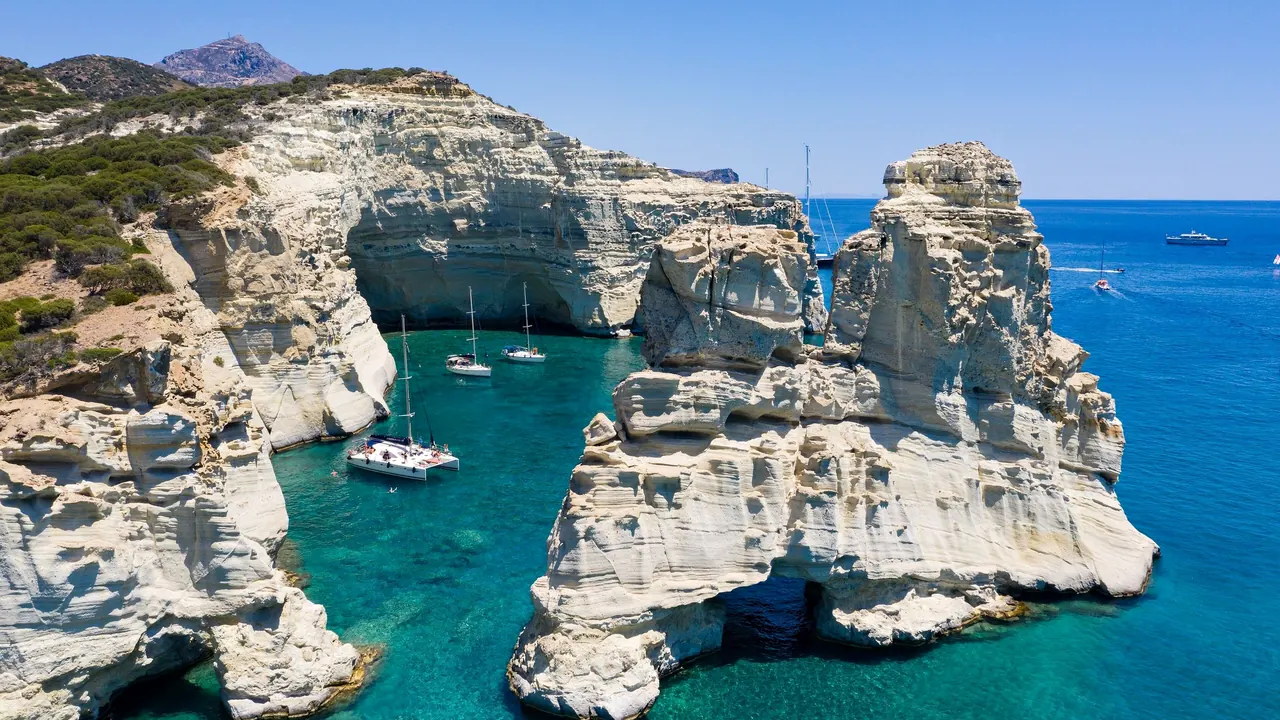
The nature on Milos lies almost all along the coast: the coloured cliffs of Papafragas and Firopotamos and the rock towers and caves of Kleftiko, best seen from a boat or kayak. Inland it is dry, treeless and marked by old quarries, so walks there are pleasant rather than memorable.
Day trips
Kefalonia has more and easier options. Ithaca is a short, reliable crossing from Sami, with Vathy, Kioni and the sites linked to Odysseus. In summer, boats also go to Zakynthos and Lefkada, and Fiskardo and Paliki make good outings within the island itself.
From Milos, quiet Kimolos is close and Sifnos is possible on a fast ferry. Everything depends on the timetable and the wind, though, so these trips need more planning.
Good for families
Kefalonia is the easier choice with children. The sandy, gently shelving beaches at Skala, Lourdas and Xi can be reached by ordinary roads, and the boat ride through Melissani and spotting turtles in the harbour give children something to do besides swim.
Milos has calm sandy beaches too, and Pollonia's village beach is very easy with small children. But many of the island's best spots are down dirt tracks or only reachable by boat, there is little shade, and the long ferry from the mainland can be rough.
Getting around
You need a car on both islands, but for different reasons. Kefalonia is big and mountainous, so a drive from Argostoli to Fiskardo takes about an hour and a half on winding roads. Milos is compact, with nowhere much more than forty minutes from Adamas, but its western half is reached on rough dirt roads that some rental agreements exclude. Getting to Milos is the harder part, by long ferry or a short flight from Athens.
Shopping & style
Neither island is a shopping destination. Kefalonia has Argostoli's Lithostroto and the boutiques of Fiskardo, while Milos has the linen and ceramics shops in Plaka's lanes. The best things to bring home are edible on both: Robola and mandoles from Kefalonia, capers and sweets from Milos.
Affordability
Kefalonia is clearly cheaper for most stays. The southern resorts and villages offer fairly priced apartments, and only Fiskardo and Assos charge yachting-crowd rates.
On Milos, rooms in Pollonia, Plaka and Adamas are expensive in high summer and fill early, and boat trips to Kleftiko add to the bill. On both islands, June and September are noticeably cheaper while the sea is still warm.
Live music & performing arts
Kefalonia's music is mostly something you listen to: the Venetian-influenced kantades sung in harmony with guitar and mandolin, and Argostoli's philharmonic band at summer open-air concerts in the squares. On Milos the music is for dancing, at the village panigyria, where saints'-day feasts run late into the night to violin and lute. Neither island has a regular theatre or concert season to plan around.
Wellness & relaxation
The two islands are about level for unwinding, and neither has more than a few spas in its larger hotels. What differs is the kind of rest. Kefalonia's quiet is green and roomy: a slow lunch in a hill village, an evening on the harbour at Assos, or a few days out on the Paliki peninsula or the north-east coast, away from the main resorts.
Milos offers something Kefalonia does not: you can soak in volcanic hot springs, from the plain old bathhouse at Lakkos to the warm sand at Paliochori. Otherwise its calm is that of a small, bare island where siestas and sunsets set the pace. On both islands, June and September are the most peaceful months.
When should you go?
Pick your month. The climate figures are measured averages, not a forecast.
Kefalonia in July
Milos in July
Daytime high, °C
Rainfall in the month, mm
Where the figures come from
Kefalonia's temperatures are measured 59 km from the centre, at Zakinthos / Agrilia.
Kefalonia has no rain gauge within 25 km of the centre, so its rainfall comes from a gridded climate dataset read at the destination rather than from a gauge further away.
Milos has no weather station within reach, so its figures come from a gridded climate model rather than a measured record, and read a broad area rather than one spot.
Temperature and rainfall are climate normals, averaged over the years shown. Kefalonia: 1991-2020 normals, Zakinthos / Agrilia (58.6 km from centre). Milos: 2001-2020 normals, NASA POWER reanalysis grid, no weather station within 90 km.
Kefalonia runs hot in high summer. Daytime highs reach about 33°C in August, so beach mornings are easy but midday drives and walks are hard work, and July and August are its brightest months. The sea is warm enough to swim from June to October. The dry spell is short, though: September brings the first proper showers, October is wet at around 100mm, and November is wetter still. Walking there is best in April and May, while the mountain is green and the heat has not yet built.
Milos stays milder, with August highs nearer 27°C, which keeps its treeless walks and village lanes manageable even in summer. Its sea follows much the same swimming season, a degree or so cooler. It also stays dry for longer, with little rain through September and October still fairly mild, so both spring and autumn suit walking there.
Which traveller are you?
On an outdoors trip, Kefalonia is the stronger choice. The national park on Mount Ainos has fir forest, wild horses and summit trails, there are caves and turtles to see, and you can kayak or sail towards Ithaca. Inland Milos is dry and quarried by comparison.
For a culture and arts trip, Milos gives more in a small space. It has the early Christian catacombs, the Roman theatre and the spot where the Venus de Milo was found, plus Plaka's castle and museums, Phylakopi and the painted boathouses. On Kefalonia the 1953 earthquake left far less standing.
On a trip on a tight budget, Kefalonia is clearly kinder. Apartments around Skala, Lourdas and Lassi are fairly priced, while rooms on Milos in high summer are costly and book out early. Car hire is an extra cost on both islands, so the savings come from accommodation.
Before you go
| Measure | Kefalonia | Milos |
|---|---|---|
| Official language | Greek | Greek |
| Currency | Euro (EUR) | Euro (EUR) |
| Sockets | CF230 V, 50 Hz | CF230 V, 50 Hz |
| Driving side | Right | Right |
| Time zone | UTC+2, UTC+3 in summer | UTC+2, UTC+3 in summer |
| Emergency number | 112 | 112 |
| Main airport | Kefalonia International Airport "Anna Pollatou" (EFL)41 non-stop destinations | Milos Airport (MLO)2 non-stop destinations |
| Public holidays this year | 15 days | 15 days |
By the numbers
| Measure | Kefalonia | Milos |
|---|---|---|
| Population | 36,064 | - |
| People per km² | 49 | - |
| Swim season, months above 21 °C | 5 months | 5 months |
Where else could you go?
Every comparison below shares a destination with this one, so you can follow Kefalonia or Milos somewhere new.