Kos or Milos?
Our verdict in twelve categories, each scored against the same fixed benchmark cities, and the climate month by month, so you can choose for your trip.
Choose Kos for
- nightlife
- prices
- families
Kos is the easier and more sociable island. Long sandy beaches with shallow water, resorts built around pools, buses and cycle lanes, a real bar and club scene, and boat trips as far as Bodrum and the Nisyros volcano all make it a better choice for families, groups of friends and anyone who wants a straightforward beach vacation at moderate cost. You won't find the wild coastline here, and outside Kos Town the island can feel package-built.
Choose Milos for
- nature and the outdoors
- beaches
- food and drink
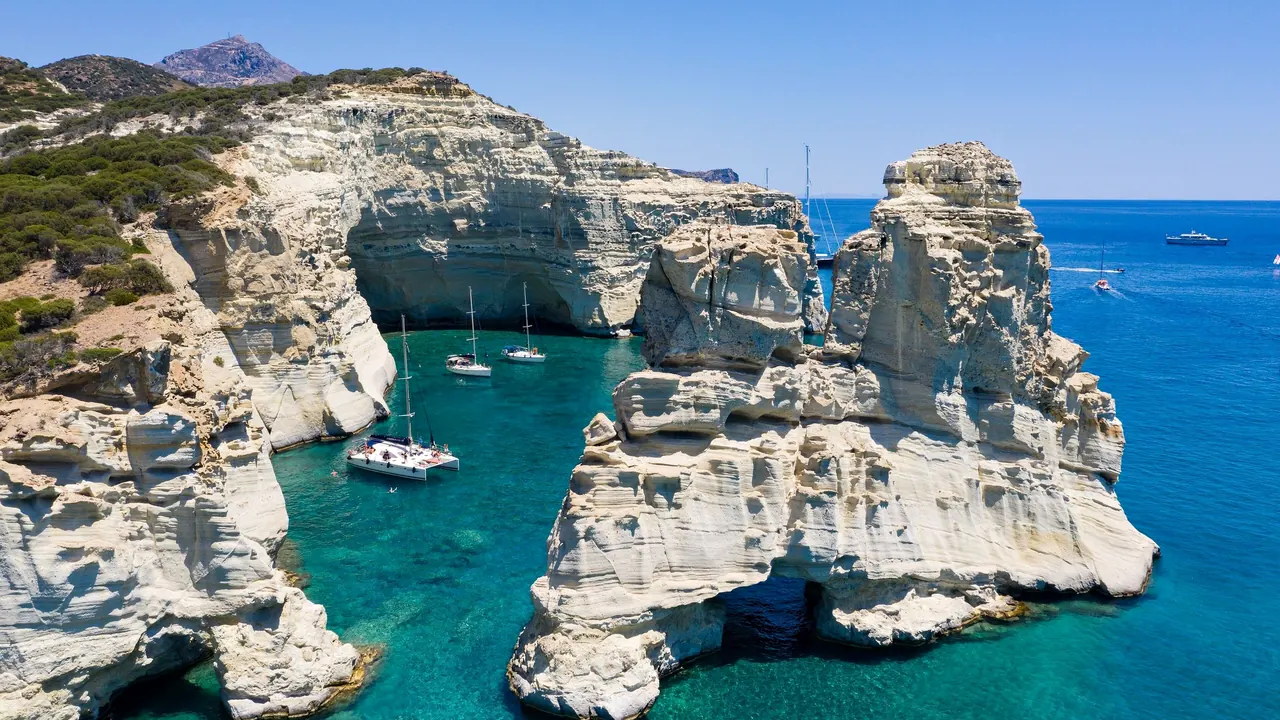
Milos is for travellers who care most about the sea and the shoreline. Its volcanic coves of white, ochre and red rock, the clear water and the sea caves of Kleftiko reached by boat make it the island for couples, swimmers, snorkellers and anyone who likes quiet evenings after a day on the water. It costs more, takes longer to reach, and without a car or a boat you will miss much of what it has.
Scoreboard
Twelve categories on one fixed scale from 0 to 100. The shaded stretch is the gap between the two.
Your match
Pick a travel style or drag the sliders, and both match scores follow your weighting.
Wins on nightlife and prices with your weighting.
Wins on nature and the outdoors and beaches with your weighting.
What matters to you?
Category by category
What the scores mean for a trip.
Beaches & swimming
The two islands are about equal for beaches, but the beaches themselves are very different. On Kos you get long, open strands of sand on the north coast from Tigaki to Mastichari, sheltered water around Kardamena and the prettier bays of the Kefalos peninsula. Many have sunbeds and facilities, and the shallow water suits paddlers.
Milos has smaller, more dramatic beaches: Sarakiniko's white pumice inlets, a coastline of coloured volcanic rock and very clear water. Some beaches can only be reached by boat, and many have no shade at all. On both islands the summer north wind decides your beach for the day. If it blows, head for the south coast.
Food & drink
Neither island is a reason to travel for food, and they are much alike: simple taverna cooking with grilled octopus and fish. Kos has chickpea pitaroudia, krasotyri cheese matured in red wine and a few wineries near Kefalos, but in the big resorts it is easy to end up eating all-inclusive food.
Milos has no mass-resort dining, but its range is also narrow. Look for pitarakia cheese pies and ladenia flatbread. Plaka and Tripiti have a handful of more ambitious kitchens with sunset views.
Culture & sights
Kos has slightly more to see, and most of it is in one town. Roman and Hellenistic ruins lie among the streets of Kos Town, the Knights' castle guards the harbour, and the terraced Asklepieion is a short ride away. You can fit a lot into a couple of days without a car.
On Milos the sights are spread out and smaller, though the island still has plenty of history. There are the early Christian catacombs, the field where the Venus de Milo was found, the Bronze Age site at Phylakopi and the painted boathouses at Klima. Each island fills about two days.
Nightlife
Kos is far ahead for going out. The lanes of the old quarter in Kos Town fill with loud bars until the small hours, and Kardamena is a full party resort with late clubs and a young crowd. Almost all of it closes outside the summer season.
Milos has no club scene. Evenings mean sunset from the castle hill at Plaka, a long dinner, then a drink by the water in Adamas or Pollonia. That is what most people come to Milos for, but anyone who wants to dance should pick Kos.
Nature & outdoors
Milos has the more remarkable landscape, and most of it is on the coast. Volcanic forces left pumice ravines, red and yellow cliffs at Papafragas and Firopotamos, and the rock towers of Kleftiko, which are best seen from a kayak or a sailing boat.
Kos is greener inland. Pine woods climb the Dikeos hills to Mount Christos, peacocks wander the Plaka forest, and flamingos gather on the Tigaki salt lake in winter and spring. The island is good for cycling and windsurfing, but its scenery is pleasant rather than dramatic.
Day trips
Kos has the better day trips because it sits close to more places. Bodrum on the Turkish coast is a short ferry ride away, so you can see another country for a day. Boats also go to the volcanic crater on Nisyros, the sponge-diving harbour of Kalymnos and quiet Pserimos.
From Milos the realistic choices are Kimolos, a short crossing from Pollonia, and Sifnos on the summer fast ferries. On both islands, day trips depend on the boat timetable, and around Milos they also depend on the wind.
Good for families
Kos is much easier with children. The north-coast beaches shelve gently, many resorts are built around pools and kids' clubs, there is a water park near Marmari, and families cycle the flat paths together. Neither island has a zoo or aquarium, and on Kos it is best to avoid Kardamena if you want quiet nights.
On Milos, Pollonia's sheltered village beach and the calm south-coast sand at Provatas work well for small children. Many other beaches are reached by steep paths, dirt tracks or boat, though, and shade is scarce in summer. The long ferry from the mainland can be hard on young travellers in rough seas.
Getting around
Kos is simpler to get to and to move around. Its airport is on the bus route, buses run the length of the main road to the resorts, and cycle lanes link Kos Town with nearby beaches. You only really need a hire car for the hill villages and the far south-west.
Milos needs a car or quad from the start. Summer buses only connect Adamas with a few villages and beaches, the western half is reached on rough dirt roads that some rental agreements exclude, and Kleftiko is easiest by boat. Getting there also takes effort: a long ferry from Piraeus, a faster boat or a short flight from Athens.
Shopping & style
Shopping is a minor part of a trip to either island. Kos has more of it, mostly in the souvenir lanes of the old quarter, which sell leather, sandals and sponges, plus the Italian-era market hall for herbs and spices.
Milos has less, but its shops are more considered. Plaka's whitewashed lanes have a few small boutiques with linen and ceramics, and capers, honey and sweets make good things to take home.
Affordability
Kos is the cheaper island by a clear margin. It is built for package travel, so there are plenty of mid-range rooms in Tigaki, Marmari and Kardamena, and buses and bike hire are inexpensive. It costs about as much as mainland Southern Europe.
On Milos the expense is mainly accommodation, which costs a lot and books out early in July and August. Car hire and boat trips add up as well. Taverna meals are fairly priced, and June or September, or a room in an inland village, brings the cost down.
Live music & performing arts
Neither island has a year-round stage, and on both the best live music comes from village saints'-day festivals with Greek music and dancing. Kos also has one organised event, the summer Hippokrateia festival, which stages concerts, theatre and dance in the Roman Odeon, the Asklepieion and the castle. Otherwise you mostly get resort entertainment and Greek-night shows.
The panigyria on Milos are held at village churches and remote chapels, with violin and lute, food and dancing that goes on late into the night. Apart from these feasts there is only the odd summer concert at the ancient theatre or in Adamas, and nothing like Kos's festival.
Wellness & relaxation
Both islands are restful rather than spa destinations, and both have natural hot water. On Kos it is mainly at Therma, where a sulphur spring runs onto a pebble beach and bathers build stone pools in the sea. Kos also has more resort spas in its large beach hotels.
On Milos the volcano warms the ground in several places: the old Lakkos baths in Adamas, the springs near Provatas and the warm sand at Paliochori. On both islands the slow pace in May, June and September restores people more than any treatment.
When should you go?
Pick your month. The climate figures are measured averages, not a forecast.
Kos in July
Milos in July
Daytime high, °C
Rainfall in the month, mm
Where the figures come from
Kos has no rain gauge within 25 km of the centre, so its rainfall comes from a gridded climate dataset read at the destination rather than from a gauge further away.
Milos has no weather station within reach, so its figures come from a gridded climate model rather than a measured record, and read a broad area rather than one spot.
Temperature and rainfall are climate normals, averaged over the years shown. Kos: 1993-2020 (rainfall 1991-2020) normals, Kos Airport (23.2 km from centre). Milos: 2001-2020 normals, NASA POWER reanalysis grid, no weather station within 90 km.
Both islands are dry from June to August, and the sea is warm enough to swim from June to October, with almost the same water temperature through the season. The difference is in the air. Kos gets hot, with highs of about 31°C in July and August, so walking around the ruins at midday is hard work. Milos stays milder at around 27°C, though its treeless interior still makes summer walks tiring. Kos also warms up sooner in spring, reaching about 24°C in May while Milos is still mild, so late May suits an early beach week on Kos.
Winter is wetter on Kos, with about 170mm of rain in January against 103mm on Milos, roughly two-thirds more. Both islands turn cool and rainy from November to March. For walking and sightseeing, aim for April, May, late September or October on either island. September is probably the best month on both, when the sea is still warm and the heat is easing.
Which traveller are you?
On a family trip with young children, Kos is the clear choice. Its north-coast beaches shelve gently, resorts have pools and kids' clubs, there is a water park, and the flat land makes short journeys easy. On Milos many of the best beaches are at the end of dirt tracks.
For an outdoors trip, Milos has more to offer. You can kayak or sail past the volcanic cliffs, sea arches and caves of Kleftiko, snorkel in very clear water and walk out to the abandoned sulphur mines. The hill trails and windsurfing on Kos are pleasant but less striking.
On a tight budget, Kos stretches the money further. It has plenty of mid-range apartments in its resorts, cheap buses and bike hire, and ruins that cost little to visit. Milos is expensive for rooms in high summer, and car hire and boat trips add to the bill.
Before you go
| Measure | Kos | Milos |
|---|---|---|
| Official language | Greek | Greek |
| Currency | Euro (EUR) | Euro (EUR) |
| Sockets | CF230 V, 50 Hz | CF230 V, 50 Hz |
| Driving side | Right | Right |
| Time zone | UTC+2, UTC+3 in summer | UTC+2, UTC+3 in summer |
| Emergency number | 112 | 112 |
| Main airport | Kos International Airport "Ippokratis" (KGS)75 non-stop destinations | Milos Airport (MLO)2 non-stop destinations |
| Public holidays this year | 15 days | 15 days |
By the numbers
| Measure | Kos | Milos |
|---|---|---|
| Population | 33,387 | - |
| People per km² | 115 | - |
| Swim season, months above 21 °C | 5 months | 5 months |
Where else could you go?
Every comparison below shares a destination with this one, so you can follow Kos or Milos somewhere new.